Read the grammar and the full expression to find the right branch of iron.
From the tool to its action
From the tool to its action
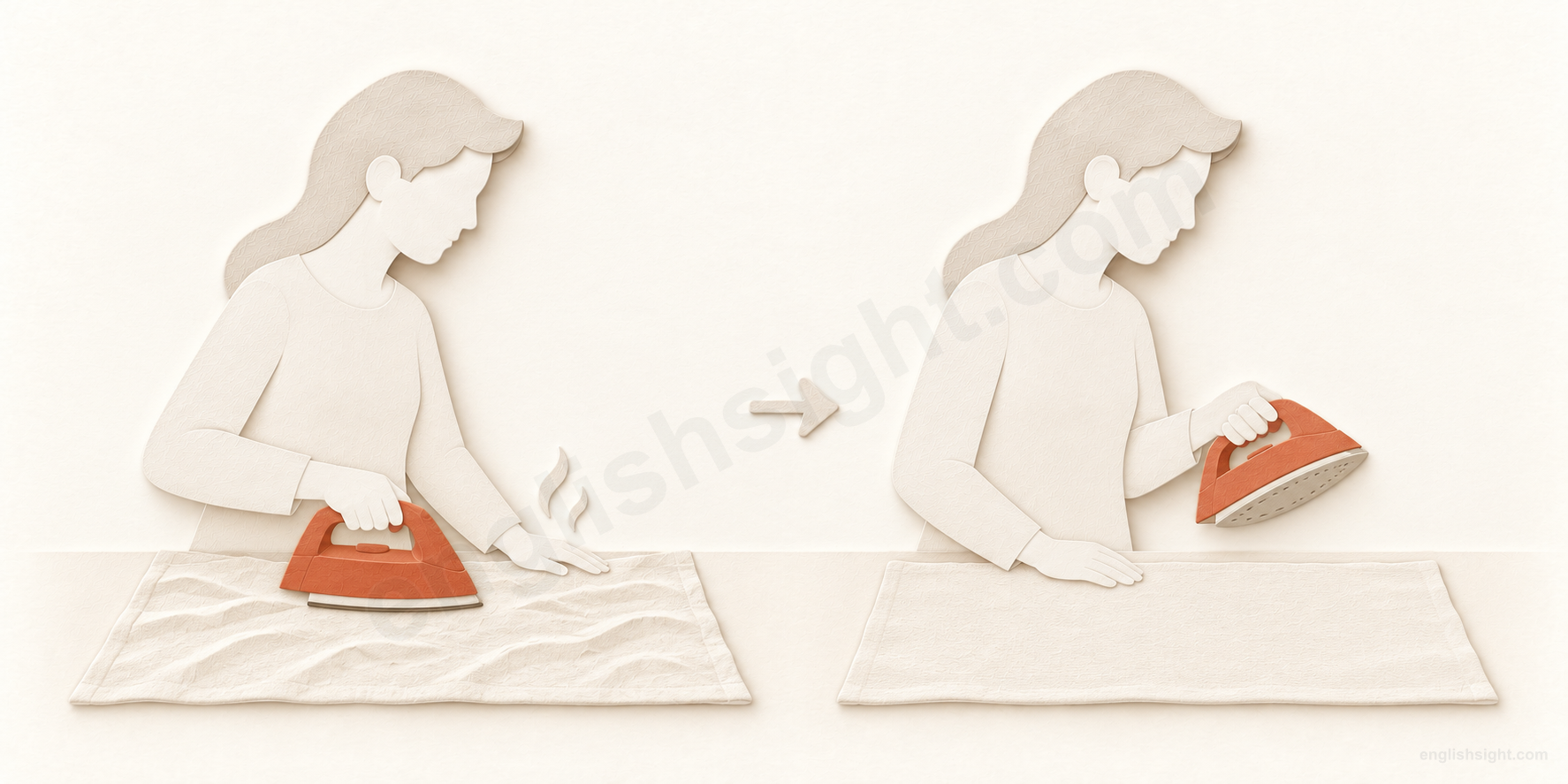
Creased cloth lies on the work surface.
iron
She lifts the iron, leaving the cloth smoother.
A woman presses it with a heated iron.
An iron is the tool; to iron is to press cloth smooth.
A person presses creased cloth with a heated iron, leaving it smoother. This explains the tool-and-action branch; the metal, nutrient, and fixed expressions have their own uses.
The sketch focuses on one productive connection, not a universal definition. Out can add removal: real creases are removed, and figuratively difficulties are resolved.
Iron first names a metal. In daily English, an iron is also a clothes-pressing appliance, and to iron is to use it on cloth. Notice how a material name, a countable object name, and a verb ask different questions.
Hardness also provides a comparison for determination and strict control. Fixed expressions about weights, plans, and opportunities need their own explanations. These connections are teaching aids, not a claim about a picture shared by all English speakers.
01
The metal and what contains it
Begin with the material name. Iron is usually uncountable here, including when it names the nutrient in food.
01
made of + iron; iron + object noun
made of iron; an iron gate
name the metal or specify a material
Situation before
You want to identify the material in an old gate.
Result or interpretation
You describe its material rather than count separate objects.
Iron names the substance; gate names the object.
Iron is a metal, with the chemical symbol Fe. Use made of iron for material and iron before a noun in iron bars, an iron gate, or iron railings. An iron gate is one gate; it is not one household iron.
For an amount, say some iron, a piece of iron, or two iron bars. Iron ore is rock from which iron can be obtained. Iron and steel are related material names, but they are not interchangeable: steel is made using iron.
In a sentence
The old gate is made of iron.
Watch the difference Do not say two irons when you mean two pieces of the metal. That plural normally suggests objects, such as appliances or golf clubs.
02
cast iron / wrought iron; cast-iron / wrought-iron + noun
cast iron; wrought iron
recognize familiar material names
Situation before
A shop describes a heavy pan and a decorative fence.
Result or interpretation
The full material names distinguish the products.
Cast and wrought are parts of established material names.
Cast iron is a type of iron shaped by pouring molten metal into a mould. A cast-iron pan is made of that material. Wrought iron is a form used for decorative gates and fences; wrought-iron describes such an object.
These are material distinctions, not two versions of a clothes iron. Write made of cast iron with the material noun; a hyphen is usual in the adjective cast-iron before another noun.
In a sentence
We cooked the beans in a cast-iron pan.
Watch the difference Keep the full expression: cast iron names a material; an iron on its own usually names a pressing appliance in a household setting.
03
be rich in iron; iron deficiency; iron + tablets
rich in iron; iron deficiency
talk about iron as a nutrient
Situation before
You read a description of the nutrients in food.
Result or interpretation
You understand iron as a substance present in small amounts.
The material name also applies to iron present in food and the body.
A food rich in iron contains a relatively large amount of this nutrient. Iron deficiency names a lack of iron. The words do not suggest that food contains little household irons or that visible pieces of metal are being eaten.
Iron tablets names tablets containing an iron preparation; tablets is the countable head noun. This unit explains the language used on food and health information, rather than recommending a supplement.
In a sentence
The label says these beans are rich in iron.
Watch the difference Use iron without an article for the nutrient: contains iron, not contains an iron.
02
An iron, other tools, and irons
A material name can become a countable name for an object. Learn the object from the full expression and context.
04
a / an / the + iron; a steam iron
an iron; a steam iron
name the appliance for pressing clothes
Situation before
Your shirt is creased and you need a household tool.
Result or interpretation
You ask for one iron, not a quantity of metal.
An iron is a countable tool with a heated flat base.
In a home, an iron normally means the appliance used to press cloth smooth. Say an iron, the iron, or two irons. A steam iron uses steam as part of the pressing process.
The name connects the tool with metal, but it does not describe every material in a modern appliance. Compare The base contains metal with Can I borrow your iron? Only the second asks for a complete tool.
In a sentence
Does the room have an iron for my shirt?
Watch the difference Use an, not a, directly before iron because its first sound is a vowel sound.
05
a soldering iron; a curling iron
a soldering iron; a curling iron
identify a particular tool from its full name
Situation before
Someone asks for an iron while repairing a wire.
Result or interpretation
The modifier identifies the relevant tool.
The words before iron specify what the tool is for.
A soldering iron is a heated tool used when joining metals or wires with solder. A curling iron is a heated hair tool; British English commonly calls it curling tongs. These names identify different objects, not actions performed on clothes.
Iron can occur in established tool compounds even when the object is not simply made from pure iron. Read the compound as a unit; do not assume every word before iron makes a natural new tool name.
In a sentence
He used a soldering iron to repair the loose connection.
Watch the difference An iron alone in an ordinary hotel request usually means a clothes iron; include soldering or curling when that distinction matters.
06
a + number + iron
a seven iron
recognize a numbered golf club
Situation before
A golfer chooses a club for the next shot.
Result or interpretation
A number identifies a club in the iron category.
Here an iron is sports equipment, not a pressing appliance.
In golf, an iron is one of the clubs with a metal head. A seven iron is a particular numbered club. The sporting context tells you what is being counted.
This is a useful recognition sense, not a requirement to learn golf technique. The expression belongs to the object branch of iron; it does not derive its meaning from smoothing cloth.
In a sentence
Mia chose a seven iron for the shot.
Watch the difference A seven iron is one club with the number seven, not seven separate irons.
07
be / keep someone in irons; leg irons
in irons; leg irons
recognize metal restraints in historical accounts
Situation before
An old account describes a prisoner’s restricted movement.
Result or interpretation
Irons refers to restraints attached to the body.
The plural names restraints, not an amount of the metal.
Irons can mean heavy metal restraints for prisoners, especially in accounts of the past. In irons means wearing or being held in such restraints; leg irons specifies restraints for the legs.
This recognition item helps with stories and historical descriptions. It is separate from the everyday plural two irons for two appliances; context selects the sense.
In a sentence
The old account describes prisoners kept in irons.
Watch the difference Do not use in iron for this established plural expression.
03
Pressing cloth and removing difficulties
The tool gives us the ordinary verb iron. Iron out can describe removing real creases or resolving practical problems.
08
iron + clothing / fabric; be + ironing; be + ironed
iron a shirt; be ironing
press fabric smooth with an iron
Situation before
A clean shirt still has unwanted folds.
Result or interpretation
Someone uses a heated iron to make it smoother.
The noun names the tool; the verb names using it on cloth.
Iron a shirt has a person as subject and the shirt as object. The object is the fabric being treated. You can also leave it unstated when understood: I was ironing when you called.
The verb is regular: iron, irons, ironed, ironing. The progressive describes work in progress, and the passive is natural: The shirts were ironed yesterday. A freshly ironed shirt describes the resulting state.
In a sentence
I’m ironing my shirt before the interview.
Watch the difference Ironing is not washing. A shirt can be clean but still need ironing.
09
do the ironing; a pile of ironing; something needs ironing
do the ironing; need ironing
talk about the task or the clothes involved
Situation before
There is a pile of creased clothing after washing.
Result or interpretation
You refer to the housework as a whole.
Irons are tools; ironing can name the work or the clothes.
Do the ironing names the household task. The ironing can also mean clothes waiting to be ironed or already ironed: context tells you which. An ironing board is the surface designed for this work.
These shirts need ironing means someone needs to iron them; the shirts are not doing the action. Need to be ironed is another way to say it. In I am ironing, by contrast, ironing is part of the verb phrase.
In a sentence
These shirts need ironing, so I’ll do the ironing tonight.
Watch the difference For the task use uncountable ironing, not an ironing or three ironings in ordinary housework talk.
10
iron out + crease / wrinkle; iron + it / them + out
iron out a crease
remove a real fold by pressing
Situation before
There is an unwanted crease in a sleeve.
Result or interpretation
Pressing removes the crease.
In this pattern the object can be what is removed.
Compare iron the sleeve with iron out the crease. The sleeve is the thing treated; the crease is the unwanted feature being removed. Out contributes the removal meaning.
With a noun, both iron out the crease and iron the crease out are possible. With a pronoun, put it between the verb and particle: iron it out. This physical removal gives a useful comparison for dealing with practical difficulties.
In a sentence
I ironed out the crease in the sleeve.
Watch the difference Say iron it out, not iron out it.
11
iron out + problem / difference / detail; iron + it / them + out
iron out problems / differences / details
resolve difficulties so a plan can work
Situation before
The team agrees on a plan but some details are causing trouble.
Result or interpretation
They work through the difficulties and settle them.
The roughness is practical or interpersonal, not a fold in cloth.
Iron out a problem, iron out differences, and iron out the remaining details describe resolving what gets in the way. Details here are unsettled details needing agreement or adjustment, not all the information in a plan.
The smoothing comparison helps you remember the phrase, but the whole phrasal verb carries the established meaning. Say We ironed them out for several problems. The passive is also natural: The differences have been ironed out. It does not mean hiding or ignoring them.
In a sentence
We need to iron out the delivery details before we sign.
Watch the difference Use iron out the problems, rather than bare iron the problems, for this ordinary figurative meaning.
04
Firmness, health, and severe control
Hard metal offers a useful comparison for determination or control. These are established descriptions, not claims about a person’s physical material.
12
an iron will; a will of iron; iron + determination / constitution
an iron will; a will of iron
describe exceptionally firm determination
Situation before
Someone faces repeated setbacks.
Result or interpretation
Their determination remains strong.
Hard metal supplies a comparison for not giving way.
An iron will and a will of iron describe great determination. Iron determination works similarly. The comparison concerns firmness; it does not say the person feels no emotion or can never change a sensible decision.
As a figurative adjective, iron usually comes before the noun. She has an iron will is natural; She is iron is not the ordinary way to describe her determination. An iron constitution instead describes robust health, not a political constitution.
In a sentence
It took an iron will to keep training after so many setbacks.
Watch the difference Iron will is an established collocation; do not add iron to any positive quality and expect a natural phrase.
13
rule + with an iron fist / hand / a rod of iron; an iron grip on + something
rule with an iron fist; an iron grip
describe severe, unyielding control
Situation before
A leader allows little disagreement.
Result or interpretation
People experience harsh control.
Firmness can become oppressive control rather than admirable persistence.
Rule with an iron fist or an iron hand means govern or control people severely. Rule with a rod of iron expresses similar severity. Iron discipline describes a very strict system; it is stronger than simply being well organized.
An iron grip can describe a very strong physical hold or, figuratively, powerful control: an iron grip on the organization. The object and context tell you which. These descriptions often carry criticism; they are not automatically compliments.
In a sentence
The director ruled the company with an iron fist.
Watch the difference An iron fist is not necessarily a literal punch, and iron discipline does not mean discipline involving metal equipment.
14
an iron fist / hand in a velvet glove
an iron fist in a velvet glove
describe firmness hidden by a gentle manner
Situation before
A manager speaks warmly but enforces every decision strictly.
Result or interpretation
The gentle surface conceals severe control.
The glove changes the outward manner, not the underlying firmness.
An iron fist or hand in a velvet glove combines a hard inner image with a soft outer one. Someone may appear pleasant while remaining uncompromising in how they control others.
Learn the whole expression. It does not simply mean kindness, and it does not require anyone to be wearing a real glove. Depending on context it can sound admiring of effectiveness or critical of concealed severity.
In a sentence
She managed the team with an iron fist in a velvet glove.
Watch the difference The velvet glove does not cancel the iron fist: the contrast is the point of the expression.
15
cast-iron + guarantee / promise / alibi
a cast-iron guarantee
describe something presented as completely reliable
Situation before
A customer wants certainty about a promise.
Result or interpretation
The speaker presents the promise as exceptionally secure.
This compound extends strength to reliability, not to a physical material.
Especially in British English, a cast-iron guarantee or promise is presented as unable to fail. A cast-iron alibi is presented as exceptionally strong. These are figurative uses of the compound adjective cast-iron.
Compare a cast-iron pan, where the adjective identifies the material. A guarantee is not made of metal. The phrase communicates the speaker’s claim of certainty; it cannot itself prove that a promise is trustworthy.
In a sentence
They wanted a cast-iron guarantee that the price would not change.
Watch the difference Do not shorten this established expression to an iron guarantee as your default wording.
05
Weights, plans, and opportunities
Learn these expressions as whole units. Neither the metal nor the ironing picture supplies their entire meaning.
16
pump iron
pump iron
lift weights for exercise
Situation before
A friend asks what you do at the gym.
Result or interpretation
You describe weight training informally.
Iron stands for exercise weights in this fixed expression.
Pump iron is an informal way of saying lift weights to build strength. The verb pump changes normally: pumps iron, pumped iron, pumping iron. There is no pump moving liquid metal.
Use lift weights in neutral descriptions. Pump iron does not mean every kind of exercise: running and stretching alone are not pumping iron.
In a sentence
On Saturdays, Lee pumps iron at the gym.
Watch the difference Keep iron uncountable in this expression: pump iron, not pump an iron or pump irons.
17
have + several / other / too many + irons in the fire
have several irons in the fire
keep several activities or possible plans going
Situation before
One job application may not succeed.
Result or interpretation
You keep other possibilities active too.
Several possible projects are being pursued at the same time.
Have several irons in the fire describes involvement in several activities or plans, often so that at least one succeeds. Other irons in the fire means other options are being pursued. The expression itself does not promise success.
Too many irons in the fire adds a warning that there may be more commitments than someone can manage. The whole phrase evokes several pieces of metal being worked on; it has no connection with doing several loads of ironing.
In a sentence
I’m applying for that job, but I have other irons in the fire.
Watch the difference Retain the plural irons and the wording in the fire. This is an idiom, not a separable phrasal verb.
18
strike while the iron is hot
strike while the iron is hot
act promptly when the opportunity is good
Situation before
Someone has just expressed interest in your proposal.
Result or interpretation
You act before the favorable moment passes.
The useful timing, rather than the household tool, is the central idea.
Strike while the iron is hot advises acting when circumstances offer a good opportunity. The image is of working hot metal while it can be shaped. It does not tell you to strike a clothes iron.
The saying is about making use of a favorable moment, not a general instruction to rush every decision. Keep the familiar wording as a unit; strike supplies the action and while introduces the useful time window.
In a sentence
The editor likes the idea, so let’s strike while the iron is hot and send a proposal.
Watch the difference The idiom does not mean act only when you feel angry or excited; hot refers to the metal image.
Choose the branch before choosing the form
Countability changes the meaning
Iron as a metal or nutrient is uncountable. An iron is a tool, and irons can be several tools, golf clubs, or restraints. Ironing names the work or the clothes involved. The article, plural ending, and context matter.
Pronunciation and forms
British English commonly has /ˈaɪən/ and American English /ˈaɪərn/. Follow the spoken form rather than saying the letters as “eye-ron.” The regular verb forms are irons, ironed, ironing. Ironing and ironed do not double the n.
Do not turn every phrase into a particle verb
Iron out is a separable phrasal verb: iron the problem out, iron it out. Pump iron, in irons, and irons in the fire have different grammatical structures. Ordinary ironing permits progressive and passive forms. Have a shirt ironed can describe arranging for someone else to do the work; the verb iron itself does not supply that arrangement meaning.
Coverage boundary
The lesson prioritizes current everyday meanings and useful fixed expressions, with golf and historical restraints as recognition items. Specialist metallurgy, obsolete weapon slang, nautical uses, rare verbs meaning fit with iron or shackle, and separate historical names such as the Iron Age and Iron Curtain are not developed here. No frequency ranking or complete inventory of every compound is claimed.
Read the whole expression
Choose the meaning or pattern that matches the situation.
1. A hotel guest wants a tool to press a shirt. Which request fits?
2. The delivery problems have been settled. Replace problems with a pronoun.
3. What does “The shirts need ironing” mean?
4. A boss rules with an iron fist but speaks gently. Which addition describes that contrast?
5. A writer has several proposals underway in case one is rejected. Which expression fits?
Sources and teaching notes
The linked dictionaries were consulted for meanings, forms, and expressions. Explanations, examples, and the sketch are original teaching material; suggested connections are teaching interpretations.
The sketch explains the tool-and-action branch; it is not a shared mental image for every speaker or every meaning.