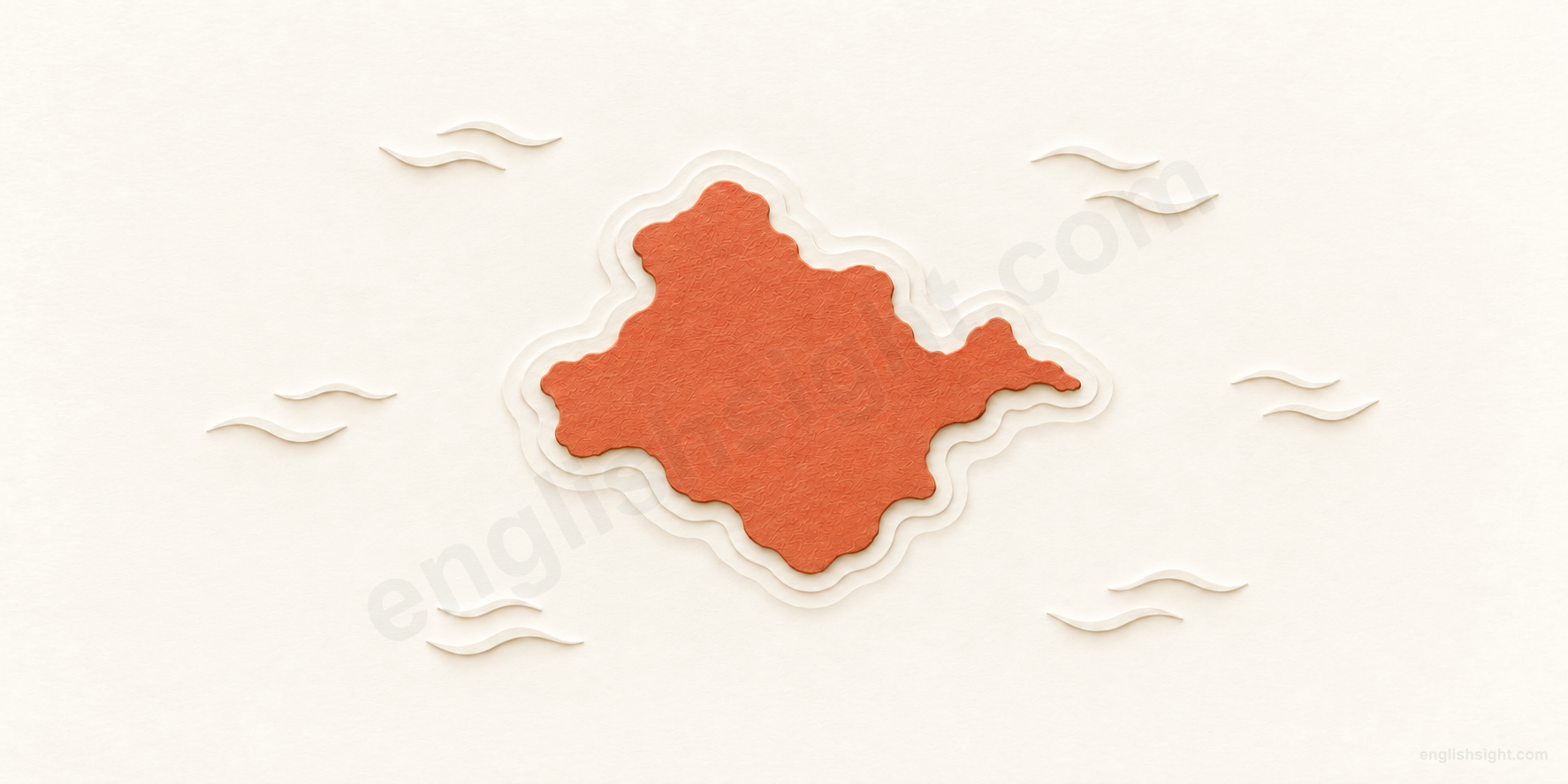
Start with land surrounded by water, then recognize islands in roads, kitchens, and descriptions.
Distinct within its surroundings
Distinct within its surroundings
A distinct area of land
island
An island within its surrounding water
Water surrounds the entire coastline.
Water surrounds the land on every side. Other uses borrow the idea of a distinct area within different surroundings.
A land area is completely surrounded by water; extended uses present something as a separate area within different surroundings.
The core diagram shows a static relationship, not an action or a change over time. Water must surround the geographical island; kitchen, road, and figurative uses keep only selected parts of that relationship.
An island is a land area with water all around it. Common extensions keep the idea of a distinct area set within different surroundings, while the full phrase tells you whether those surroundings are water, traffic, kitchen space, or a contrasting situation.
This connection is a teaching model. It helps you compare familiar uses without claiming that every English speaker pictures the word in the same way or that every compound can be predicted from a drawing.
01
Land, location, and travel
Start with the geographical noun. Articles, prepositions, and the next noun tell us which island, where someone is, or how they travel.
01
an / the + island; number + islands
an island / islands
a land area with water all around it
Situation / surroundings
You see land in a lake.
What you describe
The map shows water around its entire coast.
The complete water boundary makes this an island.
Island is normally a countable noun: an island, the island, two islands. It can be in a sea, a river, or a lake; it need not be tropical, tiny, remote, or empty of people.
The geographical meaning concerns the boundary, not how lonely a place feels. A peninsula remains joined to a larger land area, even though water surrounds most of it. Continents are conventionally classified separately from islands.
An artificial island is made by people; a volcanic island is formed through volcanic activity. These modifiers tell you about origin and do not create new meanings of island.
In a sentence
There is a small island in the middle of the lake.
Watch the difference A beach is the land beside water; an island has water around its whole land area. Do not call every coastal place an island.
02
live / stay / be + on an / the island
live / stay on an island
locate someone or something on the island’s land
Situation / surroundings
Your friend asks where your family lives.
What you describe
You identify the island as their location.
On presents the island as the land where people live or stay.
Use on an island for ordinary geographical location: live on an island, a house on the island, or spend a week on an island. This is the usual choice when island itself is the place noun.
Compare an island in the lake: the island is within the lake’s area, while the house is on the island. The preposition expresses a different relationship in each phrase.
A country or region can take in even when it consists of islands: She lives in Japan. Do not replace every in before an island country’s name with on. We say on the island of… when explicitly describing that land area.
In a sentence
My grandparents live on an island near the coast.
Watch the difference For the ordinary location, say on an island, not in an island. In an island’s caves is possible because the caves are the enclosing place.
03
go / travel to + island; come / return from + island; off + island / coast
go to / return from / off the island
distinguish destination, origin, and nearby water
Situation / surroundings
You plan a ferry trip and compare locations.
What you describe
You say where the ferry goes and where a boat is anchored.
To marks the destination; from marks origin; off can locate something in nearby water.
Go to the island and take a ferry to the island describe a destination. Return from the island gives the starting point of the return journey. These are ordinary prepositional phrases, not phrasal verbs built from island.
An island off the coast lies in the water near that coast. A boat anchored off the island is near its coast, rather than on its land. Off does not itself tell you an exact distance.
With a movement verb, off can have a different interpretation: get off the island means leave it. Compare The boat is off the island, a location, with We need to get off the island, a wish to leave. The verb and context supply the difference.
In a sentence
We took a ferry to the island and saw a boat anchored just off its northern coast.
Watch the difference Off the island does not mean inside the island. Read the verb to distinguish being nearby in the water from leaving the land.
04
the island of + name; name + Island; a group / chain of islands
the island of… / a group of islands
identify one island or describe several
Situation / surroundings
You point out a named place on a map.
What you describe
You distinguish one island from a whole group.
A name identifies the land; a group or chain includes several islands.
The island of Bali identifies an island by name; of introduces the name, not an owner. Caldey Island shows another naming pattern, with Island as part of the proper name. Use the established name rather than freely reversing its words.
A group of islands is several islands considered together. A chain of islands, also an island chain, suggests a series extending along an area. Island is singular when it modifies chain.
Plural geographical names often use the: the Canary Islands, the Virgin Islands. A single island’s name often does not, as in Caldey Island. Follow the actual name; the island of Bali contains the because island is the identifying common noun.
In a sentence
The ferry connects the main island with a group of smaller islands.
Watch the difference A group of islands is not one island. Do not add -s to island in the compound island chain.
05
island + noun: nation / state / life / home / residents
an island nation / island life
use island before another noun to show a connection
Situation / surroundings
You describe a country’s geography and daily life.
What you describe
You connect the country and lifestyle with islands.
Island can modify another noun without becoming an ordinary descriptive adjective.
An island nation is a nation whose territory is an island or islands. Island life means life on islands; an island home is a home located on an island. The following noun names the thing you are discussing.
These are noun combinations. Island usually stays singular before nation, life, home, or residents. It does not work like an adjective in very island or more island.
Island does not mean country: one island may contain more than one country, and one country may include many islands. Keep the physical land area distinct from the political unit.
In a sentence
Island life changes when the last ferry of the day leaves.
Watch the difference An island nation may consist of many islands. Do not assume the combination means exactly one island.
02
Familiar travel expressions
These established combinations add a particular kind of island or a way of visiting several islands. Learn the whole expression rather than guessing from each word alone.
06
a desert island; be stranded on + a desert island
a desert island
an uninhabited island, often imagined as tropical
Situation / surroundings
You imagine being stranded somewhere without a settlement.
What you describe
You picture an island where nobody lives.
Desert in this expression points to the absence of inhabitants.
A desert island is an island where no people live, typically pictured as tropical. It does not have to be a sandy desert with almost no rain. The established combination carries the uninhabited meaning.
The question What would you take to a desert island? asks you to imagine isolation and limited supplies. A person may arrive or become stranded there without changing the expression’s usual background picture.
Uninhabited island is a more direct neutral description of an island without residents. A remote island is far away; it may still have a large population. Deserted can describe a place that has been left empty.
In a sentence
If you were stranded on a desert island, how would you find drinking water?
Watch the difference Do not infer a dry climate from desert island. In this noun phrase, desert has first-syllable stress: /ˌdezət ˈaɪlənd/ in British English.
07
go island-hopping; spend + time + island-hopping
go island-hopping
travel from one island to another
Situation / surroundings
You want to visit several islands during a holiday.
What you describe
You plan successive journeys between them.
Hopping suggests repeated short stages between islands, not literal jumps.
Island-hopping is the activity of visiting one island after another, especially on holiday in an area with many islands. You may use boats or planes; hopping is a travel image rather than a description of how your feet move.
Say go island-hopping or spend a week island-hopping. As the name of an activity, island-hopping is uncountable. A single visit to one island is not normally described as island-hopping.
This is a compound built around hop. It is not the ordinary verb island plus a particle, and it does not mean walking around different parts of one island.
In a sentence
We spent a week island-hopping, taking a ferry to a different island every other day.
Watch the difference Do not use island-hopping for staying on one island throughout a trip.
03
An island within different surroundings
Roads, kitchens, and figurative descriptions borrow the idea of a distinct area with something else around it. The surroundings need not be water.
08
a traffic island; wait on + the island
a traffic island
a separate area within a road that directs traffic or protects pedestrians
Situation / surroundings
A wide road has a raised area between its lanes.
What you describe
Pedestrians wait there before completing their crossing.
Traffic surrounds a separate area instead of water surrounding land.
A traffic island is an area set apart within a road, often raised, that separates or guides traffic. Some provide a place for pedestrians to pause while crossing; others mainly carry signs or separate lanes.
In a road-crossing context, island alone can mean the pedestrian waiting area. Oxford also gives refuge in British English and safety island as related terms. The full phrase traffic island makes the road sense clear.
The connection with the map is a distinct area among surrounding movement. It is a conventional road term, not a claim that there is water around the concrete.
In a sentence
We waited on the traffic island until the second half of the road was clear.
Watch the difference Not every traffic island is a pedestrian crossing place. Its design and context determine its purpose.
09
a kitchen island; on / around + the island
a kitchen island
a separate kitchen unit with a work surface and access around it
Situation / surroundings
A kitchen has a counter away from the wall units.
What you describe
People can approach its work surface from all sides.
The unit stands apart, with room around it.
A kitchen island is a freestanding unit with a counter or worktop, usually in the central part of a kitchen. It can provide preparation space, storage, or seating; island does not itself specify which of these it has.
Once the kitchen is the clear topic, speakers can say the island: Put the bowl on the island. On refers to the work surface, while island identifies the unit.
This established sense borrows separation and surrounding access from geographical islands. A counter running along a wall is not a kitchen island just because it is large.
In a sentence
Put the vegetables on the kitchen island so we can prepare dinner together.
Watch the difference A kitchen island need not be circular, and its shape does not define it. The freestanding position and access around it matter.
10
an island of + quality; an island of… in / amid…
an island of calm / stability
a distinct place or area with a quality unlike its surroundings
Situation / surroundings
The surrounding streets are noisy and busy.
What you describe
One enclosed garden feels unusually peaceful.
The island is a contrasting pocket within a larger setting.
An island of calm is a place that remains peaceful while the surrounding situation is noisy, troubled, or busy. Island of stability applies the same contrast to something that remains stable amid wider uncertainty.
The words after of name the quality found in this distinct area. A sea of noise or uncertainty may describe the surrounding contrast, but that phrase is optional. There need not be literal land or water.
This is a figurative pattern, not an unlimited rule that island of plus any noun makes a natural expression. Use a clear contrast and a combination that suits the context. It can sound more descriptive or literary than a quiet place.
In a sentence
The little garden was an island of calm in the crowded city.
Watch the difference The contrast can be positive or negative; island does not itself mean peaceful or good.
11
No man is an island.; No one is an island.
No man is an island.
people are connected with and depend on other people
Situation / surroundings
Someone insists they must solve every problem alone.
What you describe
You remind them that asking for support is normal.
An isolated island becomes a metaphor for complete human independence.
No man is an island is a familiar saying from John Donne: nobody is entirely separate from other people. It is used to emphasize connection, mutual influence, or the need for others, rather than to describe geography.
Man in this traditional wording means a person, not only an adult male. In your own explanation, No one is an island communicates the idea with gender-neutral wording.
The statement does not mean people can never enjoy solitude or act independently. It rejects the stronger idea of complete separation. Learn the whole saying; its social message is not a new literal definition of island.
In a sentence
You can ask the team for help—no one is an island.
Watch the difference This is a saying about human interdependence, not a rule that every person needs company at every moment.
Keep the boundary and the context in view
Pronunciation and countability
Island is pronounced /ˈaɪlənd/: the s is silent, and the first syllable sounds like eye. Use an island because the spoken word starts with a vowel sound. The regular plural is islands /ˈaɪləndz/. Ordinary singular uses need a determiner, as in an island or this island.
A land area is not a political label
Island describes geography, not national status, climate, population, or access. An island can have cities and bridges. The contrast with mainland is about the larger land area being discussed, not necessarily a different country.
Noun uses and scope
This lesson teaches the modern noun and familiar combinations. Dictionaries also record a verb island meaning make island-like or isolate, but Collins marks the British verb rare. That verb and specialist anatomical, naval, railway, and fuel-station senses are outside this introductory lesson. Verb tense, passive, causative, and particle-verb families are not applicable to the noun uses taught here.
A useful connection has limits
The separate-area model relates several uses; it does not make them interchangeable. A traffic island and a kitchen island have established meanings. A phrase such as an island of calm depends on a contrast supplied by its context.
Choose the relationship
Decide what is surrounded, what surrounds it, and what the whole expression contributes.
1. A piece of land has water on three sides but is joined to a larger land area. Which word fits that description?
2. You are describing the location of a family’s house on an island. Which sentence is the ordinary choice?
3. A story calls a green tropical island a desert island. What does the expression tell you?
4. A recipe tells you to leave a bowl on the island. You are standing in a kitchen. What is the likely place?
5. A busy station has a quiet waiting room described as an island of calm. What does that mean?
6. A colleague says, “No one is an island,” while encouraging you to ask for help. What is the message?
Sources and teaching notes
The sources below support the meanings and usage discussed here. Explanations and examples are original. The diagram and the connection between uses are teaching interpretations, not dictionary evidence.
The diagram is a teaching aid, not a picture shared by every native speaker.