Soft enough to wobble, firm enough to hold together.
Recognize the food, read the regional context, and follow the texture into other uses.
Soft, yet holding together
A soft substance that holds together
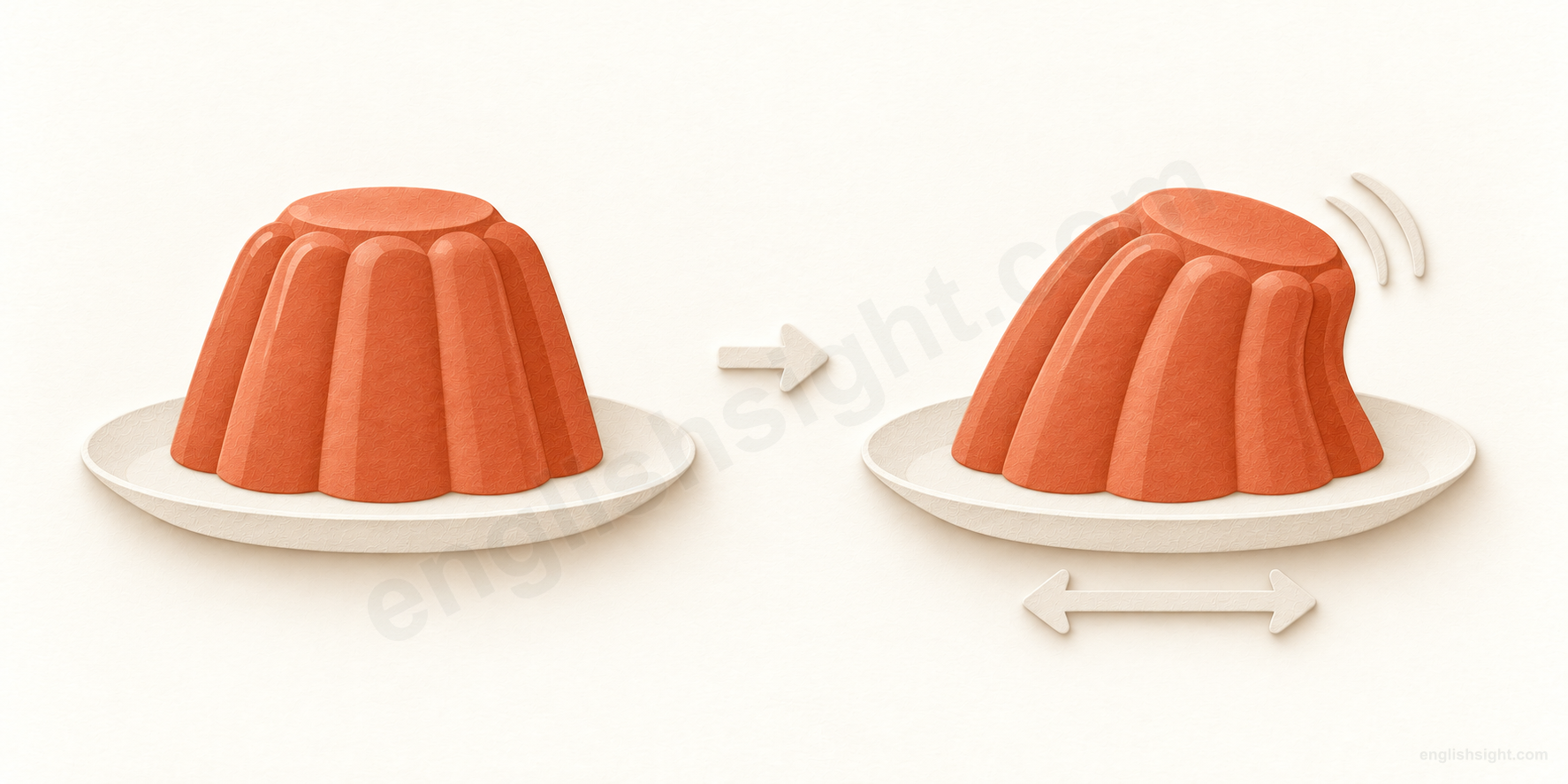
A moulded jelly stands upright on a plate.
jelly
The soft jelly bends while remaining one mass.
A gentle side-to-side movement of the plate makes it wobble.
Soft enough to bend, firm enough to stay together.
A jelly can hold a shape while yielding or wobbling when moved. This soft, partly solid consistency connects the food with similar substances and the image of unsteady legs.
The moulded dessert makes the texture easy to see. A spread need not wobble in this way, and the picture does not define every compound or explain the slang adjective.
Jelly /ˈdʒeli/ often names a soft food that holds together instead of pouring like juice. At a British party it may be a wobbling dessert; on American toast it is usually a fruit spread.
Texture connects several uses, including a familiar image of nervous legs. Other established names need context, and the slang adjective meaning jealous is a separate word formation. The diagram is a teaching aid, not a shared mental picture claimed for every English speaker.
01
At the table and in the kitchen
Region, serving context, and the whole noun phrase help you identify the food.
01
have / make + jelly; jelly with + food
jelly and ice cream
a soft, wobbling dessert, especially in British English
Situation
Dessert is being served at a party in Britain.
What is meant
The jelly is a sweet set food, not a sauce for toast.
British dessert context selects the wobbling food meaning.
In British English, jelly commonly means the set, fruit-flavoured dessert. In North America, gelatin dessert or jello is clearer for this meaning; Jell-O is a brand name.
A bowl of jelly and jelly with ice cream describe serving it. Strawberry jelly may name the flavour, but the same fruit word can describe a preserve: look at how it is served.
In a sentence
We served orange jelly with ice cream at the party.
Watch the difference Do not assume that a request for jelly in the United States is a request for this dessert.
02
spread + jelly + on + bread; a peanut butter and jelly sandwich
spread jelly on toast
a smooth fruit preserve used as a spread or filling
Situation
You are preparing breakfast in an American kitchen.
What is meant
Jelly supplies the fruit spread on the bread.
The preserve meaning is especially prominent in American food contexts.
Fruit jelly is a preserve made from fruit juice and sugar, without pieces of fruit. Jam is made from fruit and may retain pulp or pieces. British English also uses jelly for such smooth preserves, so the contrast is not simply Britain versus America.
A peanut butter and jelly sandwich is a familiar American combination. A jelly doughnut has a sweet fruit filling; jelly before doughnut modifies the noun and does not mean that the whole doughnut wobbles.
In a sentence
I spread grape jelly on my toast.
Watch the difference Jam and jelly overlap in everyday food talk, but jelly is the more precise name for the preserve without fruit pieces.
03
some / a little jelly; a jar / spoonful of jelly; a jelly / jellies
some jelly / two jellies
an amount of the food, or individual servings or kinds
Situation
One bowl contains the food; another tray holds separate small desserts.
What is meant
You choose amount words or a countable serving.
Countability changes what you are counting, not the basic texture.
Use some jelly or a little jelly for an amount. A jar of jelly counts its container; a spoonful of jelly measures an amount. These work well for the preserve.
In British dessert talk, a jelly or two jellies can mean one or two separately made desserts. Jellies can also mean different kinds of preserve. For an unambiguous shopping request, say two jars of jelly rather than relying on two jellies.
In a sentence
I made two small lemon jellies for dessert.
Watch the difference Use the plural jellies, not jellys. Some jelly does not tell you the number of servings.
allow the mixture to become firm enough to hold together
Situation
The prepared mixture is still liquid.
What is meant
After setting, it keeps a soft shape.
Jelly names the food; set supplies the change of consistency.
Recipes say let the jelly set or wait until it has set. Set here means become firm; it does not mean freeze into ice. The noun can refer to the preparation even before setting is complete.
Jelly also exists as a cooking verb: The mixture began to jelly means it began becoming jelly-like. It can take an object too: jelly the juice. Recognize the forms jellied and jellying, but set is a straightforward choice in everyday instructions. Jell is a related verb; Our plans are starting to jell means they are taking a coherent shape, not becoming dessert.
In a sentence
Leave the bowl in the fridge until the jelly has set.
Watch the difference Jell and jelly are distinct verb spellings: jelled / jelling versus jellied / jellying.
05
meat / fish + in jelly; jellied + food noun
fish in jelly / jellied eels
fish surrounded by a savoury set preparation
Situation
A cold dish has fish inside a soft, set layer.
What is meant
In tells you what surrounds the fish.
Jelly need not be sweet or fruit-flavoured.
In fish in jelly or meat in jelly, jelly is a savoury preparation, often made with stock and gelatin. Aspic is another name for this kind of preparation.
In supplies the surrounding relationship: fish in jelly is surrounded by the set preparation, unlike fish with a separate sauce. Especially in British food descriptions, the adjective jellied comes before a noun and means prepared or cooked in jelly: jellied eels.
In a sentence
The menu offered cold fish in jelly.
Watch the difference Do not add sweetness to the meaning just because you first learned the dessert use.
02
Substances and an unsteady feeling
Some uses describe consistency; a familiar figurative expression compares nervous legs with a wobbling jelly.
06
petroleum jelly; jelly-like + noun
petroleum jelly / a jelly-like substance
a material named or described by its thick, soft consistency
Situation
You are identifying a material rather than ordering food.
What is meant
Texture helps explain jelly, but does not establish ingredients or edibility.
A similar consistency does not make a substance the same product.
Jelly can describe substances resembling the food in consistency. A jelly-like substance is an explicit comparison: -like means resembling, so you need not know the material’s exact name.
Petroleum jelly is the established name of a soft substance obtained from petroleum. It is not fruit preserve. Learn the full name; the texture connection alone cannot tell you what a product contains or how it should be used.
In a sentence
There was a small tub of petroleum jelly beside the mirror.
Watch the difference Do not use jelly as a universal replacement for gel: hair gel is the usual product name, not hair jelly.
07
legs / knees + be / feel like jelly; legs / knees + turn to jelly
my legs turned to jelly
my legs suddenly felt weak and unsteady
Situation
You are about to speak in front of a large audience.
What is meant
Nerves make your legs feel unreliable.
Soft, wobbling jelly provides a comparison for an unsteady bodily feeling.
My legs felt like jelly describes the sensation. My knees turned to jelly emphasizes the onset of weakness. Nervousness is a familiar context, and the expression is figurative rather than a claim about a physical substance.
In feel like jelly, like introduces the comparison. In turn to jelly, turn to presents the change. Learn the whole expression; jelly by itself is not an adjective meaning nervous.
In a sentence
My knees turned to jelly when they called my name.
Watch the difference Compare My knees felt like jelly with I’m jelly: the latter can be slang for jealous, a different meaning.
03
Other established names and slang
Learn these expressions as complete units. A useful physical image is not a rule for inventing their meanings.
You see these expressions on packages or a bakery menu.
What is meant
The final noun helps identify the kind of food.
These compounds name different foods, not three portions of the same dessert.
A jelly bean is a small bean-shaped sweet with a firm outer coating and a soft centre. A jelly baby is a British soft, fruit-flavoured sweet shaped like a small baby. The plurals are jelly beans and jelly babies; jelly stays unchanged in front.
A jelly roll in North American English is a rolled cake with a filling such as jam; British English calls it a Swiss roll. A slice of jelly roll is cake, not a slice cut from a wobbling moulded jelly.
In a sentence
We bought a bag of jelly beans and a slice of jelly roll.
Watch the difference Read each complete compound. A jelly bean is a sweet, not a bean coated with breakfast preserve.
09
a jelly / jelly shoe; jellies / jelly shoes
jelly shoes / jellies
light plastic shoes, often worn at the beach
Situation
A beach shop has shoes made from flexible plastic.
What is meant
Jellies refers to footwear rather than food.
The setting and the word shoes identify an established footwear name.
A jelly or jelly shoe can name a light plastic shoe. The plural jellies may refer to the pair or this kind of footwear; jelly shoes makes the intended meaning clearer to someone unfamiliar with the shorter name.
This is a conventional object name. Do not infer that the shoes contain edible jelly or that every soft shoe can be called a jelly.
In a sentence
She packed her jelly shoes for the beach.
Watch the difference Two jellies could be two desserts in a kitchen. Footwear context changes the reading.
10
be + jelly; so + jelly
I’m so jelly!
I’m jealous, in playful slang
Situation
A friend sends a photograph from a lovely holiday.
What is meant
You playfully say you wish you had that experience.
This adjective comes from jealous, not from the food’s consistency.
In casual messages, jelly can mean jealous. I’m so jelly! may be a light-hearted response to someone’s good fortune; it need not accuse anyone of possessiveness.
This use is slang, so jealous is the safer choice in ordinary neutral or formal writing. The adjective does not take a plural ending: we’re jelly is possible in slang, not we’re jellies for this meaning.
In a sentence
“You’re spending the weekend by the sea? I’m so jelly!”
Watch the difference Do not explain this use as feeling physically wobbly. It is a playful form based on jealous, with the ending -y.
Let context choose the meaning
Jelly does not identify one recipe
The dessert, fruit preserve, and savoury preparation are related food uses, not interchangeable dishes. A fruit name alone may be ambiguous: grape jelly on toast points to a preserve, while jelly with ice cream in Britain points to dessert.
Noun, verb, and adjective behave differently
The noun plural is jellies. The cooking verb has jellies, jellied, and jellying; there is no particle-verb family to memorize here. Jellied also works as an adjective before a food noun, as in jellied eels. Jelly in jelly sandwich is a noun modifier. In I’m jelly, it is a slang adjective meaning jealous.
Two additional names to recognize
Royal jelly is a substance made by worker bees and fed to young queen bees; it is not a royal dessert. Merriam-Webster also records jelly for a jellyfish. These are recognition notes, not lessons in beekeeping or animal classification.
Scope of this lesson
Specialist lighting filters, gelignite slang, historical uses, and violent descriptions of crushing something to jelly are not developed here. The selection covers practical meanings and expressions without claiming a frequency ranking.
Use the context
Choose the expression or interpretation that fits the whole situation.
1. An American breakfast menu offers toast with grape jelly. What is jelly here?
2. Your knees turn to jelly just before a speech. What happens?
3. You made two separate small jelly desserts. Which sentence fits?
4. A recipe tells you to wait until the jelly has set. What should you wait for?
5. A friend writes “I’m so jelly!” under a photograph of your holiday. What is the likely meaning?
Sources and teaching notes
The linked dictionary pages support the meanings and usage notes. Explanations and examples are original; the texture diagram is a teaching interpretation.
The diagram illustrates a useful connection, not a picture shared by every native speaker.