Follow jewel from precious stones to valuable ornaments and expressive praise.
Beauty and value made focal
Beauty and value made focal
A precious stone
jewel
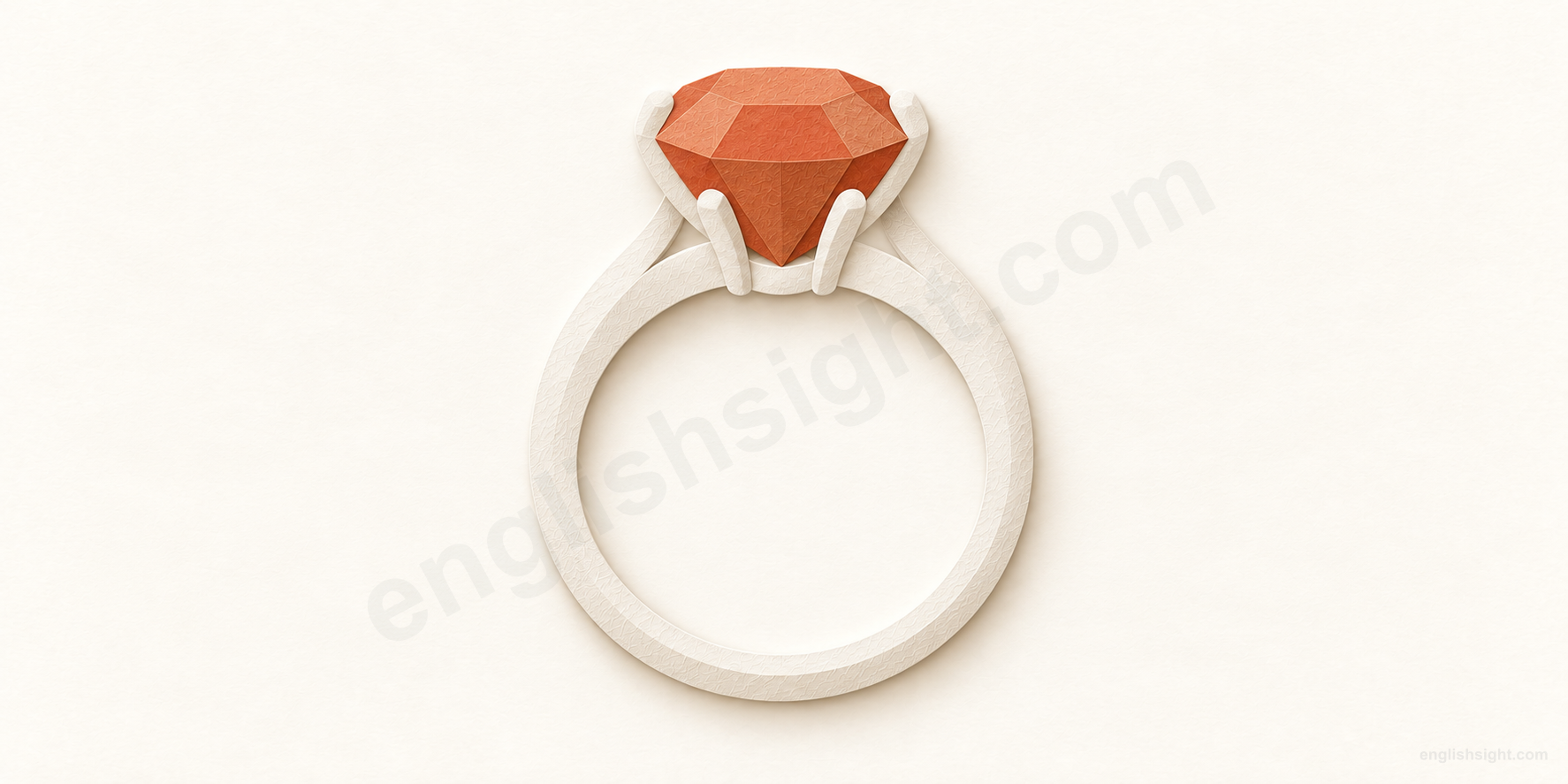
The highlighted stone is the jewel in this ring.
Held in the setting of a ring
The jewel here is the precious stone; the ring is the whole ornament.
A jewel is a precious stone; by extension, the word can single out someone or something as especially worth treasuring.
The sketch shows a stone held in a ring setting. It illustrates the physical noun and the distinction between a stone and its ornament. It shows no required action or change, and does not explain every fixed compound.
In a ring, jewel can name the stone; in a story about a dinner, her jewels may mean her valuable ornaments. When you call a helpful person a jewel, you carry the idea of preciousness into a compliment.
The connection is a teaching aid. It does not claim that every English speaker imagines the same picture, or that every compound can be guessed from the picture.
01
Stones and precious ornaments
Identify a stone, describe valuable things people wear, and recognize royal ceremonial objects. Context tells you what is being counted.
01
a jewel; jewels; a ring set with a jewel
a precious jewel
a valuable stone used in ornament
Situation
You examine a ring with a coloured stone.
What you mean
You identify the stone as a jewel.
The jewel can be one part of a larger object.
In this sense, jewel names a precious stone, such as a ruby or diamond. In a ring set with a jewel, the ring is the whole ornament and the jewel is the stone held in it. A loose stone can also be a jewel; it need not already be mounted.
Jewel is countable: a jewel, one jewel, several jewels. Precious describes value; sparkling describes reflected light. These adjectives do not create new meanings of jewel. Gem and gemstone overlap with this stone sense.
In a sentence
A small red jewel was set in the silver ring.
Watch the difference Not every stone is a jewel, and jewel does not mean only diamond.
02
wear / steal / insure + jewels; a piece of jewellery / jewelry
wear her jewels
wear or keep valuable jewellery
Situation
She chooses accessories for a formal dinner.
What you mean
She puts on her valuable necklace and earrings.
Plural jewels may name whole ornaments, not individual stones.
With wear, steal, or insure, jewels can refer to precious ornaments such as necklaces and rings. Her jewels does not tell us how many stones they contain. Family jewels can literally mean valuable jewellery owned by a family.
For the general category, use jewellery in British spelling or jewelry in American spelling. That noun is uncountable: some jewellery or two pieces of jewellery. Two jewels can mean two precious stones or ornaments, depending on context; it is not a neutral way to count any two accessories.
In jewel thief and jewel box, jewel modifies the following noun: the thief steals jewels, and the box stores them. The usual modifier is singular even when more than one jewel is involved.
In a sentence
She wore her grandmother’s jewels to the dinner.
Watch the difference Say a piece of jewellery, not a jewellery or two jewelleries.
03
the Crown Jewels + plural verb
the Crown Jewels
royal objects used on ceremonial occasions
Situation
You read a guide to a royal collection.
What you mean
You understand that the collection includes ceremonial objects.
Crown Jewels names a collection, not just stones attached to one crown.
The Crown Jewels are royal ceremonial treasures, including a crown and other precious objects such as a sceptre. The expression is plural; in a full sentence, use are rather than is.
Capital letters are common when naming a particular royal collection. Compare a jewel in a crown, which can simply be a stone in one physical crown. The established collection name has a wider reference.
In a sentence
The Crown Jewels are displayed behind thick glass.
Watch the difference The figurative expression the company’s crown jewel does not refer to royal ownership.
02
People and things worth treasuring
The idea of preciousness supports praise. These uses express an evaluation, not a claim about money or mineral material.
04
someone is a jewel; you’re a jewel for + -ing
You’re a jewel.
tell someone that you value them highly
Situation
A neighbour takes care of your cat while you are away.
What you mean
You thank her with an affectionate compliment.
The person is precious to you because of their help or qualities.
Calling someone a jewel is informal praise. You may use it to thank a kind or helpful person, or to say that someone is especially valuable to a group. You’re a jewel! is warmer and more expressive than a neutral Thank you.
The person does not become an object, and the compliment need not concern appearance. You’re a jewel for looking after the cat supplies the reason with for + -ing. It does not make for part of a phrasal verb.
In a sentence
You’re a jewel for looking after the cat all week.
Watch the difference This is personal, expressive praise; use a more neutral thank-you when that tone would feel too familiar.
05
a jewel of a + singular noun; the jewel of + place / group
a little jewel of a café
praise something as especially lovely or valuable
Situation
You find a small café that you particularly enjoy.
What you mean
You recommend it with strong praise.
Of a café identifies what kind of thing is being praised.
A jewel of a café means a café that deserves special admiration. The construction a jewel of a + singular noun treats the following thing as a jewel metaphorically. Little can suggest small size and affection; it is not required.
The jewel of the old town instead relates something outstanding to a larger place or group: The library is the jewel of the old town. A jewel of a café identifies the praised thing as a café; the jewel of the town identifies its relationship to the town. Neither wording measures a sale price.
In a sentence
We found a little jewel of a café beside the station.
Watch the difference Do not omit the second article in a jewel of a café.
06
the jewel in the crown of + whole; the jewel in someone’s crown; someone’s crown jewel
the jewel in the crown
the most valued or impressive part of a larger whole
Situation
A town has several visitor attractions.
What you mean
You single out its restored theatre as the outstanding one.
The imagined crown supplies the larger whole; its jewel is the prized part.
The jewel in the crown of something is its most attractive or valuable feature. You can also say the jewel in someone’s crown. The crown is a metaphor for the larger collection, achievement, or organization; there need be no physical crown.
Someone’s crown jewel is a related established expression, often used for an organization’s most prized asset: The theatre is the town’s crown jewel. Crown jewel can be plural when several assets are singled out. By contrast, the Crown Jewels in a royal museum names actual ceremonial treasures.
In a sentence
The restored theatre is the jewel in the crown of the town’s arts programme.
Watch the difference In this idiom, in the crown is the established wording; a jewel on a crown normally invites a literal reading.
03
Decoration, colour, packaging, and watches
Read the whole expression: a decorated object, a rich colour, a disc case, and a watch bearing require different interpretations.
07
a jewelled / jeweled + noun; jewel + object; be jewelled with + jewels
a jewelled pin
an object decorated with jewels
Situation
A pin has stones attached as decoration.
What you mean
You describe its decorated appearance.
Jewelled describes what an object is decorated with.
A jewelled pin has jewels as decoration. British spelling normally uses jewelled and jewelling; American spelling normally uses jeweled and jeweling. These forms relate to the transitive verb jewel, meaning to decorate or fit something with jewels.
Compare a pin set with jewels and a jewelled pin: both direct attention to decoration. In ordinary conversation, decorated with jewels is often the clearest way to describe the process. The verb does not mean to turn an object into a gemstone. A passive such as The pin was jewelled describes the object receiving decoration.
In a sentence
A jewelled pin held her scarf in place.
Watch the difference Jewel as a noun and jewelled as an adjective have different jobs: a jewel is not the same phrase as a jewelled pin.
08
in jewel tones; a jewel-toned + noun
jewel tones
rich colours associated with gemstones
Situation
You compare fabrics for curtains.
What you mean
You choose a rich green and a deep purple.
The resemblance is in colour, not in material or price.
Jewel tones are deep or vivid colours reminiscent of gemstones, such as emerald green or ruby red. Fashion and interiors writing use the expression for fabric, paint, and other materials that need not contain any stones.
Tone here means a colour shade, not a sound. In a jewel-toned dress, the compound adjective describes colour. Compare a jewelled dress, which describes attached decoration rather than a colour choice.
In a sentence
She chose curtains in jewel tones for the sitting room.
Watch the difference A jewel-toned fabric can be plain; the expression does not say that jewels are sewn onto it.
09
a jewel case; jewel cases
a jewel case
a rigid plastic case for a disc
Situation
You pick up a CD with a cracked container.
What you mean
You ask for a replacement plastic case.
The full compound has a conventional packaging meaning.
In CD or DVD packaging, a jewel case is a plastic box that holds the disc. Learn this as a complete term: a jewel case in a music shop does not normally mean a box of precious stones.
Jewel box can refer to a box for jewels. Context and the second noun matter; the stone-and-value teaching image alone cannot predict the disc-packaging meaning. The term jewel case is countable: one case, two cases.
In a sentence
The CD plays perfectly, but its jewel case is cracked.
Watch the difference Do not assume that a jewel case contains jewels when the topic is CDs.
10
a watch with + number + jewels
jewels in a watch
small hard bearings inside a watch mechanism
Situation
You see a jewel count in a watch description.
What you mean
You understand that it counts internal working parts.
These jewels support moving parts rather than decorating the outside.
A watch can contain jewels used as bearings in its mechanism. A jewel count in a description therefore need not mean visible gems on the face or strap. The materials may be synthetic; the technical job is different from ornament.
This is a recognition note for product descriptions, not a lesson in watch repair. The noun is still countable. Compare a jewelled strap, which directs attention to decoration, with jewels inside the movement.
In a sentence
The watch has seventeen jewels inside its movement.
Watch the difference Do not interpret a jewel count as a count of decorative stones on the outside.
Keep material, grammar, and praise distinct
Jewel and jewellery
Jewel is countable. Jewellery (British) and jewelry (American) name a category and are normally uncountable. Jewels often suggests valuable ornaments; jewellery also covers simpler decorative items.
Value is sometimes an opinion
A jewel of a café and You’re a jewel express praise. They do not establish a market value or require a particular appearance. Gem overlaps with both stones and praise, but fixed expressions still need to be learned individually.
Forms and limits
The ordinary plural is jewels. The decorating verb is transitive: jewel, jewels, jewelled/jewelling in British spelling and jeweled/jeweling in American spelling. It permits passive description, but there is no everyday phrasal-verb family to memorize. This lesson does not expand technical glasswork terms, proper names, or slang.
Choose what jewel means here
Use the situation and the complete expression.
1. A ring has one ruby held in a gold setting. What does the jewel refer to in “The jewel is red”?
2. You want a neutral expression for two decorative items, perhaps a plain bracelet and a necklace. Which wording fits?
3. A neighbour has been wonderfully helpful. What does “You’re a jewel!” express?
4. A company calls its most prized business its “crown jewel”. What is it emphasizing?
5. A seller says, “The CD’s jewel case is broken.” What needs replacing?
6. A catalogue describes “a jewel-toned scarf”. What can you infer?
Sources and teaching notes
The sources below support the meanings, forms, and established expressions. The explanations, examples, and visual teaching connection were created for this lesson.
The diagram is a teaching aid, not a shared mental picture of all English speakers.