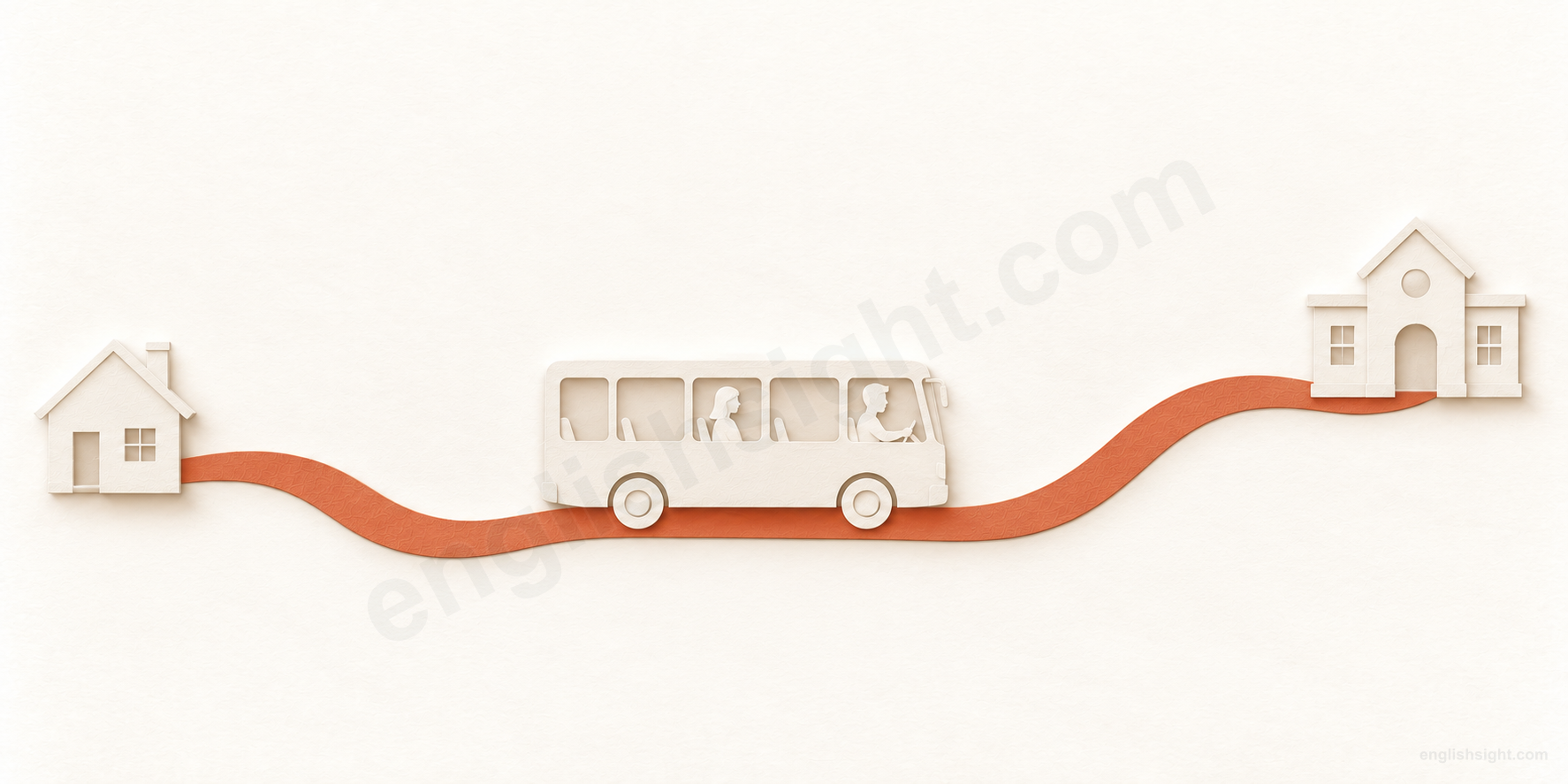
A journey is travel experienced over a route and time; the same image can describe change and discovery.
A route experienced over time
A route experienced over time
The starting house is behind the bus.
journey
The destination is still ahead.
The bus travels along the winding road.
The journey is the travel along the route; the bus is still on the way.
A journey treats travel from one place to another as an experience extending over a route and time. Figuratively, stages of change or discovery take the place of locations.
The bus shows one means of travel. A journey can be planned, in progress, interrupted, or complete; neither a long distance nor successful arrival is part of every use.
When you talk about a journey, you bring the travelling itself into focus: where it begins, what happens along the way, and where it leads. The experience can be short and ordinary, especially in British English, or long and demanding.
English also uses journey for development and discovery. This is a useful comparison between a route through places and a process through experiences, not a claim that every speaker pictures the word in the same way.
01
Travel between places
Name the travel itself, then add its route, transport, and extent.
01
a / the / my + journey; plural journeys
a journey / journeys
an instance of travelling between places
Starting situation
You leave your village.
What follows
You spend time travelling toward the coast.
Journey names the travelling experience, not just the destination.
As a countable noun, journey lets you treat travel as one event: a journey, the journey, or several journeys. It directs attention to getting between places rather than simply being on holiday.
A long or difficult journey is a familiar use, but length is not a requirement. British English also readily uses journey for short everyday travel: My journey to work is quite short.
The route in the diagram represents travel unfolding over time. A planned or unfinished journey is still a journey; the noun does not guarantee arrival.
In a sentence
Our journey to the coast began before sunrise.
Watch the difference Use a determiner with an ordinary singular count noun: a long journey, not long journey on its own.
02
a journey from + place + to + place; a journey through / across + area; the journey home
a journey from… to… / through… / across…
describe where the travel starts, ends, or passes
Starting situation
You need to explain your route.
What follows
The listener can identify the departure point, destination, and region crossed.
The prepositions supply different parts of the route.
From marks the starting point and to marks the destination: a journey from Leeds to York. Either can appear alone when the other place is understood.
Through focuses on passing within a region; across focuses on crossing an area toward another side. Compare a journey through the forest with a journey across the desert. These are ordinary prepositional phrases, not separate phrasal verbs.
Back can mark a return direction: the journey back to the village. Home already works as a direction word: the journey home, without to before home.
In a sentence
The journey from the village to the coast took us through a forest.
Watch the difference To names the destination; through names an area on the way. Say the journey home, not the journey to home.
03
a train / bus / car journey; a journey by + transport; a journey on foot
a train journey / a journey by train
identify how someone travels
Starting situation
You choose the train rather than the car.
What follows
You describe the travel by its means of transport.
Transport changes the kind of journey, not the basic place-to-place relation.
A train journey, bus journey, car journey, or rail journey uses a noun before journey to identify transport. A journey by train puts the same information after the noun.
Use by train, by bus, or by car when naming the general means of transport; use on foot for walking. On the train instead locates someone on a particular service or vehicle.
Journey is not limited to land travel. A sea journey or a journey into space is possible; voyage is another word particularly associated with travel by sea or in space.
In a sentence
We finished the journey on foot after the bus broke down.
Watch the difference Say by bus for the means of transport, not by a bus in this general pattern. Walking is on foot, not by foot.
04
a two-hour journey; a day’s / two days’ journey; a journey of + distance; the journey takes + time
a two-hour journey / a day’s journey
measure travel in time or distance
Starting situation
You are comparing two routes.
What follows
You explain how much travelling each route involves.
Time and distance describe the extent of the travel.
In a two-hour journey, two-hour is a compound modifier before the noun: hour stays singular. Compare The journey takes two hours, where hours is plural.
A day’s journey and two days’ journey measure the travel in days, with different apostrophe positions. A journey of 300 kilometres measures distance instead of duration.
Journey time means the time spent travelling: The new bridge will reduce journey time. The word journey itself does not mean exactly one day, despite its history.
In a sentence
It is a two-hour journey, but yesterday the journey took three hours.
Watch the difference Write a two-hour journey, not a two-hours journey. Use takes for duration; costs normally describes money.
02
Arrange and describe the stages
Begin, interrupt, and complete travel; distinguish its legs and directions.
05
make a journey; go on a journey; embark on / undertake a journey
make a journey / go on a journey
undertake an instance of travel
Starting situation
You decide that you need to travel.
What follows
You describe the travelling event as a whole.
Make and go on combine naturally with the noun journey.
Make a journey describes undertaking the travel: We made the journey twice last month. Make does not mean manufacture a physical object here.
Go on a journey also presents the event. On is a preposition followed by the noun phrase a journey, not a particle attached to the verb journey.
Undertake a journey is more formal. Embark on a journey often highlights beginning a substantial undertaking; it can be used even when no ship is involved.
In a sentence
We made the journey twice to collect all the equipment.
Watch the difference For an ordinary account of travelling, use make a journey or go on a journey rather than a literal translation such as do a journey.
06
begin / continue / resume / complete + a journey; set out on a journey; break one’s journey
begin / continue / break / complete a journey
describe stages and interruptions in travelling
Starting situation
You have started travelling but need a rest.
What follows
You stop temporarily and then travel farther.
An interruption can belong to the same journey.
Begin a journey and set out/off on a journey mark departure. Continue or resume a journey means travel goes on, with resume especially suggesting a previous pause. Complete a journey marks reaching its end.
In British English, break your journey means stop somewhere for a while before continuing. It does not mean damaging a journey or necessarily abandoning your plans.
At journey’s end is a more literary way to say at the end of the journey: At journey’s end, they finally rested. The possessive ending belongs to singular journey.
In a sentence
We broke our journey in Bath and continued the next morning.
Watch the difference Break your journey describes an interruption; cancel your journey means decide not to make it.
07
a leg of + the journey; on / during + the journey; be on a journey
a leg of the journey / on the journey
locate a stage or event within the travel
Starting situation
Your route has a train section and a bus section.
What follows
You identify the final section and something that happened while travelling.
A leg is one part; on places an event within the journey.
A leg of a journey is one section of it, often between stops or changes of transport. The last leg need not involve walking; leg is an established metaphor for a stage.
On the journey and during the journey locate events within the travel: We talked on the journey. On a journey can instead say that someone is currently travelling.
A whole journey may include several legs, delays, and stops. The diagram’s connecting route can help you keep those parts within one travel event.
In a sentence
The last leg of our journey was a short bus ride.
Watch the difference A leg of the journey is a section of travel, not a traveller’s body part in this expression.
08
the outward / return / onward journey; the journey back
the outward / return / onward journey
distinguish going out, coming back, and travelling farther
Starting situation
You reach a city and plan what comes next.
What follows
You distinguish travel home from travel to another place.
The modifier tells you how this journey relates to other travel.
The outward journey is the travel away from your starting point. The return journey is the travel back. You can speak of both parts even though journey often focuses on one direction at a time.
The onward journey takes you farther after a stop or change, often to another destination. If you arrive in Bristol and then continue to Cardiff, Bristol to Cardiff is the onward journey.
In ordinary travel planning, a trip often includes going somewhere, spending time there, and coming back. This is a useful tendency, not a rule that every trip returns or every journey is one-way.
In a sentence
Our outward journey was by train, but our return journey was by bus.
Watch the difference Return means back toward where you started; onward means farther along your travel plans. They are not interchangeable.
03
Before departure and after arrival
Wish someone well, ask about the travel, or explain why it was unnecessary.
09
have a safe / good journey; safe journey!
Have a safe journey!
wish someone well before they travel
Starting situation
A friend is about to leave.
What follows
You wish them travel without harm.
The greeting expresses a wish, not a report of an outcome.
Have a safe journey! is a friendly departure wish. Safe journey! is a shorter informal version. You may also say Have a good journey! when you hope the travel will be pleasant.
These are conversational formulas. Have does not describe ownership here, and the wish does not guarantee what will happen.
You can say these before someone leaves even for a fairly short journey. The occasion, rather than distance alone, makes the expression appropriate.
In a sentence
Have a safe journey, and let me know when you arrive.
Watch the difference Use this as a departure wish. After someone arrives, ask about their journey instead.
10
did + person + have a good journey?; how was + possessive + journey?
Did you have a good journey?
ask how the travel went
Starting situation
Your visitor has just arrived.
What follows
You invite them to describe the travel conditions.
The question concerns the travelling, rather than the whole visit.
Did you have a good journey? is a natural arrival question, particularly familiar in British English. It invites an answer about delays, comfort, traffic, or other travel experiences.
How was your journey? asks a similar open question. A good journey is usually pleasant or trouble-free; it is not a claim that the traveller behaved morally well.
Compare How was your trip? after a holiday or work visit: that can ask about the whole visit, including what happened at the destination.
In a sentence
“Did you have a good journey?” “Yes, the train was quiet and on time.”
Watch the difference Do not assume good journey asks whether the holiday or meeting was successful. Context may focus only on the travel.
11
a wasted journey; have / make a wasted journey
a wasted journey
travel that fails to achieve its purpose
Starting situation
You travel to collect a parcel.
What follows
The office is closed, so you cannot collect it.
The travel happened, but the reason for going was not fulfilled.
A wasted journey is one that turns out to serve no useful purpose. This expression is particularly associated with British English.
The journey need not be delayed, dangerous, or uncomfortable. You may arrive quickly but discover that there was no reason to come.
The adjective wasted gives the evaluation. Journey still names the travel itself, so the phrase does not mean that the travel never took place.
In a sentence
The shop was closed, so we had a wasted journey.
Watch the difference A cancelled journey does not take place as planned; a wasted journey takes place but fails to serve its intended purpose.
04
Development, discovery, and the verb
Follow the travel comparison into changing experience, and recognise the more literary verb.
12
a learning / personal / life journey; a journey from + state + to + state
a journey from… to… / a learning journey
describe change as a process with stages
Starting situation
A learner starts without much confidence.
What follows
Over time the learner gains skills and becomes more confident.
Stages of development take the place of places on a physical route.
A journey can be a process of personal change or development. A learning journey or a life journey presents experiences over time, not literal movement between towns.
From and to can name states: a journey from fear to confidence. The path in the diagram is a teaching comparison for stages of change; it is not evidence that every development is steady or has a fixed destination.
This wording often appears in reflective accounts, education, and personal stories. For a small isolated task, a direct word such as task or lesson may be clearer than calling everything a journey.
In a sentence
Her learning journey began with a few words and grew into daily conversations.
Watch the difference A figurative journey can include setbacks. It does not promise continuous improvement or a completed goal.
13
a journey of discovery / self-discovery
a journey of discovery / self-discovery
present finding things out as an unfolding experience
Starting situation
You explore a subject or your own interests.
What follows
You gradually discover things that change your understanding.
Of identifies what characterises the experience, rather than its physical destination.
A journey of discovery can involve actual travel, but it can also describe research, learning, or exploration without a change of location. Discovery characterises what happens along the way.
A journey of self-discovery focuses on learning about your own character, needs, or values. Self- changes the object of discovery; it does not mean travelling alone.
Compare a journey to Rome: to identifies a destination. Of discovery describes the nature of the journey, so the two phrases do different jobs.
In a sentence
Trying different kinds of work became a journey of self-discovery.
Watch the difference Self-discovery means discovering things about yourself; it does not imply a solo holiday.
14
take + person + on an emotional journey; an emotional journey back to + place
take someone on an emotional journey
lead someone through a sequence of feelings or experiences
Starting situation
A viewer starts watching a film.
What follows
The story carries the viewer through fear, sadness, and relief.
A story can organise emotional stages without moving the audience physically.
An emotional journey presents a sequence of feelings as an experience over time. A story, film, or piece of music can take someone on that journey.
The whole take someone on pattern describes leading someone through an experience. It is not a special transitive meaning of the verb journey: journey is a noun here.
An emotional journey may also be real travel that brings strong feelings, such as returning to a childhood home. Context decides whether the travel itself is literal.
In a sentence
The film takes its audience on an emotional journey from fear to hope.
Watch the difference In takes the audience on a journey, takes is the verb and journey is a noun. Do not analyse the phrase as journey taking an object.
travel, especially in formal or literary narration
Starting situation
A writer describes travellers moving across a region.
What follows
The account follows their movement over a distance.
The verb makes travelling the action of the sentence.
Journey is also a verb: They journeyed north. It is more formal or literary than ordinary travel or go, so I travelled by bus is usually more neutral in everyday conversation.
The regular forms are journey, journeys, journeyed, and journeying. Journeying can describe travel in progress: They were journeying through the hills when the storm began.
The normal learner pattern has no direct object: journey to a place, through a region, into space, or north. These route phrases do not form a separable particle-verb family; use journeyed through it, not journeyed it through.
In a sentence
The explorers journeyed north through the valley for several days.
Watch the difference For ordinary use, say journeyed to the island, not journeyed the island. Rare transitive uses exist, but this lesson teaches the usual intransitive pattern.
Keep the word, construction, and context apart
Journey, trip, travel, and voyage
Journey highlights the travelling between places. Trip often includes a visit and a return, but this is a tendency rather than an absolute rule. Travel is usually uncountable when it names the activity in general: Travel can be tiring; we made three journeys, not three travels in this sense. Voyage is especially associated with travel by sea or in space.
Forms and ordinary grammar
The plural noun is journeys. The verb has journeys, journeyed, and journeying, keeping the y. Noun constructions such as make a journey or take someone on a journey must not be mistaken for verb patterns. The usual intransitive verb has no direct object to passivise, and there is no everyday causative or separable particle-verb family to learn here. General dictionaries also record transitive journey, but it is outside the ordinary learner pattern taught in this lesson.
The comparison has limits
Figurative journeys can involve learning, emotions, discovery, or personal change. Their value is the sense of experience unfolding over time, not a promise of a straight path, improvement, or arrival. Technical customer journeys, historical meanings, and extended proverbs are outside this lesson.
Choose the useful expression
Decide whether the speaker means travel, its stages, a conversational wish, or a developing experience.
1. The travel normally lasts two hours. Which noun phrase is correct?
2. You stopped overnight in a city and continued travelling the next morning. What describes this in British English?
3. You arrived in Bristol and will continue to Cardiff. What is Bristol to Cardiff in these plans?
4. Trying several kinds of work helped Ana understand her own interests. What does a journey of self-discovery mean here?
5. A friend is about to leave. Which sentence wishes them well for the travel?
6. You reached the office comfortably, but it was closed and you could not collect your parcel. Which description fits?
Sources and teaching notes
The sources support the meanings, constructions, register notes, and comparisons. Explanations and examples are original; the visual model is a teaching interpretation.
The route is a teaching comparison, not a picture shared by every native speaker.