From everyday opinions and estimates to competition results and legal decisions.
From information to an assessment
From information to an assessment
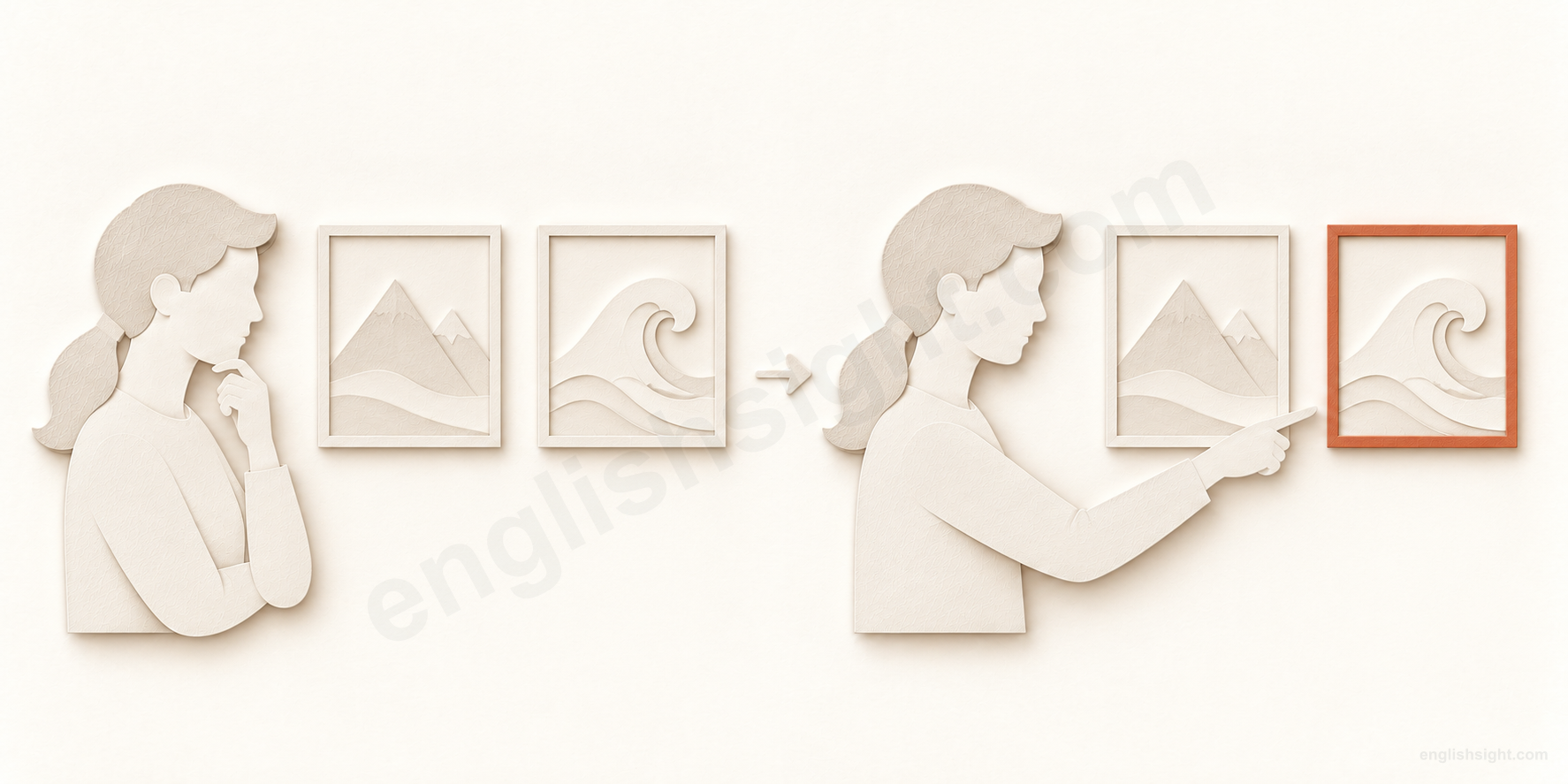
The evaluator considers two artworks; neither is marked as selected.
judge
She points to the wave picture, now marked by an orange frame.
She compares the entries and forms an assessment.
The evaluator forms a view; the artworks stay unchanged. Selection is the result in this contest example.
To judge is to form an assessment of someone or something using the information available; in an official role, that assessment can determine a result.
Considering information does not guarantee care, fairness, certainty, or a negative verdict. The diagram uses an art contest to make the assessing role visible; estimating distance and criticizing behavior do not literally involve selecting a painting.
Judge brings attention to an assessment: someone considers a person, thing, or situation and reaches a view. That view can concern quality, quantity, conduct, or an official result. It may be sound or mistaken.
As a noun, a judge is the person in an assessing role. The role can be official, as in a court or competition, or informal, as in a good judge of character. The picture offers one teaching model, not a shared mental image claimed for all English speakers.
01
Forming opinions and estimates
Judge can assess quality, reach a conclusion, estimate an amount, or criticize a person. The object and following words tell you which task is involved.
01
judge + person / thing; judge without an expressed object
judge the quality
form an opinion about someone or something
Situation / evidence
You have tried the material in a real task.
Assessment / result
You can now assess how well it works.
The object is what you assess; judge does not guarantee a correct or fair opinion.
When choosing a tool, assessing a performance, or considering a plan, judge focuses on the opinion you reach from available information. Judge the quality asks how good something is; judge the impact asks what effect it has had.
You can say It’s too early to judge when the object or issue is already understood. This is an ordinary verb used without an expressed object, not a special phrase meaning to wait forever. Compare choose: you can judge several tools without selecting one.
In a sentence
Try the material outdoors before you judge its quality.
Watch the difference Judge is wider than criticize: an assessment can be favorable, unfavorable, or uncertain.
The words after the object describe the object as assessed, not a change caused by judging.
In judge the bridge unsafe, the bridge is the object and unsafe is the assessment. The same construction can use a noun phrase: We judged the trial a success. Judge something to be useful gives another way to state the assessment, often in more formal writing.
Passives are natural: The bridge was judged unsafe; the design was judged to be effective. The proposal was judged as reasonable is another possible passive pattern. A to-infinitive can also describe an earlier action: She was judged to have handled the dispute well. These patterns report a view or finding; they do not say the act of judging caused the condition or action assessed.
In a sentence
After the inspection, the team judged the bridge unsafe.
Watch the difference Say They judged it to be useful, not They judged it be useful. This is an assessment, not a causative pattern.
03
judge + (that) clause; judge + whether / how / what clause; it is judged that…
judge that… / judge whether…
give a conclusion or assess an open question
Situation / evidence
You consider the available information.
Assessment / result
You either reach a conclusion or evaluate whether it is justified.
That introduces a proposition; whether introduces a question to be assessed.
We judged that the plan would work reports our conclusion. We need to judge whether the plan will work identifies the question that still needs assessment. Judge how well it works similarly asks for an assessment of degree.
The formal passive It was judged that more staff were needed puts the conclusion first and leaves the assessors unnamed. In conversation, We thought… is often less formal than We judged that…. There is no separate particle verb here.
In a sentence
We need to judge whether the extra service is worth the cost.
Watch the difference Whether does not assert that the service is worthwhile; it presents the issue to be decided.
04
judge + amount / distance / speed; judge how + clause; judge + object + to be + amount
judge the distance / how long…
estimate a size, amount, age, speed, or duration
Situation / evidence
You can see the far bank but have no measuring equipment.
Assessment / result
You estimate how far away it is.
The result is an estimate of an amount, rather than a verdict about quality.
Judge the distance, judge the speed, and judge how long something will take use available clues to estimate a quantity. This can be a practical skill: judging a gap, for example, means assessing its size accurately enough for the task.
I judged the walk to be about three kilometres states an approximate amount with an object and to be. Measure normally involves obtaining a measurement with a tool or defined procedure; judge allows an estimate. Judge correctly or wrongly makes the accuracy explicit.
In a sentence
From the hill, I judged the lake to be about two kilometres away.
Watch the difference Judging a distance does not itself mean measuring it exactly or deciding whether it is a good distance.
05
judge + object + by / on + basis; judge + object + against + standard
judge by / on / against
identify evidence, criteria, or a standard for assessment
Situation / evidence
Several entries must be assessed fairly.
Assessment / result
Everyone is assessed using stated criteria.
The preposition adds the basis or comparison standard; it is not a detachable particle.
Judge a person by their actions points to evidence for your view. Judge entries on originality presents originality as a criterion. Judge each proposal on its own merits asks you to assess its actual strengths and weaknesses rather than unrelated factors.
Judge your work against a standard compares it with a benchmark. By and on can overlap, so these are useful tendencies rather than exclusive rules. In Entries were judged by three artists, by names the assessors; in judged by their originality, it names a criterion. Read the following noun phrase.
In a sentence
The entries will be judged on originality, not on the cost of the materials.
Watch the difference In judge it by its cover, it stays before by. Do not treat by as a movable particle.
06
judge + person; judge someone harshly; who are you to judge?
Don’t judge me.
ask someone not to condemn or criticize you
Situation / evidence
You reveal a choice you worry someone will disapprove of.
Assessment / result
You ask them to withhold a negative judgment.
In this interpersonal use, judge often suggests a negative opinion.
Don’t judge me commonly means do not think badly of me or condemn my behavior. It does not normally ask someone to stop estimating your age. Judge someone harshly makes the severity of the criticism explicit.
Who are you to judge? challenges someone’s right to criticize and can sound confrontational. I’m not one to judge can disclaim that right, although a following but may still introduce criticism. Tone and the relationship between speakers matter.
In a sentence
Please don’t judge me for leaving the party early; I was exhausted.
Watch the difference Being judged does not always mean being criticized: in a contest it can simply mean being assessed.
02
The person making the decision
As a countable noun, a judge can hold a legal office, assess a competition, or have skill in evaluating something. Everyday speakers can also claim the right to decide.
07
a / the judge; appear before a judge; Judge + name
a judge / Judge Rivera
a legal official with authority to make decisions in court
Situation / evidence
A dispute is brought to court.
Assessment / result
An authorized official handles legal decisions in the case.
The noun names an office; it does not mean any person with a strong opinion.
A judge is a countable noun: a judge, two judges. You may appear before a judge, and a judge may rule on an issue or sentence someone. Judge can also be a title before a name: Judge Rivera.
The exact work and powers depend on the legal system and the kind of case. A jury is a group of people with a different role; do not assume the judge personally determines guilt in every trial. These examples teach ordinary vocabulary, not a universal court procedure.
In a sentence
Judge Rivera asked both lawyers to explain the agreement.
Watch the difference Use a capital letter for the title in Judge Rivera; use lowercase in the judge. Judge and jury are different words.
08
a judge in / at a competition; a panel of judges; the judges’ decision
a panel of judges
a group of people appointed to assess a competition
Situation / evidence
A contest needs independent assessors.
Assessment / result
A group evaluates the entries and helps determine the result.
A competition judge assesses performance or entries; no court is involved.
A judge at a singing contest or a cooking competition assesses the entrants. A panel of judges is the group doing this work. The judges’ decision uses a plural possessive: the decision belongs to the judges.
A referee or umpire typically enforces the rules and makes decisions during play in particular sports; a judge may score a performance or serve a specific officiating role. Learn the title used in the sport: the three words are not freely interchangeable.
In a sentence
A panel of judges will choose the winning photograph.
Watch the difference Being a competition judge does not make someone a legal judge; the context identifies the role.
09
a good / poor judge of + subject; be no judge of…
a good judge of character
a person skilled at assessing a particular subject
Situation / evidence
You need advice about whether someone is reliable.
Assessment / result
You ask a person whose assessments of people are usually sound.
Of introduces the field being assessed, not a court or contest.
A good judge of character is good at assessing what people are like. A poor judge of distance is bad at estimating distances. This use often appears with good, bad, poor, or an adjective describing judgment.
I’m no judge of art and Not that I’m any judge signal that the speaker lacks expertise or confidence in that field. These expressions concern ability to assess; they do not imply an official appointment.
In a sentence
Mina is a good judge of character, so I asked what she thought of the new partner.
Watch the difference Use of for the subject of expertise: a good judge of character, not a good judge about character.
10
let + person + be the judge of that; be the best judge of + noun / what-clause
Let me be the judge of that.
claim the right to make an assessment yourself
Situation / evidence
Someone tells you what you will enjoy.
Assessment / result
You say that you want to decide that for yourself.
The speaker claims the assessing role, without claiming a legal office.
Let me be the judge of that means allow me to assess that matter myself. The word that refers to what the other person has just said. It can be firm or defensive, especially when rejecting unwanted advice.
You’re the best judge of what you need is a more supportive use: the other person is best placed to assess their own needs. Here a whole what-clause follows of. The noun still names the evaluator, not the assessment itself.
In a sentence
“You won’t like this film.” “Let me be the judge of that.”
Watch the difference This can sound assertive. For a gentler response, say I’d like to see for myself.
03
Official judging in competitions and courts
The verb also names the work done by a judge. An official result differs from a private opinion, even though both involve assessment.
11
judge a competition / entries; act as a judge; be judged + complement
judge a competition
assess entries and decide a competition result
Situation / evidence
The entrants submit their work.
Assessment / result
An assessor evaluates the work for the contest result.
The object can be the competition, its entries, or the people competing.
Judge a competition names the judging task as a whole. Judge the entries focuses on the work being assessed. If the contest is already understood, We need someone to judge leaves the object unspoken.
The passive moves the assessed work into subject position: All entries will be judged anonymously. The winning entry was judged the best combines the contest use with an assessment complement. This does not mean that every act of judging immediately produces a final winner; there may be several rounds.
In a sentence
Two local artists have agreed to judge the poster competition.
Watch the difference In the contest-officiating use, judge the competition means assess the entries and determine results. In another context, the same words could mean form an opinion about the event itself; the context decides.
12
judge a case; judge + person + guilty / not guilty; be judged + complement
judge a case / judge someone guilty
make a legal decision about a case or person
Situation / evidence
Evidence and arguments are considered in a legal case.
Assessment / result
A formal finding is made.
The legal context supplies institutional authority, beyond a private belief.
Judge a case means consider it and reach a legal decision. Judge someone guilty or not guilty states a finding with an adjective complement. In everyday news, find someone guilty is also a natural way to describe such a finding.
Compare I judged the explanation unlikely: that may simply be my opinion. A legal use of judge depends on the court context and does not make every private assessment legally binding. Sentencing concerns a penalty; it is not identical to deciding guilt.
In a sentence
The defendant was judged not guilty after the court heard the evidence.
Watch the difference Do not use judge someone to mean arrest them or sentence them to a particular penalty without further context.
04
Evidence, limits, and independent judgment
These familiar expressions identify your evidence, leave room for missing information, invite another person’s assessment, or warn against judging appearances.
13
judging by / from + evidence, + clause; to judge from + evidence, + clause
judging by / judging from / to judge from
introduce the evidence for your conclusion
Situation / evidence
You see a line of people outside a small café.
Assessment / result
You infer that it is popular.
The introductory phrase identifies the clue; the main clause gives the inference.
Judging by the queue, the café is popular means the queue is the basis for that belief. Judging from and To judge from can introduce the same sort of reasoning. The clue may be a report, behavior, a sound, or visible evidence.
This established comment phrase is not a progressive tense by itself: Judging by the queue… has no finite am or is. It also does not say that the café is doing the judging. Compare I am judging a contest, where am judging is a genuine progressive verb phrase describing an activity.
In a sentence
Judging by the queue outside, the café must be popular.
Watch the difference An inference can be wrong. The queue could have another explanation; the expression identifies evidence without proving the conclusion.
14
as / so far as + person + can / could judge, + clause
as far as I can judge
limit a claim to what you can assess
Situation / evidence
You have checked what you can, but some facts are missing.
Assessment / result
You offer a conclusion within those limits.
As far as marks the limits of your knowledge, not a physical distance.
As far as I can judge introduces or qualifies a conclusion based on what you know. So far as I can judge is an alternative. You are leaving room for information that could change the assessment.
The expression is more deliberate than a simple I think. Can concerns your ability to assess the matter; it does not mean you have permission to act as a legal judge. A past narrative can use As far as I could judge.
In a sentence
As far as I can judge, the repair has solved the problem.
Watch the difference Keep as far as together. This phrase does not promise that every possible test has been completed.
15
judge for + reflexive pronoun; judge for yourself whether…; it is not for + person + to judge
judge for yourself
reach your own opinion from the available evidence
Situation / evidence
You have heard someone else’s opinion.
Assessment / result
You examine the material and make your own assessment.
For yourself emphasizes whose independent judgment is wanted.
Judge for yourself invites someone to look, listen, or try something instead of simply accepting another person’s verdict. You can give the issue explicitly: Judge for yourself whether the room is large enough.
It’s not for me to judge takes the opposite conversational position: I am not the person who should decide or criticize in this matter. Compare judge yourself, where yourself is the object being assessed. Judge for yourself does not necessarily mean assess your own character.
In a sentence
Read the two reports and judge for yourself which explanation is stronger.
Watch the difference For yourself concerns independence; yourself without for normally identifies the person being assessed.
16
don’t / you can’t judge a book by its cover
Don’t judge a book by its cover.
do not assess people or things only by appearance
Situation / evidence
A building looks unpromising from outside.
Assessment / result
You reserve judgment until you know what it offers.
The book and cover stand for a thing and its outward appearance.
This saying warns against treating the outside as a complete guide to value or character. You can’t judge a book by its cover is another common form. It can refer to people, places, products, or literal books.
The point is not that appearance contains no information at all. It is that appearance alone can mislead. The wording is conventional: replacing book and cover with unrelated objects loses the recognizable saying, even if a listener can understand the new metaphor.
In a sentence
The café looks rather plain, but don’t judge a book by its cover—the food is excellent.
Watch the difference The saying is figurative and does not require a real book. Its message is to look beyond appearances.
Assessment, authority, and grammar
Judge, decide, and assess
Judge emphasizes an assessment of something. Decide can select a course of action: deciding to leave does not itself mean judging someone. Assess is useful for a systematic evaluation; estimate highlights an approximate quantity. Context often allows overlap.
The person and the opinion
A judge is a person; a judgment is the assessment or decision. Do not say My judge is that it is safe when you mean My judgment is that it is safe. The related noun is written judgment, or also judgement especially in British English.
Forms and complements
The forms are judge, judges, judged, judging; drop the final e before -ing. Noun and base verb are pronounced /dʒʌdʒ/. Judging can describe an activity, as in She is judging the contest. Passives and assessment complements are common; judge has no general causative pattern meaning make someone become the quality assessed.
Phrases and scope
By, on, from, against, and for introduce evidence, criteria, standards, or the evaluator’s independence. They do not form a family of separable particle verbs. This lesson covers modern everyday noun and verb uses; historical biblical leaders, specialist legal offices, and compounds such as line judge are not developed here.
Read the role and the construction
Choose the interpretation or wording that fits the situation.
1. You look across a valley and make a rough estimate of its width. What are you doing?
2. A team assessed a bridge and concluded that it was unsafe. Which sentence reports the finding?
3. “Leah is a good judge of character.” What does this tell us?
4. “Judging by the queue, the café is popular.” What is the queue doing in this sentence?
5. You want a friend to examine two reports and form an independent opinion. Which invitation fits?
6. A friend says, “Don’t judge me for changing my mind.” What is the likely request?
Sources and teaching notes
Modern uses and constructions were checked in the publisher pages below. The explanations and examples are original; the visual model is a teaching interpretation.
This diagram illustrates assessment in a contest. It is a teaching model, not a mental image shared by every English speaker.