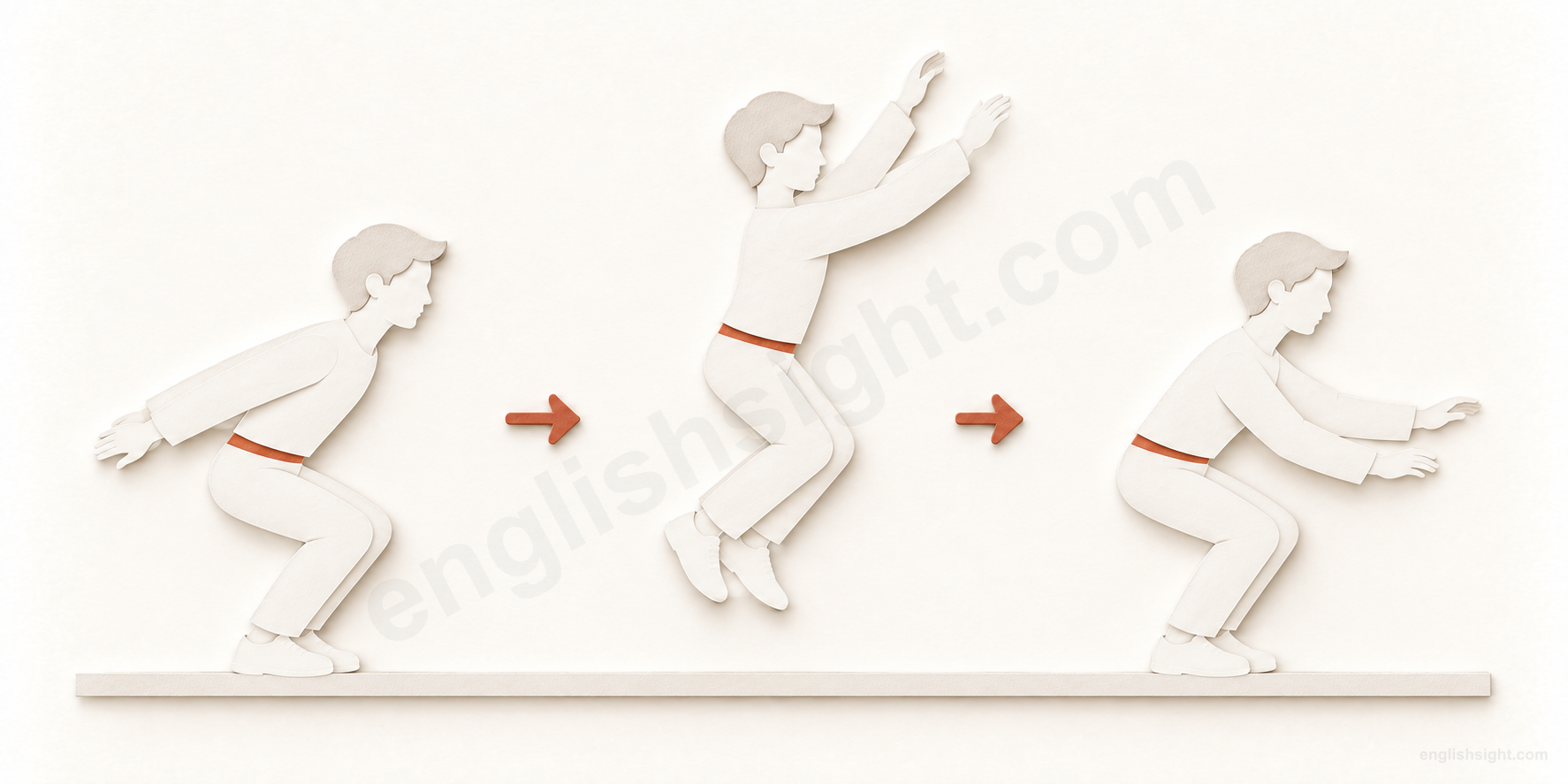
From leaving the ground to changing level, joining in, and acting too soon.
A break in contact, then a landing
Push off, leave support, land again
The person bends their knees with both feet on the ground.
jump
They land with bent knees and both feet supported again.
They push off and are briefly airborne, with both feet clear of the ground.
One person, three moments: prepare, leave the ground, land again.
In its physical use, jump means pushing away from a surface into the air; many other uses describe a sudden move or change rather than a smooth progression.
The physical sequence explains one central use. Direction comes from the following words, while fixed phrases may add meanings that need to be learned separately.
A physical jump takes a body off its support for a moment. In other uses, jump can present a change as abrupt: a price rises sharply, a speaker switches topics, or someone responds without delay.
Use that connection as a teaching model, then check the whole expression. It cannot predict the established meanings of jump at a chance, jump ship, or jump the gun. The diagram is a memory aid, not a claim that every English speaker has the same mental picture.
01
Bodies, surfaces, and quick movements
Start with a physical jump. Direction words, objects, and noun patterns tell us where the movement goes and what is being measured.
01
jump; jump + direction; jump + distance
jump / jump up and down
push away from a surface into the air
Situation before
A child bends her knees with her feet on the ground.
What happens
She pushes off and is briefly in the air.
The body leaves its support; the jump need not travel forward.
You can jump on the spot or jump two metres. In the measurement pattern, two metres tells us the distance achieved; it is not an object receiving an action. Jumped is both the past tense and the past participle, pronounced /dʒʌmpt/.
Jump up and down describes repeated jumps. Jump for joy connects jumping with delight. It can also express great happiness without a report of literal jumping: I could have jumped for joy when my bag turned up.
In a sentence
The children jumped up and down when their team scored.
Watch the difference Jumping is not always upward travel overall: a person can jump down from a low step.
02
jump over + obstacle; jump + obstacle; jump + horse + over + obstacle
jump over a fence / jump a fence
pass above or across an obstacle in a leap
Situation before
A fence stands between the runner and the next part of the path.
What happens
The runner clears it without passing through it.
The object can name what is crossed, rather than someone affected.
Jump over a fence and jump a fence can describe the same crossing. Over makes the spatial relation explicit; it does not turn every physical direction phrase into a fixed idiom. Jump across a gap emphasizes crossing its width.
In riding, I jumped the horse over a low fence means I guided the horse in making the jump. This is a particular transitive use, not a general rule allowing jump someone to mean make any person jump.
In a sentence
The dog jumped over the fallen branch.
Watch the difference Jump the fence usually means cross it by jumping; jump on the fence makes it the surface you land or move on.
03
jump off / from + source; jump down; jump into / out of + place; jump onto + surface
jump off / down / into / out of
specify the departure point, direction, or destination
Situation before
A cat is on a low wall beside the garden.
What happens
It leaves the wall and lands in the garden.
The following word supplies the path; jump supplies the abrupt movement.
Off and from name a starting point; into names entry; out of names exit; onto names arrival on a surface. The phrases can combine: The cat jumped down from the wall. Off does not mean a bad result, and into does not by itself mean danger.
Jump on a bed can describe repeated jumping while on it; jump onto the bed clearly describes reaching it. Context decides whether a person who jumps into water starts at ground level or above it.
In a sentence
The cat jumped off the wall into the garden.
Watch the difference Use out of the box for departure, not out the box in the general standard pattern taught here.
04
jump to + possessive + feet; jump up; jump in / into / out of / on + vehicle
jump to your feet / jump in a car
move quickly and suddenly into a position or place
Situation before
Maya is sitting when her name is called.
What happens
She immediately stands.
A quick movement need not be a full airborne leap.
Jump to your feet means stand up suddenly. Jump up can mean the same in context. Jump in! beside an open car door invites someone to get in quickly; it need not ask them to leap over the door.
Jump on a train or plane can mean board it promptly. Distinguish jump a train, which can suggest dangerous or unauthorized boarding, especially in North American usage. For a neutral travel plan, take a train is clearer.
In a sentence
Maya jumped to her feet when the host called her name.
Watch the difference Match the possessive to the subject: I jumped to my feet; they jumped to their feet.
05
jump at + sound; make + person + jump; nearly jump out of + possessive + skin
make someone jump / jump out of your skin
react with a sudden movement to surprise or fright
Situation before
You are quietly reading when a door slams.
What happens
You jerk with surprise.
The reaction can be involuntary, unlike a deliberate athletic jump.
The door made me jump uses make plus an object and a bare verb. I jumped at the bang describes what triggered the reaction. My heart gave a jump is a noun expression for a sudden startled or emotional sensation.
Nearly jumped out of my skin is an informal exaggeration for being extremely startled. No one leaves their body. It is different from jumping for joy, where delight rather than fright is the point.
In a sentence
The sudden ringtone made me jump.
Watch the difference Say made me jump, not made me to jump. The passive causative is I was made to jump, with to restored.
06
a jump of + distance; make / do + a jump; the high / long jump; a jump on a course
a jump / the long jump / a jump in a course
name a leap, an event, or an obstacle
Situation before
An athlete completes one attempt.
What happens
The recorded jump is six metres long.
The noun can name the action or, in a course, the barrier itself.
Jump is countable: one jump, three jumps. A standing jump starts without a run; a running jump follows an approach. The high jump and the long jump name athletics events, not just any high or long leap.
The horse refused the last jump names an obstacle on the course. The horse made a clean jump names its movement. A parachute jump names a descent from an aircraft with a parachute, rather than an upward spring from the ground.
In a sentence
Her final jump was longer than her first two jumps.
Watch the difference Use a jump of six metres for the measured distance; a jump in prices uses in to name what increases.
07
jump rope; be jumping rope
jump rope
exercise by repeatedly clearing a moving rope
Situation before
A rope swings toward your feet.
What happens
You jump as it passes underneath.
This names an activity with an established regional expression.
Jump rope and skip rope are North American expressions for the activity; British English commonly uses skip. In I jump rope, rope normally has no article because the whole phrase names the activity.
A jump rope can also name the piece of equipment in North American English. Compare I bought a jump rope with I jump rope after work: the first needs a noun phrase for an object, the second names exercise.
In a sentence
I jump rope for a few minutes before training.
Watch the difference Jump a rope could describe clearing a particular rope once; it is not the usual name of this repeated exercise.
02
Sudden changes and interrupted sequences
An amount, a topic, or a machine can jump. Check whether the sentence describes a rise, a missing step, a sudden shift, or a special established use.
08
jump by + amount; jump + amount; jump from + starting value + to + ending value; a jump in + quantity
prices jump / a jump in prices
rise noticeably and suddenly
Situation before
A ticket costs twenty pounds.
What happens
Its price suddenly becomes thirty pounds.
The changing quantity is the subject; by gives the increase and to gives the new level.
The price jumped to £30 gives the new price; jumped by £10 gives the amount added. Jumped from £20 to £30 gives both endpoints. The noun pattern is a jump in prices or a £10 jump in the price. You can also omit by before a measured increase: The share price jumped 10p. Here 10p is the amount of the rise, not the final price.
Jump presents the rise as sharp or abrupt relative to the context. Increase is more neutral and can describe gradual change. A number can jump without anything physically moving, so the airborne figure is only a memory link here.
In a sentence
Ticket prices jumped from £20 to £30 in a week.
Watch the difference Do not confuse jumped by 20% with jumped to 20%: an increase and a final rate are different quantities.
09
jump from + A + to + B; jump around; jump ahead / back / to + point; jump + steps
jump from topic to topic / jump ahead
shift abruptly or pass over part of a sequence
Situation before
A talk is discussing travel costs.
What happens
It suddenly switches to an unrelated personal story.
A break in sequence can concern ideas, time, or omitted steps.
Jump from one topic to another or jump around describes abrupt changes of subject. A story can jump back ten years in time. Let’s jump to the last section deliberately moves to a later point without covering everything between.
You jumped a step means a step was omitted. The noun make the jump from school to work describes a substantial transition. Read the context: jumping ahead in a book skips material, while jumping ahead in a race can describe moving into a lead.
Jump from job to job describes abrupt or repeated changes of employment. Someone can also jump from a junior role to a senior one, rising suddenly in rank. The change need not involve a literally missing step; the context identifies the positions and whether the shift is upward.
In a sentence
The speaker kept jumping from one topic to another.
Watch the difference Jump to page ten names a destination in the text; jump ten pages measures how far you move through it.
10
device / pointer + jump; jump + the rails / track
the needle jumps / jump the rails
move abruptly, often out of the expected position
Situation before
A pointer is moving steadily across a scale.
What happens
It suddenly jerks to another position.
The moving thing need not have legs or make a deliberate effort.
A needle, cursor, or picture can jump when its position shifts abruptly. This use describes the visible movement; it does not by itself diagnose the cause. A record that jumps fails to follow its normal groove smoothly.
A train that jumps the rails leaves its track. Here the rails are the expected course, not an obstacle deliberately cleared like a sporting hurdle. These descriptions share abrupt displacement, but they are not instructions for how the machines work.
In a sentence
The needle jumped when I moved the cable.
Watch the difference The machine jumped describes its movement; I jumped the machine is not the ordinary way to say I made it move.
11
jump + car; jump-start + vehicle / process
jump a car / jump-start a project
use outside help to get something started
Situation before
A car will not start because its battery lacks enough power.
What happens
An external battery connection helps start the engine.
This established vehicle use has a related process metaphor.
In North American English, jump a car can mean jump-start it using another battery. Jump-start is understood more widely and makes the intended meaning clearer. The car can be the subject of a passive: The car was jump-started.
Jump-start a project or business means give it a strong initial boost. The project is not literally leaping. Learn jump-start as its own compound; the spelling and the vehicle meaning cannot be predicted from the basic jumping diagram alone.
In a sentence
A neighbour helped us jump-start the car.
Watch the difference Jump-start the business means help it begin or gather momentum; it does not simply mean its profits jumped.
12
place / event + be jumping
the place is jumping
be full of lively activity
Situation before
The room fills with people and music.
What happens
It becomes busy and energetic.
The -ing description characterizes the atmosphere.
The club is jumping is an informal way to say it is very lively. The place itself is not leaving the ground, and the expression does not require every person there to be dancing.
Compare The children are jumping, which normally describes an action. Subject choice matters: people can be literally jumping, while a restaurant or party that is jumping is usually being described as bustling.
In a sentence
By nine, the little café was jumping.
Watch the difference Jumping is informal here. For a neutral report, say the café was very busy.
03
Opportunities, conversations, and reactions
These combinations describe accepting, joining, noticing, criticizing, or attacking. The small word and the kind of object matter.
13
jump at + chance / offer / opportunity; jump at + pronoun
jump at the chance
accept eagerly and without hesitation
Situation before
Someone offers you a place in a workshop.
What happens
You eagerly accept the offer.
At introduces the opportunity you welcome, not a physical landing place.
Jump at an offer emphasizes enthusiasm. I would jump at the chance can describe an imagined offer; it does not say one has already arrived. The chance to join us uses to plus a verb to specify the opportunity.
Keep at before its complement: I jumped at it. Compare I jumped at the noise, which describes a startled reaction, and the North American jump at someone, which can mean criticize them. The object and situation distinguish these uses.
In a sentence
When they offered me a place, I jumped at the chance.
Watch the difference Say jumped at it, not jumped it at. This pattern is not a separable verb-particle construction.
14
jump in; jump in with + comment / question
jump in with a question
enter a conversation suddenly, often interrupting
Situation before
Two colleagues are discussing the plan.
What happens
You suddenly add a question.
The person joins the exchange, rather than entering a physical container.
Jump in can describe interrupting or taking a turn quickly. With names your contribution: jump in with a question, an objection, or a suggestion. May I jump in? asks permission to contribute.
The phrase can sound helpful or intrusive depending on timing. Compare jump into the discussion, where into takes a noun phrase. Do not treat in as a movable particle followed by a direct object: jump the discussion in is not this pattern.
In a sentence
Could I jump in with a quick question?
Watch the difference Jump in does not always imply rudeness. Tone and whether you allow others to finish affect the interpretation.
15
jump in and + verb; jump into + activity; jump in with both feet
jump in / jump into a task
start taking part promptly and energetically
Situation before
A task needs volunteers.
What happens
You start helping straight away.
In or into frames participation; the subject commits to an activity.
Jump in and help describes starting promptly. Jump into a project names the activity after into. The context may praise initiative or suggest that someone acted before thinking enough; jump in alone does not settle that judgment.
Jump in with both feet emphasizes wholehearted involvement. The feet are figurative in a business discussion. Compare I jumped into the pool, where the same directional pattern can describe literal physical entry.
In a sentence
Nina jumped in and helped us sort the boxes.
Watch the difference Use into before the named activity: jump into the work. Do not say jump into to help; say jump in to help.
16
feature / mistake + jump out at + person
jump out at someone
be immediately noticeable to a person
Situation before
You scan a page with a mismatched date.
What happens
The error immediately catches your attention.
The thing noticed is the subject; the observer follows at.
A mistake jumped out at me means I noticed it readily. The page does not physically eject the mistake. Nothing jumped out at me can mean nothing was especially striking, not that you saw nothing at all.
Contrast The cat jumped out at me: that can describe a real animal suddenly moving toward you. The abstract subject mistake strongly supports the attention meaning. Keep both out and at in the full pattern.
In a sentence
The wrong date jumped out at me as soon as I opened the file.
Watch the difference Say It jumped out at me, not It jumped me out. The observer is not a direct object.
17
jump on + person + for + noun / -ing; jump down + possessive + throat
jump on someone / jump down someone’s throat
criticize or respond angrily and abruptly
Situation before
A colleague hears a small mistake.
What happens
They respond with sharp criticism.
Here the force is verbal, not necessarily physical.
Jump on someone for being late means criticize them quickly or strongly. North American English also uses jump at someone for criticism. At an opportunity and at a person therefore need different readings.
Jump down someone’s throat describes an unexpectedly angry or sharp response, often to something they have just said. Please don’t jump down my throat is a request for a calmer reaction. Both expressions are informal and evaluate how someone responds.
In a sentence
Please don’t jump down my throat; I’m only asking a question.
Watch the difference In jump down her throat, her marks whose throat appears in the idiom. Do not replace the whole phrase with jump her down.
18
jump + person; jump on + person; be jumped
jump someone / jump on someone
attack suddenly and unexpectedly
Situation before
A pedestrian is walking along a quiet road.
What happens
Attackers suddenly assault the pedestrian.
With a person as direct object, jump can describe an assault.
They jumped him is informal and commonly describes a sudden physical attack. He was jumped is a normal passive of this transitive use. In contrast, He jumped says that he himself made a sudden movement.
Jump on someone can describe attack or criticism; context must decide. In The child jumped on Dad during their game, the words may instead describe playful physical movement, so the form alone does not prove an assault.
In a sentence
Two strangers jumped him outside the station.
Watch the difference I jumped at the bang means I was startled. I was jumped means I was attacked; the passive changes who undergoes the action.
04
Timing, rules, effort, and advantage
Learn these expressions as units. The idea of a leap may help you remember them, but it does not supply their full meaning.
19
jump to conclusions; jump to the conclusion that + clause
jump to conclusions
reach a judgment before considering enough evidence
Situation before
A message has not been answered.
What happens
You immediately assume the recipient is angry.
The imagined leap skips the checking needed before a conclusion.
Jump to conclusions criticizes a decision made too quickly. A conclusion reached this way could turn out to be correct; the expression concerns the inadequate reasoning process, not a guarantee of a false answer.
Use the plural for a general habit or warning: Don’t jump to conclusions. Use the conclusion that… for a particular belief. To introduces the result, while the following that-clause states what the person believes.
In a sentence
Don’t jump to the conclusion that she is angry just because she hasn’t replied.
Watch the difference Jump at the conclusion is not this idiom. Use to for the judgment you reach.
20
jump the gun; jump the gun by + -ing
jump the gun
act before the appropriate signal or time
Situation before
An announcement is planned after everyone agrees.
What happens
Someone sends it before agreement is complete.
The error is premature action, not necessarily an incorrect belief.
Jump the gun can describe a runner starting before the race signal and, informally, any action taken too soon. The image of starting early is useful, but no gun needs to be present in an office example.
Compare jumping to conclusions: that concerns deciding too soon. Jumping the gun concerns acting too soon. You could have correct information yet jump the gun by publishing it before the agreed date.
In a sentence
We jumped the gun by sending the invitations before the date was confirmed.
Watch the difference The idiom normally keeps the: jump the gun. Jump a gun is not the same expression.
21
jump the queue; jump the line; cut in line
jump the queue / jump the line
take a place ahead of people who should be served first
Situation before
Other customers are waiting ahead of you.
What happens
You get served before your proper turn.
The expression concerns bypassing order, not jumping over people.
Jump the queue is British usage; jump the line and cut in line are North American alternatives. The phrase often expresses disapproval because someone avoids the normal turn-taking system.
A person with influence may figuratively jump the queue for an appointment without standing in any physical line. Contrast jump over a queue, which would describe literal movement across a line of people.
In a sentence
The other passengers complained when a man jumped the queue.
Watch the difference The queue is the whole waiting order here; jump in a queue does not express the same bypassing meaning.
22
jump the lights; run a red light
jump the lights
go through a red traffic signal instead of stopping
Situation before
A traffic signal requires drivers to stop.
What happens
A driver goes through the signal.
This established road expression describes disregarding the signal.
Jump the lights is an informal British expression. Run a red light is a widely understood alternative, especially in North American English. The car is not physically leaping over the lights.
Compare jump the gun, which can apply to any premature action. Jump the lights names a particular road situation, so neither expression is a general substitute for the other.
In a sentence
A driver jumped the lights at the junction.
Watch the difference Do not interpret jump the lights as switching the lights on or making them brighter.
23
jump through hoops; jump through + many / several + hoops + to-infinitive
jump through hoops
deal with a demanding series of steps to achieve something
Situation before
You need permission for a small project.
What happens
You face several awkward forms and checks.
The hoops stand for successive demands, not a single literal ring.
Jump through hoops often expresses frustration at complicated or annoying requirements. A to-infinitive can state the goal: jump through hoops to get approval. The phrase can also describe making great efforts to satisfy someone.
Compare jump a step, which leaves something out. Jump through hoops says you go through demanding steps, so these expressions can describe opposite approaches to a process.
In a sentence
We had to jump through several hoops to get the room booking approved.
Watch the difference Keep through. Jump over hoops could describe physical obstacles and does not reliably convey this idiom.
24
jump on + the / a + bandwagon; jump on the + topic + bandwagon
jump on the bandwagon
join a popular trend in the hope of benefiting
Situation before
A product trend becomes popular.
What happens
More companies copy it to gain sales or attention.
The full idiom adds the idea of following a successful or fashionable trend.
The phrase often sounds disapproving: the speaker suggests that a person or organization follows others for advantage, rather than from an earlier commitment. It can describe fashion, politics, products, or online behavior.
Jump on a bus can simply describe boarding. Jump on the bandwagon has a conventional social meaning; neither on alone nor the basic jump diagram supplies the judgment about motives.
In a sentence
Several brands jumped on the bandwagon after the style became popular online.
Watch the difference Joining a team is not automatically jumping on the bandwagon; the popularity and benefit-seeking context matters.
25
jump ship; jump ship to + organization / activity
jump ship
leave a ship without permission, or abruptly leave an organization
Situation before
A worker belongs to a struggling company.
What happens
The worker leaves for another company.
The figurative expression treats an organization as a shared vessel.
In its shipboard use, jump ship means leave the crew without authority. In work or politics, it means abruptly abandon the organization, group, or cause. Figurative use does not require literal wrongdoing.
The wording may imply disloyalty or a sudden departure, so leave the company is a more neutral description. Jump off a ship, in contrast, describes physical movement away from a ship and does not by itself say someone deserted the crew.
In a sentence
Two designers jumped ship to join a new studio.
Watch the difference The idiom has no article: jumped ship. Jumped the ship is not the usual idiom for leaving an organization.
26
jump bail
jump bail
fail to appear for trial after release on bail
Situation before
A person has been released while waiting for trial.
What happens
They fail to appear for the trial as required.
This is a legal expression with a specific conventional meaning.
In news reporting, jumped bail describes failing to appear for trial after being released on bail. Bail concerns release pending trial; the phrase is not a way of saying someone physically jumped or paid a bill.
Learn the fixed expression without an article. This lesson explains its ordinary dictionary meaning, not the procedures or conditions of bail in a particular legal system.
In a sentence
The report said the defendant had jumped bail.
Watch the difference Jump bail and jump ship both concern leaving obligations behind, but they refer to different situations and are not interchangeable.
27
jump in at the deep end; be thrown in at the deep end
jump in at the deep end
begin a difficult activity with little preparation
Situation before
You have little experience of a demanding task.
What happens
You begin handling it without a gentle introduction.
The pool image represents difficulty and lack of preparation.
Jump in at the deep end suggests entering the challenge yourself. Be thrown in at the deep end suggests that other people or circumstances put you there. Neither requires an actual swimming pool.
Compare jump in with both feet: that emphasizes wholehearted commitment. The deep end emphasizes a demanding start without preparation. You can commit fully to an activity that is easy, or face a difficult start unwillingly.
In a sentence
I jumped in at the deep end by leading the first workshop myself.
Watch the difference The established expression uses at the deep end, rather than on the deep end.
28
get a jump on + task / competitor; get the jump on + competitor; stay one jump ahead of + person
get a jump on / stay one jump ahead
gain an early advantage or keep ahead
Situation before
Others will start preparing tomorrow.
What happens
You begin today and gain an advantage.
The noun jump represents a lead rather than physical height.
Get a jump on the packing means start it early. Get the jump on a competitor emphasizes gaining an advantage by acting first. Both are especially associated with North American usage.
Stay or keep one jump ahead of someone means maintain an advantage through earlier action or better information. Compare jump ahead to chapter five, which simply changes the point in a sequence and need not involve competition.
In a sentence
Let’s get a jump on the packing so tomorrow is less rushed.
Watch the difference Use ahead of them, not ahead them. Get a jump on a task does not mean physically land on it.
29
jump to it; had better + jump to it
Jump to it!
tell someone to start immediately and hurry
Situation before
There is a task to do and little time.
What happens
Someone urges immediate action.
It points to the task; the whole phrase gives an energetic instruction.
Jump to it! is an informal, forceful way to tell someone to get moving on a task. It can sound playful among friends or bossy in a request, so tone and relationship matter.
Compare jump to your feet, which describes standing, and jump to a conclusion, which describes judging. To occurs in all three, but only the complete expressions tell you what sort of action is intended.
In a sentence
The guests arrive in ten minutes, so we’d better jump to it.
Watch the difference For a gentler request, say Could we get started? rather than assuming Jump to it! is always polite.
30
be jumping up and down about + issue
be jumping up and down about something
express strong anger or excitement
Situation before
A change upsets several residents.
What happens
They complain loudly and energetically.
A familiar physical action becomes an informal description of a strong reaction.
People who are jumping up and down about a problem may be making a fuss or protesting without literally leaving the ground. In another context, the same words can express excitement rather than anger.
Compare the children jumping up and down after a goal: that can be literal movement. Look for the surrounding details, such as complaining, protesting, or cheering, instead of assigning one emotion to the phrase in every sentence.
In a sentence
The neighbours were jumping up and down about the late-night deliveries.
Watch the difference Jump up and down does not always mean complain; literal movement and delighted excitement remain possible.
31
show / series + jump the shark
jump the shark
add an implausible development that suggests a show is declining
Situation before
A series has been successful for years.
What happens
A far-fetched new plot makes viewers question its quality.
This is a fixed media idiom, not a general synonym for make a mistake.
People use jump the shark when a show appears to have passed its best point, especially after an unbelievable attempt to keep viewers interested. It expresses an evaluation, not an objectively measurable event.
The words do not require a real shark in the new plot. A viewer might apply the phrase to a sudden, implausible change in a long-running series; simply disliking a single scene does not automatically establish the same claim.
In a sentence
For me, the series jumped the shark when the quiet family drama turned into a space adventure.
Watch the difference This informal critical expression usually concerns a decline after earlier success, not the first episode merely being weak.
Keep the motion, grammar, and whole expression distinct
Forms and word classes
Forms are jump, jumps, jumped, jumped, jumping. The final sound in jumped is /t/, with no extra syllable. The common noun is countable: a jump, several jumps. This lesson covers modern verbs, nouns, and selected fixed expressions, not every compound containing jump.
Jump, hop, leap, and skip
Jump is a general word for springing off a surface. Hop often suggests a small jump on one foot; leap often highlights a larger or energetic jump and can sound more vivid. Skip can describe light alternating steps, rope exercise in British English, or leaving something out. These are tendencies, not a rule about exactly how many feet every jump uses.
Objects and passives depend on the meaning
Jump a fence names an obstacle cleared. Jump someone can mean attack them; be jumped then means be attacked. Jump a car is an established North American use for jump-start it. For startling, use make someone jump. Do not invent a general jump someone to do something causative pattern.
Read the small word and the object together
Jump into a pool can describe physical entry; jump into a project describes participation. Jump at a chance expresses enthusiasm; jump at a sudden sound can express surprise. Not every direction phrase is an idiom, and not every verb followed by a small word has a movable object.
Coverage has a boundary
These are common-use families and selected useful idioms, not a frequency ranking or every dictionary entry. Technical computing, bridge, mining, and historical senses, specialized sports compounds, and rare or vulgar uses are not expanded. The physical picture cannot prove the meanings of fixed expressions.
Read the whole situation
Choose the expression that matches both the meaning and the grammar.
1. A price was £20 and is now £30. Which sentence gives the new level?
2. Someone offers you a place on a course and you eagerly accept. What fits?
3. An error is immediately obvious when you read a document. Which sentence fits?
4. A door slams and you jerk with surprise. What happened?
5. You sent an accurate announcement a day before the agreed release time. Which phrase targets the timing?
6. You completed several awkward checks to get permission. Which expression fits?
7. In a meeting, you want to add a question immediately. Which request is natural?
Sources and teaching notes
Usage was checked against the dictionary pages below. Explanations and examples are original; connections between uses are teaching interpretations rather than a claim about one shared mental image.
The diagram helps explain a connection; it is not a picture shared by every native speaker.