Follow how possession, conditions, and activities are maintained over time.
A state maintained over time
Maintain it across time
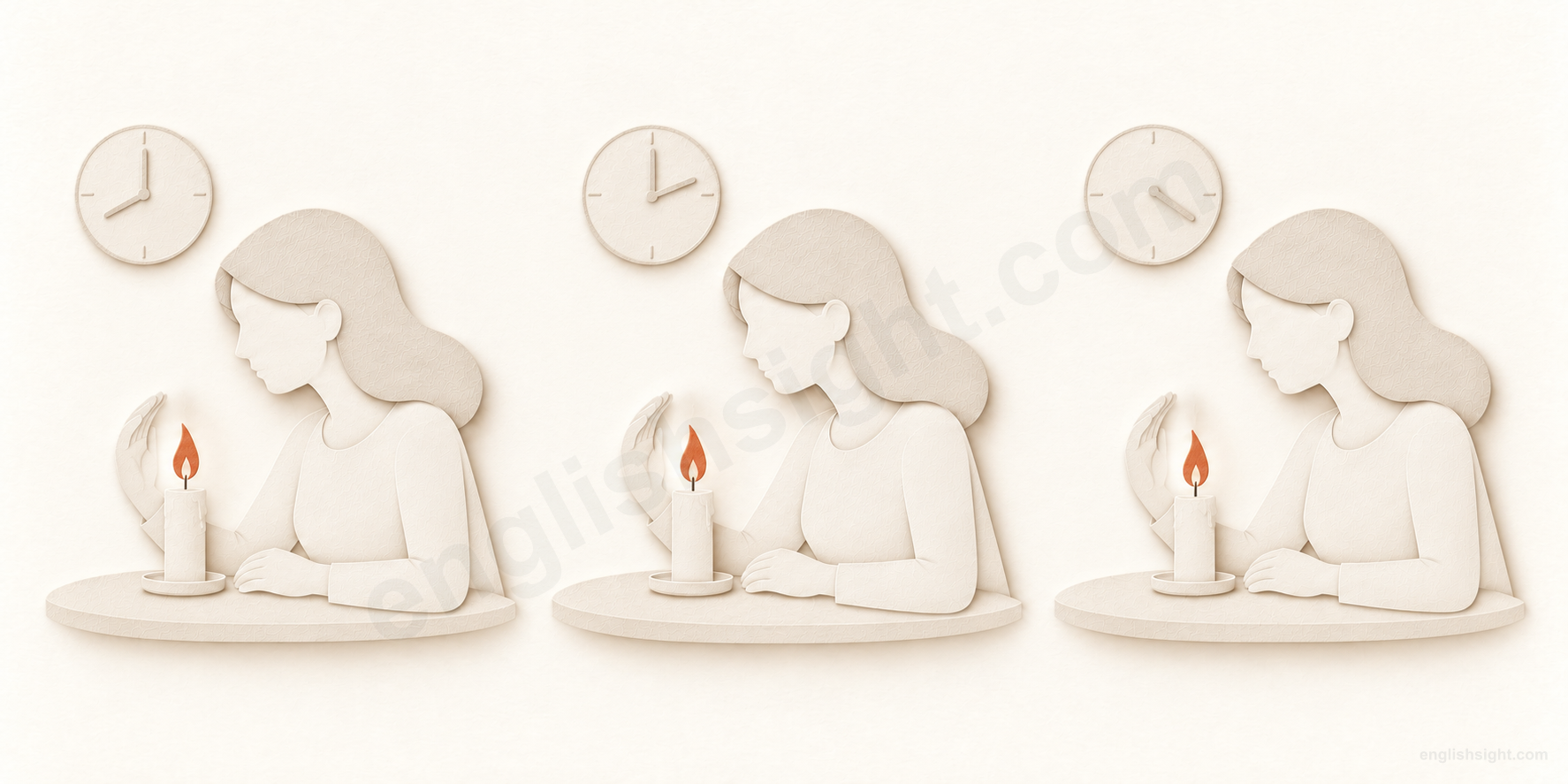
The candle is already burning.
keep
Later, the same candle is still burning.
The woman shelters its flame as time passes.
Keep the candle burning: maintain the burning state over time.
Having it, still having it. Being warm, staying warm. Working, continuing to work. Keep often directs attention to what persists.
Continuity connects many uses, but nouns, complements, and established expressions choose the precise meaning. Keeping a promise requires action, and keep as a castle noun is a separate use.
Keep often points to continuity: an object stays with you, a state stays true, or an activity continues. Ask what is being maintained and whether it belongs to the subject or an object.
The diagram is a memory aid, not a claim that all native speakers see one picture. Fluent speakers recognize familiar sentence patterns; a single model cannot predict every combination.
01
Possession, storage, and continuing states
Keep often asks you to maintain what is already true: having something, being in a condition, or leaving an object in its usual place. Compare the subject with any object that follows.
01
keep + noun phrase
keep the receipt
retain something instead of returning or discarding it
Starting situation
The receipt is already in your possession.
What is maintained?
You still have it for later use.
retain something instead of returning or discarding it
The object names what stays with you. Keep the receipt is about retaining it; get the receipt describes obtaining it, and have the receipt describes possession without highlighting retention.
You can keep a job, keep a copy, or keep the change. These objects differ, but the shared idea is continued possession or access. Keep the change tells the receiver not to return the remaining money.
In a sentence
Keep the receipt in case the headphones stop working.
Watch the difference Retention need not mean legal ownership. You can keep a borrowed book for another week with permission.
02
keep + object + place phrase
keep the keys in a drawer
store something in a usual or chosen place
Starting situation
The keys need a regular storage place.
What is maintained?
The drawer is where they are stored.
store something in a usual or chosen place
Here the place phrase matters: keep the keys in a drawer describes their storage arrangement, not just owning the keys. The present tense commonly describes a habit.
Put the keys in a drawer describes placing them there on one occasion. Keep them there asks that the arrangement continue. The passive is ordinary: The keys are kept downstairs.
In a sentence
We keep the spare keys in the kitchen drawer.
Watch the difference In is a preposition with its own object, the drawer. This is not an idiomatic phrasal verb keep in meaning detain.
03
keep + thing + for + person; keep + person + thing
keep a seat for me
reserve something for a person
Starting situation
A seat is available.
What is maintained?
It remains available for the intended person.
reserve something for a person
A for-phrase identifies the beneficiary: keep a seat for me asks someone not to let another person use it. This reservation use is especially familiar in British English.
The alternative keep me a seat places the person before the thing. It does not mean keep me sitting; me is the person benefiting from the reserved seat, not the object being maintained in a position.
In a sentence
Could you keep a seat for me near the front?
Watch the difference Keep a seat for me reserves it. Keep me in my seat would describe preventing me from leaving it.
04
keep + adjective
keep calm / warm / quiet
remain in a condition
Starting situation
You are already calm, warm, or quiet.
What is maintained?
The condition continues.
remain in a condition
With an adjective and no intervening object, the subject stays in the named state. Keep calm addresses your own calmness. The model is continuity, whereas get calm or become calm concerns a change.
Keep warm can involve an effort to remain warm, but the verb does not specify the method. A coat, movement, or heating might help. Use the adjective, not an adverb: keep quiet, not keep quietly, for this meaning.
Two noun expressions also concern self-control: She kept her head during the emergency means she stayed calm; I could not keep a straight face means I could not look serious because I wanted to laugh. These are established expressions, not literal instructions about a head or face.
In a sentence
Keep warm while you wait outside.
Watch the difference Keep is not freely interchangeable with be before every adjective. Learn familiar combinations such as keep busy, keep safe, and keep fit.
05
keep + object + adjective / position phrase
keep the door open
cause a person or thing to remain in a state
Starting situation
The door is open.
What is maintained?
Someone ensures that it stays open.
cause a person or thing to remain in a state
The object is the entity whose state is maintained. In keep the door open, the door is open; in keep the children quiet, the children are quiet. The subject may actively maintain that state.
Compare open the door, which changes its position, with keep it open, which maintains it. This construction also permits a place or position: keep your coat on; keep the bag under your seat.
In a sentence
Please keep the door open while we carry the boxes in.
Watch the difference Do not insert to be in the basic pattern: keep it open. The passive is natural: The door was kept open.
06
food + keep (+ well / for a period); be keeping + well
the soup will keep / keeping well
remain usable, or be in a state of health
Starting situation
Food is fresh, or someone has a health condition.
What is maintained?
The condition is assessed over time.
remain usable, or be in a state of health
Food keeps when it remains suitable to eat. The subject is the food: This bread keeps well. Keep the bread fresh instead has someone maintaining the bread’s condition.
How are you keeping? is an informal health question, particularly familiar in British and Irish English. Keeping well means being in good health. These are different constructions, even though both concern a continuing condition.
An informal extension allows postponement: Your news will keep until after lunch means the news can wait to be told. Nothing about food is implied; this conventional use treats the matter as still available to deal with later.
In a sentence
The soup will keep in the fridge until tomorrow.
Watch the difference A usage example is not a food-safety guarantee. Actual storage time depends on the food and conditions. How are you? is the more general greeting.
02
Activities and responsibilities over time
An -ing complement names an activity that continues or recurs. With other nouns, a familiar combination can mean fulfilling a responsibility, recording information, or providing care.
07
keep (on) + -ing
keep doing / keep on doing
continue an activity or repeat it
Starting situation
An activity has begun or has happened before.
What is maintained?
It continues or happens again.
continue an activity or repeat it
Keep walking describes continuing the walk. Keep forgetting describes repeated lapses rather than one uninterrupted act of forgetting. The activity and context decide which reading fits.
Keep on trying gives a similar continuation meaning, often emphasizing persistence. The following verb uses -ing. In this continuation use, ordinary keep is not normally itself progressive: She keeps asking, rather than She is keeping asking.
In a sentence
I keep forgetting where I put my glasses.
Watch the difference Keep doing continues or repeats an activity. Keep to do is not the equivalent pattern. Other keep senses can be progressive: I’m keeping the receipt.
08
keep + object + -ing; keep + person
keep someone waiting
make a person or thing continue an activity
Starting situation
A person is waiting or a machine is running.
What is maintained?
That activity continues because of a cause.
make a person or thing continue an activity
In keep someone waiting, the person after keep is the one who waits. In keep the engine running, the engine runs. This is different from keep waiting, where the subject itself waits.
The cause can be intentional or accidental. A delay can keep customers waiting without anyone wanting that result. Keep someone can also mean delay them: I won’t keep you long.
In a sentence
The delayed train kept us waiting for an hour.
Watch the difference Keep us waiting maintains our wait. Make us wait causes or requires us to wait and does not use the same complement form.
09
keep + promise / word / appointment
keep a promise / keep an appointment
do what was promised or agreed
Starting situation
You have made a commitment.
What is maintained?
You act in accordance with it.
do what was promised or agreed
A promise is not a physical object stored somewhere. Keep a promise means carry it out. Keep your word is another familiar way to express honoring what you said.
Keep an appointment means attend as arranged. The connection with continuity is maintaining a commitment through action, but the noun supplies the particular obligation. Break a promise names the opposite outcome.
In a sentence
I promised to call on Sunday, and I kept my word.
Watch the difference Make a promise creates the commitment. Keep the promise fulfills it; saying it again is not enough.
10
keep a diary; keep a record / account of + noun
keep a diary / a record
maintain written information over time
Starting situation
Events or expenses need recording.
What is maintained?
A record is maintained for reference.
maintain written information over time
Keep a diary means write entries over time, not merely store an unused notebook. Keep a record of expenses means maintain information about those expenses.
The object changes how we understand keep: keep the old diary can mean retain the book, while keep a diary during the trip means write in it. The surrounding words distinguish storage from the recording activity.
In a sentence
I keep a record of every repair to the car.
Watch the difference Of introduces what the record concerns. Keep records is broader than simply remembering something mentally.
Keep chickens means have and care for them, including their continuing needs. Keep yourself or a family can mean earn or provide enough for living expenses.
These care and support uses are established extensions, not permission to say keep a person for every kind of relationship. Keep a shop, especially in British usage, means manage it; run a shop is a more broadly familiar alternative.
In a sentence
They keep a few chickens behind the house.
Watch the difference Have a pet simply describes possession. Keep a pet can include its continuing care. Support a family is often clearer about money.
12
keep at + task / it; keep + person + at + task; keep (someone) going
keep at it / keep going
persist with work, continue through difficulty, or sustain someone
Starting situation
A task is difficult or energy is running low.
What is maintained?
Work or normal activity can continue.
persist with work, continue through difficulty, or sustain someone
Keep at it asks someone to continue working on a task. At introduces the task: keep at the exercise. Adding a person changes who works: The coach kept us at it means the coach made us continue.
Keep going encourages continuation, including coping with hardship. A snack will keep me going until dinner means it will sustain me until then; the snack is not making me travel. These extensions depend on the whole construction.
In a sentence
The exercise is difficult, but keep at it for another five minutes.
Watch the difference Keep at it has it after at. Keep it up has it before up; the two expressions use different patterns.
13
keep + employee + on; keep + rented property + on; keep on at + person + about + topic
keep staff on / keep on at someone
continue employing or renting; repeatedly nag a person
Starting situation
A job or rental could end, or a reminder could be repeated.
What is maintained?
The arrangement continues, or the person is repeatedly bothered.
continue employing or renting; repeatedly nag a person
Keep an employee on means continue employing them: keep her on. Keep a rented flat on means continue renting it. Compare keep your coat on, an ordinary state construction about wearing it, not employment.
Keep on at someone about something, especially British English, means repeatedly and annoyingly remind or criticize them: Please stop keeping on at me about my room. It is different from keep on cleaning, which continues the cleaning itself.
In a sentence
The café kept two temporary workers on after the summer.
Watch the difference The employee pattern separates: keep her on, not keep on her. The nagging pattern retains at before the person.
14
clock + keep (good) time; person + keep time (with + music)
keep time / keep good time
measure time accurately or follow a musical beat
Starting situation
A clock measures time, or musicians follow a rhythm.
What is maintained?
The clock stays accurate, or the players stay on the beat.
measure time accurately or follow a musical beat
A watch keeps good time when it remains accurate: My old watch still keeps good time. This is not about reserving free time or storing minutes. Good evaluates its accuracy.
With a musician, keep time means maintain the beat: Tap your foot to keep time with the music. The subject and context distinguish the clock and music readings; learn them as established combinations.
In a sentence
My old watch still keeps good time.
Watch the difference Keep track of time is being aware of passing time; keep time can concern a clock’s accuracy or musical rhythm.
03
Distances, limits, and things prevented
Small words specify a relation that is maintained: away from danger, out of a room, within a plan, or below a limit. Some combinations also have conventional abstract meanings.
15
keep + person / thing + from + -ing; keep from + -ing
keep someone from doing
prevent an action or stop yourself doing it
Starting situation
An action could occur.
What is maintained?
A cause prevents it from occurring.
prevent an action or stop yourself doing it
The object identifies the person prevented, and from introduces the blocked activity: keep the dog from escaping. Without that object, keep from laughing means restrain your own laughter.
The memory connection is maintaining a boundary against an event. It does not mean continuing that event. Compare keep talking with keep someone from talking: the second prevents speech.
In a sentence
The heavy rain kept us from leaving.
Watch the difference From is followed by a noun or -ing form, not an ordinary to-infinitive. Avoid keep us to leave for this meaning.
16
keep away from / out of / off / back from; keep + object + out
keep away / out / off / back
maintain a distance or an excluded position
Starting situation
A place, object, or danger sets a boundary.
What is maintained?
Someone remains away from or outside it.
maintain a distance or an excluded position
Away from names separation, out of names exclusion from an area or activity, off can prohibit contact, and back asks for distance from a reference point: keep away from the fire; keep out of the kitchen; keep off the grass; keep back from the edge.
Adding an object changes who is controlled: keep the dog out. These fairly transparent spatial uses still require their usual prepositions. Keep off sweets and keep off politics extend avoidance to consumption or a topic, not physical height.
Keep out of trouble means avoid becoming involved in problems. Two other combinations need their own contexts: Keep down! asks you to stay low so you are not seen; I hope the rain keeps off means you hope it does not start raining. Neither is explained simply by physical separation.
In a sentence
Please keep the dog out of the kitchen.
Watch the difference Keep out! can stand alone on a sign. Keep out of names what is excluded. Out does not universally mean leaving; here the outside position is maintained.
17
keep to + path / plan / agreement / point
keep to a path / plan / point
stay within a route, agreement, or topic
Starting situation
A route or limit has been established.
What is maintained?
You stay within it rather than depart from it.
stay within a route, agreement, or topic
Keep to the path means do not leave it. Keep to the plan means follow the agreed arrangement. Keep to the point asks someone to avoid irrelevant material when speaking or writing.
The shared teaching image is staying within a chosen line or limit. To is a preposition with a noun phrase after it; this is not the to that introduces an infinitive in want to leave.
With a place, the expression can mean remain there rather than go out: She mostly keeps to her room means she spends most of her time there. It does not mean she is walking towards the room.
In a sentence
We need to keep to the plan if we want to finish today.
Watch the difference Keep to a plan means follow it. Keep planning means continue making plans; the grammar and activity are different.
18
keep + thing + up; keep up + noun; keep + person + up
keep up the good work
maintain a level, effort, or practice
Starting situation
Work, contact, or a standard is already being maintained.
What is maintained?
It continues without dropping away.
maintain a level, effort, or practice
Keep up the good work encourages someone to maintain the quality of their work. Keep up payments means continue paying as required; keep up your Spanish means continue practicing it.
Keep something up is separable: keep the work up, keep it up. A different object changes the reading: keep someone up means prevent them from going to bed. Rain can also keep up, meaning continue.
Up also appears with levels and maintenance: Strong demand keeps prices up means prices stay high; The music kept our spirits up means it helped us stay cheerful; They keep the garden up means they maintain it in good condition. These are separate object-based readings, not just encouragement to work.
In a sentence
You’ve made a strong start, so keep it up.
Watch the difference With a pronoun object, use keep it up, not keep up it. Keeping someone up concerns their bedtime, not necessarily their mood.
19
keep up with + person / developments / work
keep up with someone / the news
match a pace or remain informed
Starting situation
Someone or something is progressing or changing.
What is maintained?
You avoid falling behind.
match a pace or remain informed
Walking with a faster friend gives a clear physical reading: you match their pace. Keeping up with changes at work means remaining sufficiently informed as things change.
With identifies the person or stream of information being followed. You cannot remove it and retain an object in the same pattern: keep up with her. Keep her up instead means prevent her from going to bed.
Do not assume a person always signals walking speed. I keep up with two old classmates can mean I stay in contact with them. We keep up with the payments means we make the regular payments on time. These contact and regular-obligation meanings are established uses of the whole expression.
In a sentence
I read the weekly summary to keep up with changes at work.
Watch the difference The complete expression is not separable around with: keep up with it, not keep it up with. Keep it up belongs to a different pattern.
20
keep + costs / noise / voice + down
keep costs / noise down
prevent a level from becoming too high
Starting situation
Costs or sound could increase.
What is maintained?
They remain at a limited level.
prevent a level from becoming too high
Down contributes a low-level reading in this conventional combination. Keep costs down means control them; keep your voice down asks someone to speak quietly.
The phrase is separable: keep the noise down or keep down the noise; with a pronoun, keep it down. Keep somebody down can instead describe suppression or restriction of a person or group.
In a sentence
We share the office to keep costs down.
Watch the difference This does not require a downward movement in space. Costs are amounts, and noise is a level of sound.
21
keep + food / drink / it + down
keep food down
retain food in the stomach without vomiting
Starting situation
Someone has swallowed food or drink.
What is maintained?
It does not come back up.
retain food in the stomach without vomiting
With food, keep it down has a distinct established health meaning: the person is able to avoid vomiting after swallowing it. Keeping the volume of the food low is not the intended interpretation.
The object and situation distinguish it from keep the noise down. Both share the wording keep down, but learners need separate example situations rather than one translation for every object.
In a sentence
After feeling sick all morning, she could finally keep some water down.
Watch the difference This expression describes an observed ability, not a diagnosis or advice about treatment.
22
keep + object + back; keep + information + back from + person
keep something back
withhold information, reserve an amount, or restrain a feeling
Starting situation
Information, money, or a feeling could be released.
What is maintained?
Part of it remains withheld.
withhold information, reserve an amount, or restrain a feeling
With information, keep something back means not disclose it. With money, it can mean reserve part rather than give or spend everything. With tears, it means restrain their expression.
Back helps the teaching image of something not being released, but context supplies the exact action. Compare keep back from the edge, where back describes physical distance rather than withheld information.
In a sentence
She kept a little money back for the journey home.
Watch the difference With a pronoun, say keep it back. Keep something back from someone may concern concealment, not physically placing it behind them.
23
keep + person + in; keep + emotion + in; keep + person + in + supplies
keep someone in
make someone stay inside; restrain emotion; supply necessities
Starting situation
A person might leave, a feeling might show, or supplies may run out.
What is maintained?
The person stays, the feeling is contained, or supplies continue.
make someone stay inside; restrain emotion; supply necessities
Keep someone in makes them stay indoors or in a place, including a hospital. The hospital kept him in overnight describes staying for observation; a teacher can also keep a pupil in as a punishment. This does not mean entering the place.
Different objects yield other readings: She kept her anger in means she did not express it. The job keeps us in groceries means it provides a regular supply of groceries. The last pattern has a person plus in plus the supplied things.
In a sentence
The hospital kept him in overnight for observation.
Watch the difference Distinguish keep him in from keep in touch with him, a separate contact expression. With a pronoun in the first pattern, say keep him in.
04
People, information, and familiar expressions
Established combinations describe maintaining contact, company, awareness, or privacy. Learn each whole expression rather than assigning one permanent meaning to every small word.
24
keep a secret; keep + information + from + person; keep + it + to yourself
keep a secret / keep it to yourself
avoid disclosing information
Starting situation
You know information that others do not know.
What is maintained?
You do not share it.
avoid disclosing information
Keep a secret concerns confidentiality. Keep something from someone emphasizes that a particular person is not told; keep it to yourself asks the listener not to pass the information on.
The information remains within a restricted relationship, which fits the boundary memory model. However, keep yourself to yourself has a different object and normally describes avoiding much social contact.
In a sentence
This is a surprise, so please keep it to yourself.
Watch the difference Keep it to yourself hides the information. Keep to yourself describes a person’s social behavior, not necessarily a secret.
25
keep in touch (with + person)
keep in touch
continue communicating after separation
Starting situation
People have an existing connection.
What is maintained?
They continue exchanging messages or meeting.
continue communicating after separation
Keep in touch asks that communication continue, especially after people move apart. With names the other person: keep in touch with your old classmates.
The expression does not require literal touching. Get in touch usually concerns initiating contact; keep in touch concerns maintaining it. Learn in touch as an established state phrase rather than a physical instruction.
In a sentence
We still keep in touch even though we live in different cities.
Watch the difference Contact can be maintained at different intervals. The phrase does not promise constant messaging or specify the communication channel.
26
keep track of + noun / question clause
keep track of something
maintain awareness of changing information
Starting situation
There are details, changes, or items to follow.
What is maintained?
Your information stays sufficiently current.
maintain awareness of changing information
Keep track of expenses means follow and record them so that you know the current situation. Keep track of time means remain aware of how much time is passing.
Track is part of the established expression, not necessarily a physical trail. Unlike merely remembering an old fact, keeping track often involves updates as the situation changes.
For supplying updates to another person, use keep someone posted: I’ll keep you posted about the repairs means I will tell you how the repairs are progressing. Here posted is a past-participle form describing an informed state, not a request to mail the person somewhere.
In a sentence
I use a notebook to keep track of what I spend.
Watch the difference Keep a record emphasizes recorded information. Keep track emphasizes continuing awareness; recording can be one way to achieve it.
27
keep + person + company
keep someone company
spend time with someone so they are not alone
Starting situation
A person would otherwise be alone.
What is maintained?
Someone stays or spends time with them.
spend time with someone so they are not alone
The person after keep is the one receiving companionship. Company here means being together, not a business. The expression can describe a short visit rather than an enduring relationship.
The link with maintenance is sustaining someone’s company for a period, but the whole combination determines the social meaning. Keep a company is not the corresponding way to say manage a business.
In a sentence
I’ll stay and keep you company until the bus arrives.
Watch the difference There is no article before company in this expression. A company usually means a business and changes the meaning.
28
keep + noun / it + in mind; keep in mind + that-clause
keep something in mind
remember or consider a relevant fact
Starting situation
A fact matters to a decision or later action.
What is maintained?
You continue taking that fact into account.
remember or consider a relevant fact
Keep the deadline in mind asks someone to remember it while planning. In mind is an established mental-state phrase, not a physical storage location. The teaching connection is keeping the information relevant.
A noun can stand before in mind: keep it in mind. A full statement normally follows keep in mind that: Keep in mind that the last bus leaves at ten. The clause supplies the fact to consider.
In a sentence
Keep in mind that the last bus leaves at ten.
Watch the difference Keep in mind does not mean learn a fact for the first time. It asks you to remember or take account of it.
29
keep an eye on + person / thing; keep an eye out for + person / thing
keep an eye on / keep an eye out for
watch or look after something; stay alert for something
Starting situation
Something needs supervision, or you are looking for a possible sight.
What is maintained?
It is watched, or you remain ready to notice it.
watch or look after something; stay alert for something
Keep an eye on my bag asks someone to watch or look after it. Keep a close eye on sales means monitor them carefully. Neither requires using only one eye; the whole expression describes continuing attention.
Keep an eye out for a blue sign asks you to stay alert so you notice it if it appears. On marks an existing target of supervision; out for marks what you are looking for. Compare the different prepositions as part of each expression.
In a sentence
Could you keep an eye on my bag while I buy a ticket?
Watch the difference Keep an eye on a child is supervision. Keep an eye out for a child means look for or be ready to notice one, not necessarily look after one already beside you.
30
keep the peace (between + people)
keep the peace
prevent quarrels and maintain peaceful relations
Starting situation
People may quarrel or start fighting.
What is maintained?
Their relations remain peaceful.
prevent quarrels and maintain peaceful relations
Keep the peace can describe preventing arguments in everyday relationships: I changed the subject to keep the peace between my brothers. The continuing state is peaceful relations, not simply a low sound level.
It can also describe maintaining public order, for example by the police. Learn the with peace in this expression. This lesson covers the ordinary social meaning; formal legal requirements to keep the peace are outside its scope.
In a sentence
I changed the subject to keep the peace between my brothers.
Watch the difference Keep quiet concerns silence. Someone can keep quiet to keep the peace, but people can also disagree politely without being silent.
05
Forms and separate noun uses
Keep becomes kept in the simple past and past participle. A few familiar noun uses belong to the same spelling but need their own explanation.
31
keep / keeps / keeping / kept; a keep; earn your keep
keep → kept → kept; keeping
recognize the verb’s irregular forms
Starting situation
A sentence requires the correct time or participle form.
What is maintained?
Keep changes form to fit the grammar.
recognize the verb’s irregular forms
The simple past and past participle are both kept: I kept the note; I have kept it. The -ing form is keeping, and the third-person singular is keeps.
The noun keep can mean the main fortified tower of a castle. In earn your keep, keep refers to the cost of being supported. These noun uses are not extra ways to conjugate the verb.
For keeps is a separate informal phrase meaning permanently: You can have this book for keeps means you do not need to return it. The -s belongs to the fixed expression; it is not the third-person verb keeps in She keeps the book.
In a sentence
I have kept every letter she sent me.
Watch the difference Do not use keeped. The castle noun is countable: a keep or the keep. In earn your keep, keep refers to living costs, not a building.
The object and pattern decide the use
Persistence is a teaching link, not a universal definition
Keep a receipt, keep calm, keep waiting, and keep a promise describe different tasks. Continuity connects them, but does not replace their grammar or the meaning supplied by the object.
Compare whole constructions
Keep talking continues speech; keep someone from talking prevents it. Keep her up prevents sleep; keep up with her matches her progress. Changing the complement changes the relationship.
Scope of this lesson
This is an editorial selection of common modern verb uses, constructions, and expressions, with a short form and noun note. It is not a frequency ranking, an official Ogden lesson, or every specialist, regional, or historical use.
What is being maintained?
Choose the sentence that fits the situation, then compare the explanations.
1. You have already started walking and want to continue. Which instruction fits?
2. Your friend walks faster than you, and you cannot match her speed. Which sentence fits?
3. The door is already open. You want it to remain open while you move a table. Which request fits?
Sources and teaching notes
Definitions and usage were checked against the sources below. Explanations, example sentences, and the diagram were written for this lesson; the visual connection is a teaching interpretation.
This diagram helps explain a connection; it is not a picture shared by every native speaker.