Recognize the kettle, follow the heating process, and learn the expressions as whole phrases.
From water in a vessel to hot water ready to pour
Hold water, heat it, pour it
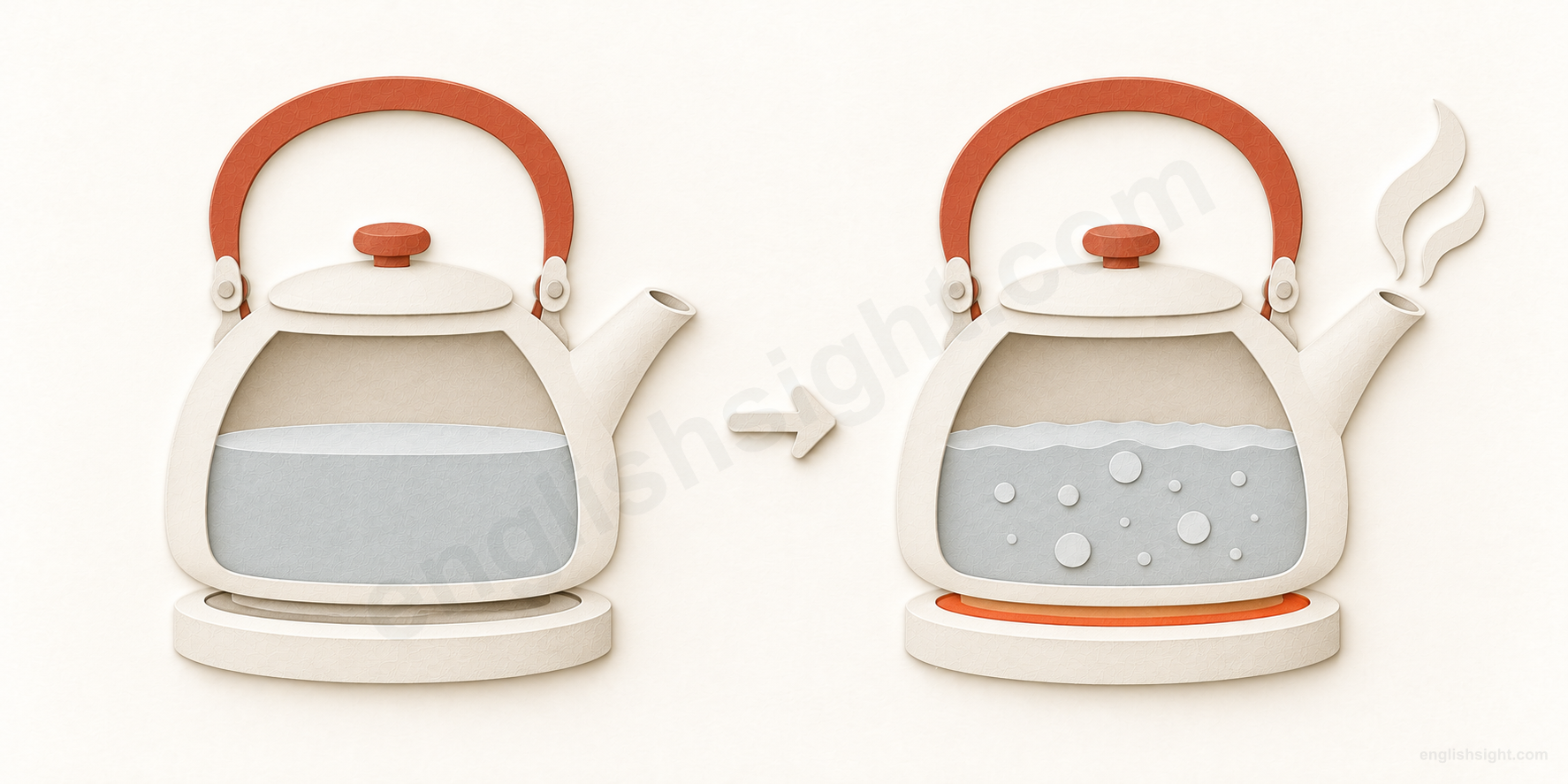
Still water inside the kettle.
kettle
Boiling water ready to pour.
Heating brings the water to boiling point.
The water heats; the vessel stays a kettle, even when cold.
A household kettle is a vessel designed to heat water to boiling point, with a handle and spout for pouring.
The same vessel appears before and after heating. It is still a kettle when cold; boiling is its purpose, not a condition it must always be in.
Start with a familiar purpose: a kettle holds water so it can be heated to boiling point and poured out. The word can name the vessel, and some expressions use the vessel to refer to its contents.
The sketch shows that everyday purpose. Idioms and the modern crowd-control verb need their own explanations; the picture cannot predict them. It is a teaching aid, not a claim about a picture shared by all English speakers.
01
Recognize the vessel
Start with the water-heating vessel, its main types, and the broader cooking-pot meaning.
01
a / the + kettle; plural kettles
a kettle
a vessel used for heating water to boiling point
Situation / starting point
You need hot water for a drink.
Meaning / result
You choose the vessel designed to heat the water.
The defining purpose is heating water, not brewing tea.
A household kettle normally has a lid, a handle, and a spout. The handle lets you hold it and the spout directs the water as you pour. Kettle names the object even when it is empty or cold.
A teapot is for brewing and serving tea. You can heat water in a kettle and then pour it into a teapot. Teakettle is an American name for the water-boiling vessel; despite tea in its name, it is not the same thing as a teapot.
Kettle is countable: a kettle, the kettle, two kettles. Use a determiner with an ordinary singular reference: Where is the kettle? The plural ending adds a /z/ sound.
In a sentence
We need a new kettle for the kitchen.
Watch the difference Do not assume that every container with a spout is a kettle; its purpose matters.
02
electric / stovetop / whistling + kettle
an electric kettle
specify how a kettle is heated
Situation / starting point
You compare two ways to heat water.
Meaning / result
You choose an electrically powered kettle.
Electric describes the source of power; kettle names the vessel.
An electric kettle heats water using electricity. A stovetop kettle is heated on a stove; whistling kettle describes a type that makes a whistling sound as steam escapes. These modifiers describe equipment, not new abstract senses of kettle.
Kettle and teakettle are both used in American English. The regional labels in dictionaries help you recognize alternatives; they do not mean an American speaker cannot use kettle. Electric kettle is a useful explicit name when the type matters.
In a sentence
Our electric kettle switches off when the water boils.
Watch the difference Do not replace kettle with teapot just because the hot water will be used for tea.
03
a kettle of + food; cook something in a kettle
a kettle of soup
a pot used for cooking or heating liquids and food
Situation / starting point
Soup needs to cook in a large vessel.
Meaning / result
A cooking pot holds the soup over heat.
The broader cooking-vessel sense need not have a pouring spout.
Kettle can also name a metal cooking pot, especially in American usage. A large kettle of soup is therefore possible without suggesting that soup was put in an electric water kettle.
Pot is often the clearer everyday word for a general cooking vessel. The context and any modifier identify the equipment: a fish kettle is cooking equipment, whereas a different kettle of fish is a figurative expression.
In a sentence
They cooked the soup in a large iron kettle.
Watch the difference Do not treat this broader dictionary sense as an instruction to cook soup in an electric water kettle.
02
Make hot water
The surrounding verbs distinguish filling, starting the heat, reaching boiling point, and measuring the contents.
04
fill + the kettle + with water; water in / from the kettle
fill the kettle with water
put water into the vessel before heating
Situation / starting point
The kettle needs water.
Meaning / result
Water is inside it, ready to be heated.
With introduces the contents; the kettle is the container.
Fill the kettle with water follows the ordinary pattern fill a container with its contents. Fill here does not require filling it to the very top; the appropriate amount depends on the vessel.
Compare water in the kettle, which locates the water, with water from the kettle, which identifies its source when pouring. Empty the kettle means remove its contents; it does not mean remove the kettle itself.
In a sentence
Please fill the kettle with enough water for two cups.
Watch the difference Use fill the kettle with water, not fill water with the kettle.
05
put the kettle on; put it on; switch the kettle on / off
put the kettle on
start heating water in a kettle
Situation / starting point
Someone would like a hot drink.
Meaning / result
You start heating the water.
On signals starting the heating, not putting on clothing.
Put the kettle on is a familiar household request or offer, particularly in British English. For a stovetop kettle it can involve putting it on the heat; for an electric kettle it normally means switching it on.
The offer often suggests making tea or coffee next, but tea is supplied by the situation, not by the noun kettle. With a pronoun, say put it on. Switch the kettle on and switch it on explicitly describe operating an electric kettle; switch it off stops the heating.
In a sentence
You sit down, and I’ll put the kettle on.
Watch the difference Starting the kettle does not mean that the water has already boiled.
06
boil the kettle; the kettle is boiling / has boiled
boil the kettle / the kettle is boiling
heat the water, or report that it has reached boiling point
Situation / starting point
Water is being heated.
Meaning / result
The water reaches boiling point.
The vessel stands for the water inside it.
Boil the kettle means heat its water until the water boils. The kettle is boiling reports the state of the water, not a metal or plastic vessel turning into vapour. This is an ordinary container-for-contents use, especially familiar in British household talk.
Boil water in the kettle says the same basic thing more explicitly. Put the kettle on describes starting the process; the kettle has boiled says boiling point has been reached. A whistling kettle may signal this with a whistle, but not every kettle whistles.
In a sentence
I’ve boiled the kettle, so we can make coffee now.
Watch the difference The noun stays kettle: boil is the verb doing the grammatical work here.
07
a / two + kettle(s) of water; a full kettle of water
a kettle of water
the amount of water held in a kettle
Situation / starting point
You describe how much water you heated.
Meaning / result
You count one vessel’s worth of water.
Of links the container measure to its contents.
A kettle of water can mean the water contained in one kettle. We boiled two kettles of water can refer to two successive kettlefuls, not necessarily two separate appliances.
The amount is approximate unless the capacity is specified. Both a full kettle of water and a kettle full of water describe a filled vessel. In the first, full comes before kettle; in the second, full of water follows it. Neither expression gives a universal number of litres.
In a sentence
We needed two kettles of water to fill the basin.
Watch the difference In the measure pattern, use of: a kettle of water, not a kettle water.
03
Recognize whole expressions
These expressions refer to situations or criticism. Their established meanings cannot be predicted from the water-heating picture.
08
something + is + a different kettle of fish
a different kettle of fish
a substantially different matter or situation
Situation / starting point
Two related activities seem comparable.
Meaning / result
You point out that one needs a different approach.
The whole idiom contrasts situations; no fish or cooking is required.
A different kettle of fish is informal. It marks something as importantly different from the thing just discussed, often because the demands or circumstances change.
You may hear a completely different kettle of fish or another kettle of fish. The comparison need not mean that the second thing is worse: different is the key contrast. Do not try to derive this meaning by translating kettle and fish separately.
In a sentence
Cooking for two is easy; cooking for thirty is a different kettle of fish.
Watch the difference Keep of fish in the idiom; a different kettle alone normally describes a different vessel.
09
that / this + is + a fine kettle of fish
a fine kettle of fish
an awkward or troublesome situation
Situation / starting point
The plan has gone wrong.
Meaning / result
You comment on the resulting mess.
Fine is ironic here, not praise.
A fine kettle of fish expresses dismay at an awkward state of affairs. It is a colorful idiom to recognize; That’s a mess is a plainer alternative. The whole phrase carries the negative judgment.
Compare a different kettle of fish, which stresses a difference between matters. A fine kettle of fish comments on trouble and does not require a comparison. Neither phrase describes what to cook.
In a sentence
The keys are inside the locked car—this is a fine kettle of fish!
Watch the difference Do not interpret fine here as meaning that the situation is good.
10
that is + the pot calling the kettle black
the pot calling the kettle black
criticizing someone for a fault you also have
Situation / starting point
Someone repeatedly arrives late.
Meaning / result
That same person criticizes another person for lateness.
The criticism rebounds because both people share the fault.
This expression points out hypocrisy: the person making the criticism has the same fault. The full phrase supplies that meaning; kettle by itself does not mean a hypocrite.
It can be used as a response, as in That’s the pot calling the kettle black. It is a pointed criticism and can sound confrontational. Use a direct explanation of the shared fault if you need a more neutral tone.
In a sentence
Dan is always late, so his complaint about my lateness is the pot calling the kettle black.
Watch the difference The idiom requires a shared fault; it is not simply any unfair criticism.
04
A separate news use
The modern verb kettle concerns containing a crowd. Recognize it as a separate branch, rather than a kitchen instruction.
11
kettle + people; people + be kettled; kettling; a kettle (police enclosure)
police kettled the protesters
surround a crowd and keep it in an enclosed area
Situation / starting point
People are gathered in a public place.
Meaning / result
Police lines contain the group and restrict its exit.
Here kettle is a transitive verb naming a crowd-control tactic.
In news about demonstrations, police may kettle a crowd. The people are the object of the verb. The passive protesters were kettled puts those people first; kettling is also used as the name of the tactic.
The forms are kettle, kettles, kettled, kettling. Collins labels this British informal usage; Merriam-Webster also records the verb. This is a separate containment use, not an instruction to heat anything and not a phrasal verb.
The related countable noun a kettle can name the enclosed area formed by a police cordon: The crowd was held inside a kettle. Here the surrounding police lines, rather than a kitchen vessel, provide the boundary. Collins labels this noun British informal too.
In a sentence
The report says police kettled the protesters near the station.
Watch the difference Read the word’s grammatical role: kettled after police is a verb, not a plural kitchen noun.
Keep the vessel, contents, and whole phrase distinct
Kettle versus teapot
A kettle heats water; a teapot brews and serves tea. Teakettle is another name for a water-boiling kettle, especially in American usage.
Grammar comes from the surrounding words
Kettle is normally a countable noun. Put and boil are the verbs in put the kettle on and boil the kettle. Kettles can be a plural noun or a present-tense verb; the sentence shows which.
A picture has limits
Container-for-contents wording explains the kettle is boiling and a kettle of water. It does not generate the meanings of a different kettle of fish or the pot calling the kettle black. Learn those expressions together.
Scope of this lesson
The cooking-pot sense and the modern crowd-control verb and related enclosure noun are included for recognition. Specialist industrial vessels, geological hollows, the kettledrum sense and circling birds of prey are outside the everyday teaching focus. This is a useful selection, not a frequency ranking or every recorded use.
Choose the meaning in context
Use the whole phrase and the situation to choose.
1. You want to heat water before pouring it over tea leaves. Which vessel does that first job?
2. Your host says “I’ll put the kettle on.” What are they offering to do?
3. “The kettle is boiling.” What is reaching boiling point?
4. “Running a large hotel is a different kettle of fish.” What does the phrase emphasize?
5. An untidy person criticizes someone else for being untidy. Which expression fits the shared fault?
Sources and teaching notes
Dictionary meanings and constructions were checked against Collins and Merriam-Webster. The explanations, examples and schematic diagram are original teaching material; the visual model is not a dictionary definition of every use.
The diagram explains a familiar function; it is not an image shared by every native speaker.