From a matching lock to a crucial fact, a keyboard control, and a musical framework.
The right key enables access
The right key enables access
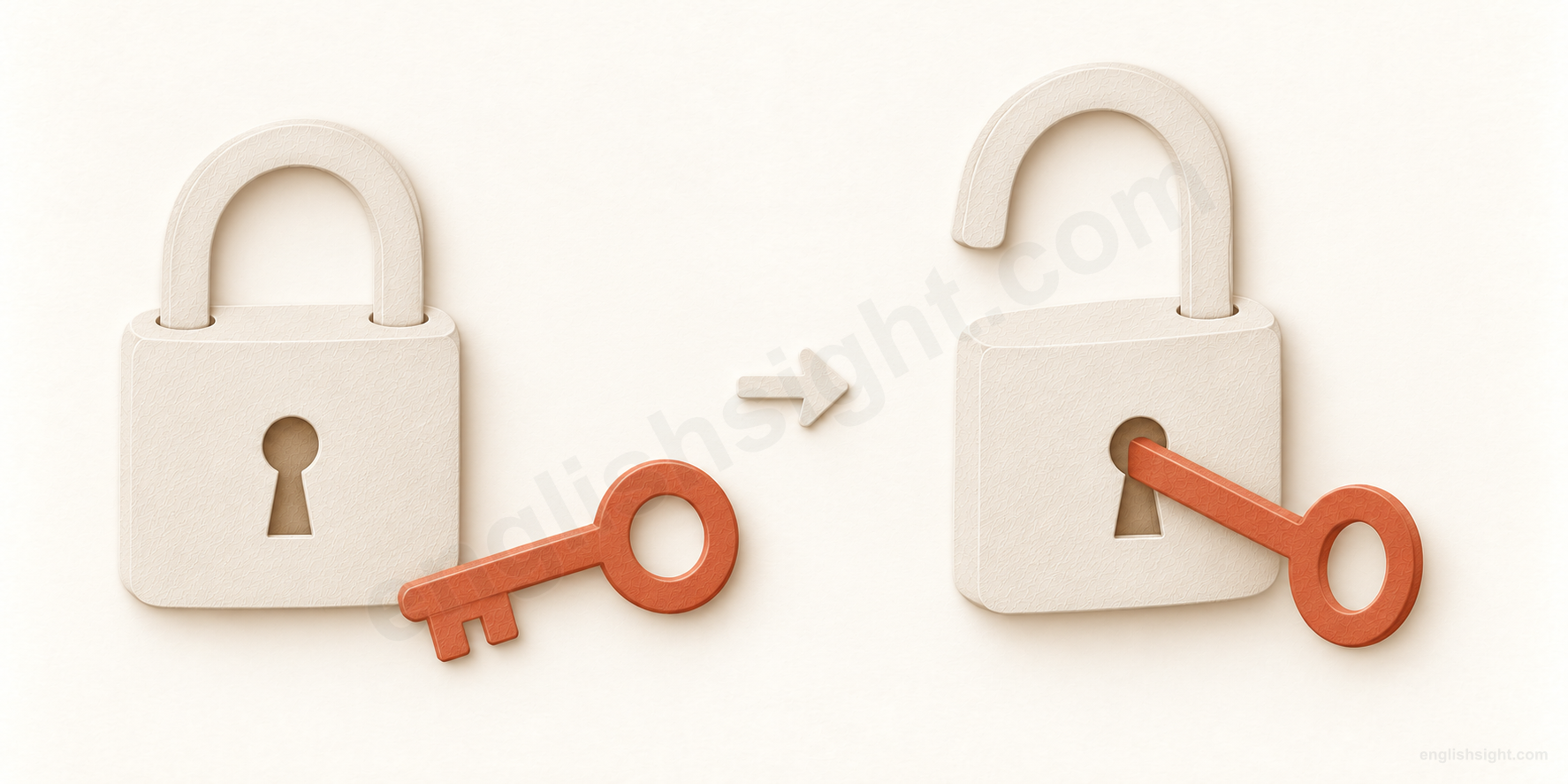
The padlock is closed, with its matching key separate.
key
The same padlock is open, with the key inserted and one end of the shackle lifted clear.
Using the matching key releases the lock.
A matching key enables a lock to open. A crucial fact or method can similarly enable understanding or progress.
A key operates a matching lock so that something closed can be opened; figuratively, a crucial method or fact can make achievement or understanding possible.
The picture highlights the key’s enabling role, using the same lock before and after it is operated. A key can also lock something. Keyboard, music, and fixed-expression branches need their own explanations.
Start with a useful relationship: a key works with a particular lock to control access. Figuratively, the key to a result or an explanation names what makes that result or understanding possible.
English also uses key for controls, reference guides, and musical organization. These are established senses to learn in context; one picture cannot generate every meaning or predict every expression.
01
Keys, locks, and access
Start with a device that operates a matching lock, then learn practical key vocabulary and the fixed expression under lock and key.
01
a key to / for + place or lock; a key for + -ing; turn a key in a lock; with a key
the key to the front door
a device that operates a matching lock
Situation / need
The door is locked, and you have the matching key.
Meaning in context
Turning that key lets you unlock the door.
The key is the device; the lock is the mechanism it operates.
Ask Where are my keys? when looking for the objects you use for your home or car. A key may unlock or lock something; an older car key can also operate the ignition. Some keys turn other mechanisms: a key for winding a clock operates its winding mechanism rather than a lock. The object is countable: a key, two keys, a set or bunch of keys.
The key to the front door and a key for the garage both identify what the key operates. Put or insert the key in the lock, then turn it. To say what instrument you use, say I opened the door with a key.
The access relationship is central to this picture: the useful object must work with that lock. Having a key does not by itself mean you have opened anything. In I locked my keys in the car, the keys are trapped inside; they were not themselves locked with another key.
In a sentence
I left the key to the front door in my other coat.
Watch the difference Normally say unlock the door or open it with a key. Key the car has a different established meaning later in this lesson.
02
a spare / master key; have / get a key cut; a key card
a spare key / a master key / a key card
different ways to provide access
Situation / need
You need a backup, broader access, or an electronic room key.
Meaning in context
You choose the kind of key that serves that purpose.
Spare describes a backup; master describes the range of locks; card describes the device.
A spare key is an extra one kept in case the usual key is lost or unavailable. Have or get a key cut means arrange for a physical key to be made: We had a second key cut for our daughter. Cut describes manufacture, not cutting a working key in half.
A master key can open several different locks in a building. A spare front-door key normally opens the same lock as the original. Being a spare does not make it a master key.
A hotel may give you a key card, also called a card key in North American English. It contains information read by an electronic reader instead of using the teeth of a traditional metal key. These forms share an access function, not one physical shape.
In a sentence
We had a spare key cut and left it with our neighbour.
Watch the difference A master key is not a universal key that opens every lock everywhere.
03
keep / put + something + under lock and key; be under lock and key
under lock and key
securely locked away, or held in prison
Situation / need
Documents must be kept securely away from unauthorized access.
Meaning in context
They are stored in a locked place.
The full expression describes secure confinement, not the physical position of an object under a key.
Keep something under lock and key means keep it in a securely locked place. The expression emphasizes restricted access; it does not specify whether there is a cupboard, drawer, or safe.
With a person, be or be kept under lock and key can mean be in prison: The suspect is now under lock and key. Context tells you whether the subject is a stored possession or a confined person. Learn the phrase as a fixed unit.
In a sentence
The original documents are kept under lock and key.
Watch the difference Keep the fixed wording: under lock and key, without a before lock or key.
02
What makes the difference
A method, fact, person, or condition can make an outcome or an explanation possible. The noun and adjective express this connection with different grammar.
04
the / a key to + noun or -ing; the key is + to-infinitive
the key to success
the crucial means or condition for achieving a result
Situation / need
You ask what makes a desired result possible.
Meaning in context
You identify a method or condition that matters decisively.
The noun key names an enabling factor; to introduces the result or activity.
In Regular practice is the key to improvement, practice is presented as the crucial way to improve. This is a figurative access relationship: a means makes a result possible, just as a matching key makes access possible. It is not a claim that success happens automatically.
The key to learning is patience uses to as a preposition, so an activity after it takes the -ing form. The key is to practise a little every day has different grammar: to practise is an infinitive saying what the method is.
The key presents the factor as central in the speaker’s account. A key to success presents one important means, allowing others. Context determines how strong the claim is; no single factor is guaranteed to be sufficient.
In a sentence
Regular practice is the key to remembering new words.
Watch the difference Say the key to remembering, not the key to remember, for this means-and-result construction. The key is to remember… is a separate pattern.
05
hold / have / find the key to + noun or -ing
hold the key to understanding
possess the crucial information or means
Situation / need
A problem remains unexplained.
Meaning in context
One person or fact may supply what is needed to explain it.
Hold the key can describe access to an explanation as well as influence over an outcome.
A message may hold the key to a mystery: something in it enables an explanation. A person who holds the key may know an essential fact or control something needed for a result. No physical key needs to exist.
Hold the key to solving the problem names the activity made possible. The old letter holds the key to the family’s move means the letter may explain why they moved. This explanatory use differs from naming the method for reaching a future goal, although both use the enabling connection.
You can also say We have found the key to the puzzle. A clue offers a lead; calling something the key gives it a more decisive role. A speaker may still be mistaken, so holds the key is an assessment, not proof.
In a sentence
This old letter may hold the key to understanding why the family moved.
Watch the difference Hold the key does not always mean know a secret. A group can hold the key to a decision because its support is decisive.
06
key + noun; play a key role in + noun or -ing
a key role / the key point
a role or detail of crucial importance
Situation / need
Several people or details contribute to an event.
Meaning in context
You identify one that matters greatly.
Key modifies a noun here; it does not name an object someone possesses.
A key role is a very important role in how something happens. The same adjective works in a key factor, a key issue, key information, and a key person. A plural noun keeps the adjective unchanged: three key points.
The enabling-factor idea helps explain the emphasis: other things depend heavily on that contribution. The phrase does not necessarily claim there is only one important role. A and the belong to the noun phrase: a key role is one crucial role; the key role identifies a particular one.
Main is a broad word for what is principal or largest in its category. Key emphasizes crucial importance to how a situation works. The main entrance is the principal entrance; a key entrance would require context in which that entrance is strategically important.
In a sentence
Mina played a key role in organizing the event.
Watch the difference Say key points, not keys points. The adjective has no plural ending.
07
be key; be key to + noun or -ing
is key to improving
is crucial for a result or activity
Situation / need
You want to explain why one condition matters.
Meaning in context
You directly describe that condition as crucial.
Key is an adjective after be; the key is a noun phrase.
Although key often appears before a noun, it can follow be: Timing is key. You can add a complement with to: Clear instructions are key to avoiding mistakes. The activity follows the preposition in the -ing form.
Clear instructions are the key to avoiding mistakes uses a noun phrase with the. Clear instructions are key to avoiding mistakes uses an adjective without the. Both are natural; the noun wording explicitly presents instructions as the crucial means.
The spelling matters in a third pattern: The instructions are keyed to beginners describes instructions adjusted to suit beginners. Keyed is the past participle of a verb, not an alternative spelling of the adjective key.
In a sentence
Clear instructions are key to avoiding mistakes.
Watch the difference Keep adjective key unchanged after a plural subject: The details are key. Do not change it to keys or keyed for this meaning.
03
Answers, symbols, and digital information
A key can provide the information needed to interpret something. In computing, it can also name data used in encryption, a separate technical application.
08
an answer key; check / look in the key
check the answer key
the supplied answers to exercises
Situation / need
You have completed a page of practice questions.
Meaning in context
You compare your work with the supplied answers.
A key is the reference that lets you check solutions.
An answer key lists the expected or correct answers for exercises or a test. In a workbook, the key can mean the same thing when the context is clear. The whole list is one key even if it contains many answers.
Look in the key or check the key to find the solutions. A key may contain short answers without detailed reasoning, so it is not necessarily a full explanation. This is a conventional reference-book use of the idea of making something understandable.
In a sentence
The answer key is on the last page of the workbook.
Watch the difference One book can have one answer key with twenty answers; twenty answers are not automatically twenty keys.
09
a map / chart / pronunciation key; the key to a diagram
read the map key
a guide explaining symbols or abbreviations
Situation / need
A map uses unfamiliar marks.
Meaning in context
Its key tells you what each mark represents.
The key links a symbol with its meaning.
A map key explains the signs, colours, or lines used on that map. A chart or diagram can have a key too. A pronunciation key similarly explains symbols used to represent sounds.
The map may show a small tent symbol, and the key may identify it as a campsite. The key does not tell you the answer to every question about the map; it tells you how to interpret its notation. Legend is another word used for a map or chart key.
In a sentence
The map key shows that a dotted line marks a walking path.
Watch the difference An answer key gives solutions; a map key explains symbols. Decide from what the reference helps you read.
10
an encryption / decryption key
an encryption key
data used to encode or decode information
Situation / need
A program processes protected digital information.
Meaning in context
The required key data is used in the cryptographic operation.
Here key names digital data, not a button or a metal object.
In computing, an encryption key is data used by a process that encrypts information; a decryption key is used to recover readable information. A digital key need not be something a person types or can remember.
The access connection can help you remember the term, but it does not explain how the technology works. A password, which a person may enter to gain access, is not simply another name for every encryption key. This lesson teaches recognition of the term, not cryptographic design.
In a sentence
Without the required decryption key, the program cannot read the encrypted file.
Watch the difference Do not confuse this key with a keyboard key: pressing a button is not what the noun means here.
04
Pressing keys and talking about music
A physical key is a control you press. A musical key is a tonal framework, not a control, a single note, or a judgment about accurate singing.
11
press / tap / hold down + a key; the Enter / Shift / arrow key
press the Enter key
one control on a keyboard or keypad
Situation / need
A device is waiting for a command.
Meaning in context
You press a particular key to give that command.
A key is one control; a keyboard contains a set of them.
Use key for a control you press on a computer keyboard or on a phone keypad. Press, hit, or tap a key describes the action; hold down a key means keep it pressed. A physical key can stick or stop working.
Name the control with Enter, Shift, or arrow: Press the Enter key. A shortcut key or key combination provides quick access to a command. The ordinary wording for one on-screen control may be button; do not replace every use of button with key.
This is a control sense. It connects with operating something, but the padlock picture does not tell you which key to press or what any device will do.
In a sentence
Hold down the Shift key while you press the right arrow key.
Watch the difference The keyboard is the whole set of controls. I broke a key and I broke my keyboard do not identify the same amount of equipment.
12
a piano / organ key; play / press the keys
the piano keys
the controls pressed to play an instrument
Situation / need
A player is at a piano.
Meaning in context
Pressing different keys produces different notes.
The key is the physical control, while the note is the musical sound.
The white and black parts pressed on a piano are keys. An organ has keys too, and some wind instruments have key mechanisms. In this physical sense, keys is an ordinary countable plural.
A broken key is a damaged part of the instrument. A wrong note is a sound that does not fit what the player meant to play. A player may produce a wrong note by pressing the wrong key; the control and the sound are still different things.
In a sentence
One of the black keys on this piano is stuck.
Watch the difference The piano has many keys, but a song in one key is about tonal organization, not the number of controls being used.
13
in + key name; in the key of + key name; change key; a lower key
in the key of C major
organized around a particular tonal centre
Situation / need
Musicians need to agree how a song is pitched and organized.
Meaning in context
They name its key and can move it to a different one.
A musical key relates notes around a central note; it is not a single physical key.
C major and A minor name musical keys. The song is in C major and The song is in the key of C major are both normal. This use concerns relationships between notes and a tonal centre, rather than a lock or a keyboard control.
Change key describes a move to a different tonal framework. Try the song in a lower key asks for the music to be moved lower, often to suit a singer’s voice. This does not simply ask the player to sing more quietly.
A scale is an ordered sequence of notes; a key describes how music is organized around a tonal centre. They are related concepts, but the words are not freely interchangeable. Advanced harmony is outside this introductory lesson.
In a sentence
Can we try the song in a lower key? The high notes are difficult for me.
Watch the difference A lower key moves the song’s pitches downward; lower volume means quieter sound.
14
sing / play off-key; an off-key voice / remark; be off-key
sing off-key / an off-key remark
out of tune, or unsuitable in tone
Situation / need
A singer’s pitch or a speaker’s tone does not fit.
Meaning in context
You describe the mismatch as off-key.
The expression can judge musical accuracy or, figuratively, social appropriateness.
Sing off-key means sing out of tune. Off-key can also describe the sound: an off-key voice. It does not mean the singer deliberately chose a different musical key for the whole song.
Figuratively, an off-key remark has a tone that is wrong for the situation. His cheerful joke seemed off-key after the bad news criticizes its appropriateness, not its factual accuracy. This musical comparison is established usage, not a meaning created by off on its own.
In a sentence
His joke sounded off-key during such a serious discussion.
Watch the difference Off-key is different from low-key: an off-key remark sounds inappropriate; a low-key event attracts little attention.
05
Input, adjustment, attention, and mood
Learn these verbs and established expressions as complete patterns. Their meanings do not follow automatically from the picture of a lock.
15
key + information; key in + noun; key + noun / pronoun + in; key + information + into + device
key in a number
enter information using keys
Situation / need
A machine needs a number or other information.
Meaning in context
You type the information using its keyboard or keypad.
The object of the verb is the information entered.
Key, key in, and key something into a device describe entering information with a keyboard or keypad. You can key in a number or key a number in. With a pronoun, say key it in, not key in it.
In key the code into the machine, into introduces the destination; keep the code before into. The passive is useful when the operator is unimportant: The details were keyed into the system. Keying keeps the y, and the past and past participle are keyed.
This verb connects directly with keyboard keys rather than with unlocking a door. Enter a number is a broader ordinary alternative; key in specifically suggests input by pressing keys.
In a sentence
The machine asked for my booking number, so I keyed it in.
Watch the difference Key it in has a pronoun object between verb and particle. Key in on it, below, has a different structure and meaning.
16
key + something + to + needs / purpose; be keyed to + needs / audience
be keyed to the audience
be adjusted to suit particular needs or conditions
Situation / need
A writer considers who will use a guide.
Meaning in context
The guide is designed to suit those readers.
The thing adjusted comes before keyed; the needs it matches follow to.
The guide is keyed to the needs of beginners means its content or difficulty is made suitable for beginners. This verb pattern is often passive and is especially associated with North American English. Geared to or tailored to is an alternative.
An active version identifies the person doing the adjusting: We keyed the presentation to the audience’s experience. This matching use is established; it does not describe typing the audience into a machine.
Compare The guide is key to the course, meaning crucial to the course, with The guide is keyed to the course, meaning adapted to fit it. The final -ed changes the grammatical construction and the meaning.
In a sentence
The examples are keyed to the needs of first-time users.
Watch the difference After to, give the audience, purpose, or conditions being matched. This is not the noun phrase the key to success.
17
key on / key in on + target
key in on a problem
focus attention or effort on a particular target
Situation / need
Several issues are being discussed.
Meaning in context
A group directs its attention to one of them.
The target follows on; it is not information being typed in.
In American English, key on or key in on can mean focus on something judged important. The team keyed in on the cost of travel means the team paid particular attention to that cost. Focus on is a straightforward alternative for general use.
In American football, key on an opponent can mean watch that player’s movements to anticipate a play. That specialized application also directs attention at a target. It does not mean enter the player’s name on a keyboard.
Compare key it in, enter that information, with key in on it, focus on that issue. In the focusing expression, it follows on. Do not move it between key and in as though this were the input verb.
In a sentence
The team keyed in on the cost of travel.
Watch the difference Keep on in the focusing pattern. Key in the cost means type the cost, not focus on it.
18
key + a car; a car is / was keyed
someone keyed my car
deliberately scratch a car with a key
Situation / need
A car’s paintwork is undamaged.
Meaning in context
Someone deliberately scratches it using a key.
The car is the thing damaged; the key is the implied instrument.
In Someone keyed my car, key is a transitive verb naming deliberate damage to the paintwork with a key. The tool gives its name to the action. This is not a general verb meaning use any key for any purpose.
My car was keyed is a natural passive when the person responsible is unknown. The ordinary word for opening the car’s lock is unlock: I unlocked the car with my key. Context and the direct object make the damage meaning clear.
In a sentence
Someone keyed my car while it was parked outside.
Watch the difference I keyed the car does not normally mean I unlocked it, started it, or made a new key for it.
19
be / feel / get keyed up; key + someone / pronoun + up
feel keyed up
feel very excited or tense
Situation / need
An important event is approaching.
Meaning in context
Someone feels too excited or nervous to relax.
The full expression describes heightened emotional tension.
Be, feel, or get keyed up describes a state of excitement or nervous tension, often before a significant event. I was too keyed up to eat could refer to eager anticipation, worry, or a mixture of both. It does not necessarily mean happiness.
An active pattern can name what creates the excitement: The loud music keyed everyone up. With a pronoun, it keyed them up has the object before up. The state expression keyed up is especially useful for everyday recognition.
Learn this as an established emotional expression. Up contributes an idea of increased intensity within the whole pattern; the lesson’s lock picture cannot predict the meaning.
In a sentence
I felt too keyed up to eat before the interview.
Watch the difference Keyed up describes a person’s tense or excited state. It does not mean important, which is the adjective key.
They choose a modest event with little publicity or fuss.
Low-key describes the manner or level of attention, not the importance of the occasion.
A low-key celebration is kept restrained rather than made into a big public event. The adjective also describes an announcement, an approach, or a response that avoids drawing much attention.
Keep the party low-key describes how you want it to be. A birthday can be deeply important to someone and still be low-key. This established compound is not the musical instruction to perform in a lower key.
For this standard adjective, low-key is the useful spelling. This lesson does not expand newer slang adverb uses of lowkey or technical lighting terms.
In a sentence
We want to keep the birthday celebration low-key this year.
Watch the difference Low-key does not mean unimportant or out of tune. Compare a key event, a lower musical key, and singing off-key.
Read the noun, adjective, or whole expression
The key, key, and keyed are different forms
The noun has singular key and plural keys. Adjective key stays unchanged: a key point, two key points, timing is key. The verb forms are key, keys, keyed, keying. Keyed into usually describes input; keyed to can describe adjustment; keyed up describes excitement or tension.
Two jobs for to
In the key to learning and is key to learning, to is a preposition followed by a noun or -ing activity. In The key is to listen carefully, to begins an infinitive naming the method. In the key to the door, the noun phrase identifies what the physical key operates.
Do not force the lock picture onto every branch
The access model connects physical keys with crucial means and explanatory information. Physical controls and musical tonality are conventional senses. Off-key, low-key, keyed up, and key in on require their complete patterns; the diagram does not prove their meanings.
Grammar follows the particular sense
The input, adjustment, and damage verbs can take objects and form passives: data was keyed in, material was keyed to users, a car was keyed. Progressive keying is possible for an action in progress. There is no general key someone to do causative pattern to learn. Have a key cut uses have plus an object and past participle; cut names the service.
Choose the right meaning and structure
Use the surrounding words to decide whether key is an object, a crucial factor, a control, or part of an expression.
1. Complete the sentence about a method: Regular practice is the key to __ new words.
2. The examples have been adapted to suit beginners. Which sentence expresses that?
3. A machine requests your booking number. Replace the number with it. Which instruction means type it?
4. The singer asks to try the song in a lower key. What is being requested?
5. You want to know what a triangle means on a hiking map. Which reference helps?
6. The team keyed in on the delivery problem. What did the team do?
7. The birthday matters deeply to Kai, but Kai wants a low-key celebration. What does low-key mean?
8. Someone says My car was keyed. Which meaning is intended in ordinary use?
Sources and teaching notes
The sources below support the meanings and constructions. Explanations and examples are original. The diagram’s connection between access and crucial means is a teaching model, not a dictionary definition of every use.
The diagram illustrates an enabling relationship; it does not claim that all English speakers share one mental picture.