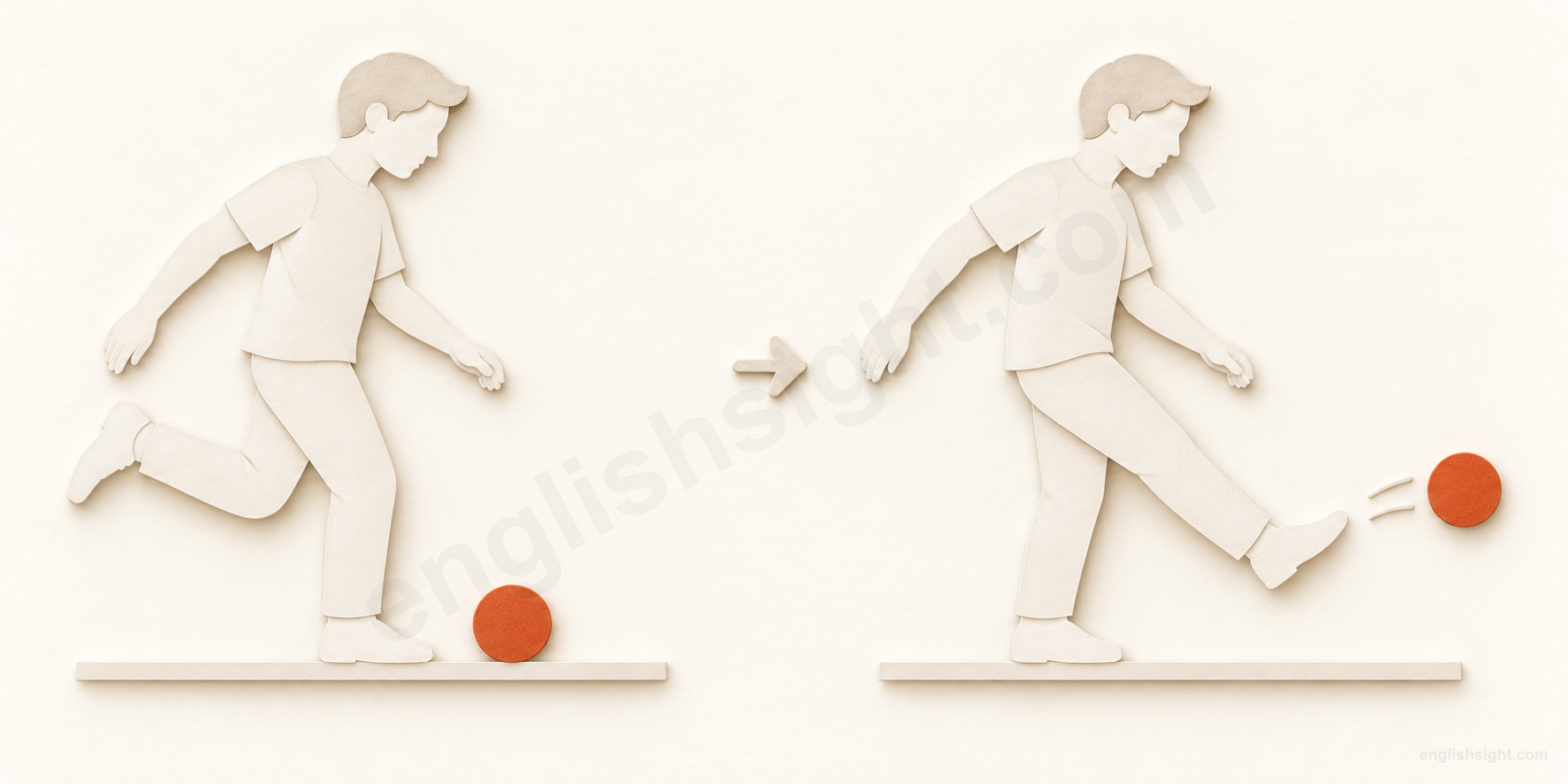
From a foot striking outward to familiar expressions for starting, rejecting, enjoying, and resisting.
A leg movement delivers force
The leg moves; the foot delivers the force
The ball rests ahead of the planted foot; the other leg is drawn back.
kick
The kicking leg is extended, and the ball moves away to the right.
The leg swings forward and the foot strikes the ball.
A quick leg movement delivers force through the foot, sending the ball away in this example.
A quick movement of the leg can bring the foot into contact with a target and give that target a push or blow.
Kick can also describe leg movement without contact. A target, direction, or result comes from the rest of the construction; starting, pleasure, and other idioms require their own explanations.
Kick most directly describes a quick, forceful movement of a foot or leg, often to hit or move something. Some constructions keep that action clear; others have established meanings you need to learn as a whole.
The diagram is a teaching model for the physical action and its effect. It is not an image shared by every English speaker, and it cannot predict idioms such as kick the bucket.
01
Feet, movement, and personal change
Start with the foot or leg action, then notice how an object or result changes the construction.
01
kick + person / thing; kick someone in / on + the + body part
kick the ball / kick someone
hit with the foot
Situation before
A ball rests near your foot.
Action, effect, or intention
Your foot strikes it.
Kick specifies the foot, whereas hit leaves the means open.
The subject makes a quick movement of the leg and hits with the foot. The object is the person or thing receiving the contact. A gentle kick is possible: kick does not always mean a violent attack.
Kick him in the shin names a person first and then the affected body area. The passive changes the viewpoint: The ball was kicked by a defender. Neither pattern needs an extra verb meaning make.
In a sentence
Nora kicked the ball gently toward the fence.
Watch the difference A punch uses a fist; a kick uses a foot. Do not use kick for every kind of hit.
02
kick at + target; kick + object + direction / result adjective
kick at / kick away / kick open
aim a kick or specify its direction and result
Situation before
A foot moves toward a target.
Action, effect, or intention
The target may be struck, moved, or opened.
At marks a target; an object plus a result describes what the kick does.
Kick at the ball describes a directed attempt and does not guarantee contact. Kick the ball normally presents contact. Kick the ball away or into the garden adds its path; the direction comes from away or into, not from kick alone.
Kick the door open uses open as the resulting state of the door. Kick it down or in can describe breaking it by kicking. These are physical result constructions, distinct from abstract kick in meaning begin to work.
In a sentence
With both hands full, she kicked the gate shut.
Watch the difference Kick at it can miss. Kick it open says that it becomes open, not merely that someone tries.
03
kick; kick + your legs / feet
kick your legs / the baby is kicking
move the legs sharply, with or without contact
Situation before
A swimmer holds the edge of the pool.
Action, effect, or intention
The legs move repeatedly in the water.
A kick can be a leg movement without an object being hit.
A swimmer kicks to move through water; a dancer kicks a leg high. A baby kicking can mean leg movement inside the womb or outside it. You do not need to supply an object after kick.
Kick your legs names the moving body parts, rather than something they strike. The progressive is natural for an action in progress: The baby is kicking. This differs from stative verbs that normally avoid the progressive.
In a sentence
Hold the board and kick your legs slowly.
Watch the difference Do not assume that every use of kick describes damage, anger, or contact.
04
kick + a goal / points; take + a free kick / penalty kick
kick a goal / take a free kick
score by kicking, or name a sporting kick
Situation before
A player has a scoring opportunity.
Action, effect, or intention
A kick may score points or restart play.
Sport determines whether kick names a scoring action or an awarded play.
Kick a goal or kick points can mean score by kicking in sports such as rugby and football. A penalty kick and a free kick are names for particular sporting actions; take a penalty or take a free kick is ordinary wording.
The exact rules differ between sports. He kicked the ball reports an action, while He kicked a goal reports a scoring result. This lesson teaches the language rather than the rules of every code.
In a sentence
Their captain kicked the winning goal.
Watch the difference Kicking the ball does not by itself mean scoring. Identify the sport before interpreting a penalty.
05
kick + the habit / an addiction
kick the habit
stop a difficult, harmful habit
Situation before
Smoking has become a lasting habit.
Action, effect, or intention
The person stops smoking.
The whole informal expression means giving up a harmful habit.
Kick the habit commonly refers to smoking or drug use. The unwanted habit is treated as something to get rid of, but this is a teaching connection, not a literal foot movement.
You can also hear kick drugs or kick an addiction. Kick is stronger and more informal than stop. It is not a general substitute for stop in phrases such as stop the bus or stop talking.
In a sentence
After several attempts, Ben finally kicked the habit.
Watch the difference Use the surrounding context to identify the habit; kick the habit does not automatically mean every habit.
06
kick yourself for + noun / -ing; could kick yourself
kick yourself for something
feel annoyed with yourself about a mistake
Situation before
You miss an inexpensive ticket.
Action, effect, or intention
You regret failing to buy it.
A reflexive pronoun turns the criticism toward the same person.
I could kick myself expresses self-directed annoyance or regret, rather than an intention to hit yourself. For introduces the reason and can be followed by a noun or an -ing form.
Choose the pronoun to match the subject: She kicked herself for forgetting. The pattern is fixed enough to learn as an expression; the diagram does not explain regret on its own.
In a sentence
I could kick myself for leaving my keys at home.
Watch the difference Say for leaving, not for leave. Kicked himself can also be literal in an unusual physical context.
02
Starting, removing shoes, and taking effect
Kick off and kick in have several established meanings. Subjects and objects tell you which one is intended.
07
event + kick off; kick off + event; kick it off; kick off with + activity
kick off / kick off a meeting
begin, or cause an event to begin
Situation before
The meeting has not started.
Action, effect, or intention
The first activity opens it.
Kick off can take the event as subject or the starter as subject.
A match or team kicks off when play begins. In informal event language, We kick off at ten means we start at ten; We kick off with introductions identifies the opening activity.
Kick off the meeting or kick the meeting off makes someone the starter. With a pronoun, use kick it off. The noun is kick-off in British spelling, often kickoff in American spelling: a project kickoff. The verb remains two words.
In a sentence
We will kick off the workshop with a short game.
Watch the difference Off does not mean finish here. Distinguish We kicked off at ten from We finished at ten.
08
kick off + shoes; kick + shoes / them + off
kick off your shoes
remove shoes by moving your feet
Situation before
Your shoes are still on your feet.
Action, effect, or intention
You loosen and push them off.
Here off means separation from the feet, not the beginning of an event.
This is a physical removal: the feet do the work, often with little care or effort. Take off your shoes is neutral and need not involve this movement.
Both kick off your shoes and kick your shoes off are possible. A pronoun goes in the middle: kick them off. The object tells you which sense of kick off is intended.
In a sentence
At the door, I kicked off my wet shoes.
Watch the difference Kick them off refers to shoes here; with people, it can mean remove them from a place or group.
09
person / trouble + kick off
someone kicks off
suddenly become angry or violent
Situation before
A customer hears that the shop is closing.
Action, effect, or intention
The customer starts shouting.
Context can make kick off an angry outburst rather than an ordinary start.
In informal British conversation, He kicked off can describe suddenly becoming angry or aggressive. It all kicked off can report that trouble erupted.
There need not be any kicking with the feet. The expression depends on an established conversational sense; for a neutral international description, say became angry or an argument started.
In a sentence
He kicked off when they refused to let him in.
Watch the difference In a sports report, the same words may simply describe the start of play.
10
mechanism / rule / effect + kick in
the heater kicks in
begin operating or taking effect
Situation before
The room cools below the set temperature.
Action, effect, or intention
The heating starts to work.
The subject is what begins to operate or produce an effect.
A mechanism, a rule, a discount, or a feeling can kick in. The important change is that it now operates or affects the situation, not that someone strikes it.
This use is informal and intransitive: The discount kicks in tomorrow. To make a device start deliberately, switch it on may be more precise; kick in can suggest an automatic threshold or a delayed effect.
In a sentence
The backup generator kicked in during the power cut.
Watch the difference Do not add a direct object in this sense: The system kicked in, not The system kicked in the lights.
11
kick in; kick in + money / help
kick in some money
contribute money or help
Situation before
Friends need to pay for a shared gift.
Action, effect, or intention
Each person adds a contribution.
Kick in can describe adding your share, especially in North American English.
We each kicked in ten dollars means each person contributed that amount. The amount can be stated, or Everyone kicked in can leave it understood.
This informal use is related to joining a shared effort, not to operating a machine. Chip in is a familiar alternative. The literal kick the door in belongs to physical force instead.
In a sentence
Everyone kicked in five dollars for the picnic.
Watch the difference The people contribute; the money does not begin operating. Read the subject and the object together.
03
Exclusion, reactions, discussion, and mistreatment
Word order and the kind of object distinguish removal, an outward strike, informal discussion, and unfair treatment.
12
kick + person + out of + place / group; kick + person + off + team
kick someone out / off the team
make a person leave a place or group
Situation before
A member repeatedly breaks the rules.
Action, effect, or intention
The group removes the member.
A figurative kick can mean forceful exclusion without physical contact.
Kick someone out of a room or club is informal and forceful. Kick someone off a team uses off because the person loses their position on it. Expel or remove may be more suitable in formal wording.
Say kick him out, not kick out him. A passive is natural: He was kicked out of the club. The expression alone does not tell you whether anyone touched him.
In a sentence
They kicked him out of the club for threatening another member.
Watch the difference Out of names exclusion from a place or group; off is usual with a team. Neither necessarily describes an actual kick.
13
kick out (at + target)
kick out at someone
strike outward or react angrily
Situation before
A frightened horse feels someone behind it.
Action, effect, or intention
It thrusts its legs toward that person.
Kick out at identifies a target of outward striking or an angry reaction.
In a literal account, kick out at means try to hit with the legs. Contact is not guaranteed. You can also use it figuratively for an angry or violent reaction against someone or something.
The preposition at keeps the target separate from the movement. Compare They kicked him out, where him is the person being expelled; He kicked out at them instead makes him the person reacting.
In a sentence
The horse kicked out at the noisy dog.
Watch the difference Kick out at someone is not the same construction as kick someone out.
14
kick around + idea; kick + idea / it + around
kick an idea around
discuss an idea informally
Situation before
A plan is still uncertain.
Action, effect, or intention
People explore it without deciding yet.
An idea is passed through discussion, not physically struck.
Kick ideas around describes exploring possibilities in an informal exchange. It does not promise a decision or approval. Around helps suggest movement between possibilities, but the meaning belongs to the whole established phrase.
Kick around an idea and kick an idea around both occur; kick it around puts a pronoun in the middle. Kick ideas about is also used, especially in British English.
In a sentence
We kicked a few names around before choosing one.
Watch the difference This is exploratory discussion, not criticism or rejection of every idea.
15
object + be kicking around / about; person + kick around + place
something is kicking around
be somewhere, unused or not carefully stored
Situation before
You need a spare cable.
Action, effect, or intention
You remember one lying in a drawer.
The object exists nearby without being put to use.
An old cable kicking around is simply lying somewhere, perhaps forgotten. The progressive is especially natural. Nothing is actually moving or being kicked.
Kick about is a British alternative. With a person as subject, kicking around a city can instead mean spending time moving about without a particular plan: We spent a day kicking around town.
In a sentence
There is a spare cable kicking around in my desk.
Watch the difference Compare We kicked the cable around: with a direct object, this could describe physically moving it with our feet.
16
kick + person + around; be kicked around
kick someone around
treat someone roughly or unfairly
Situation before
A worker is repeatedly treated badly.
Action, effect, or intention
The worker refuses to accept more mistreatment.
The person is the target of rough treatment, not an idea for discussion.
Kick someone around can describe bullying or unfair treatment without literal blows. It presents the person as lacking power over the way others treat them.
The passive being kicked around is common for the victim’s viewpoint. The object changes the interpretation: kick ideas around concerns discussion; kick a person around normally concerns mistreatment.
In a sentence
She refused to be kicked around by her new manager.
Watch the difference This does not mean casually spend time with someone. Use hang out with for that meaning.
04
Rest, jolts, rising dust, and complaints
Some combinations describe physical movement; others carry an established informal meaning.
17
kick back; kick back and + verb
kick back
relax and stop making an effort
Situation before
Your work for the day is finished.
Action, effect, or intention
You rest and enjoy some free time.
The informal whole expression invites relaxation.
Kick back is especially common in North American English. It has no object in this meaning: kick back and listen to music. It does not mean kick something behind you.
Compare kick back a ball, which can be literal return movement. The separate noun kickback refers to an illicit payment, not a period of rest; do not write a kickback when you mean a break.
In American English, kick back money can also mean return part of a payment as an illicit reward: The supplier kicked back part of the fee to the official. This payment sense is distinct from relaxing or physical recoil.
In a sentence
Let’s kick back and watch a film tonight.
Watch the difference Resting is kick back, two words. A kickback is a different noun.
18
object + kick / kick back; the kick of + object
the machine kicks / kicks back
move backward with a sudden jolt
Situation before
A tool meets resistance.
Action, effect, or intention
It jerks back toward its user.
The sharp movement resembles the force of a physical kick.
A gun can kick when fired, and a tool can kick back suddenly. Here the subject is the thing that jolts, not a person striking with a foot.
The noun kick can also name recoil. This physical use differs from kick back meaning relax. A technical manual may use the noun kickback for a tool’s sudden backward movement.
In a sentence
The tool kicked back when the blade caught.
Watch the difference The direction comes from back; kick alone emphasizes a sudden forceful movement.
19
kick up + dust; kick + it + up; wind / storm + kick up
kick up dust / the wind kicks up
raise material or increase in strength
Situation before
A car travels over a dry road.
Action, effect, or intention
Dust rises behind it.
Up can add upward movement; in another pattern it marks increasing strength.
Kick up dust or dirt means make it rise through movement. A vehicle or animal can do this, so the subject need not have a foot. Kick it up keeps a pronoun before up.
The wind kicked up has no object and means the wind became stronger, especially in North American use. Distinguish what rises from what becomes stronger by checking the subject and object.
In a sentence
The truck kicked up a cloud of dust.
Watch the difference The wind kicked up and The wind kicked up dust are different patterns: growing stronger versus raising material.
20
kick up + a fuss / a stink / a row
kick up a fuss / a stink
complain loudly or create a disturbance
Situation before
A customer is unhappy with the service.
Action, effect, or intention
The customer makes the complaint very noticeable.
Fuss, stink, and similar nouns identify an angry public reaction.
Kick up a fuss means make noisy or forceful complaints. A stink is a more vivid informal alternative; it need not involve an actual smell.
This pattern shares a broad idea of stirring something up with raised dust, but the complaint meaning belongs to established combinations. Do not replace fuss with any random noun and expect the same meaning.
In a sentence
The neighbors kicked up a fuss about the late-night noise.
Watch the difference This usually suggests a conspicuous complaint, not a quiet polite request.
05
Kicks as actions, thrills, effects, and things
The noun can count a blow, name excitement or a strong effect, describe a current enthusiasm, or informally name shoes.
21
give + object + a kick; a kick to / in + body part
give something a kick
name one foot or leg movement
Situation before
The ball is beside you.
Action, effect, or intention
You send it away with one movement.
As a countable noun, a kick names an instance of the action.
Give the ball a kick packages the action as one event. You can count two kicks or describe a hard kick. In swimming, a strong kick may describe the swimmer’s leg action or technique.
A kick to the knee or a kick in the stomach identifies where a blow lands. The noun does not need a direct object: use a prepositional phrase, or say a kick of the ball in a sporting context.
In a sentence
Give the ball a gentle kick toward me.
Watch the difference Kick is countable in this physical sense: a kick or several kicks.
22
get a kick out of + noun / -ing; give someone a kick; for kicks
get a kick out of something / for kicks
feel pleasure or do something for excitement
Situation before
You hear a funny voice message.
Action, effect, or intention
You enjoy it and laugh.
A kick can name a small thrill rather than a physical blow.
Get a kick out of something means enjoy it or find it exciting or amusing. Out of is followed by a noun or an -ing form. Give someone a kick presents the same pleasure from its cause.
Do something for kicks means do it for fun or excitement, rather than for a practical goal. The plural is fixed in this expression. It can describe harmless amusement or reckless behavior; context supplies the judgment.
In a sentence
I get a kick out of hearing my little brother tell jokes.
Watch the difference Keep of in out of, and use for kicks rather than for a kick when you mean for fun.
23
have a kick; with a kick
have a kick
have a strong stimulating effect
Situation before
You try a strong drink.
Action, effect, or intention
You notice its powerful effect.
A figurative kick is a forceful sensation, not physical contact.
A drink with a kick has a strong effect, often because it contains alcohol. The noun is often singular in this use. You may also hear it for the sharp impact of a strongly flavored drink or food.
The connection to the sketch is an impression of sudden force. It does not mean the drink literally moves, and it differs from get a kick out of it, which describes enjoyment.
In a sentence
That cocktail has quite a kick.
Watch the difference A strong effect is not necessarily a pleasant one; get a kick out of explicitly concerns enjoyment.
24
be on a + topic + kick
be on a kick
be very interested in something for a time
Situation before
You discover a new activity.
Action, effect, or intention
It becomes a current enthusiasm.
A kick can be a temporary phase of strong interest.
In informal American English, on a kick describes a current enthusiasm or habit of activity. A topic can modify kick: a baking kick, a fitness kick.
The phrase often suggests a phase rather than a permanent identity. It is distinct from kick the habit: someone on a fitness kick is currently interested in exercise, not necessarily stopping anything.
In a sentence
I’m on a baking kick and have made bread three times this week.
Watch the difference Use on a kick, not in a kick, for this expression.
25
kicks; a pair of kicks
a new pair of kicks
sneakers or casual sports shoes
Situation before
Someone shows a new pair of sports shoes.
Action, effect, or intention
A friend comments on the shoes.
Plural kicks can be an informal name for footwear.
Kicks can mean sneakers in informal North American speech, especially in fashion contexts. These are shoes, not a series of blows.
A pair of kicks works like a pair of shoes. This is a recognition item: trainers or sneakers is a clearer neutral choice when talking to a broad audience.
In a sentence
Those new kicks look great with your jeans.
Watch the difference The footwear sense normally uses the plural; one kick usually means an action or effect.
06
Recognize the whole expression
These expressions need their own meanings and tone. The physical sketch is a memory aid, not a rule for decoding them.
26
be + alive and kicking
alive and kicking
still healthy, active, or popular
Situation before
You wonder whether an old band still performs.
Action, effect, or intention
It is still active.
The expression emphasizes continuing life or activity.
Alive and kicking can describe a person who is healthy and active, or a business, tradition, or band that still has energy and support.
It is more emphatic and conversational than simply alive. The subject need not actually kick, and the phrase is not a medical assessment.
In a sentence
The club is still alive and kicking after forty years.
Watch the difference With a tradition or organization, alive is already figurative; no physical body is implied.
27
kick the bucket
kick the bucket
die, in a humorous or informal expression
Situation before
A speaker jokes about a distant future death.
Action, effect, or intention
The expression refers to dying.
This fixed idiom cannot be predicted by adding the literal words.
Kick the bucket means die. It is informal or humorous and can sound insensitive in serious conversations about a real death.
Learn the expression as a unit. Kicking a bucket in a literal scene does not explain why the idiom means die; the lesson makes no claim about its historical origin.
In a sentence
He jokes that he wants to see the world before he kicks the bucket.
Watch the difference For condolences or formal news, died or passed away is normally more suitable.
28
kick the can (down the road); kick something into the long grass / into touch
kick the can down the road
postpone dealing with a problem
Situation before
A decision is difficult.
Action, effect, or intention
People leave it for a later date.
The problem is treated as something pushed ahead instead of resolved.
This informal idiom criticizes delay: the problem remains even though immediate action is avoided. It often appears in discussions of public policy, budgets, or work decisions.
British kick a proposal into the long grass or into touch can similarly describe shelving or rejecting it. These expressions are not identical: into touch can emphasize dismissal, while down the road emphasizes postponement.
In a sentence
Another temporary deal just kicks the can down the road.
Watch the difference The can is fixed wording in the postponement idiom; replacing it freely can lose the idiomatic meaning.
29
a kick in the teeth for + person; kick someone in the teeth; kick someone when they’re down
a kick in the teeth / kick someone in the teeth / kick someone when they’re down
a painful setback, or further harm to someone already struggling
Situation before
Someone has already suffered a disappointment.
Action, effect, or intention
Another event causes hurt or makes the situation worse.
Physical injury provides a metaphor for emotional harm.
A kick in the teeth is an upsetting disappointment or setback, often felt to be unfair. The noun phrase describes the event, not necessarily a person deliberately hurting someone.
Kick someone when they’re down means continue to harm or criticize someone already defeated or in difficulty. It is a separate expression: down describes their disadvantaged situation, not necessarily a physical position.
The related verb phrase kick someone in the teeth means treat them badly or fail to help when they need support: They felt the company had kicked them in the teeth by withdrawing its promised help. The noun names a hurtful event; the verb presents someone as responsible for the treatment.
In a sentence
Losing the grant was a real kick in the teeth for the volunteers.
Watch the difference A setback can be a kick in the teeth without any literal violence or deliberate attack.
30
kick your heels; kick up your heels
kick your heels / kick up your heels
wait with nothing to do, or relax and enjoy yourself
Situation before
One person waits for an appointment; another celebrates.
Action, effect, or intention
Similar words describe different situations.
The small word up separates two established heel expressions.
Kick your heels, especially in British English, means spend time waiting without anything useful to do. We kicked our heels for an hour describes an unproductive wait.
Kick up your heels, especially in North American English, means relax and enjoy yourself, often by celebrating or dancing. These are fixed expressions, not freely predictable combinations of kick and heel.
In a sentence
We were left kicking our heels while they finished the meeting.
Watch the difference Adding up changes the idiom: kicking up your heels describes enjoyment rather than idle waiting.
31
bring / drag someone kicking and screaming into + situation
drag someone kicking and screaming
make someone accept a change despite strong protest
Situation before
A group strongly resists new software.
Action, effect, or intention
It adopts the software reluctantly.
The familiar phrase can describe unwilling cooperation without literal dragging.
A child may literally kick and scream when upset. Figuratively, bring or drag someone kicking and screaming into a new situation means they resist it very strongly.
The main verb supplies the bringing or forcing. Kicking and screaming describes the resistance; it does not mean they gladly accept the outcome. Use the context to distinguish a real struggle from a vivid account of change.
In a sentence
The office was dragged kicking and screaming into the digital age.
Watch the difference The subject may be an organization; literal legs and shouting are not required.
32
need / give someone + a kick in the pants; kick into high gear
a kick in the pants / kick into high gear
a strong push to act, or a shift to intense activity
Situation before
A project has made little progress.
Action, effect, or intention
A warning or new effort gets it moving.
A forceful push is a useful metaphor, but each whole expression has its own use.
A kick in the pants, or British a kick up the backside, is an informal way to describe forceful encouragement or criticism that makes someone act. It can sound blunt or disapproving.
Kick into high gear means start working much more actively or quickly, using a vehicle’s gears as a metaphor. It describes increased intensity; the words do not mean someone literally kicks a gear.
In a sentence
That poor result was the kick in the pants we needed.
Watch the difference Do not confuse this motivating push with a kick in the teeth, which emphasizes emotional hurt.
33
kick the tires / tyres (on + product)
kick the tires / tyres
test or inspect something before deciding to buy
Situation before
A buyer is considering a product.
Action, effect, or intention
The buyer checks how suitable it is.
The fixed phrase can extend beyond physically inspecting a vehicle.
To kick the tires means assess quality or suitability before buying or committing. In business talk, a customer might kick the tires on a software service by trying it out.
Tires is American spelling; tyres is British spelling. The phrase is informal. It suggests checking, not necessarily buying, and not a guarantee of a thorough technical evaluation.
In a sentence
We are kicking the tires on the new booking system before signing a contract.
Watch the difference A buyer who is just kicking the tires may still be far from a purchase decision.
34
kick + person / thing + to the curb
kick someone / something to the curb
end a relationship or get rid of something unwanted
Situation before
Someone no longer wants a relationship or an old possession.
Action, effect, or intention
They reject it or end it.
The informal expression presents rejection as forceful removal.
In North American English, kick someone to the curb can mean end a relationship with them. With something, it can mean discard what is no longer wanted.
This is more dismissive than leave someone or replace something. The curb is part of the fixed expression, not a required real location. The literal road-edge image is only a memory aid.
In a sentence
She kicked the unreliable app to the curb and tried another one.
Watch the difference This wording is forceful and casual; it may sound disrespectful when used about a person.
Keep the foot action and the fixed expressions distinct
Forms and grammar
Forms are kick, kicks, kicked, kicked, kicking. Kicked ends in /t/. The verb allows ongoing actions and ordinary passives: was kicking; was kicked. Kick the gate open is a result construction, not a general pattern for making someone do anything.
Read the whole pattern
Kick him out, kick out at him, and get a kick out of it are different constructions. A noun phrase after kick can be a target, a moving body part, a sporting result, or a habit; it does not always name something hit.
Strong informal language
Kick ass or butt can mean act energetically or succeed impressively; kick someone’s ass can mean punish or defeat them. Ass is offensive slang, and butt is milder. Learn these for recognition and use neutral alternatives such as do very well or defeat in polite settings. Kick someone upstairs means move them to a seemingly senior role with less real influence. Kick the hell or shit out of someone means kick them very severely; these are strong or offensive expressions for recognition, with shit the more offensive word.
Scope of the lesson
This selection covers modern everyday meanings and widely encountered phrases, without claiming a frequency ranking. Technical sport rules, specialist kick drum and kickback terminology, old slang for a pocket, bottle-base senses, and regional or dated idioms are not developed into full units.
Choose by context and construction
Check the subject, object, small words, and situation.
1. A player swings a foot toward the ball but may miss. Which wording leaves contact open?
2. The room gets cold and the automatic heating begins to work. Which expression fits?
3. The club forces a member to leave. Choose the usual pronoun position.
4. You find your cousin’s impressions very funny. Which sentence describes that enjoyment?
5. You wait for an hour with nothing useful to do. Which heel expression fits?
6. You want to ask someone to start a discussion. Choose the verb form.
Sources and teaching notes
The linked dictionary pages support the meanings, patterns, and register notes. Explanations and example sentences are original. The diagram offers a bounded teaching connection, not an account of every speaker’s mental image.
This diagram helps explain a connection; it is not a picture shared by every native speaker.