From a body joint to posture, height, and expressions about strength.
A joint and a change of angle
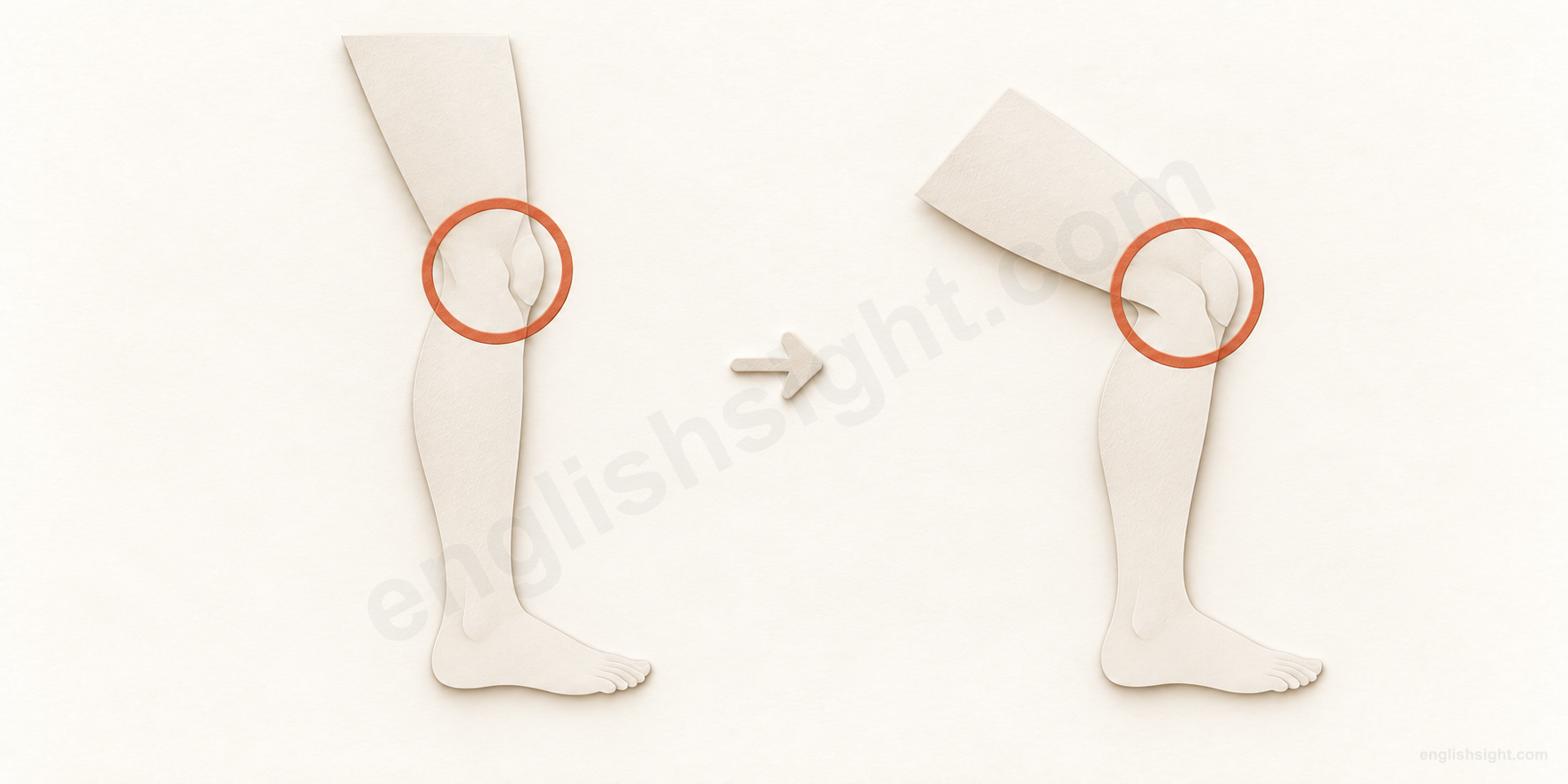
The joint where a leg bends
The leg is straight.
knee
The same leg is bent at the knee.
The upper and lower leg change angle at the highlighted knee.
The knee connects the upper and lower leg and lets the leg bend. Fixed expressions need their own explanations.
The knee joins the upper and lower leg, allowing the leg to bend and straighten.
The joint is the starting point for this lesson. The drawing explains bending; it does not turn every knee expression into a literal movement or provide medical guidance.
A knee is the joint region between the upper and lower parts of a human leg. Start there, then notice how an expression directs attention to a posture, a nearby surface, or a familiar comparison.
The basic body-part meaning is concrete. Some extensions are easy to follow, while fixed expressions such as the bee’s knees need to be learned as a whole. This lesson offers a teaching connection, not a single image shared by every English speaker.
01
A joint, a body region, and nearby surfaces
Start with the place where a human leg bends. Everyday contexts also point to clothing over it or the surface formed by sitting.
01
a / my / left / right knee; knee + noun
my knee / knee pain
the joint and surrounding area where the leg bends
Starting situation
A runner points to the middle of her leg.
Meaning in context
She identifies the painful body part.
Knee names the joint region, not the whole leg.
Knee is a countable noun: one knee, two knees. In ordinary descriptions, my knee can include the area around the joint, such as the skin you scrape in a fall.
Use a possessive to identify whose body part is involved: My left knee hurts. With a noun after it, knee usually stays singular: knee pain, a knee injury, knee surgery, knee pads. The following noun tells you whether you mean a symptom, an injury, a procedure, or equipment.
A knee is different from a kneecap: the kneecap is the small bone at the front of the joint. Pain in my knee locates pain; I hurt my knee describes causing an injury.
In a sentence
I scraped my right knee on the path.
Watch the difference Say My knee hurts or I have pain in my knee. Knee is countable, so I injured knee needs a determiner in ordinary prose.
02
the knee(s) of + garment; at the knee(s)
the knees of my jeans
the parts of clothing that cover the knees
Starting situation
The fabric over both knee joints is worn.
Meaning in context
You describe holes in the jeans.
The body-part name also identifies its corresponding clothing area.
In holes at the knees, the knees belong to the jeans: these are the sections over your knees. Context decides whether knee refers to your body or to fabric.
Compare I scraped my knee with I tore my jeans at the knee. A knee patch covers or repairs this part of a trouser leg; it does not mean a patch inside the body.
In a sentence
These jeans have holes at both knees.
Watch the difference A hole in the knee of your jeans describes clothing damage, not an injury to the joint.
03
sit / rest on + person’s knee(s); across + person’s knees
sit on someone’s knee
sit on the upper surface of a seated person’s legs
Starting situation
A grandfather is sitting in an armchair.
Meaning in context
His small granddaughter sits on his legs.
In this seated context, knee refers to a supporting surface near the lap.
A child on someone’s knee is sitting on that person’s upper legs. The child does not have to balance on the exact joint. On my knees can likewise describe something resting across my legs while I sit.
Compare The child is on my knee with I am on my knees. In the first, I support the child while seated. In the second, my own knees are on the ground. On my lap is another clear way to describe the seated surface.
In a sentence
Grandad sat with a blanket across his knees.
Watch the difference Check who is sitting and what on refers to; the same preposition does not make these two postures identical.
02
Bending, kneeling, and losing steadiness
The surrounding verbs and prepositions tell you whether someone changes posture, stays low, or feels unsteady.
04
bend / straighten + possessive + knee(s); bend at the knee
bend / straighten your knees
change the angle at the knee joints
Starting situation
Your legs are straight.
Meaning in context
Your lower and upper legs form an angle.
The noun names the joint; bend or straighten names the movement.
Bend your knees asks you to flex the joints. Straighten your knees asks you to bring your legs back toward a straight position. The diagram contrasts these positions; it is not an anatomical model of every movement.
You can bend your knees while standing, sitting, or crouching. That alone does not mean your knees touch the ground. Kneel describes the posture in which one or both knees rest on a surface.
In a sentence
Bend your knees a little before you jump.
Watch the difference Knee is not the ordinary verb for kneeling. He knees down is not a substitute for He kneels down.
05
be / get down on + possessive + knees; fall / drop to + possessive + knees
on your knees / fall to your knees
remain in, or move into, a kneeling position
Starting situation
You stand beside a low cupboard.
Meaning in context
You lower yourself so your knees touch the floor.
On describes a position; to after a movement verb marks the resulting position.
Be on your knees describes the posture. Get down on your knees or go down on your knees describes entering it. Fall or drop to your knees can suggest a sudden movement.
People kneel to clean, pray, look closely, or beg; the posture does not specify the purpose. Context can also make on your knees figurative, as with an exhausted person or a struggling business.
In a sentence
I got down on my knees to look under the cupboard.
Watch the difference For a physical posture, keep the possessive: on my knees. On knee is not the usual form.
06
be / crawl / get down on + possessive + hands and knees
on your hands and knees
supported low down by both hands and knees
Starting situation
A tiny screw falls under a desk.
Meaning in context
You search with your hands and knees on the floor.
Hands and knees together specify a lower, four-point posture.
Be on your hands and knees describes a position. Crawl on your hands and knees adds movement in that position. You can also stay still while looking or reaching.
This is more specific than on your knees, which does not say that your hands touch the ground. The and joins two body parts in one familiar expression.
In a sentence
We searched for the screw on our hands and knees.
Watch the difference Use on, not in. Crawling is supplied by crawl or by the situation, not automatically by knee.
07
go / get down on one knee; drop to one knee
down on one knee
with one knee resting on the ground
Starting situation
A person needs to reach a small child’s height.
Meaning in context
They lower one knee to the ground.
One knee distinguishes this posture from kneeling on both knees.
Go down or get down on one knee describes lowering your body onto a single knee. A marriage proposal is a familiar context, but the posture itself does not mean propose.
Compare He went down on one knee to tie a shoelace with He went down on one knee and proposed. The purpose or following action supplies the difference.
In a sentence
She got down on one knee to talk to the child.
Watch the difference Use one knee in the singular. On one knees is incorrect.
08
take a knee; take the knee (protest)
take a knee / take the knee
kneel on one knee, with the purpose supplied by context
Starting situation
Players stand before a match.
Meaning in context
They kneel together as an act of protest.
An identical posture can perform different social or sporting actions.
In reports of anti-racism protests, take a knee and take the knee refer to a public kneeling gesture against racial injustice. The protest meaning belongs to the established expression and its context.
In American football, a player can take a knee to end a play. In wider US use, take a knee can mean kneel briefly, for example to rest or pray. A report about a quarterback with the ball differs from a report about players protesting before a match.
Take does not mean physically pick up a detached knee here. Read the full expression and the situation.
In a sentence
The players took a knee before the match to protest against racism.
Watch the difference Do not assume every instance of take a knee is a protest, or replace a with the in every sporting use.
09
be / go weak at the knees; knees knock / buckle / give way
weak at the knees / knees knocking
feel physically unsteady or strongly affected by emotion
Starting situation
You are about to give a speech.
Meaning in context
Fear makes your legs feel shaky.
Knee expressions can describe steadiness literally or use it to convey emotion.
Weak at the knees can describe a feeling caused by fear, illness, excitement, or attraction. Someone’s smile made me go weak at the knees often expresses strong attraction rather than a diagnosed leg problem.
My knees were knocking evokes fear and trembling. My knees buckled or gave way describes the legs failing to support me, perhaps causing a fall. These are related descriptions, not interchangeable names for one emotion.
In a sentence
I went weak at the knees when I saw how high the bridge was.
Watch the difference Weak at the knees does not always mean romantic attraction, and knees buckled need not be figurative.
03
Knee level and familiar compounds
Knee can supply a height reference, name the body part used in an action, or form part of a compound with its own meaning.
use the knee as a reference for height or clothing length
Starting situation
You compare the end of a skirt with your leg.
Meaning in context
Its hem reaches approximately to your knee.
The knee provides a body-based reference point, not a fixed measurement.
Above the knee and below the knee locate something relative to the joint. Knee-length describes a garment that reaches the knees, such as a skirt or shorts. Knee-high describes something reaching that height, such as boots or socks.
High often describes height upward from the ground or foot; length describes how far a garment extends. Their uses can overlap with items such as socks. Neither expression gives a universal measurement in centimetres.
The humorous expression knee-high to a grasshopper means very small or very young: I’ve known her since she was knee-high to a grasshopper. It is exaggeration, not a literal comparison for measuring a child.
In a sentence
She wore a knee-length skirt and flat shoes.
Watch the difference Write the compounds with a hyphen: knee-high boots and a knee-length skirt. Knee-long is not the usual clothing term.
11
knee-deep + noun; be knee-deep in + noun
knee-deep in water / work
immersed up to the knees, or very involved in something
Starting situation
You step into a flooded patch.
Meaning in context
The water reaches your knees.
A depth measured on the body can become a figurative description of involvement.
Knee-deep water reaches roughly to a standing person’s knees. Be knee-deep in mud describes the person surrounded by material to that level; the in phrase names the surrounding substance.
Be knee-deep in work or paperwork is figurative: you have a lot to deal with. It need not describe a physical pile, and it does not specify an exact number of tasks.
In a sentence
By Friday, we were knee-deep in paperwork.
Watch the difference The figurative meaning comes from knee-deep in as a whole; knee alone does not mean busy.
12
knee + person / thing; knee + person + in the + body part
knee someone in the stomach
hit or push with the knee
Starting situation
Two players collide during a game.
Meaning in context
One player’s knee strikes the other’s stomach.
As a verb, knee identifies the body part used to make contact.
Knee is also a transitive verb: someone knees someone or something. Knee someone in the stomach names the affected person as object and then the body area in an in phrase. A sports collision can be accidental; the context supplies intention.
The forms are knee, knees, kneed, kneeing. The final e stays in kneeing. A passive is possible: He was kneed in the stomach. Contrast this with kneel, which means lower yourself onto one or both knees. You can say kneel down, but not knee down.
In a sentence
During the game, he accidentally kneed me in the stomach.
Watch the difference Kneed means struck with a knee; needed is a different word. To describe resting on your knees, use kneel.
13
a knee-jerk reaction / response / rejection
a knee-jerk reaction
an automatic response made without careful thought
Starting situation
Someone hears a new proposal.
Meaning in context
They reject it immediately without considering it.
The compound uses an automatic physical response as a comparison for unthinking behavior.
A knee jerk is the involuntary movement of the lower leg after the tendon below the kneecap is tapped. The adjective knee-jerk applies this reflex idea to an automatic reaction.
A knee-jerk reaction or knee-jerk rejection usually criticizes a lack of thought. It does not describe every quick decision: a fast but well-considered response need not be knee-jerk. The adjective normally comes before a noun.
In a sentence
Let’s read the proposal before making a knee-jerk rejection.
Watch the difference Knee-jerk is a compound adjective here, not the verb knee plus an object called jerk.
04
Strength, submission, childhood, and praise
Learn these as whole expressions. A connection with posture can help with some, but it does not predict every idiom.
14
bring + person / organization + to + possessive + knees; be on + possessive + knees
bring someone / something to their / its knees
defeat someone or leave an organization unable to function effectively
Starting situation
A company depends on a single source of power.
Meaning in context
A long outage leaves it almost unable to operate.
The image of losing an upright position helps convey a severe loss of strength.
Bring someone to their knees can mean defeat them or force them to give in. Bring a business or industry to its knees means damage it so badly that it cannot function effectively.
Bring describes causing this condition. Be on its knees describes the condition itself: The company is on its knees. Neither expression requires a literal body or a visible kneeling action.
Match the possessive to the affected party: the company and its knees; the workers and their knees. This is a strong expression, not an ordinary way to describe a small delay.
In a sentence
The long power outage brought the factory to its knees.
Watch the difference Do not read the company as the agent of bringing: it is the affected object in this sentence.
15
ask / beg on bended knee(s); bend the knee to + person / power
on bended knee / bend the knee
appeal humbly or submit to someone’s authority
Starting situation
Someone wants another person to reconsider.
Meaning in context
They describe asking with extreme humility.
Kneeling can suggest a humble appeal, but the precise function comes from the expression.
Ask or beg on bended knee, also on bended knees, presents an especially humble or earnest appeal. It may exaggerate: I won’t ask on bended knee need not describe an actual posture.
Bend the knee can mean kneel or submit to someone’s power: They refused to bend the knee to the ruler. This can sound formal or dramatic. It differs from the ordinary movement instruction Bend your knees.
Bended survives in this fixed expression. In ordinary descriptions use bent: He sat with bent knees. A physical one-knee proposal and a figurative humble appeal are related contexts, not definitions of the noun knee.
In a sentence
She said she would not beg on bended knee for another chance.
Watch the difference Keep bended in the fixed expression; do not generalize it to the ordinary past tense of bend, which is bent.
Years later the child remembers that early learning.
The expression evokes childhood closeness, not a required physical position.
At my mother’s knee is a traditional way to place learning in early childhood. It often appears with learned, heard, stories, or songs.
The expression does not require that the learner was literally sitting on a knee. Compare on my mother’s knee, which can describe that physical seating arrangement. The preposition changes the expression.
In a sentence
I learned that song at my mother’s knee.
Watch the difference Use at for this childhood-learning expression. Sitting on someone’s knee is a different construction.
17
be the bee’s knees; think + person / thing + be the bee’s knees
the bee’s knees
an excellent person or thing
Starting situation
A friend is delighted with a small café.
Meaning in context
They praise it enthusiastically.
This fixed idiom expresses praise; the literal body-part picture does not explain its meaning.
The bee’s knees is informal praise. Calling a café the bee’s knees means you think it is excellent. The expression can sound playful.
She thinks she’s the bee’s knees can mock someone who thinks very highly of herself. Tone and the surrounding sentence decide whether the praise is sincere or critical. Learn the whole phrase rather than constructing a theory about a bee’s legs.
In a sentence
For a quiet lunch, this café is the bee’s knees.
Watch the difference Keep the in the fixed expression. A bee’s knee normally sounds like an actual body part rather than this praise.
18
cut + person + off at the knees
cut someone off at the knees
suddenly and thoroughly shut someone down or humiliate them
Starting situation
A speaker boasts that no one can challenge his claim.
Meaning in context
A short, decisive reply publicly defeats his argument.
The figurative expression evokes taking away someone’s ability to keep going.
In this American idiom, cut someone off at the knees can describe abruptly crushing or humiliating them in an exchange. It is a forceful description, not a literal instruction about injury.
Compare cut someone off, which can simply mean interrupt them. Adding at the knees makes the whole expression more emphatic: the person is decisively put down, not merely stopped halfway through a sentence.
In a sentence
Her calm reply cut the boastful speaker off at the knees.
Watch the difference Place an object pronoun before off: cut him off at the knees, not cut off him at the knees.
Keep the body part and the full expression distinct
Sound and forms
Knee is pronounced /niː/: the k is silent. The noun plural is knees /niːz/. The verb forms are knees, kneed /niːd/, and kneeing. Kneel is the separate verb for resting on one or both knees.
A teaching connection has limits
The body joint explains many literal combinations and helps with some metaphors. It does not mechanically predict praise in the bee’s knees, the social purpose of taking a knee, or the meaning of every compound.
Scope
This lesson covers everyday body and clothing uses, posture, useful compounds, and established idioms. Specialized animal anatomy, structural braces, tree-root growths called knees, obsolete verbs, and specialist medical terminology are outside the main course. The example sentences are original and are not restricted to the historical Basic English 850-word list.
Choose the meaning that fits
Look at the person, posture, and whole expression.
1. You lower yourself onto both knees to clean the floor. Which sentence describes your position?
2. A player accidentally strikes another player with a bent knee. Which sentence reports this?
3. An outage brought a factory to its knees. What happened?
4. A report says a quarterback took a knee while holding the ball during play. Which interpretation fits that context?
5. A colleague says she is knee-deep in paperwork. What does she mean?
Sources and teaching notes
The sources below support the meanings and expressions. Explanations and examples are original; the diagram is a teaching aid, not proof of a shared mental image.
The diagram highlights a useful connection; it does not represent an image shared by every native speaker.