Name the tool, describe an action, and recognize the meanings of familiar knife expressions.
A blade makes a cut
A blade makes a cut
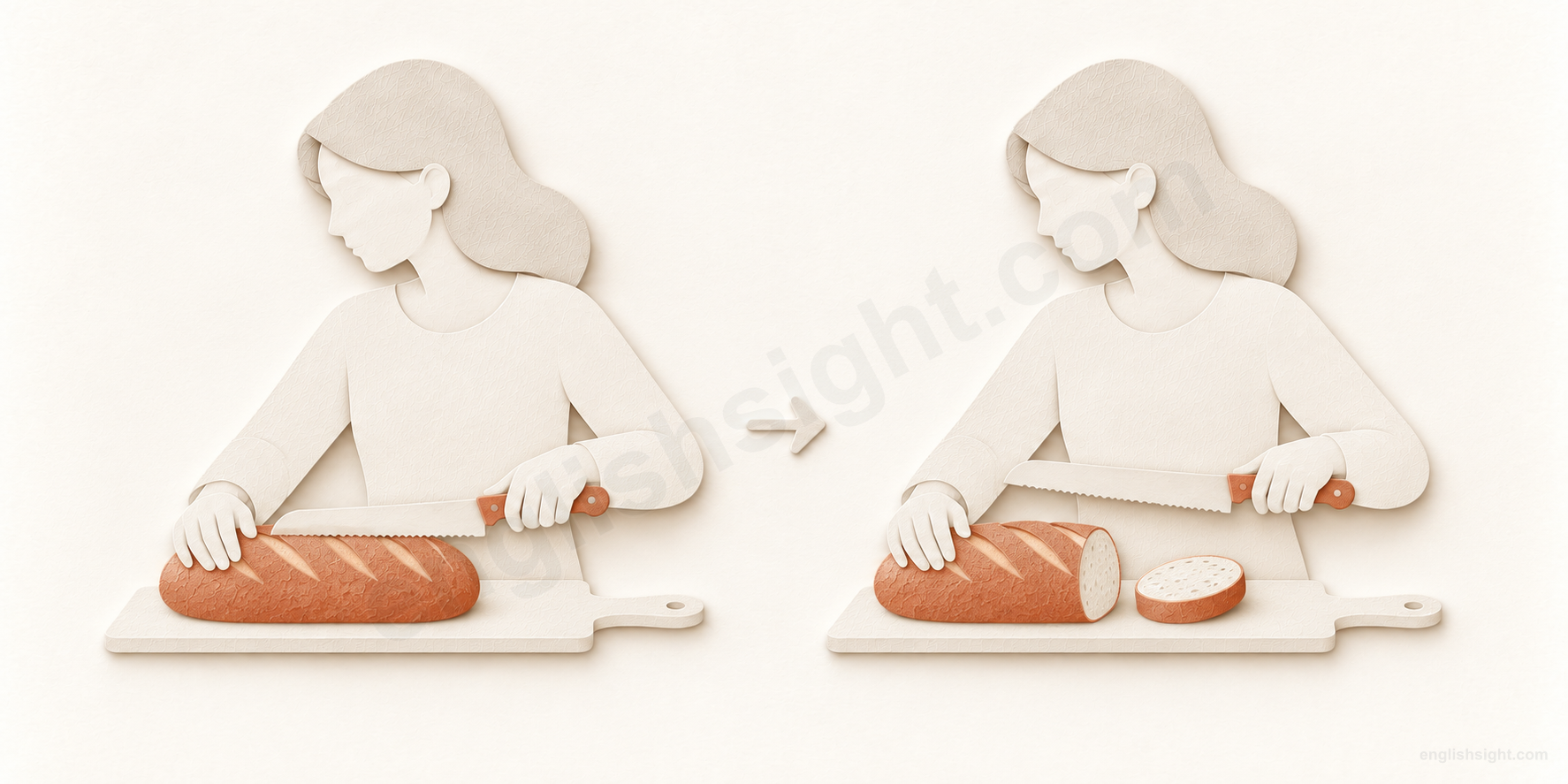
A woman holds a bread knife against an uncut loaf.
knife
One slice is separate from the rest of the loaf.
She cuts through the loaf with the knife’s edge.
The knife’s edge cuts into the loaf and separates a slice.
A knife is a handled blade; its cutting edge can enter material and separate it along a cut.
The sketch shows one use of a cutting knife, not a definition requiring every knife to be sharp or in action. Butter knives and palette knives extend the tool family to spreading. Idioms require their own explanations.
A knife is first a physical tool: a blade and a handle. Picture its edge meeting material and making a cut. From there, some uses suggest cutting-like movement or harm, while fixed expressions add meanings that must be learned as a whole.
The picture is a teaching model. It does not claim that all English speakers imagine the same scene, or that every knife expression can be guessed from a single image.
01
Name the tool and its job
Start with the physical object. Words before knife identify its purpose; the verb tells us what someone does with it.
01
a / the / possessive + knife; number + knives
a knife / two knives
a handled blade used as a cutting tool
Situation / starting point
There is a whole loaf on the board.
Meaning / result
A knife provides an edge that can slice it.
Knife names the tool; it does not say that cutting has already happened.
A knife is normally a countable object: a knife, the knife, my knife. The blade is its metal working part; the handle is the part held. Blade can also name the cutting part of a machine, so it is not always interchangeable with knife.
The core picture is a blade meeting material and making a cut. It helps connect literal cutting with some figurative uses, but the noun still names a knife lying unused in a drawer.
In a sentence
We need two knives, one for the bread and one for the vegetables.
Watch the difference The plural noun is knives /naɪvz/, not knifes. In knife /naɪf/, the initial k is silent.
02
cut / slice + object + with a knife; use a knife to + verb
cut something with a knife
name the instrument used for cutting
Situation / starting point
An apple needs to be divided.
Meaning / result
Someone uses a knife to cut it.
The apple receives the action; with introduces the tool.
In cut the apple with a knife, cut describes the action and knife identifies the instrument. Use a knife to cut the apple expresses the same practical purpose with a to-infinitive.
A sharp knife has an effective cutting edge; a blunt knife, or a dull knife, has an edge that cuts poorly. Sharpen the knife means improve that edge. A point is the tip; it is not the whole cutting edge.
In a sentence
Maya cut the apple into quarters with a small knife.
Watch the difference For ordinary food preparation, say cut or slice with a knife. Knife the apple is not the usual everyday choice.
03
bread / carving / kitchen + knife; a knife and fork
a bread knife / a knife and fork
choose or request a knife for a meal
Situation / starting point
Bread needs slicing, or a meal is about to begin.
Meaning / result
The speaker names the appropriate utensil.
A purpose word narrows the kind of knife without creating a new verb.
A bread knife is for cutting bread; a carving knife is for cutting slices from cooked meat. Kitchen knife is a broader description. These are compound nouns: pluralize the head, as in bread knives.
At a meal, a knife and fork refers to the pair of utensils. You can ask Could I have a knife and fork, please? Use knives and forks when speaking of several such utensils.
In a sentence
Could I have a knife and fork for my meal, please?
Watch the difference Knife and fork names objects; it does not specify a universal rule for which hand holds each one.
04
spread + butter + with a butter knife
a butter knife
a utensil for spreading butter
Situation / starting point
Butter needs spreading over bread.
Meaning / result
A broad flat utensil spreads it.
Some named knives are designed for spreading rather than sharp cutting.
A butter knife has a rounded end and a flat working edge. Its name remains knife even though its main job is to spread butter.
Spread butter with a butter knife describes the action naturally. The familiar object category is broader than a rule that every knife must have a pointed tip or a dangerously sharp edge.
In a sentence
Nora spread butter on the toast with a butter knife.
Watch the difference A butter knife is a real utensil; like a knife through butter is a separate expression about ease.
05
a craft knife; a palette knife
a craft knife / a palette knife
name tools for precise cutting or spreading
Situation / starting point
A maker needs to cut card, or an artist needs to handle paint.
Meaning / result
Different blade tools serve different tasks.
The compound name identifies a particular tool, not just any kitchen knife.
A craft knife is a very sharp tool used for cutting materials such as paper and thin wood. Oxford labels this name British English. In this name, craft describes its purpose.
A palette knife has a flexible blade and rounded end and is used in art and cooking. An artist can use one with paint. Here the family resemblance is a handled blade; sharp cutting is not the only possible job.
In a sentence
The artist used a palette knife to mix the paint.
Watch the difference Do not assume craft knife and palette knife describe the same blade or can do the same job.
02
Weapons and cutting-like movement
Knife can also be a verb. Its object and surrounding words distinguish an attack from a descriptive image of movement.
06
a knife attack; pull a knife on + person
a knife attack / pull a knife on someone
a knife used to threaten or harm
Situation / starting point
A report describes a threat involving a blade.
Meaning / result
The knife is understood as a weapon.
Context gives the object its threatening role.
A knife can be used as a weapon. In knife attack, knife is a noun modifying attack: it identifies the weapon. Knife crime similarly refers to crime involving knives.
Pull a knife on someone describes producing a knife to threaten that person. On introduces the person threatened; it does not mean putting the knife on top of them.
At knifepoint means while someone is threatening with a knife or is being threatened with one: The cashier was robbed at knifepoint. This describes the threat and does not by itself say that anyone was cut. Knifepoint is written as one word here, without an article.
In a sentence
The witness said the robber had pulled a knife on the shopkeeper.
Watch the difference A knife attack is a noun phrase. It does not use knife as a verb.
07
knife + person; person + be + knifed
knife someone / be knifed
injure or kill a person with a knife
Situation / starting point
A news report describes an assault.
Meaning / result
The verb names an injury inflicted with a knife.
As a verb with a person as object, knife normally describes violence.
In Someone knifed him, someone is the attacker and him is the person injured with the knife, for example by stabbing or slashing. He was knifed is the passive: it puts the injured person first and can leave the attacker unnamed. Merely threatening someone with a knife is not enough to describe them as having been knifed.
The verb forms are knife, knifes, knifed, knifing. Notice the contrast between plural nouns, two knives /naɪvz/, and a singular verb, he knifes /naɪfs/. In ordinary kitchen conversation, choose cut with a knife rather than borrowing this attack pattern.
In a sentence
The report said that a man had been knifed outside the station.
Watch the difference Being knifed does not by itself say that the person died. It is stronger and more specific than being hurt.
08
moving subject + knife through + water / waves / air
knife through the water
move through something in a cutting-like way
Situation / starting point
A fast boat meets the surface of the water.
Meaning / result
It moves through, suggesting a blade cutting a path.
Through names what the moving subject passes through.
This descriptive verb use compares movement to a blade cutting a way. The boat is the subject; no person is being stabbed. A ship can knife through waves, and a bird can be described as knifing through the air.
The image suits vivid narration more than a neutral travel report. Through is an ordinary path preposition here, not a detachable particle: the boat knifed through it, not the boat knifed it through.
In a sentence
The speedboat knifed through the water toward the harbour.
Watch the difference Read the subject and complement. A boat knifing through water and a person being knifed describe different events.
03
Surgery, ease, and a tense situation
These familiar expressions use the blade as an association or comparison. Learn the whole phrase, including its articles and prepositions.
09
go / be under the knife
go under the knife
have a surgical operation
Situation / starting point
A person is preparing for surgery.
Meaning / result
They undergo an operation.
The surgical instrument stands for the procedure as a whole.
Go under the knife is an informal way to say have surgery. Be under the knife can describe undergoing the operation. The definite article belongs to the expression.
This is an association with surgical instruments, not a claim about the patient’s physical position below an ordinary kitchen knife. It can refer to surgery generally, not only cosmetic procedures.
In a sentence
After months of knee trouble, Daniel finally went under the knife.
Watch the difference For neutral or formal wording, say have surgery or have an operation. Do not infer the exact procedure from the idiom.
10
verb phrase + like a (hot) knife through butter
like a (hot) knife through butter
with very little difficulty or resistance
Situation / starting point
A task seems as if it might be difficult.
Meaning / result
Someone handles it very easily.
The whole comparison emphasizes ease.
This established comparison imagines a blade passing easily through soft butter. It can describe a team overcoming opponents or a person working through a difficult task; there need be no actual knife.
Both like a knife through butter and like a hot knife through butter occur. Like introduces the comparison; through belongs inside its image. The words around it supply the actual action.
In a sentence
Leah went through the practice questions like a hot knife through butter.
Watch the difference The comparison is positive about ease, but it does not always mean careful or high-quality work.
11
you could cut the atmosphere / tension with a knife
you could cut the atmosphere with a knife
the social tension is very noticeable
Situation / starting point
An argument ends, and everyone sits silently.
Meaning / result
The tension feels almost solid.
A physical cutting image expresses an intense social atmosphere.
You could cut the atmosphere with a knife describes a very tense situation. Tension can replace atmosphere: You could cut the tension with a knife. Collins marks the atmosphere expression as mainly British.
The imagined thickness makes the tension vivid. Could does not offer practical advice or report anyone’s ability to cut air; the whole sentence is figurative.
In a sentence
After the accusation, you could cut the atmosphere with a knife.
Watch the difference This means tension, not merely any strong feeling such as excitement or happiness.
04
Hurtful words and personal opposition
Knife imagery can describe social harm. These expressions differ in whether they emphasize a hostile act, existing pain, or a continuing grudge.
12
the knives are out (for + person)
the knives are out for someone
people are ready to blame or damage someone
Situation / starting point
A leader faces an unpopular decision or failure.
Meaning / result
Opponents are preparing to attack the leader’s position.
The plural knives suggests multiple sources of hostility.
The knives are out for someone means that people want that person to suffer a setback, perhaps losing a position. It is especially useful for recognizing political or workplace commentary; Collins marks it as mainly British.
For names the target. The knives are out can stand alone when the target is clear. This describes a hostile situation, not proof that actual weapons are present.
In a sentence
After the failed launch, the knives were out for the director.
Watch the difference The idiom uses plural knives with are or were. Do not replace it with a singular knife without changing the expression.
13
put / stick the knife in; put / stick the knife into + person
put / stick the knife in
deliberately hurt or undermine someone
Situation / starting point
Someone has an opportunity to speak about a colleague.
Meaning / result
They use it to cause that person trouble.
The hurt can come from words or actions.
Put the knife in and stick the knife in are informal expressions for acting against someone in a hurtful way. They may describe a cruel remark, damaging criticism, or an attempt to undermine someone.
When the target is named directly, use put or stick the knife into someone. The knife is grammatically the object of put or stick; the whole combination supplies the figurative meaning.
In a sentence
Rather than help, his colleague stuck the knife in by mocking his mistake.
Watch the difference Do not classify this automatically as the verb knife plus a particle. The main verb here is stick or put.
14
twist / turn the knife (in the wound)
twist / turn the knife
make someone’s existing distress worse
Situation / starting point
A person is already upset by a failure.
Meaning / result
Someone adds another painful remark or action.
Unlike a general hostile act, this expression foregrounds pain that already exists.
Twist the knife means add to someone’s unhappiness, often deliberately. Turn the knife and the longer twist or turn the knife in the wound use the same hurt-intensifying image.
The wound need not be physical. Mentioning someone’s failure again when they are already upset can twist the knife. The existing distress is the starting point of the figurative scene.
In a sentence
He twisted the knife by reminding me that everyone else had passed.
Watch the difference This is more specific than disagreeing or giving necessary criticism: it presents the added pain as unkind.
15
have + possessive + knife in + person
have one’s knife in someone
hold a grudge against or unfairly target someone
Situation / starting point
A person repeatedly treats a colleague badly.
Meaning / result
The colleague describes continuing personal hostility.
Have describes an attitude or continuing treatment, rather than one new attack.
This British expression describes having a grudge against someone or victimizing them. The possessive follows the subject: I have my knife in him; she has her knife in me.
It differs from stick the knife in, which can describe a particular harmful act. Have one’s knife in someone can describe the longer hostility behind a series of such acts.
In a sentence
I think the supervisor has her knife in me; she criticizes everything I do.
Watch the difference This is an accusation of hostility, not a neutral way to say someone supervises or evaluates your work.
05
An uncertain balance and a judgment about intelligence
Related expressions draw on an edge or on sharpness. Their meanings belong to established combinations rather than to knife alone.
16
situation / person + be on a knife-edge
on a knife-edge
in a finely balanced situation, or anxiously awaiting its result
Situation / starting point
A small change could determine success or failure.
Meaning / result
The result remains uncertain, and people may feel anxious.
An edge provides an image of a narrow, precarious balance.
A situation on a knife-edge could succeed or fail after a tiny change. This compound draws on the edge, rather than on the act of cutting.
A person on a knife-edge can be extremely anxious about an uncertain result: We were on a knife-edge waiting for the announcement. This emotional use should be distinguished from the unstable situation itself.
In a sentence
With one vote still uncounted, the election result was on a knife-edge.
Watch the difference Keep a in on a knife-edge. This expresses precarious uncertainty, not the ease in like a knife through butter.
17
person + be not the sharpest knife in the drawer
not the sharpest knife in the drawer
an unkind way to say someone is not intelligent
Situation / starting point
Someone comments on another person’s understanding.
Meaning / result
The comparison questions that person’s intelligence.
Sharp contributes its separate association with quick understanding.
This informal, sometimes joking expression says that someone is not very intelligent. The comparison depends on sharp meaning mentally quick, as well as on a sharp cutting tool.
Not the sharpest tool in the box is a related established variant. Both can sound insulting even when presented as humor; neither assesses an actual drawer of utensils.
In a sentence
The character is described as “not the sharpest knife in the drawer.”
Watch the difference This is useful to recognize, but it is unsuitable for respectful feedback about a person’s mistake.
Keep the object, action, and expression distinct
The spelling changes differently in nouns and verbs
One knife /naɪf/ becomes two knives /naɪvz/. The verb has knifes, knifed, and knifing: the third-person singular is not knives. The k is silent in all these forms.
Cut is the general action word
Cut covers many actions and instruments; knife names a particular tool. For an everyday instruction, use Cut it with a knife. Knife as a verb with a human object usually means an attack; the passive be knifed is common in reporting.
An image helps, but the combination decides
A hurtful remark may be compared to a knife in someone’s heart. Such a metaphor suggests emotional pain, but knife does not independently mean every kind of pain. Under the knife, the knives are out, and on a knife-edge have established meanings and different grammar.
Scope and register
This lesson emphasizes the everyday noun, useful tool compounds, the attack verb, descriptive knife through, and recognizable idioms. Machine cutting blades are another technical noun use. General dictionaries also record knife for spreading, marking, or secretly undermining someone; these less central verb uses are not expanded here. No productive causative or particle-verb family is needed to explain the common uses taught.
Choose the intended meaning
Use the whole construction and the situation. The same blade image can play different roles.
1. You need three cutting utensils. Which form is correct?
2. You want to divide a pear while preparing lunch. Which instruction is the usual everyday wording?
3. A friend says, “I’m going under the knife next week.” What does the expression mean?
4. Someone is already upset about failing. Another person deliberately reminds them that everyone else passed. Which phrase emphasizes the added distress?
5. A final vote could change the result. Which sentence describes that uncertainty?
6. “The boat knifed through the waves.” What is being described?
Sources and teaching notes
The sources below support the meanings and patterns. Explanations, examples, and the compatibility sketch are original teaching material. The cutting relation is a teaching model, not evidence that every expression developed from it.
This diagram illustrates a useful connection; it does not represent a picture shared by every English speaker.