From cord fastenings to tight feelings, close clusters, and established expressions.
Interlacing becomes a compact fastening
Interlacing becomes a compact fastening
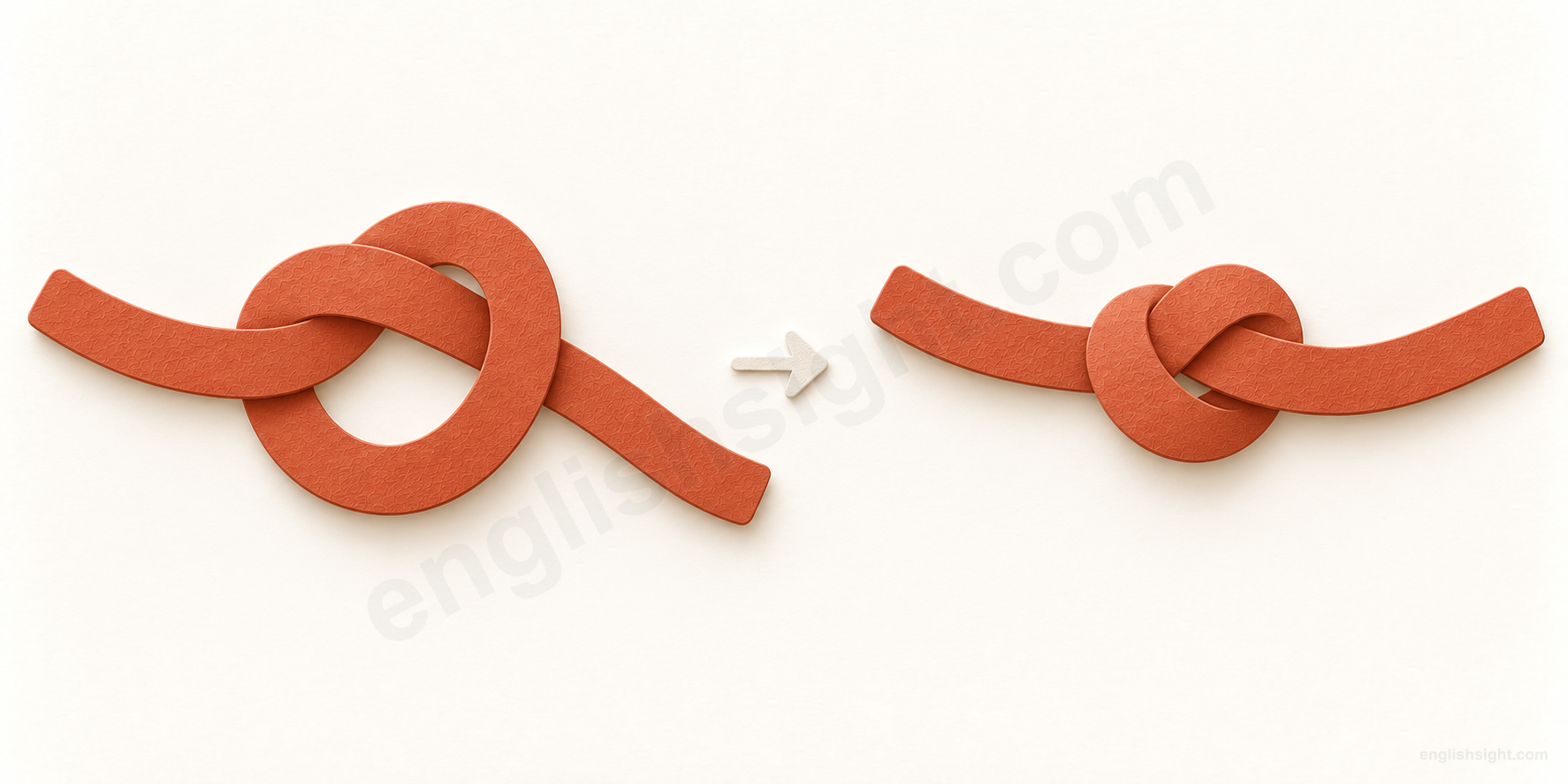
The cord is loosely interlaced.
knot
The knot is compact and tight.
The interlaced parts draw together.
Interlaced parts draw together into a tight knot.
Parts of flexible material pass around and through one another, forming a knot that can draw tight.
The sketch compares a loose interlacing with a compact knot. It is a memory model, not a step-by-step tying guide or a claim that all senses derive from the same physical action.
A knot is most concretely an interlaced part of rope, string, or another flexible material. It may be made deliberately to fasten something, or form accidentally as a tangle. Knot is both a countable noun and a verb.
Use the compact interlacing as a teaching connection for tightness, grouping, and difficulty. The speed unit is a separate branch, and fixed expressions still need to be learned as complete expressions.
01
Making and releasing a knot
Name the fastening, describe the action, and distinguish an intentional knot from an unwanted tangle.
01
tie a knot in + material; join A and B with a knot
tie a knot
make an interlaced fastening in flexible material
Starting situation
The cord has no fastening.
Result or interpretation
An interlaced part holds when tightened.
A knot is the fastening; tie names the action.
A knot is a countable noun: a knot, one knot, several knots. Rope, string, laces, and strips of cloth can be looped and interlaced to form one. A knot may join two ends or sit in a single length of cord.
In tie a knot in the string, in identifies the material containing the knot. In join the cords with a knot, with identifies the fastening used. These prepositions express different relationships.
A tight knot is drawn firmly together; a loose knot has room to move. Tighten the knot and loosen the knot change its tightness. The core picture shows that change, without teaching a particular knot for safety-critical use.
In a sentence
Tie a knot in the string so the beads cannot slide off.
Watch the difference Tie a knot is literal; tie the knot can instead mean get married.
Knot is also a verb. In knot the ends together, someone acts on the ends; together describes the resulting connection. You can also knot a scarf around your neck, where around supplies the position.
The scarf was knotted around her neck is a passive description of the fastening. A knotted cord uses the past participle to describe the cord. Neither form requires a phrasal-verb analysis.
Tie is broader: you can tie something using a bow or another fastening. Knot specifically draws attention to forming or using a knot. With a pronoun, say knot them together.
In a sentence
Mina knotted the two fabric strips together to make a longer band.
Watch the difference Knot a box is usually less informative than tie string around a box: name the flexible material you knot.
03
untie / undo / loosen + a knot
untie a knot
release an existing fastening
Starting situation
The cord is fastened.
Result or interpretation
The knot is released.
Untying reverses tying; loosening need not remove the knot.
Untie a knot and undo a knot both describe opening it. In I cannot undo this knot, the problem is releasing the fastening, not making a new one.
Loosen the knot only says make it less tight; the knot may remain. Untangle the cord focuses on separating twisted or caught parts and may involve more than one knot.
Untie and undo are separate verbs used with the noun knot, not combinations of knot with a particle. In untie, un- is a prefix that indicates reversing the tying.
In a sentence
I loosened the knot first, then untied it.
Watch the difference Loosen and untie describe different possible results.
04
material + knots; material + gets knotted; a knot in + material
get knotted
become tangled without someone deliberately tying a fastening
Starting situation
The threads are separate and usable.
Result or interpretation
They catch and twist together.
A knot can form accidentally.
Thread, wool, and hair can form unwanted knots. In The thread knotted as I pulled it, knot is intransitive: no object follows because the thread itself changes.
The thread got knotted describes the resulting change, and knotted thread describes the state. You can say There is a knot in the thread when locating one troublesome spot.
A tangle can be a larger, looser mass of mixed-up strands. Knot often picks out a more concentrated part of it; the words overlap but are not interchangeable in every sentence.
In a sentence
The thread got knotted while I was sewing the sleeve.
Watch the difference Get knotted has an unrelated rude British use; the material subject here makes the literal meaning clear.
02
Hair, muscles, and nervous tension
The compact shape or tight feeling provides a useful connection, but the body does not contain a literal rope knot.
05
wear / have + hair + in a knot; knot + hair + location
wear your hair in a knot
arrange hair in a compact twisted shape
Starting situation
Long hair hangs loose.
Result or interpretation
The hair is gathered into a rounded arrangement.
An arranged hair knot differs from unwanted knots in hair.
With hair, a knot can be an intentional hairstyle, similar to a bun. In wear your hair in a knot, in describes the arrangement rather than something caught inside the hair.
Knot your hair on top of your head uses the verb transitively. Hair loosely knotted at the back is a participial description of the same kind of arrangement.
Contrast Her hair was full of knots: that normally means unwanted tangles. The singular arrangement in a knot and plural knots in her hair guide the reading.
In a sentence
She wore her hair in a loose knot at the back of her head.
Watch the difference Do not confuse a deliberate hair knot with tangled strands that need combing.
06
a knot in + muscle / shoulder; muscles + knot; knotted muscles
a knot in a muscle
a localized tight or hard-feeling area in a muscle
Starting situation
The muscle feels relaxed.
Result or interpretation
One area feels tight and uncomfortable.
The compact tightness is a comparison, not a literal cord.
People describe a tight, uncomfortable area as a knot in a muscle, or talk about knots in their shoulders. The noun identifies a localized sensation or area; it is not a diagnosis.
Muscles can knot, and knotted muscles describes muscles that have become tense. In His shoulders knotted with tension, the subject changes without an object.
In narrative descriptions a forehead can knot in a frown: it tightens and creases. The bodily use extends the idea of drawing together, not the act of tying someone up.
In a sentence
After the long drive, I could feel a knot in my shoulder.
Watch the difference A knot in a muscle is descriptive language; it does not identify a specific medical cause.
07
a knot in + possessive + stomach; stomach + be in knots; stomach + knot with + emotion
a knot in your stomach
an uncomfortable tight feeling associated with emotion
Starting situation
You are waiting for important news.
Result or interpretation
Your stomach feels tense.
Fear or excitement may be felt as constriction.
A knot in my stomach and My stomach is in knots describe nervous tightness. Context may suggest fear, worry, or excitement. The expression does not mean an actual tied object is inside the body.
My stomach knotted is an intransitive change. The thought knotted my stomach makes the cause the subject and stomach the object. My stomach knotted with fear names the accompanying emotion with with.
A knot of fear in her throat describes a similar tight feeling with an emotion specified by of. Compare tying yourself in knots, which focuses more on mental confusion or anxious effort.
In a sentence
My stomach was in knots while I waited for the interview to begin.
Watch the difference The singular a knot in my stomach and plural my stomach is in knots are both natural.
03
Wood, groups, and complicated problems
Knot can name a concentrated spot, a close cluster, or a difficulty whose parts are hard to separate.
08
a knot in + wood / board; wood + with knots
a knot in the wood
a hard spot in timber where a branch grew
Starting situation
A tree has a branch connected to its trunk.
Result or interpretation
The cut wood shows a compact patch with different grain.
This is a natural feature of wood, not a tied fastening.
A knot in a board is part of the wood where a branch was attached. It may show as a round or oval patch whose grain differs from the surrounding surface.
The preposition in locates the feature: a knot in the wood, knots in the floorboards. Nothing needs to be tied, and a person is not performing a knotting action.
The compact shape makes a useful memory connection, but the wood sense has to be learned as an established noun use.
In a sentence
The shelf has a dark knot near one end.
Watch the difference A knot is not necessarily a hole: a knot can remain in the wood.
09
a knot of + people / spectators / visitors
a knot of people
a small group standing close together
Starting situation
Several people gather.
Result or interpretation
They form a close cluster.
Of names the people making up the group.
A knot of people describes a compact cluster, often seen from outside it. A small knot of visitors and little knots of spectators give a similar picture.
This is especially useful in written descriptions. A group of people is more neutral in ordinary conversation. No one is literally tied to anyone else.
In a knot of people, of identifies the members. This differs from a knot in the rope, where in locates a fastening.
In a sentence
A small knot of visitors gathered beside the map.
Watch the difference Do not use knot as the general word for any organized team or large crowd.
10
a knot of + problems / difficulties; untangle + a knot of problems
a knot of problems
an interconnected difficulty that is hard to resolve
Starting situation
Several issues affect one another.
Result or interpretation
It is hard to separate and solve them.
Entanglement supplies a metaphor for difficulty.
In descriptions of legal or practical difficulties, a knot can be a problem or a tangle of connected problems. A knot of legal problems makes their interdependence salient.
This is more figurative and less neutral than simply saying a problem. A writer may describe trying to untangle the knot, extending the same comparison to finding a solution.
The metaphor helps organize the meaning, but it does not make every difficult task a natural knot collocation. The adjective knotty is a related word used in knotty problem.
In a sentence
The sale left us with a knot of legal problems.
Watch the difference Prefer problem for a neutral everyday description; knot adds a figurative sense of entanglement.
04
Established expressions
Learn these as whole expressions. Articles, pronouns, and context distinguish marriage, confusion, and decisive problem solving.
11
couple + tie the knot; tie the knot with + person
tie the knot
get married
Starting situation
A couple plans their wedding.
Result or interpretation
They marry.
The whole expression has an established social meaning.
Tie the knot is an informal expression for getting married. The subject may be the couple: They tied the knot last spring. It is an event, not just a statement that they are dating or engaged.
The fixed the matters. They tied a knot usually describes making a literal fastening. The union image is a memory aid; you cannot replace the words freely and keep the marriage idiom.
They are planning to tie the knot expresses an intention. It does not say the wedding has already happened.
In a sentence
After ten years together, Eva and Luis finally tied the knot.
Watch the difference Keep the in the marriage idiom; a knot normally gives the literal fastening meaning.
12
tie + somebody / yourself + (up) in knots; get tied up in knots
tie yourself in knots
become confused or anxious through complicated thinking or effort
Starting situation
You try to explain several conflicting points.
Result or interpretation
You lose a clear line of thought.
The entanglement is mental, not a physical restraint.
Tie yourself in knots can mean make yourself confused or anxious while trying to do or explain something complicated. The reflexive pronoun matches the subject: I tied myself in knots; she tied herself in knots.
Tie someone in knots puts another person in that confused state, especially through difficult arguments or questions. His questions tied me in knots makes the questions the cause and me the affected person.
Tie somebody or yourself up in knots is a familiar variant, and get tied up in knots describes becoming confused. The complete pattern supplies the idiomatic meaning; in knots alone does not mean every kind of confusion.
In a sentence
I tied myself in knots trying to explain why both answers could be right.
Watch the difference For anxious bodily tightness, my stomach is in knots is more specific; this expression focuses on the person and their thinking.
13
cut the Gordian knot
cut the Gordian knot
resolve a complicated problem by a bold decisive action
Starting situation
A complicated difficulty resists ordinary solutions.
Result or interpretation
One decisive choice bypasses the complication.
Cutting contrasts with laboriously untying.
The Gordian knot can stand for an exceptionally difficult problem. To cut the Gordian knot is to use a bold, direct solution rather than continue working through every complication.
This is a literary, allusive expression, more likely in commentary or discussion than in basic everyday requests. Gordian is capitalized, and the full phrase needs to be learned.
The cutting image explains the contrast with untying a knot. The solution may be decisive, but the expression by itself does not prove it is fair, harmless, or wise.
In a sentence
The committee cut the Gordian knot by replacing the entire approval system.
Watch the difference It does not simply mean cut any rope; recognize the complete figurative expression.
05
A separate measurement branch
In travel and weather reports, knots measure speed. A British idiom extends this use to doing something very quickly.
14
at + number + knots; a + number-knot + wind
travel at twenty knots
move at twenty nautical miles per hour
Starting situation
A report gives a boat, aircraft, or wind speed.
Result or interpretation
Knots provide the measurement.
A knot already includes per hour.
A knot is a unit of speed equal to one nautical mile per hour. Boats, aircraft, and winds are often described in knots. This is a separate established branch, not a way to count rope fastenings.
The usual noun phrase after a number is twenty knots. At twenty knots gives the speed: The boat was travelling at twenty knots. A twenty-knot wind uses singular knot in the compound modifier.
Because a knot is already a speed, avoid twenty knots per hour when you mean twenty nautical miles per hour. Nautical miles alone measure distance, not speed.
In a sentence
The ferry was travelling at twenty knots.
Watch the difference Knots and nautical miles measure different things: speed and distance respectively.
15
verb + at a rate of knots
at a rate of knots
very quickly
Starting situation
A task or change is progressing.
Result or interpretation
Its pace is strikingly fast.
This British idiom describes speed without an exact measurement.
At a rate of knots is a British informal expression meaning very quickly. You can use it for working, spending, or making progress, as well as literal movement.
In She is finishing the forms at a rate of knots, there is no nautical measurement to calculate. The whole phrase acts as an adverbial describing how fast the activity happens.
Compare The boat moved at fifteen knots, which gives a measured speed. Adding a rate of changes the expression into a qualitative idiom.
In a sentence
We were using up the printer paper at a rate of knots.
Watch the difference Label this British informal expression; it need not describe a boat.
Read the material, construction, and context
Silent k, doubled t
The k is silent: British /nɒt/, American /nɑːt/. Knot sounds like not in the same accent. The noun plural is knots; verb forms are knot, knots, knotted, knotting. The past and -ing forms double t.
Actions, changes, and passives
Someone knots a cord; a thread can knot by itself; the cord can be knotted by someone. Knot is not a linking verb and has no general knot + adjective or knot + person + to-infinitive pattern. Together and around specify connection or location rather than creating a broad phrasal-verb family.
Specific knot names
Reef knot, square knot, slip knot, and Windsor knot name particular forms or methods of tying. They are useful vocabulary for specific tasks, but this lesson does not teach their construction or certify a knot for climbing, sailing, or rescue.
Register and limits
A knot of people is especially descriptive or written; tie the knot and tie yourself in knots are informal. Get knotted! is a rude British dismissal, included here for recognition rather than use in polite conversation. The bird called a knot, mathematical knots, and specialist botanical or medical terminology are outside the lesson.
Choose the meaning in context
Use the subject, article, and full expression to decide what is meant.
1. A necklace needs a fastening so its beads stay on the string. Which instruction fits?
2. Her hair is full of knots. What is the natural interpretation?
3. Before the interview, my stomach was in knots. What is being described?
4. They finally tied the knot last June. What happened?
5. A report gives the ferry’s speed as twenty nautical miles per hour. Which wording preserves that meaning?
6. I tied myself in knots trying to justify both answers. What does this suggest?
Sources and teaching notes
The linked dictionaries support the usages in this lesson. Explanations, examples, and the schematic are original teaching material; the visual connections are teaching interpretations.
The sketch is a teaching aid, not a mental picture shared by every native speaker.