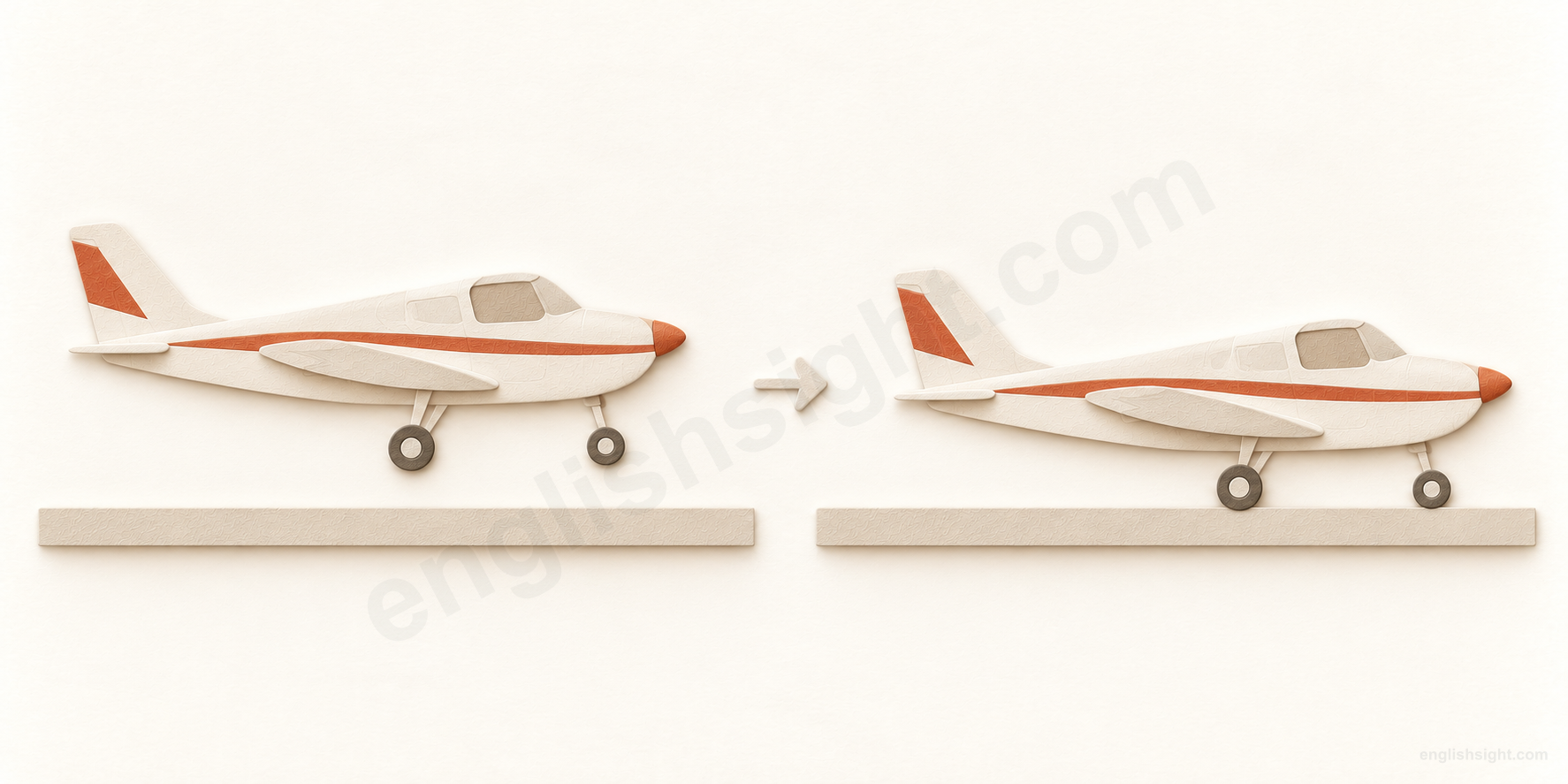
Connect land with areas of ground, reaching a surface, and established expressions for results.
The ground and the point of arrival
The ground and the point of arrival
Airborne above the ground
land
Its wheels meet the ground
The same plane comes down to the surface.
Land can name the ground; the plane lands when it reaches the surface.
Land names solid ground or an area of it; the verb land often marks reaching a surface, destination, or resulting situation.
The picture shows a physical landing. Landing can happen on water too, and the plane can continue moving after contact. Jobs, burdens, audience reactions, and idioms need the separate explanations below.
As a noun, land can name the solid ground, a particular area, property, or a country. As a verb, it often focuses on reaching a surface or destination, securing something, or finding yourself in a situation.
The picture links a plane’s arrival with the ground below it. That is a useful starting point, not a formula for every combination. Read the grammar and learn fixed expressions together.
01
Ground, property, and life from the land
Use the noun for solid ground, areas with a particular use, property, and farming. Prepositions distinguish location, route, and the source of a living.
01
on land; reach / see land; on dry land
on land / dry land
the solid ground rather than the sea or other water
Starting situation
A boat trip has kept you on the water.
Meaning or result
You are back on the ground beside the water.
The noun names a kind of surface, not an arrival event.
Use land without a or a plural ending when contrasting ground with water: on land, reach land, or see land. A land animal lives on the ground rather than in the sea.
Dry land emphasizes being out of the water. It does not necessarily describe soil that has no moisture: a rainy island still counts as dry land in this contrast.
For an ordinary outdoor surface beneath your feet, the ground is usually the natural choice. Say I dropped my keys on the ground. Inside a room, use the floor. The diagram’s ground strip illustrates the noun; the plane illustrates the separate verb.
In a sentence
After the rough crossing, we were glad to stand on dry land.
Watch the difference Land is uncountable in this contrast: on land, not on a land. Do not replace every use of ground with land.
02
travel / go / transport something + by land
travel by land
travel over the ground rather than by air or sea
Starting situation
You compare routes to a neighboring country.
Meaning or result
You choose a route over the ground.
By names the means or route; on land names the location.
By land describes how a journey is made and can include trains, buses, cars, or walking. It contrasts with by sea and by air, without specifying a particular vehicle.
On land tells us where something is. The two phrases can describe the same journey from different angles. Land transport uses land before a noun to classify the kind of transport.
In a sentence
We went by land because the ferry was cancelled.
Watch the difference Keep the bare noun in this travel expression: by land, not by the land. Use by train to specify the vehicle.
03
adjective / modifying noun + land; land use
fertile land / building land
an area of ground described by its quality or use
Starting situation
You assess what an area can be used for.
Meaning or result
You describe its condition or intended purpose.
Land is the area; the modifier supplies its quality or use.
Fertile land supports plant growth; agricultural land is used for farming; arable land is suitable for growing crops. Building land is intended or available for construction. The adjective or noun before land supplies this detail.
Land use is the way people use an area, such as for homes, farming, or woodland. Land here refers to the area, while soil refers to the material plants grow in. For filling a flowerpot, ask for soil rather than some land.
In a sentence
The village is surrounded by fertile land used for growing vegetables.
Watch the difference Land is usually uncountable here. Agricultural lands is possible for separate regions, but it is not needed for a single field.
04
own / buy / sell + land; a piece / plot / hectare of land; someone’s lands
own a piece / plot of land
have an area of ground as property
Starting situation
A family wants a site for a house.
Meaning or result
They buy a particular area of ground.
A plot counts the area; land itself is normally uncountable.
You can buy, sell, rent, or own land. Use a piece of land for an unspecified area and a plot of land for a particular piece, often for building or growing things. A hectare of land gives a measure.
Public land and private land distinguish types of ownership. Public ownership does not automatically allow every activity. Someone’s lands can mean their holdings, especially in formal or historical descriptions: the estate’s lands extend beyond the river.
Ancestral lands refers to areas associated with a community’s ancestors. Lands here names territories or holdings, rather than a plural for handfuls of soil.
In a sentence
They bought a small plot of land near the station.
Watch the difference For a house site, say a plot of land rather than a land. The countable country sense is different.
05
work / farm the land; leave / return to the land
work / farm the land
cultivate the ground or follow a farming way of life
Starting situation
A family lives by growing crops.
Meaning or result
They describe their work in agriculture.
The noun can evoke farming as an activity and way of life.
Work the land means cultivate it, and farm the land states the agricultural activity directly. The land can also stand for rural farming life in expressions such as leave the land for a city job or return to the land.
This is a noun phrase after work or farm, not the verb land. Working on the land can describe farming work; working on this plot can instead simply specify where a task happens.
In a sentence
Her grandparents worked the land before moving to the city.
Watch the difference The land here is a farming area or way of life. It does not mean that every outdoor job is farming.
06
live off the land; live off the fat of the land
live off the land
get food or a living from what the land provides
Starting situation
A household needs food throughout the year.
Meaning or result
Its own farming or gathered natural resources provide that food.
Off introduces the source of support, not movement away.
Live off the land describes supporting yourself with what you grow or obtain from the land. The context may involve farming or a more self-sufficient way of living. It does not simply mean having a house in the countryside.
Live on the land can describe a farming way of life; live off the land highlights where food or support comes from. Learn live off as a support pattern, rather than treating off as a direction.
Live off the fat of the land is a different established expression about enjoying abundant or luxurious food and comforts. It does not mean eating actual fat or necessarily growing your own food.
In a sentence
They keep chickens and grow vegetables so that they can live off the land.
Watch the difference Do not read off as leaving the land, or assume the longer fat of the land expression means basic subsistence.
02
Countries and imagined places
A land can mean a country or region, often with an emotional or storytelling tone. Some established expressions keep this territorial meaning.
07
a + adjective + land; plural lands; the / a land of + noun phrase
a distant land / the land of…
a country, region, or imagined realm
Starting situation
A story describes a place far from home.
Meaning or result
The place is presented with imagination or feeling.
This country or region sense can be countable.
A distant land, foreign lands, and someone’s native land refer to countries or regions, often in literary, emotional, or storytelling language. Country is usually the straightforward word for routine travel or administrative information.
The land of… presents a place as characterized by something, as in a land of opportunity or the land of giants. It may be real or imaginary. The extra description supplies the quality; land itself does not promise opportunity.
The land can also mean a particular country understood from context, as in throughout the land. This territorial sense differs from uncountable building land.
In a sentence
The children read about a distant land where the trees could speak.
Watch the difference A land is possible for a country or realm; it is not the normal way to count a building plot.
08
the law of the land
the law of the land
the law applying in a country
Starting situation
A discussion concerns rules binding in a country.
Meaning or result
The speaker refers to that country’s law as a whole.
The land stands for the country, not for property or soil.
The law of the land refers to a country’s law, often in a formal or emphatic statement. Of the land identifies the place where that law applies.
Land law is different: it names a subject concerning land and property. The law of the land is not restricted to rules about buying fields or houses.
In a sentence
All public officials must respect the law of the land.
Watch the difference Keep both articles in the expression. Do not interpret it as just property law.
03
Coming down and coming ashore
The subject can be the thing arriving or the person controlling its arrival. Landing concerns reaching a surface or shore; it does not always mean stopping all movement.
09
aircraft + land; land at + airport; land in + city / country; land on + surface
the plane lands
an aircraft comes down and reaches a surface
Starting situation
An aircraft is still in flight.
Meaning or result
Its wheels make contact with the runway.
The aircraft is the subject; no direct object is needed.
The plane lands describes the aircraft’s arrival at a surface. The plane is landing can describe the process as it happens. Take off describes leaving the surface to fly.
A flight can land at an airport or in a city or country; land on the runway identifies the contact surface. At, in, and on supply different ways of locating the same event.
Landing does not guarantee safety or an immediate complete stop: safely, roughly, or an emergency landing supplies further information. The plane may roll along the runway after touching down.
In a sentence
Our plane lands at Eastport Airport at six.
Watch the difference The plane landed is active intransitive grammar. It does not need was unless a different passive meaning is intended.
10
person + land + aircraft; aircraft + be landed + (by + person)
land the plane
control an aircraft as it comes down to a surface
Starting situation
The pilot controls an aircraft in flight.
Meaning or result
The pilot brings it onto the landing surface.
The controller is the subject; the aircraft is the object.
The pilot landed the plane is transitive: someone caused the aircraft’s landing through control. Compare The plane landed, which focuses on the aircraft’s own arrival without naming its controller.
A passive is possible when the aircraft is the topic: The damaged plane was landed safely by a trainee pilot. The by-phrase identifies the controller. This is different from The plane landed safely, which needs no passive auxiliary.
In a sentence
The pilot landed the small plane in a field.
Watch the difference The object names what is brought down: land it, not land to it. This is a transitive use, not a separable particle verb.
11
land + on / in / beside + place; land on + body part
land on / in something
reach a place or surface after flying, jumping, or falling
Starting situation
A bird is flying, or an object is falling.
Meaning or result
It reaches the place where it comes down.
The verb highlights the point of arrival or impact.
A bird can land on a branch, a ball can land in a pond, and someone who slips can land on their back. On often names the contact surface or the body part that takes the impact; in can name an area or container.
Land does not require solid earth: a water bird can land on water. Unlike fall, it does not necessarily suggest an uncontrolled downward movement. A bird may choose to land, while a dropped ball does not choose.
Land on your feet can be literal after a jump. Its separate figurative meaning is about a fortunate outcome. A landing can also be brief: a ball may land and then bounce.
In a sentence
The duck circled the pond and landed on the water.
Watch the difference The noun land contrasts with water, but the verb land can describe arrival on water. Do not force the noun’s restriction onto the verb.
12
athlete + land + a jump / named jump
land a jump
complete a jump successfully by coming down in control
Starting situation
A skater attempts a difficult jump.
Meaning or result
The skater comes down successfully.
The object is the jump being completed, not an aircraft being controlled.
In skating, gymnastics, and similar activities, land a jump means complete the jump with a successful landing. Here the object names the movement, while the athlete both jumps and lands.
She landed after the jump simply reports coming down. She landed the jump evaluates the completion as successful. The same spelling land + object can therefore describe different roles for that object.
In a sentence
After weeks of practice, I finally landed the jump.
Watch the difference This sporting pattern does not make land a general synonym for finish: do not say land my homework.
13
people + land + on / at / in + destination
land on an island
arrive at a place from a boat or aircraft
Starting situation
Travelers approach an island by boat.
Meaning or result
They reach the shore.
People can be the arriving subject, not only their vehicle.
We landed on the island describes arrival there by sea or air. At can locate an arrival point such as a port; on fits an island or shore. The journey’s context tells you whether the travelers used a boat or aircraft.
This extends the diagram’s arrival relation to coming ashore. It does not imply that people fell onto the beach. For a normal road journey, arrived or got there is usually a clearer choice than landed.
In a sentence
We crossed the bay in a small boat and landed on the island at noon.
Watch the difference Landing at a port and landing on an island describe arrival from water or air; do not assume every use means a plane touched down.
14
land + people / goods + on / at + place; people / goods + be landed
land passengers / goods
bring people or goods from an aircraft or boat onto land
Starting situation
Passengers or goods are aboard a boat.
Meaning or result
A crew puts them ashore.
The object identifies who or what is brought onto land.
A boat or its crew can land passengers, supplies, or cargo. The object is transferred ashore, rather than controlling the arrival. The passive focuses on the delivered people or goods: The supplies were landed before dark.
Goods can also be landed from aircraft. Collins marks the unloading-of-goods use as mainly British; unload the cargo is a clear everyday alternative. Land a catch can describe bringing a fishing boat’s catch ashore, distinct from landing an individual hooked fish.
In a sentence
The crew landed the supplies on the beach before the tide rose.
Watch the difference Cargo being landed is being brought or unloaded onto land, not being piloted like an aircraft. Read the object and context.
04
Securing something or making contact
A job, a fish, and a punch call for different interpretations of land. Read the object and the surrounding situation.
15
person + land + job / contract / role / deal
land a job / contract / role
succeed in obtaining an opportunity
Starting situation
You apply for work that several people want.
Meaning or result
You are selected for it.
The opportunity becomes secured, rather than physically reaching the ground.
Land a job, a contract, or a role is an informal way to emphasize successful acquisition. The object is something gained, often after effort or competition. Land a job is stronger than apply for a job: it reports success.
You can remember the result as something successfully brought within reach, but that is a teaching link, not a rule for replacing get. Say get a cold for becoming ill; land a cold is not an ordinary equivalent.
In a sentence
Maya landed a design job after showing the team her portfolio.
Watch the difference The ordinary pattern has a direct object: land a job, not land to a job. The tone is informal.
16
cause / helper + land + person + opportunity; land yourself + opportunity
land someone a job
help or cause someone to obtain an opportunity
Starting situation
A person has a skill or makes a good impression.
Meaning or result
That advantage results in an offer.
The first object is the beneficiary; the second is what they obtain.
Her experience landed her a job says the experience helped bring about the job offer. In land someone something, the first object names who benefits and the second names what they get.
Land yourself a job means succeed in getting a job for yourself. You can also simply say land a job. This double-object construction is a particular acquisition use; it does not authorize adding two objects to every meaning of land.
In a sentence
His language skills landed him a job with a travel company.
Watch the difference Compare His mistake landed him in trouble. A job is gained; in trouble describes the resulting situation.
17
angler + land + fish; land it
land a fish
catch a fish and bring it out of the water
Starting situation
A hooked fish is still in the water.
Meaning or result
The angler gets it into a boat or onto the bank.
Landing includes successfully bringing the fish in.
An angler can hook a fish but fail to land it if it escapes before being brought in. Land the fish therefore focuses on completing the catch, not merely getting a bite.
The fish can be brought into a boat; it need not end up on dry earth. This is a fishing use of successful retrieval, distinct from a duck that lands on the water and from unloading a boat’s catch at a port.
In a sentence
It took ten minutes to land the trout in our small boat.
Watch the difference Land a fish does not just mean see it, hook it, or put it back in the water.
18
land + a punch / blow + (on + target); punch / blow + land
land a punch / a punch lands
successfully hit a target with a blow
Starting situation
A boxer throws a punch toward an opponent.
Meaning or result
The punch makes contact.
The verb marks contact, rather than just the attempted movement.
Land a punch or blow means make it hit. A boxer can throw several punches without landing any. On introduces the target or place struck, as in land a blow on the shoulder.
The punch landed uses the punch as subject with no direct object. The boxer landed a punch uses the person as subject and the blow as object. Neither sentence means the boxer arrived on the ground.
In a sentence
The boxer landed a clean punch on his opponent’s shoulder.
Watch the difference Throwing a punch describes the attempt; landing it says it connected.
05
Where things end up and how they are received
These constructions describe consequences, burdens, final choices, criticism, and audience response. Their grammar and register matter as much as the arrival image.
19
message / document / task + land + on / in + destination; problem + land in + possessive + lap
land on someone’s desk / in an inbox / in someone’s lap
arrive somewhere, often unexpectedly or needing attention
Starting situation
A report is sent to an office.
Meaning or result
It arrives where someone will have to deal with it.
An arrival can be presented figuratively, without a fall through the air.
A report can land on your desk, and an email can land in your inbox. Informal land makes the arrival noticeable; with complaints or urgent work, it can imply that the recipient now has a problem to handle.
The subject is what arrives, and the prepositional phrase identifies the destination. Unexpectedness or difficulty often comes from the context, not from a requirement that every arrival be bad: a welcome invitation can land in your inbox too.
A problem can also land in your lap: it becomes yours to deal with, although it was not originally your responsibility. For example, The dispute landed in my lap after the coordinator resigned means I unexpectedly had to handle it. Learn in someone’s lap as an idiom, rather than a literal destination.
In a sentence
An urgent complaint landed in my inbox just before I left.
Watch the difference An email landing in an inbox highlights arrival. A problem landing in your lap gives you a responsibility; someone landing you with work explicitly names the cause.
20
person + land in + difficulty / resulting place
land in trouble
end up in a difficult situation
Starting situation
Someone takes a risk or breaks a rule.
Meaning or result
They find themselves facing consequences.
The subject experiences the resulting situation.
Land in trouble is informal and focuses on the troublesome result. Land in court or land in jail can similarly describe where a chain of events leads. The person does not need to have physically fallen there.
In identifies the resulting situation or place. Compare land in a field after a flight, where the same preposition gives a literal location. The complement and context tell you which meaning is intended.
In a sentence
If you keep ignoring the rules, you may land in trouble.
Watch the difference Use in trouble without an article. This reports a result, not an intentional plan to visit trouble.
21
cause + land + person / yourself + in + situation; land + person + in it
land someone in trouble / land someone in it
cause a person to end up in difficulty
Starting situation
A mistake or disclosure has not yet had its consequences.
Meaning or result
It leaves someone facing trouble.
The subject is the cause; the object is the affected person.
Your mistake landed us in trouble names your mistake as the cause and us as the people affected. Compare We landed in trouble, which leaves the cause outside the grammatical subject.
Land someone in it is an informal fixed expression meaning get them into trouble; it need not refer back to a previously named place. Land yourself in trouble makes the cause and affected person the same.
An active sentence can focus on the cause, while a passive such as We were landed in a difficult situation focuses on the people affected. This is a causative use of land, not land someone to do something.
In a sentence
That careless email landed the whole team in trouble.
Watch the difference Keep the person before in: landed us in trouble. Landed in us trouble does not express this relation.
22
land + person + with + burden; person + be / get landed with + burden
land someone with… / be landed with…
leave someone responsible for something unwelcome
Starting situation
A task or bill still needs someone to handle it.
Meaning or result
One person is made responsible for it.
The affected person comes before with; the unwanted responsibility follows it.
Land me with the washing-up says someone has left the unwanted task for me. It is informal and especially associated with British usage. With introduces the burden; it does not mean I am accompanying the task.
The passive is useful when the burdened person matters most: I was landed with the bill or I got landed with the bill. Be or get supplies the passive frame; landed is the past participle.
Compare land someone in trouble, which describes a resulting situation, and land someone a job, which describes something they gain. The words after the affected person change the relationship.
In a sentence
When everyone else left early, I got landed with all the cleaning.
Watch the difference Say They landed me with it, with me before with. This burden use does not mean they successfully obtained it for me as a favor.
23
land up + in / at / on + final place; land up with + eventual responsibility / possession
land up in / at / on / with…
reach a final place or situation after events unfold
Starting situation
A journey or series of events takes several turns.
Meaning or result
You describe the eventual place or outcome.
Up belongs to the end-result expression, not an upward direction.
Land up is an informal expression, mainly British, similar to end up. We landed up at a late-night café says that was our eventual destination, perhaps after other plans changed.
The following preposition fits the result: in a town, at a café, on the wrong train, or with extra work. Land up with extra work presents what you eventually have; They landed me with extra work names somebody as the cause.
Learn land up as a unit. This result use has no ordinary direct object to move around: I landed up there, not I landed there up. Do not use up to describe a plane rising into the air.
In a sentence
After trying three closed restaurants, we landed up at a café near home.
Watch the difference Land up is about where events lead, not necessarily an aircraft’s descent. End up is a broadly useful alternative.
24
land / fall on + possessive + feet
land on your feet
end up in a good position despite a difficulty or risk
Starting situation
A person loses a job or faces a setback.
Meaning or result
They unexpectedly find a good new situation.
A successful physical landing becomes an image for a fortunate outcome.
Figuratively, land on your feet means find yourself in a good position, often through luck after a difficulty. Fall on your feet is another form of the idiom. It need not mean the person never faced a problem.
Literally, a gymnast can land on her feet after a jump. A new job after a setback makes the figurative interpretation clear. The possessive changes with the subject: I landed on my feet; they landed on their feet.
In a sentence
Lena lost her job, but she landed on her feet with a better one a month later.
Watch the difference Do not interpret the figurative expression as a comment on posture or replace feet with another body part.
25
land on + person + (for + noun / -ing)
land on someone for doing something
criticize or scold someone sharply
Starting situation
A person discovers that someone ignored instructions.
Meaning or result
They criticize that person forcefully.
An informal American expression uses on to identify the target of criticism.
Land on someone can mean reprimand or criticize them severely in informal American English. For introduces the behavior being criticized: landed on me for being late.
This is an established expression, not a literal description of falling onto a person. It also differs from land on an option, where the subject reaches a choice. Criticize or tell someone off can make the intended meaning clearer.
In a sentence
My supervisor landed on me for ignoring the safety instructions.
Watch the difference The person follows on: landed on me. Landed me on describes a different physical or causative pattern.
26
land on + chosen option; land on + noun + as + role
land on a choice / name / option
finally choose an option after considering alternatives
Starting situation
A group compares several possible names.
Meaning or result
It settles on one name.
The final choice is treated as the endpoint of deliberation.
As an additional informal expression, land on something can mean settle on it after considering alternatives. The object of on is the chosen name, plan, person, or other option. The arrival image offers a useful teaching link to the end of a search.
The choice can be a person as well as a thing: We landed on Nina as our guide means we chose Nina for that role. On introduces what the discussion settles on; it does not describe physical contact. Decide on or settle on is a clear alternative.
Compare land a job, where something is obtained, and land on someone for a mistake, where somebody is criticized. The surrounding words distinguish the meanings; on does not have one automatic interpretation.
In a sentence
After comparing several names, we landed on “Maple” for the new café.
Watch the difference Keep on for the choice expression. Land an option is not an automatic equivalent of decide on one.
27
joke + land / not land; joke + land well / badly
a joke lands / doesn’t land
a joke gets or fails to get its intended response
Starting situation
A speaker makes a joke.
Meaning or result
The audience responds as intended, or the attempt falls flat.
The subject is the joke; the result concerns the audience.
In informal talk about comedy, a joke lands when it works with the audience. It didn’t land usually says it failed to get the hoped-for response, such as laughter. There is no literal object reaching the ground.
The joke is the subject in this pattern: the speaker tells it, and the audience provides the response. Compare The comedian landed a job, where the performer is the subject and the job is something obtained. Linking reception with arrival is a teaching interpretation, not a rule for every use of land.
This pattern does not itself tell you why a joke failed. The audience might not understand it, might not find it funny, or might consider it unsuitable. Keep those judgments separate.
In a sentence
My opening joke didn’t land, so I moved straight to the main topic.
Watch the difference This does not mean that the speaker forgot to finish the joke. It describes its reception.
06
Expressions to learn as a whole
These familiar images describe circumstances, uncertain categories, waking or recovering, and hoped-for prosperity. Learn the full expression rather than translating land alone.
28
the lie / lay of the land; get / check the lie / lay of the land; see how the land lies
the lie / lay of the land
the shape of terrain, or the way a situation is organized
Starting situation
You face unfamiliar terrain or an unfamiliar organization.
Meaning or result
You learn its shape, relationships, and circumstances.
A physical layout supplies an image for understanding a situation.
The lie of the land is the British form; the lay of the land is the North American form. Literally it concerns the shape and physical features of an area: a ridge may hide a building because of the lie of the land.
Figuratively, getting the lay of the land at a new workplace means finding out how things are arranged and how they stand. No actual map or hillside is required.
See how the land lies is a related British expression about finding out the situation before deciding what to do. Here lies concerns how things are positioned; it does not mean people are telling falsehoods.
In a sentence
Before suggesting changes, I spent a week getting the lay of the land at the office.
Watch the difference Learn the regional noun forms as phrases. The land lies is not a claim that the ground is being dishonest.
29
no man’s land; a no man’s land between + categories
no man’s land
an area controlled by neither side, or a situation between clear categories
Starting situation
Two opposing sides have separate territories.
Meaning or result
An intervening area is controlled by neither side.
Neither side clearly controls the space or category in question.
Literally, no man’s land is an area between opposing armies or borders that neither side controls. It does not merely mean land with no buildings or no people.
Figuratively, someone or something can be in a no man’s land between roles, groups, or categories. For example, an unresolved job status may leave someone neither clearly employed nor clearly independent. The absence of a clear category is the point, not the person’s gender.
In a sentence
The role sits in a no man’s land between technical support and sales.
Watch the difference This is a fixed compound expression. It does not simply mean private land, empty land, or an area with no men.
30
be / be back in the land of the living; be in the land of Nod
back in the land of the living
alive, awake again, or recovered enough to take part
Starting situation
Someone has been asleep, ill, or out of normal activity.
Meaning or result
They are awake or feeling active again.
An imagined realm represents being alive and participating.
In the land of the living can literally mean alive, but it is often humorous when someone wakes up or starts feeling better after illness. Back signals a return to normal activity; it need not imply that the person nearly died.
In the land of Nod is an old-fashioned humorous expression for asleep. Nod is part of that fixed expression; the basic noun land alone does not mean sleep or recovery. Use these expressions with attention to tone, especially around serious illness.
In a sentence
After sleeping through the morning, I was finally back in the land of the living.
Watch the difference The waking-up use is humorous. It does not by itself report a return from death.
31
a / the land of milk and honey
a / the land of milk and honey
a place imagined as prosperous and easy to live in
Starting situation
People hope that moving elsewhere will improve their lives.
Meaning or result
They picture the destination as full of comfort and opportunity.
The whole expression conveys imagined abundance.
A land of milk and honey describes a place where life is expected to be pleasant and plentiful. It is figurative; it does not normally advertise two agricultural products.
The phrase can express a hopeful image or question an unrealistic expectation. Calling somewhere a land of milk and honey does not prove life there is easy. The article depends on whether the place is being described as one such place or as the expected ideal.
In a sentence
They soon discovered that the new city was no land of milk and honey.
Watch the difference Interpret the phrase as a whole. It is not a literal claim about milk production or beekeeping.
Choose the meaning from the whole construction
Noun, verb, and forms
The noun and verb are both pronounced /lænd/. The verb forms are land, lands, landed, landed, landing; landed has two syllables, /ˈlændɪd/. The noun is normally uncountable for ground or property, but a land can be a country or realm. Plural lands also occurs for territories and formal descriptions of holdings.
Active, passive, and cause
The plane landed is intransitive. The pilot landed it is transitive; it was landed by the pilot is passive. Land someone a job, land someone in trouble, and land someone with a bill assign different roles to the person and following phrase. Do not invent a general land someone to do construction.
Read on, in, with, and up in context
On a runway and in a field can be ordinary location phrases. Land up is an established result expression. Land someone with something and land someone in it have conventional meanings. Not every verb followed by a preposition is a separable phrasal verb.
A teaching picture, not a universal mental image
The diagram connects ground and physical arrival. It does not claim that every English speaker pictures land this way or that all its senses can be deduced from a plane. The metaphorical links are learning aids, not proofs of meaning or historical derivations.
Scope and register
The course covers the main modern noun and verb uses and a selection of established expressions, including some regional and informal ones. Technical land rights, machinery ridges, specialist rugby scoring, proper names, and a full catalogue of compounds are not expanded here. Landing as a staircase platform is a separate noun use outside this lesson.
Read the object and the result
Choose the expression that fits the situation, not just the word land.
1. You want to buy a small area for a house. Which phrase fits?
2. A duck flies down onto a pond. Can you say it landed on the water?
3. Which sentence explicitly names the person controlling the aircraft’s descent?
4. Everyone leaves and you must do the unwanted cleaning. Which wording fits?
5. In “Her skills landed her a job,” what does the second her, immediately after landed, identify?
6. Someone loses a job but quickly gets a better one. What does She landed on her feet mean here?
7. You are describing how you traveled, rather than simply where you were. Which phrase names a route?
8. You say a joke didn’t land after an audience stayed silent. What are you describing?
Sources and teaching notes
Main noun and verb uses were checked against Oxford and Collins, with Merriam-Webster and named supplemental sources for particular uses. Explanations and examples are original. Visual and metaphorical links are teaching interpretations; supplemental usage examples are identified as such.
The diagram is a learning aid, not a picture shared by every English speaker.