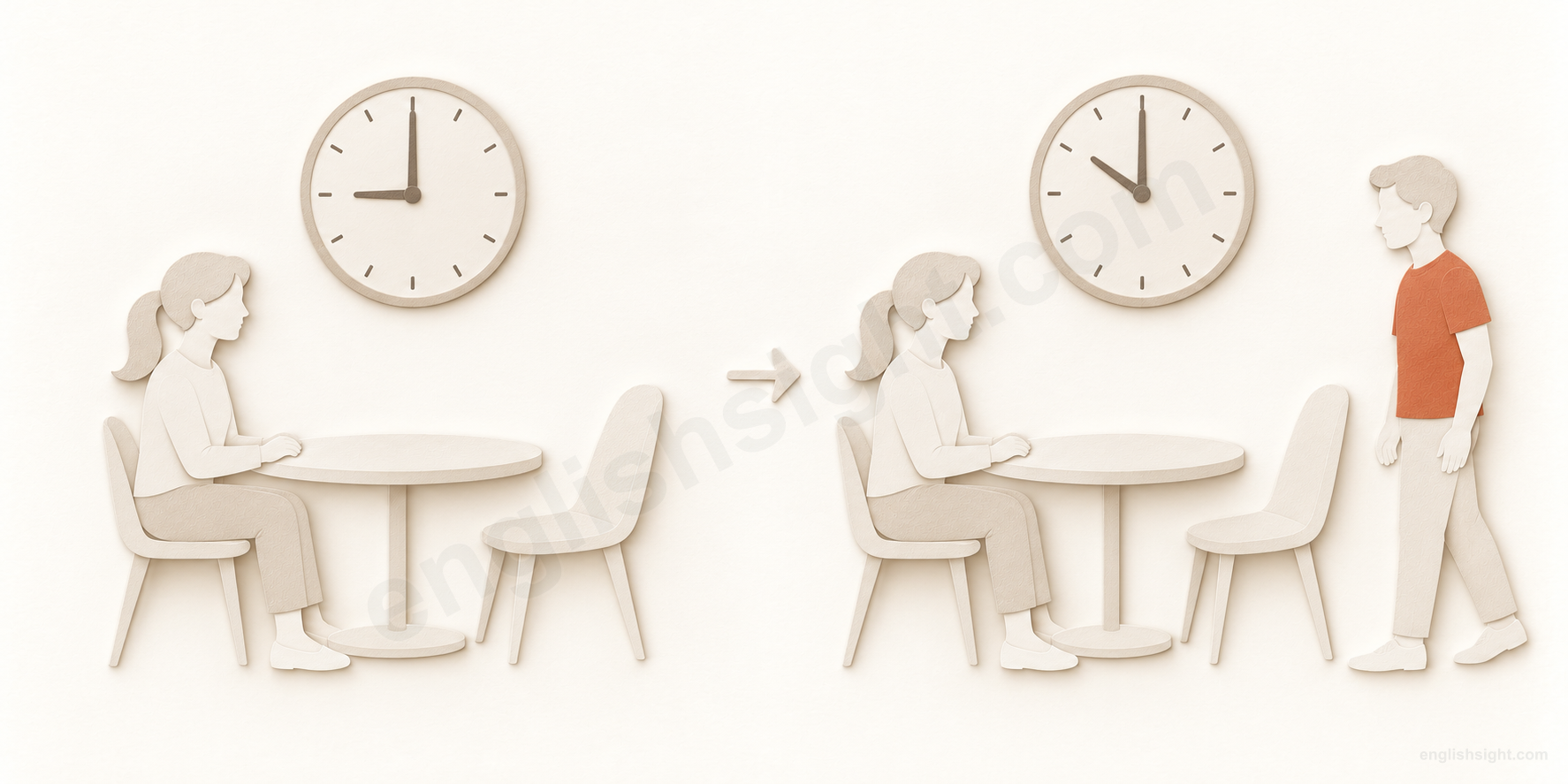
Late can mean beyond an expected time or toward the end of a period. The reference makes the difference.
Expected time and actual time
Beyond the expected point
At the agreed time, the guest’s chair is still empty.
late
The guest arrives while the other person is still waiting.
An hour passes beyond the agreed time.
The guest arrives an hour after the agreed time: late.
Late places something after an expected or usual time, or toward the end of a relevant period.
The sketch focuses on the expected-time use. In late summer, the reference is a period’s ending rather than a missed appointment. The deceased meaning is a separate established branch.
A train can be late at noon, while a concert at midnight can start on time. Late needs a reference: an expected time, a usual hour, or the shape of a period.
The timeline is a teaching model for timing. Fixed expressions and the adjective meaning deceased need their own explanations; they cannot all be predicted from a picture.
01
After the expected time
First identify the appointment, deadline, or usual time. Late compares the actual timing with that reference.
01
be + late + for + event / work / school
be late for
not be ready or present at the required time
Reference / situation
Your class starts at nine.
Timing / result
You reach the classroom after nine.
For identifies the appointment or activity whose time you miss.
In I am late for class, late describes me and for class supplies the time-sensitive activity. An apology can simply be Sorry I’m late when everyone knows the appointment.
Late can describe a person, vehicle, or event: The bus is late. It reports timing, not how fast something moves. A slow bus may still arrive on time.
In a sentence
I’m late for my driving lesson because the bus broke down.
Watch the difference For class names the scheduled activity; at the classroom describes a location, while to the classroom indicates a destination. Keep those roles distinct.
02
verb + (duration) + late; be + (duration) + late
arrive ten minutes late
happen after the scheduled time by a stated amount
Reference / situation
The train is due at 10:00.
Timing / result
It arrives at 10:10.
The duration measures the gap after the expected point.
Late is already an adverb in The train arrived late. No -ly ending is needed. The train was late uses the same word as an adjective.
Ten minutes late is ten minutes behind the expected time. Ten minutes later only places an event ten minutes after another reference event; that event might still be on time.
In a sentence
The airport bus arrived ten minutes late.
Watch the difference Write ten minutes late, not late ten minutes, in this ordinary pattern.
03
be + running + (a little / duration) + late
be running late
be behind schedule
Reference / situation
Getting ready takes longer than planned.
Timing / result
You expect to reach your appointment after its starting time.
Running describes how the schedule is progressing, not physical running.
I’m running late can warn someone before you arrive. It says your preparations or journey are behind schedule. A train or meeting can be running late too.
This is an established use of run with a timing description. It does not mean that you are moving quickly, and it is not a phrasal verb with late as a particle.
In a sentence
I’m running a little late; please start the meeting without me.
Watch the difference Being late does not imply running; running late can be true while you are still at home.
04
be late with + item; be late in + -ing; late + payment / reply / arrival
be late with a payment / in replying
complete something after it is due or expected
Reference / situation
The rent or reply is expected earlier.
Timing / result
The person has not supplied it on time.
With names what is overdue; in introduces the delayed action.
She is late with the rent focuses on a payment she owes. Sorry I’m late in replying focuses on an action; replying follows the preposition in, so it has the -ing form.
Before a noun, late can describe the delayed action or item: a late payment, a late reply, a late arrival. A late fee is a fee charged because a payment or return is overdue; the fee itself need not arrive late.
In a sentence
We are a week late with the rent, so I’ll contact the landlord today.
Watch the difference Late for the meeting concerns attendance; late with the report concerns providing the report.
05
a + late + meal / start / flight
a late lunch / a late start
an event later than usual or planned
Reference / situation
Lunch or an activity would normally begin earlier.
Timing / result
It begins at a later hour.
Late can modify the event noun directly.
A late lunch may be planned for three o’clock; nobody has to have broken a promise. A late start can be later than intended or later than people usually start.
Compare a late flight, which can mean a flight scheduled for a late hour, with My flight is late, which normally means it is delayed. The surrounding sentence identifies the reference.
In a sentence
We booked a late flight so we could finish work first.
Watch the difference A late event is not automatically an unexpected delay; the reference may be the usual hour.
06
work / stay / stay up / sleep / get up + late
work late / stay up late / sleep late
continue an activity until a late hour, or get up at a late hour
Reference / situation
The usual time for stopping an activity or getting up arrives.
Timing / result
The activity continues, or getting up happens later.
The verb determines whether late concerns continuing an activity or the time of a change.
Work late means keep working until a later hour. Stay late means remain at a place until a late hour. Stay up late means remain awake instead of going to bed. Sleep late normally means continue sleeping until a late waking time.
Sleep late is different from go to sleep late: the latter concerns falling asleep, not waking up. Get up late concerns leaving bed. Late describes the timing; it does not tell us the total hours of sleep.
In a sentence
I stayed up late on Friday, so I slept late on Saturday.
Watch the difference Do not use sleep late to mean only that you fell asleep late; say go to sleep late.
07
be / arrive + fashionably late
fashionably late
arriving after a social event starts, sometimes to make an impression
Reference / situation
A social event begins.
Timing / result
A guest makes a deliberately later entrance.
Fashionably adds a social attitude to lateness.
The phrase can suggest arriving late to seem important or stylish. It is also used humorously when someone is simply late.
It describes a social convention or a speaker’s attitude, not a rule that lateness is acceptable. It is unsuitable as a general excuse for missing work or a medical appointment.
In a sentence
“Fashionably late?” Eva joked as I reached the party half an hour after everyone else.
Watch the difference The expression may be teasing; it does not guarantee approval of the delay.
02
Toward the end of a period
The reference can be a day, season, decade, age range, or stage. A late position need not break a schedule.
08
it + be / get + late
It’s getting late.
the day has reached a late hour
Reference / situation
Time passes during the evening.
Timing / result
The hour feels advanced for the current activity.
It refers to the time; getting marks a change.
It’s late evaluates the hour. It’s getting late draws attention to time passing and often suggests leaving or stopping.
The reference depends on the activity: a late hour for calling a child may be an ordinary hour for a night worker. This sentence need not mean that anyone has missed an appointment.
In a sentence
It’s getting late; shall we finish the discussion tomorrow?
Watch the difference It gets late describes a recurring situation; It’s getting late describes the current change.
09
late at night; have a late night; late-night + noun
late at night / a late night / late-night
a late hour, a night spent awake, or something available at that hour
Reference / situation
The ordinary evening or bedtime passes.
Timing / result
An activity takes place or continues at a late hour.
The position and spelling distinguish three related expressions.
Late at night tells when something happens: We heard a noise late at night. Have a late night means go to bed later than usual. It does not mean that the night began late.
Before a noun, late-night is a compound adjective: a late-night café is open at a late hour. In a late-night meal, the meal happens then. Use no hyphen in We had a late night.
Late into the night emphasizes that an activity continues well into the night: We talked late into the night. Into supplies continuation through time; it does not turn late into a phrasal verb.
In a sentence
After a late night, we stopped at a late-night café on our way home.
Watch the difference Write late at night, not late in night; distinguish a late night from the adjective late-night.
10
late in + period; in late + month / season; in the late + decade; late last / next / this + period
late in May / in late May
near the end of a named time period
Reference / situation
A month or season has an early part and a later part.
Timing / result
The event falls toward the end.
The reference is a period’s internal structure, not a deadline.
We moved late in May and We moved in late May both locate the move near the end of May. Late in the afternoon and in the late afternoon work similarly.
Use in late summer and in the late 1990s. With last, next, or this, an adverbial time phrase needs no extra in: late last year, late next week, late this afternoon. These expressions do not themselves mean delayed.
In a sentence
The trees began to flower in late March.
Watch the difference Late March is a part of March; a late train is usually a train behind its schedule.
11
in + possessive + late + teens / twenties / thirties…; late in life
in her late twenties / late in life
near the upper end of an age range or at an advanced point in life
Reference / situation
A person passes through a span of years.
Timing / result
The event falls in the later part of that span.
The range, rather than an appointment, supplies the reference.
In her late twenties usually suggests about twenty-seven to twenty-nine; the boundary is approximate. Her late teens means roughly eighteen or nineteen.
Late in life describes an advanced stage of someone’s life without naming an exact age. Neither expression says the person has failed to meet a universal life schedule.
In a sentence
Mara started learning the violin in her late twenties.
Watch the difference Use a possessive with an age range: in her late twenties, not in late twenty.
12
at a late stage; a late + event; possessive + late + works
a late stage / a late goal / late works
something in the final part of a process, event, or career
Reference / situation
A project, match, or career has progressed.
Timing / result
The event or work belongs near its end.
A sequence can supply the same early-to-late contrast as a day.
A late goal is scored near the end of a match; it is not necessarily scored after an agreed deadline. At a late stage means much of a process has already happened.
An artist’s late works belong to the later part of that artist’s career. Late does not mean newest in every context: a composer’s late works may have been written centuries ago.
In a sentence
Changing the design at this late stage would delay the opening.
Watch the difference Do not equate late works with the latest works; late locates a career stage, latest selects the most recent.
13
be + a late bloomer / a late developer
a late bloomer / a late developer
someone whose ability, success, or development appears later than usual
Reference / situation
Other people reach a stage or show a skill earlier.
Timing / result
This person reaches it at a later age or stage.
The comparison is with an expected course of development.
A late bloomer may discover a talent or achieve success at an older age than is usual in that activity. The flowering metaphor belongs to the established noun phrase.
A late developer can concern physical development or a skill that appears later. Context tells us the area; neither phrase means someone who regularly arrives late.
In a sentence
As a painter, Leon was a late bloomer: his first exhibition opened when he was sixty.
Watch the difference Describe the particular development rather than assuming late means poor ability.
03
Delay, opportunity, and judgment
These expressions say whether waiting has reduced an opportunity, or whether doing something late is still worthwhile.
14
too late (for + noun / to + verb); not / never too late to + verb
too late to… / not too late to…
after the useful or possible time, or still within it when negated
Reference / situation
There is a period when action can work.
Timing / result
That opportunity has closed, or remains open in the negative.
Too adds the idea of exceeding a useful limit.
We were late can simply report a delay. We were too late to enter says entry was no longer possible or allowed. Too late for the last bus likewise relates the timing to a lost opportunity.
It’s not too late to change the booking means the opportunity remains. It’s never too late to learn is encouragement, not a factual promise that every opportunity has no deadline. Too can also express impracticality: It’s too late to phone now may mean the hour is socially unsuitable.
In a sentence
It’s not too late to change your order; the kitchen hasn’t started cooking it.
Watch the difference Very late describes degree; too late says a relevant practical or acceptable limit has been passed.
15
leave it + (a bit / very / too) late + to-infinitive
leave it late / leave it too late
wait until little time, or no useful time, remains
Reference / situation
You could start or act earlier.
Timing / result
You delay until close to the limit or beyond it.
Leave describes postponing the action, not physically abandoning an object.
You left it late to book the tickets criticizes waiting until near the relevant deadline. Leave it too late adds that the delay prevents the intended result.
It stands for the action under discussion. Don’t leave it until the last minute is a related warning, but late alone need not mean the final minute.
In a sentence
We left it too late to book seats together; only single seats remained.
Watch the difference A late booking may still succeed; leaving it too late says the relevant aim can no longer be achieved.
16
better late than never
Better late than never.
doing something late can still be better than not doing it
Reference / situation
A useful action has been delayed.
Timing / result
It finally happens instead of being abandoned.
The saying compares a delayed result with no result.
Use this saying to welcome a late arrival, achievement, or response. It can be sincere encouragement or a mildly sarcastic comment when someone finally acts.
The full saying carries the judgment. It does not deny that the delay caused problems, and it may be tactless when the missed deadline has already caused serious harm.
In a sentence
“I finally sent the thank-you note.” “Better late than never!”
Watch the difference Than introduces the comparison; do not replace it with then.
17
(too / rather) late in the day / game
late in the day / late in the game
at an advanced stage when action may have little effect
Reference / situation
Much of a situation has already unfolded.
Timing / result
Someone finally proposes an action or change.
Day or game can represent the whole developing situation.
Figuratively, That’s rather late in the day for an objection means the objection comes after a long opportunity to raise it and may no longer help. This often conveys disapproval.
Late in the game is a corresponding expression, especially in North American English. Both can also be literal: a goal late in the game concerns the closing part of a real match. Context distinguishes the two.
In a sentence
With the contract already signed, it’s rather late in the day to question the price.
Watch the difference The figurative expression need not refer to the evening or an actual game.
18
be + too little, too late
too little, too late
an inadequate response that also comes after serious damage
Reference / situation
A problem needs earlier and stronger action.
Timing / result
The response is both insufficient and delayed.
The expression criticizes amount and timing together.
Too little, too late judges a response on two grounds: it is not enough, and it comes too late to deal adequately with the problem. It commonly follows be or is used as a short comment.
Keep both criticisms. An early but small response is not necessarily too little, too late; nor is a large response that merely arrives later than expected.
In a sentence
After weeks of water shortages, the small delivery felt like too little, too late.
Watch the difference The phrase is a negative evaluation, not neutral information about a small delay.
04
Recent time, comparison, and special meanings
Learn the established expressions and related forms individually. The timeline does not explain every meaning of late.
19
as late as + clock time / date / time phrase
as late as
emphasize how late or how recent a time was
Reference / situation
The listener might expect an earlier time.
Timing / result
The stated time is later or more recent than that expectation.
As…as highlights a surprisingly late point.
The café stays open as late as two in the morning emphasizes a late closing time. As late as last year, they were still using paper tickets emphasizes how recently the old situation continued.
The expression does not by itself report a broken schedule. In the historical use, it concerns recency relative to now; in the clock-time use, it emphasizes an advanced hour.
In a sentence
As late as last summer, this road was still unpaved.
Watch the difference As late as emphasizes a late or recent point; no later than sets a deadline.
You describe a recent state, change, or repeated event.
These expressions mean recently, not behind schedule.
Of late is a fairly formal way to say recently. It often appears with a perfect tense: She has been quieter of late. In everyday conversation, lately or recently is usually a simpler choice.
Lately is a separate adverb, not the ordinary manner form of late. Compare He has arrived late twice this week with He has been arriving early lately: the first reports delayed arrivals; the second describes a recent pattern.
In a sentence
Our evening classes have become more popular of late.
Watch the difference We arrived lately is not the normal way to say we missed the scheduled arrival time; use arrived late.
21
possessive + late + person noun; the late + name / title
her late husband / the late…
a person who has died
Reference / situation
The person was alive in the past.
Timing / result
The speaker refers to that person after their death.
Before a person’s description or name, late can mean deceased.
Her late husband refers to her husband who has died. The late Dr Martin is a respectful or formal reference to a doctor who is no longer alive. This is an established adjective meaning, not someone arriving after an appointment.
It normally comes before the noun or name. My husband is late ordinarily means he is delayed, so do not use that sentence to announce his death. Use former or previous for an office-holder who has left a job and is still alive.
In a sentence
The scholarship honors the late Professor Helen Ward.
Watch the difference My late husband and My husband is late have very different meanings.
22
person description, late of + place / institution
late of…
formerly, until recently, associated with a place or institution
Reference / situation
Someone lived or worked at the named place.
Timing / result
That connection has recently ended.
Of introduces the former place or institution.
In formal biographical wording, a designer, late of a certain studio means the designer worked there until recently. The phrase does not say the person has died.
This is mainly useful for recognition. In ordinary conversation, who used to work at… is clearer. Keep it distinct from of late, which means recently without naming a former affiliation.
In a sentence
Our new curator is Priya Sen, late of the Northbridge Museum.
Watch the difference Late of the museum means formerly connected with it; of late means recently.
23
later (than…); duration + later; later on; sooner or later; sooner rather than later
later / later on / sooner or later
at a subsequent time, without necessarily missing a schedule
Reference / situation
You identify now or another reference event.
Timing / result
The next event comes after that point.
Later compares two times; late normally compares timing with an expectation or period.
I’ll call later places the call after now. We returned two days later places the return two days after a previously mentioned event. A later train is a train scheduled after another one, not necessarily a delayed train.
Later on is an informal alternative for a subsequent time. See you later is a familiar parting expression. Sooner or later means eventually, with no exact date. Sooner rather than later expresses a preference for action without a long wait.
In a sentence
The workshop ended at two, and we met again an hour later.
Watch the difference An hour later does not itself mean an hour late. Later, not latter, is the ordinary time comparison.
24
no / not later than + time; time + at the latest; the latest + time
no later than / at the latest
at or before the last acceptable time
Reference / situation
A task has a latest acceptable completion point.
Timing / result
The instruction excludes completion after that point.
These expressions set an upper time limit.
No later than Friday means Friday is the last acceptable day. Friday at the latest gives the same kind of limit. Earlier completion is allowed; a time after Friday is excluded.
The latest time is the furthest permitted point, not a prediction of when something will actually happen. Keep the the in at the latest. This fixed expression is more useful than trying to build a superlative adverb mechanically.
In a sentence
Please return the keys by six at the latest.
Watch the difference Later than six permits a time after six; no later than six excludes it.
25
the latest + noun; possessive + latest + noun; the latest
the latest news / the latest model
the most recent or newest of its kind
Reference / situation
Several versions, reports, or products appear over time.
Timing / result
You select the most recent one.
Latest can identify recency, rather than a delay.
The latest news is the newest available information. The latest model is the newest version, often presented as modern or advanced. The word does not guarantee that the version is better.
Latest is the usual superlative adjective form of late. Contrast a late report, which may be overdue, with the latest report, the most recent one. The latest can also stand alone for the newest information: Have you heard the latest?
In a sentence
Have you installed the latest version of the app?
Watch the difference Latest does not mean final forever: a newer version may appear later.
Check the reference and the whole expression
Adjective and adverb share the same form
Late /leɪt/ can describe a noun or the timing of a verb. It is not a verb here, so verb inflection, passive voice, causative patterns, and separable particle-verb rules do not apply. Running late is a construction with run.
Timing is different from speed
Late concerns when something happens relative to a reference. Slow concerns speed or rate. Early is the usual timing opposite. The exact boundary of a late hour or a late stage depends on the situation.
Related words carry their own grammar
Use later for a subsequent time, latest for the newest item or a final limit in fixed wording, and lately for recently. Latter and last have other uses; do not treat them as freely interchangeable time forms.
A model with limits
The timeline connects common timing uses. Of late, late of, and late meaning deceased are established expressions or senses. This lesson is a practical selection, not an exhaustive list of historical, regional, or specialist uses.
Choose the time relationship
Look for the reference time, the grammar, and any fixed expression.
1. A meeting was scheduled for 10:00. You arrive at 10:15. Which sentence directly reports the delay?
2. Your holiday is planned for the final part of August. Which sentence gives that timing without suggesting a delay?
3. The application deadline has passed, and the website accepts no more applications. Which phrase fits?
4. You want to say that you remained in bed asleep until eleven. Which sentence is clearest?
5. In “her late husband,” what does late mean?
6. A notice says “Return the keys no later than six.” Which return time meets that limit?
Sources and teaching notes
Dictionary entries below support the uses and constructions. The explanations, examples, and compatibility sketch are original teaching material; the timeline is a teaching model.
The diagram is a teaching aid, not a shared mental picture of every English speaker.