Understand the laugh, then read its cause, attitude, and familiar expressions.
A person reacts through breath, voice, and face
A person reacts through breath, voice, and face
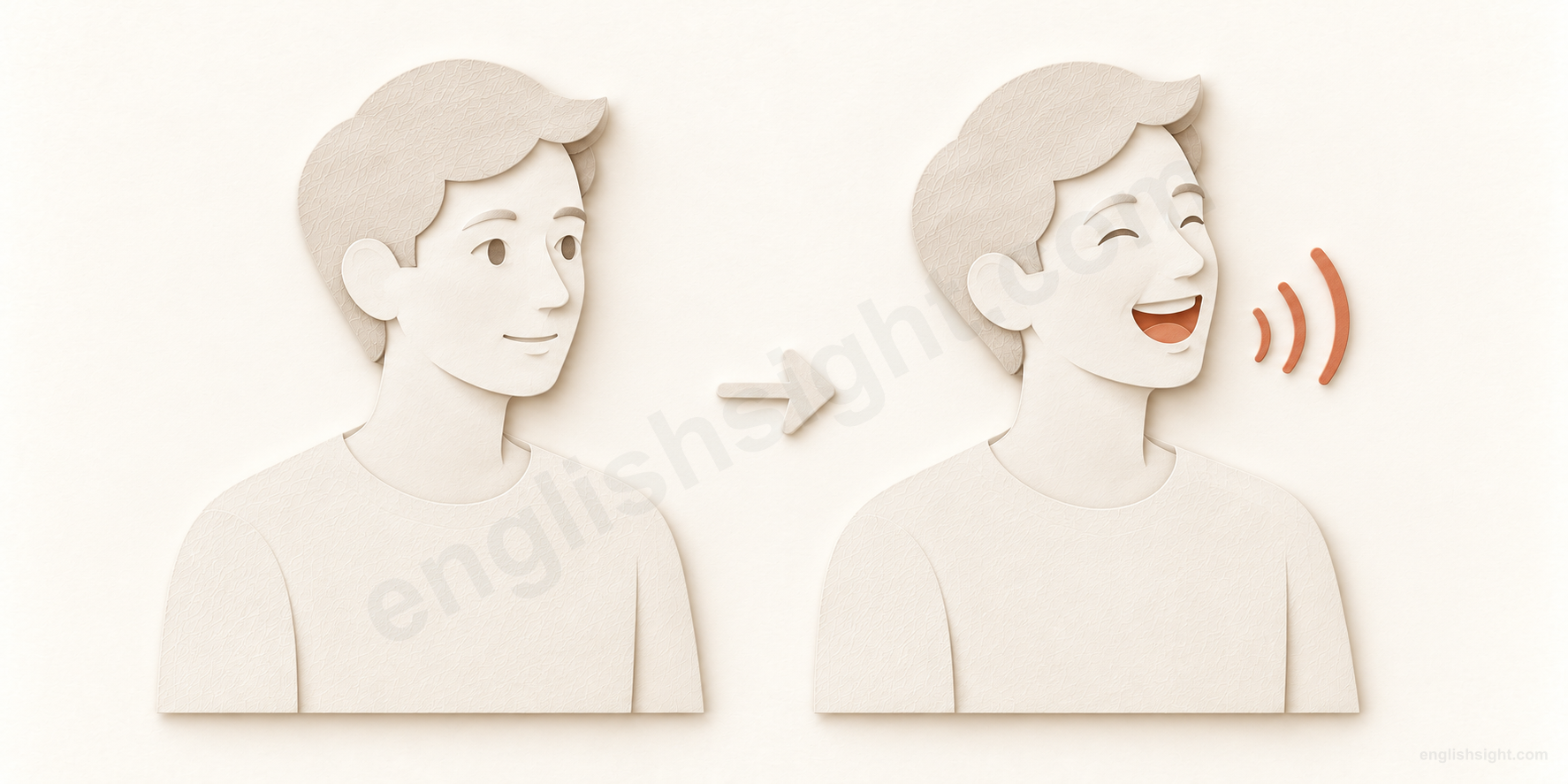
The person is calm, with open eyes and a closed mouth.
laugh
Their eyes close and their mouth opens; curved marks represent the laughing sound.
The same person begins to laugh.
The reaction changes the face and produces sound; the picture does not specify its cause or whether it is kind.
To laugh is to make the characteristic bursts of breath, usually with sound and facial movement; amusement is a common reason, but the context supplies the attitude.
The same visible reaction may be friendly, nervous, forced, or mocking. Expressions about dismissal, enjoyment, and success must also be learned as expressions; the sketch cannot predict them.
A joke may make you laugh, but so can nervousness or disbelief. Start with the reaction of the person, then use the situation and the whole expression to understand what it means.
This lesson connects the verb, the countable noun, and familiar expressions. Its visual model is a teaching aid, not a claim that every English speaker pictures the same scene.
01
The reaction and what brings it on
Start with the person laughing. Then identify the cause, the company, or the way the reaction begins.
01
person + laugh; laugh + adverb; laugh out loud / aloud
laugh / laugh out loud
make the characteristic sounds and facial movements of laughter
Situation before the reaction
A surprising line catches your attention.
Reaction or outcome
You react with a laugh.
Laugh names a bodily reaction; context supplies its emotional meaning.
In She laughed, she is the person producing the reaction. A following object is not normally needed. Laugh out loud or laugh aloud makes it explicit that the laugh is audible; laugh loudly emphasizes volume.
Amusement is a familiar cause, but someone can laugh nervously, bitterly, or to hide discomfort. A laugh does not prove happiness. Compare a smile, which describes a facial expression and need not involve a laughing sound.
In a sentence
I read the final line and laughed out loud.
Watch the difference Do not use laugh as a general translation of every smile: She smiled at the photo need not mean she laughed.
02
burst out / start / stop / keep + laughing; cannot help + laughing
burst out laughing / cannot help laughing
start suddenly or be unable to hold the reaction back
Situation before the reaction
You are trying to stay quiet.
Reaction or outcome
The laugh comes out despite your intention.
The surrounding verb tells us about onset or control.
Burst out laughing presents a sudden start. Start laughing and start to laugh are also natural. Stop laughing concerns the end of the activity; keep laughing describes its continuation.
I couldn’t help laughing means I could not prevent myself from laughing, not that I was unable to help another person. In burst out laughing and can’t help laughing, use the -ing form. Out belongs to burst out, rather than making laugh out a separate verb here.
In a sentence
I tried to stay serious, but I couldn’t help laughing at the squeaky announcement.
Watch the difference Use burst out laughing, not burst out to laugh.
03
make + person + laugh
make someone laugh
cause another person to laugh
Situation before the reaction
Your friend makes a playful remark.
Reaction or outcome
You respond by laughing.
The subject causes the reaction; the object is the person who laughs.
In That story made us laugh, the story is the cause and us identifies the people reacting. Make contributes the causative structure; laugh still names their reaction. A funny story makes me laugh is different from I make up a funny story.
In the active pattern, use the base form after make + person: makes her laugh. Compare let her laugh, which allows the reaction rather than causing it. Neither construction is a special new sense of laugh.
In a sentence
Your impression of the sleepy cat always makes me laugh.
Watch the difference In an active sentence, say made me laugh, not made me to laugh or made me laughing.
04
laugh at + thing / event
laugh at a joke
react because something seems funny
Situation before the reaction
You hear a joke.
Reaction or outcome
You show that you find it funny.
At introduces what prompts the amusement, without necessarily implying cruelty.
Laugh at a joke or a funny scene identifies the stimulus for the reaction. The person laughing remains the subject. The joke is the object of the preposition at, not a direct object of laugh.
This is not automatically ridicule: an audience can laugh at a comedian’s joke exactly as intended. When the object is a vulnerable person or their mistake, the same pattern can instead sound mocking; that reading needs its own context.
In a sentence
The children laughed at the dog’s enormous yawn.
Watch the difference Say laugh at the joke, not laugh the joke. Keep at before its object: laugh at it.
05
laugh about / over + topic
laugh about / over something
find humor in a topic or remembered event
Situation before the reaction
You remember a small mistake from a trip.
Reaction or outcome
You discuss it with amusement later.
About or over makes the incident a topic of amusement.
Laugh about an incident often fits looking back on it or discussing it. Over is also possible: We laughed over the old photos. These prepositions introduce a topic; they do not mean that laughter moves around or above an object.
We can laugh about it now suggests that something once uncomfortable can now be treated more lightly. It does not erase what happened. The noun construction have a laugh about it offers a similar way to describe the enjoyable reaction.
In a sentence
We can laugh about the missed bus now that we are safely home.
Watch the difference At often highlights the immediate stimulus; about often highlights the topic. The contexts overlap, so this is not a strict time rule.
06
laugh (along) with + person; laugh with + emotion
laugh with someone / with relief
share laughter or name the feeling accompanying it
Situation before the reaction
A friend starts laughing, or some good news arrives.
Reaction or outcome
You join in, perhaps feeling relieved.
With can introduce a companion or an emotion; the following noun distinguishes them.
Laugh with a person means laugh together with them. Laugh along with someone makes joining the reaction especially clear. It can express friendliness without making that person the target.
In laugh with relief or with delight, the noun names the feeling accompanying the reaction, not another participant. The two uses of with belong to ordinary prepositional patterns. Laughing with someone is not the same interpersonal act as laughing at them.
In a sentence
When the good news arrived, we laughed with relief.
Watch the difference Read the noun after with: with Maya names company; with relief names an emotion.
02
Sharing humor or making someone a target
The same sound can create closeness or hurt someone. Read the object of at, the context, and the speaker’s attitude.
07
laugh at + person / feature / mistake
laugh at someone
treat a person or something about them as ridiculous
Situation before the reaction
A learner mispronounces a word.
Reaction or outcome
Others make the learner feel foolish.
The target of the laughter can feel attacked rather than included.
Laugh at someone can mean mock them, whether through actual laughter or joking remarks. With an accent, appearance, or mistake as the object, it often suggests unkindness. The meaning depends on how the person is being treated, not on how loud the laugh is.
Compare They laughed with me: I share the enjoyment. They laughed at me: I am presented as the target. A joke told by a friend can still be laughed at appreciatively, so the preposition alone does not settle every case.
In a sentence
Please don’t laugh at her accent; she is learning.
Watch the difference The passive keeps at: She was laughed at. She was laughed is not the passive of this meaning.
08
laugh at + myself / yourself / himself / herself / ourselves / yourselves / themselves
laugh at yourself
see humor in your own weaknesses or mistakes
Situation before the reaction
You notice your own harmless mistake.
Reaction or outcome
You can treat it with humor instead of defensiveness.
A reflexive pronoun makes the person laughing their own target.
Being able to laugh at yourself can show that you do not take your own image too seriously. It need not mean hating or humiliating yourself. The reflexive changes who is being viewed humorously, while laugh at keeps its basic pattern.
Use the reflexive that matches the subject: I laugh at myself; we laugh at ourselves. This is different from laugh to yourself, which describes a private reaction rather than making yourself the topic.
In a sentence
I had worn two different socks, and I had to laugh at myself.
Watch the difference Laugh at yourself concerns the target; laugh by yourself concerns being alone.
09
laugh at + warning / threat / idea
laugh at a warning
dismiss something as unworthy of serious concern
Situation before the reaction
Someone gives a warning.
Reaction or outcome
The listener treats it as absurd or unimportant.
The mocking attitude can extend to rejecting a claim or risk.
With an idea, warning, or threat as its object, laugh at can mean refuse to take it seriously. A person need not be enjoying a joke. This is a dismissive extension of treating something as ridiculous.
Compare laugh about a mistake, which presents an event as a humorous topic. Laugh at a warning describes the listener’s attitude toward advice; it does not show that the warning is actually wrong.
In a sentence
They laughed at the warning until the road began to flood.
Watch the difference Do not infer safety from the verb: laughing at a danger says how someone responds, not how real it is.
10
laugh in + person’s + face
laugh in someone’s face
show open disrespect directly to someone
Situation before the reaction
You make a serious request.
Reaction or outcome
The other person responds with obvious contempt.
In someone’s face makes the disrespect direct and unmistakable.
This established expression describes an openly insulting response. It is stronger than simply saying that someone laughed while you were present. The phrase concerns contempt directed at a person, not merely the position of a smiling face.
I asked for an explanation, and he laughed in my face means my request met with blatant disrespect. It is an emotionally strong way to report an encounter, rather than a neutral description of friendly amusement.
In a sentence
I asked for a fair share, and he laughed in my face.
Watch the difference Laughing with someone face to face can be friendly; laugh in their face conventionally describes disrespect.
03
A sound, some fun, or a fun person
As a noun, a laugh can name a reaction, the enjoyment surrounding it, or someone who provides that enjoyment.
11
give / let out + a laugh; a(n) + adjective + laugh; with a laugh
give / let out a laugh
produce one laugh or a particular kind of laughing sound
Situation before the reaction
A remark gets a reaction.
Reaction or outcome
You hear a short or distinctive laugh.
The countable noun packages the reaction as an event or sound.
A laugh can be short, loud, nervous, or forced. Give a laugh and let out a laugh describe producing that reaction. With a laugh adds how someone speaks or acts: She agreed with a laugh.
Compare laughter, which usually names laughing as an uncountable activity or sound: The room filled with laughter. One laugh or several laughs is natural when counting reactions; several laughters is not the ordinary choice.
In a sentence
He gave a nervous laugh before answering the question.
Watch the difference A laugh is a noun; laugh in He laughed is a verb. Do not say He gave a laughter.
12
joke / performer + get a laugh; get a laugh out of / from + person
get a laugh / get a laugh out of someone
cause an audience or person to laugh
Situation before the reaction
You try a playful comment.
Reaction or outcome
It succeeds in getting a laughing response.
The subject prompts the reaction; the noun names the response received.
A joke gets a laugh when people laugh in response to it. Get a laugh out of someone identifies the person who reacts; get a laugh from someone is also possible. This is an effect achieved, not an object physically collected.
Compare give a laugh: the subject produces their own laugh. The joke got a laugh names what caused the reaction. The person and the joke therefore take different roles in these two noun patterns.
In a sentence
My silly drawing finally got a laugh out of Leo.
Watch the difference A joke that gets laughs may amuse people, but the expression does not tell you whether the humor is kind.
13
have a (good) laugh (about / over something); person / occasion + be a (good) laugh
have a laugh / be a good laugh
enjoy laughter, a fun occasion, or an amusing person
Situation before the reaction
Friends spend time together.
Reaction or outcome
They enjoy themselves or describe someone as fun company.
The noun extends from the reaction to the enjoyment or its source.
Have a good laugh means enjoy laughing. Have a laugh about or over something adds the topic. In The evening was a good laugh, a laugh describes an enjoyable experience rather than a single sound.
Maya is a good laugh describes someone as amusing company, especially in informal British English. It does not mean she herself is ridiculous. A barrel of laughs and a laugh a minute also describe great amusement, sometimes ironically when an experience is dull or unpleasant.
In a sentence
The quiz night was a good laugh, even though our team came last.
Watch the difference Distinguish She is a good laugh, praising her company, from They laughed at her, which may describe mockery.
14
do something + for a laugh / for laughs
for a laugh / for laughs
do something for amusement or as a joke
Situation before the reaction
You choose to try something playful.
Reaction or outcome
The intention is enjoyment rather than a serious result.
For introduces the purpose; the noun contributes the idea of amusement.
We entered for a laugh means we did it for fun. For laughs is another established form. The speaker is explaining the intention, not promising that other people will find the act funny.
Just for a laugh can describe a harmless experiment, but it can also be offered as an excuse after a joke hurts someone. Its meaning does not guarantee that the behavior was considerate.
In a sentence
We entered the costume contest just for a laugh.
Watch the difference Keep the article in for a laugh; the alternative is the plural for laughs.
04
Handling embarrassment, disbelief, and trouble
These expressions use humor as a response to a situation. Some dismiss a problem; others insist that it deserves attention.
15
laugh off + noun; laugh + noun / pronoun + off
laugh something off
respond lightly to make a problem seem unimportant
Situation before the reaction
Someone mentions an embarrassing incident or criticism.
Reaction or outcome
You joke or act unconcerned instead of treating it seriously.
Off contributes an established dismissive meaning, not physical movement.
Laugh off an accusation, a mistake, or a setback means try to reduce its apparent importance, often through humor. It describes a response, not proof that the problem has been solved or that the accusation is false.
This phrasal verb is separable: laugh off the comment or laugh the comment off. With a personal pronoun, put it between the verb and particle: laugh it off. The passive is possible too: The complaint was laughed off.
In a sentence
The singer laughed off the mistake and began the song again.
Watch the difference Say laugh it off, not laugh off it. Compare laugh about it, which need not dismiss its importance.
16
something + be + no laughing matter
no laughing matter
something that must be treated seriously
Situation before the reaction
Someone treats a problem as a joke.
Reaction or outcome
You insist on its seriousness.
The whole expression rejects the idea that this is suitable material for joking.
It is no laughing matter means the issue is serious. No modifies the noun phrase laughing matter; this is not simply a report that nobody is laughing at that moment.
The expression often corrects a lighthearted attitude toward a real problem. Compare laugh it off, which minimizes apparent importance. No laughing matter tells the listener that such a response is inappropriate.
In a sentence
Losing access to your savings is no laughing matter.
Watch the difference Use matter as a noun here. The expression does not mean that the problem is about the activity of laughing.
17
“claim” — “Don’t make me laugh!”
Don’t make me laugh!
reject a claim as ridiculous or unbelievable
Situation before the reaction
Someone makes a claim you find absurd.
Reaction or outcome
You respond with scornful disbelief.
This familiar reply can reject an idea without requesting any actual change in behavior.
As a fixed conversational response, Don’t make me laugh! means something like That is ridiculous. It often sounds rude or dismissive. The implied amusement is at the absurdity of the claim, not at a successful joke.
The same words can also be literal: Don’t make me laugh while I’m drinking asks someone to avoid causing laughter. The situation and tone distinguish the two readings, so memorize the reply without erasing the ordinary causative grammar.
In a sentence
“He says he can finish the whole job in ten minutes.” “Don’t make me laugh!”
Watch the difference This is unsuitable as a polite, neutral way of expressing doubt.
18
you have to / you’ve got to + laugh
You have to laugh. / You’ve got to laugh.
find a humorous side to an unfortunate or absurd situation
Situation before the reaction
Several small things have gone wrong.
Reaction or outcome
You choose humor rather than only frustration.
Have to here often introduces a resigned reaction, not an enforceable obligation.
You have to laugh can acknowledge that a situation is so absurd that humor seems the best available response. You’ve got to laugh expresses the same informal attitude. The speaker may still feel annoyed.
It differs from Don’t make me laugh!, which usually rejects someone’s claim. It also differs from a literal instruction during a performance, where You have to laugh on cue genuinely tells an actor what to do.
In a sentence
The new alarm woke everyone except me—you’ve got to laugh.
Watch the difference This response can sound insensitive when another person is facing something serious. Read whose problem it is.
19
not know whether to laugh or cry
not know whether to laugh or cry
be unsure how to react to a bad but absurd situation
Situation before the reaction
A frustrating result is also absurd.
Reaction or outcome
You feel caught between amusement and distress.
The paired verbs present competing reactions; no physical choice is required.
I didn’t know whether to laugh or cry describes mixed feelings about an unfortunate situation. It need not report that you actually laughed or cried. Whether introduces the alternatives that feel possible.
The expression is useful for comic frustration, such as discovering that an expensive repair created a new problem. It should not be taken as a technical description of someone’s emotional health.
In a sentence
After waiting an hour, I discovered I was in the wrong queue; I didn’t know whether to laugh or cry.
Watch the difference Laugh or cry is an established contrast here, not a claim that these are the only human reactions.
05
Strong reactions, rejection, and later success
Learn these established expressions as units. Their meanings go beyond the visible act of laughing.
20
laugh + possessive + head off; laugh + reflexive + silly / hoarse / sick; laugh until you cry
laugh your head off / laugh yourself silly
laugh very hard or for a long time
Situation before the reaction
Something seems extremely funny.
Reaction or outcome
The reaction becomes intense.
Body and result expressions often exaggerate how strong the reaction is.
Laugh your head off means laugh a great deal; no body part comes off. Laugh yourself silly uses a reflexive pronoun and a result description. Laugh until you cry can describe actual tears caused by laughing hard.
Die laughing and split your sides laughing are also exaggerations for strong amusement. These are informal expressions, not predictions of injury. Laugh yourself hoarse or sick follows a similar result pattern and can describe a real physical aftereffect.
In a sentence
We laughed our heads off at the improvised ending.
Watch the difference Match the possessive or reflexive to the subject: she laughed her head off; we laughed ourselves silly.
21
have the last laugh (on / over someone)
have the last laugh
succeed in a way that proves doubters or opponents wrong
Situation before the reaction
Others dismiss your chances.
Reaction or outcome
Your eventual success makes their judgment look foolish.
Last concerns the final outcome, not the timing of a literal laughing sound.
Have the last laugh is about later vindication. The person initially doubted ends up successful. They do not need to laugh aloud, and the expression does not simply mean telling the final joke.
The saying He who laughs last laughs longest warns against celebrating too early: the eventual outcome may favor someone else. Treat this as a related proverb, not a new tense or grammatical rule.
In a sentence
They doubted her tiny shop, but she had the last laugh when it became the busiest shop on the street.
Watch the difference Keep the: have the last laugh is the established expression.
22
laugh all the way to the bank
laugh all the way to the bank
make a lot of money and feel pleased about it
Situation before the reaction
Others may dismiss an idea or dislike a product.
Reaction or outcome
Someone profits handsomely anyway.
The bank stands for financial gain, not a necessary physical destination.
This informal idiom highlights profitable success. It often contrasts criticism or poor reputation with the money a person or business makes. The person need not be seen laughing or visiting a bank.
Unlike have the last laugh, the outcome is specifically financial. Making a profit does not by itself prove artistic quality, fairness, or good judgment; the expression concentrates on the winner’s satisfaction.
In a sentence
The critics disliked the film, but its producers laughed all the way to the bank.
Watch the difference Do not reduce this to being happy while walking to a bank; the financial-success meaning belongs to the whole idiom.
23
laugh up + possessive + sleeve (at someone / something)
laugh up your sleeve
be privately amused, often at another person
Situation before the reaction
You see someone make a claim you know is foolish.
Reaction or outcome
You hide your amusement.
The sleeve is part of an established image of concealed laughter.
Laugh up your sleeve suggests secret amusement, often because someone else has been fooled or looks foolish. The important contrast is between the private attitude and the outward appearance, not the position of your arm.
Compare laugh in someone’s face, which is openly disrespectful. Laugh to yourself can simply mean reacting privately and need not suggest pleasure at another person’s expense.
In a sentence
She looked serious, but she was laughing up her sleeve at his grand announcement.
Watch the difference Use the possessive that matches the person laughing; an actual sleeve is not required.
24
if + favorable condition, person + will be laughing
be laughing
be in a very favorable position
Situation before the reaction
One final obstacle stands between you and success.
Reaction or outcome
Removing it would put you in a comfortable position.
In this informal use, the -ing form describes advantage rather than a current sound.
We’ll be laughing can mean we will be doing very well or have little left to worry about. A condition often makes the advantage clear: If we can sell the remaining tickets, we’ll be laughing.
Compare We’re laughing at the video, which describes an actual ongoing activity. Be laughing has the favorable-position reading only when the context supports it; it is not the meaning of every progressive form.
In a sentence
If the grant covers the rent, we’ll be laughing.
Watch the difference This use is informal and may be less transparent to international learners than We’ll be in a good position.
25
laugh + person / idea + out of court; be laughed out of court
laugh something out of court
reject an idea as too ridiculous to consider
Situation before the reaction
Someone proposes an idea.
Reaction or outcome
Others dismiss it without serious consideration.
Out of court is a fixed rejection image; a legal hearing is not required.
This informal expression, especially associated with British English, describes complete rejection through ridicule. The idea or explanation is what is dismissed. It can also take a person as its object when that person’s case is being rejected.
The passive is common: My suggestion was laughed out of court. Compare laugh it off, which emphasizes minimizing the importance of a difficulty; laugh it out of court emphasizes refusing to consider a claim or proposal.
In a sentence
My proposal for a midnight meeting was laughed out of court.
Watch the difference This is an idiom, not a statement that laughing physically removed a document from a courtroom.
Choose the reaction, the grammar, and the attitude
Forms and pronunciation
Forms are laugh, laughs, laughed, and laughing. Standard British pronunciation is /lɑːf/ and standard American pronunciation is /læf/. The gh represents /f/; laughed ends in /ft/, without an extra syllable. Laugh can freely describe an ongoing activity: They are laughing.
Usually no direct object
Use laugh, laugh at a joke, or make someone laugh. In narratives, laugh can introduce speech: “That was close,” she laughed. Expressions such as laugh yourself silly and laugh a nervous laugh permit particular objects; they do not license I laughed him to mean I made him laugh.
Passive and particles
A person can be laughed at, and a claim can be laughed off or laughed out of court. Ordinary She laughed has no object to turn into a passive. At stays before its object; off permits laugh the comment off and requires laugh it off with a personal pronoun.
Meaning and scope
A chuckle is a quiet laugh; giggle often suggests light, repeated laughter, sometimes through embarrassment. A smile need not be a laugh. This lesson covers modern everyday verb and noun uses plus selected idioms. Animal sounds, poetic laughing landscapes, offensive intensifiers, and a full catalog of regional sayings are outside its scope.
Read the whole reaction
Choose the expression that fits the people, the attitude, and the result.
1. A classmate feels hurt because others treat her mistake as ridiculous. Which sentence reports that treatment?
2. Your friend’s imitation causes you to laugh. Which sentence has the right grammar?
3. You respond to a minor mistake as if it is unimportant. Complete “I laughed ___.”
4. A performer makes the audience react with laughter. Which sentence focuses on the response the performer achieves?
5. People said your idea would fail, but it later succeeds. Which expression fits?
6. You want a friend to stop treating a serious loss as a joke. Which expression fits?
Sources and teaching notes
Verb, noun, grammar patterns, and idioms were checked against Oxford and Collins. Explanations and example sentences are original; the diagram is a teaching model.
The diagram models a reaction; it does not claim a shared mental picture for all English speakers.