Recognize leaves, follow the sheet-shaped extensions, and learn the expressions as whole phrases.
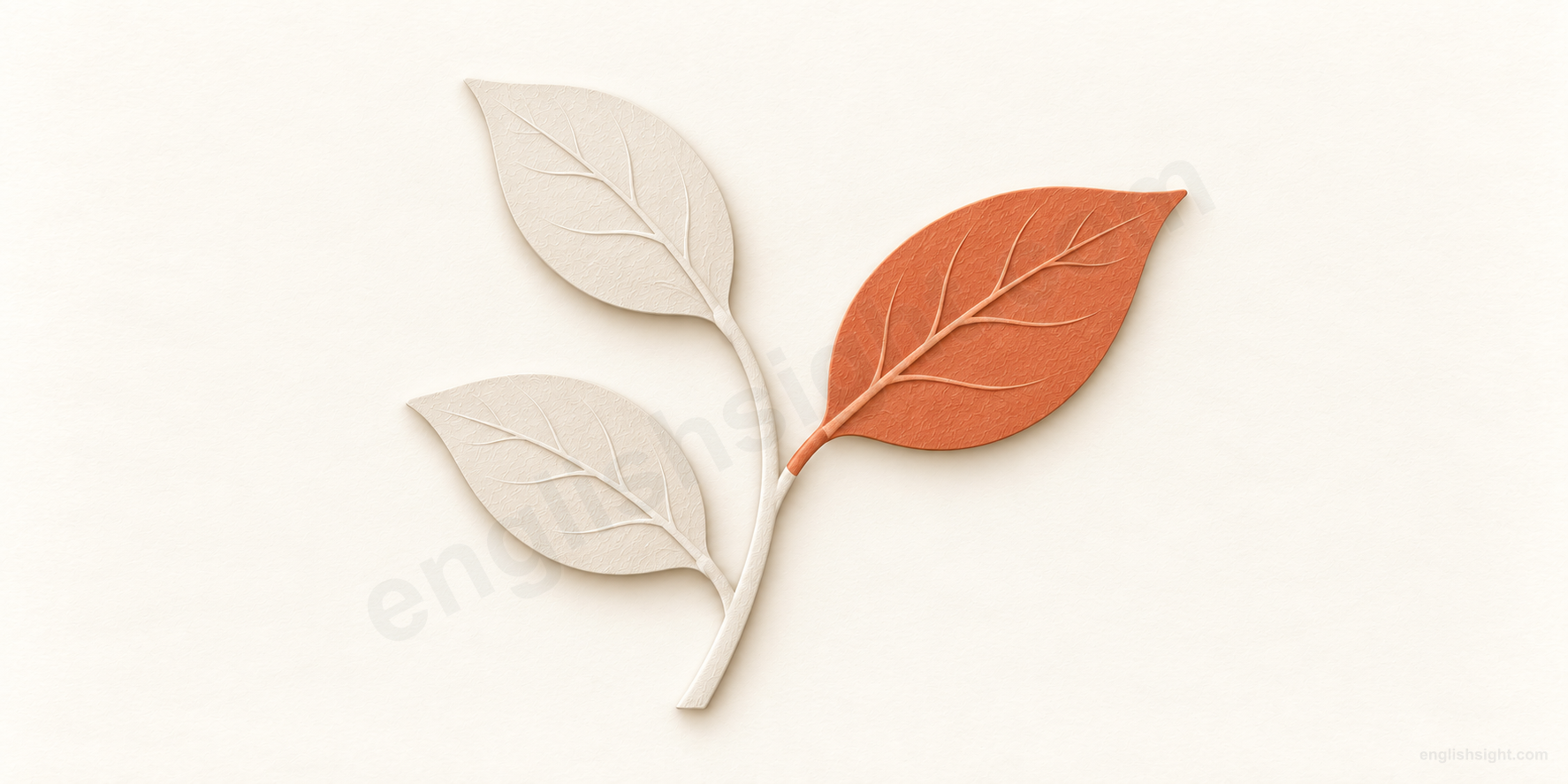
A blade growing from a stem
A blade growing from a stem
A stem supports several leaves.
leaf
The highlighted plant part is one leaf.
Follow the short stalk into the highlighted blade.
The highlighted leaf is attached to the stem; it is one part of the sprig.
A typical leaf is a thin blade that grows from a plant stem or branch as one part of its foliage.
The highlighted blade is the leaf; the supporting stem is another part. Thinness and a flat shape help connect some object meanings, but do not define all leaves or predict the idioms.
Start with a real plant: a leaf is one of its usually thin blades. English also uses leaf for certain sheets and flat sections, while familiar idioms carry meanings that need to be learned in context.
This lesson connects selected meanings as a learning aid. It does not claim that every meaning follows a single rule or that every English speaker imagines the same picture.
01
Plants, food, and the seasons
Start with real leaves. Count individual blades, describe a tree’s seasonal state, and recognize useful forms.
01
a leaf; two / several leaves; the leaves on / of + plant
a leaf / leaves
one plant leaf, or more than one
Situation / starting point
You look closely at a plant.
Meaning in this context
You identify individual leaves on its stem.
A leaf is a plant part, not the whole plant.
Look for a blade growing from a stem or branch: that is a typical leaf. Leaves vary greatly in shape; not every leaf is broad, and a fallen brown leaf is still a leaf. The drawing highlights one example rather than defining every possible shape.
Use a leaf for one and leaves for more than one: A leaf is floating in the bowl; Two leaves are floating in it. Leaves on the tree locates them; the leaves of the tree identifies the plant they belong to. A branch supports leaves and is not itself a leaf.
In a sentence
A yellow leaf landed on my sleeve.
Watch the difference For ordinary plant leaves, use leaves /liːvz/, not leafs. Leaf /liːf/ changes both its spelling and its final sound.
02
plant name + leaf / leaves
basil leaves / cabbage leaves
leaves used as food or flavoring
Situation / starting point
You prepare a dish.
Meaning in this context
You add the required leaves.
The plant name specifies the kind of leaf.
Basil leaves, cabbage leaves, and tea leaves refer to actual plant material. The first noun identifies the plant; it does not need an apostrophe. Leaves can remain identifiable after they have been picked or dried.
In Add three basil leaves, the number counts individual leaves. This is different from three basil plants, which counts whole plants. Follow the particular recipe when it asks for leaves rather than stems or a whole plant.
In a sentence
Add four basil leaves just before serving.
Watch the difference Leaf is not a general word for every edible plant part: roots, seeds, and fruit have their own names.
03
be in (full) leaf; come into leaf
in leaf / come into leaf
have leaves, or begin to grow them
Situation / starting point
The branches are bare after winter.
Meaning in this context
New leaves appear on the tree.
In leaf describes a state; come into leaf describes its beginning.
A tree is in leaf when it has its leaves. In full leaf emphasizes that its foliage is fully developed. Here leaf refers to the covering collectively, so the fixed expression has no a and no plural ending.
The trees are coming into leaf tells us that leaves are appearing. Compare The leaves are falling or The tree is shedding its leaves: these describe losing foliage, not developing it. These expressions are useful for describing seasonal change without implying that every tree follows the same schedule.
In a sentence
The trees beside the river are coming into leaf.
Watch the difference Say The tree is in leaf, not in a leaf. A bird in the leaves is physically among individual leaves; that is a different construction.
04
plant + leaf (out); plant + be leafing out
leaf out
produce leaves
Situation / starting point
The shrub has bare stems.
Meaning in this context
Leaves begin growing on it.
The plant is the subject of the growing process.
In The shrubs leaf out, leaf is a verb and out accompanies the production of leaves. This is useful gardening language, especially in American English. The noun image is direct: the plant develops the parts called leaves.
Bare leaf can also mean produce leaves, but grow leaves or put out new leaves is an easy alternative for learners. Compare The shrub has leaves, which reports a state, with The shrub is leafing out, which describes growth taking place.
In a sentence
The young shrubs are leafing out after the rain.
Watch the difference The verb is regular: leafs, leafed, leafing. The shrub leafs out has leafs; the shrub’s leaves are a plural noun.
05
a four-leaf clover; a broad-leaved plant; leafless + noun
four-leaf / broad-leaved
describe the number or type of leaves
Situation / starting point
You compare the leaves on two plants.
Meaning in this context
You describe a plant by its foliage.
Compound modifiers describe a plant rather than count separate plants.
A four-leaf clover is described by its four leaves or leaflets in everyday naming. A broad-leaved plant has broad leaves. The number or descriptive word contributes the detail; leaf does not itself mean lucky or broad.
In these modifiers, spelling belongs to the established form: four-leaf and broad-leaved. The separate adjective leafless means without leaves, as in leafless branches. These forms help you describe appearance without treating them as new verb meanings.
In a sentence
We planted a broad-leaved shrub beside the gate.
Watch the difference Use four-leaf in a four-leaf clover; do not transfer the ordinary plural into four-leaves clover.
02
Sheets and browsing
In books, leaf names a sheet. The verb leaf through describes moving through pages to get an impression of the contents.
06
a leaf of + book; a leaf missing from + book
a leaf of a book
one sheet belonging to a book
Situation / starting point
You examine an old book.
Meaning in this context
You turn one physical sheet.
One leaf has two sides; a page can name one side.
For precise counting, a leaf is a physical sheet and a page is one side of it. A leaf with print on both sides therefore carries two pages. Everyday instructions usually say Turn the page rather than Turn the leaf.
Leaf is useful in descriptions of old books, manuscripts, or missing sheets. The link with a plant leaf is a teaching comparison between thin flat parts; it is not a rule that lets you call every flat object a leaf.
In a sentence
One leaf is missing from the old notebook.
Watch the difference A missing leaf may remove two numbered pages. Do not assume that a leaf and one printed page are always the same unit.
07
leaf through + book / pages / pronoun
leaf through a book
browse by turning pages
Situation / starting point
You have a few minutes to look at a book.
Meaning in this context
You turn pages and glance at what is inside.
Leaf through describes browsing, without promising careful reading.
A person leafs through a magazine, an album, or a catalogue to get a quick impression or find something interesting. Through presents movement across its pages; this is not moving physically through the book.
Keep the thing being browsed after through, including a pronoun: I leafed through it. Unlike turn it over, this construction does not place it between leaf and through. Compare read the report carefully: that explicitly describes close reading, which leaf through does not.
In a sentence
I leafed through the catalogue while the shop assistant checked the price.
Watch the difference Say leaf through it, not leaf it through. The past form is leafed /liːft/, not left.
08
loose-leaf + binder / notebook
a loose-leaf binder
a binder or book with removable sheets
Situation / starting point
Your notes are on separate sheets.
Meaning in this context
You arrange and remove them as needed.
Loose-leaf describes how the sheets are held.
A loose-leaf binder allows you to take individual sheets out and put them back in. Here leaf has the paper sense and loose describes the sheets’ removable arrangement.
This adjective normally comes before the noun: a loose-leaf notebook or loose-leaf binder. It does not mean that the binding is broken. A damaged bound book may have loose pages, but that does not make it a purpose-designed loose-leaf notebook.
In a sentence
I keep the lesson notes in a loose-leaf binder.
Watch the difference In this stationery expression, leaf refers to paper, not to plant leaves placed inside a book.
03
Thin sheets and movable sections
A shared flat shape helps connect these established object names. The material and situation tell you which meaning applies.
09
gold / silver leaf; a sheet of gold leaf
gold leaf
gold prepared in extremely thin sheets
Situation / starting point
An object is ready to be decorated.
Meaning in this context
A thin layer of gold covers part of its surface.
Here leaf names a material in thin sheet form.
Gold leaf is gold made into very thin sheets for surface decoration. Silver leaf uses the same material pattern. This sense keeps the idea of a thin layer, without suggesting that the metal grew on a plant.
As a material, gold leaf is normally uncountable: The frame is covered with gold leaf. To count individual portions, a sheet of gold leaf is clear. Gold leaf and a gold-colored leaf are different: the second could describe a plant leaf or an ornament.
In a sentence
The craft worker covered the frame with gold leaf.
Watch the difference For an amount of this material, use some gold leaf or a sheet of gold leaf, rather than treating the material as an ordinary plant leaf.
10
add / insert a leaf; a table with two leaves; a drop-leaf table
a table leaf
a section that extends a table’s surface
Situation / starting point
The table is too small for all the guests.
Meaning in this context
An extra section makes its top larger.
A leaf is a movable or additional flat part of the tabletop.
Some tables have an extra board fitted into the top; others have a hinged part that folds up or down. Either kind can be a leaf. The surrounding words identify a furniture part rather than foliage.
Add a leaf to the table explains the action and its destination. A drop-leaf table has a hinged section that drops down when not in use. In furniture descriptions, leaf names the section; extend names what you do to make the table larger.
In descriptions of doors or shutters, a leaf can also mean one flat movable section. That is another established use of the section idea, rather than a name for every part of the frame.
In a sentence
We added a leaf to the dining table for the family meal.
Watch the difference Adding leaves here means adding table sections, not decorating the table with plants.
04
Comparisons and established idioms
Learn the whole expression. A leaf picture may help you remember it, but does not supply the full meaning by itself.
11
person + turn over a new leaf
turn over a new leaf
begin behaving in a better way
Situation / starting point
Someone has a habit they want to change.
Meaning in this context
They decide to make a fresh start in their behavior.
The whole idiom expresses personal improvement.
Turn over a new leaf is used when someone starts, or promises to start, behaving better. A blank new sheet in a book is a useful memory image, but the idiom does not describe a tree growing a new leaf.
The subject is the person changing their behavior. Keep a new leaf together; change the tense of turn: He turned over a new leaf. A promise to do so expresses an intention, not proof that the improvement will last.
In a sentence
After missing several meetings, I decided to turn over a new leaf and arrive on time.
Watch the difference This is about a fresh start in conduct; it is not the usual expression for every new object or ordinary change of plans.
12
take a leaf out of / from + someone’s book
take a leaf out of someone’s book
follow another person’s useful example
Situation / starting point
You notice a method that works well for someone.
Meaning in this context
You adopt a similar method yourself.
The book represents someone’s way of doing things.
You take a leaf out of someone’s book when you copy their approach because it seems worth following. Take a leaf from someone’s book is also established. The person need not own or have written a real book.
The possessive identifies the model you follow: Maya’s book, your book, or their book. This expression recommends learning from a person’s example; it does not itself accuse them or you of stealing.
In a sentence
I took a leaf out of Maya’s book and made a checklist before packing.
Watch the difference Keep the whole expression. Taking a leaf from a tree has a literal plant meaning and does not express imitation.
13
person + shake / be shaking like a leaf
shake like a leaf
tremble strongly, for example from fear or cold
Situation / starting point
A person is frightened or very cold.
Meaning in this context
Their body visibly trembles.
The comparison draws on a leaf’s trembling movement.
If someone is shaking like a leaf, their body is trembling a lot. The context can give the cause, such as fear or cold. Like introduces the comparison; the person does not become a leaf.
In I was shaking like a leaf before my speech, the progressive form describes trembling at that time. The phrase can make the description vivid, but does not by itself diagnose a medical condition or explain why the shaking occurred.
In a sentence
I was shaking like a leaf before I walked onto the stage.
Watch the difference Keep a in like a leaf. The phrase describes shaking, not simply feeling sad or remaining still with worry.
14
a fig leaf; a fig leaf for + problem
a fig leaf
something used to hide an awkward truth or problem
Situation / starting point
A problem would embarrass an organization.
Meaning in this context
A token action or excuse gives it a covering.
The figurative covering conceals rather than fixes the problem.
Literally, a fig leaf is a leaf from a fig tree. Figuratively, a fig leaf is something presented to hide an embarrassing or uncomfortable situation. This use often appears in critical discussion of public decisions.
In a fig leaf for poor planning, for identifies what the covering conceals. The expression usually carries criticism: the speaker thinks the apparent answer is a cover. It does not simply praise an effective solution.
In a sentence
The manager’s brief apology was a fig leaf for months of poor planning.
Watch the difference Context decides between the actual plant part and the critical metaphor; do not assume every mention of a fig leaf is political or figurative.
Let the object and the construction guide you
Noun leaves, verb leafs
For ordinary nouns use leaf /liːf/ and leaves /liːvz/. The verb forms are leaf, leafs /liːfs/, leafed /liːft/, and leafing. In She leaves at six, leaves belongs to the different verb leave; the past of leave is left.
Countability depends on the sense
Count individual plant leaves, book leaves, and table leaves. Gold leaf usually names a material, and in leaf is a fixed collective expression. These differences belong to the particular senses and constructions.
Do not overextend the picture
Not every flat sheet is naturally called a leaf. Use the established names of objects, and learn new leaf, someone’s book, and fig leaf expressions in full. The plant diagram illustrates the central noun; it does not show every phrase literally.
Scope of this lesson
Specialist botanical classifications, mechanical leaf springs, construction wall leaves, and historical or slang senses are not expanded here. Leaf out describes growth and has no ordinary object to passivize. This lesson does not propose a general causative leaf pattern.
Choose the meaning that fits
Read the situation, then choose the sentence or interpretation that matches it.
1. You find more than one plant leaf on the floor. Which form fits?
2. You turned pages and glanced at pictures without reading carefully. Which sentence fits?
3. A book has one physical leaf with a page printed on each side. How many printed pages does that leaf carry?
4. Bare trees begin growing new leaves. Which expression describes the change?
5. You copy a colleague’s useful habit. Which expression fits?
6. Someone promises to stop arriving late and behave more responsibly. What does their promise mean?
Sources and teaching notes
The dictionary pages below were consulted for meanings and forms. The explanations and examples are original; the visual connection is a teaching model.
The diagram is a learning aid, not a picture shared by every native speaker.