Recognize leather as a material, then read the words around it.
From material to product
Prepared skin becomes a usable material
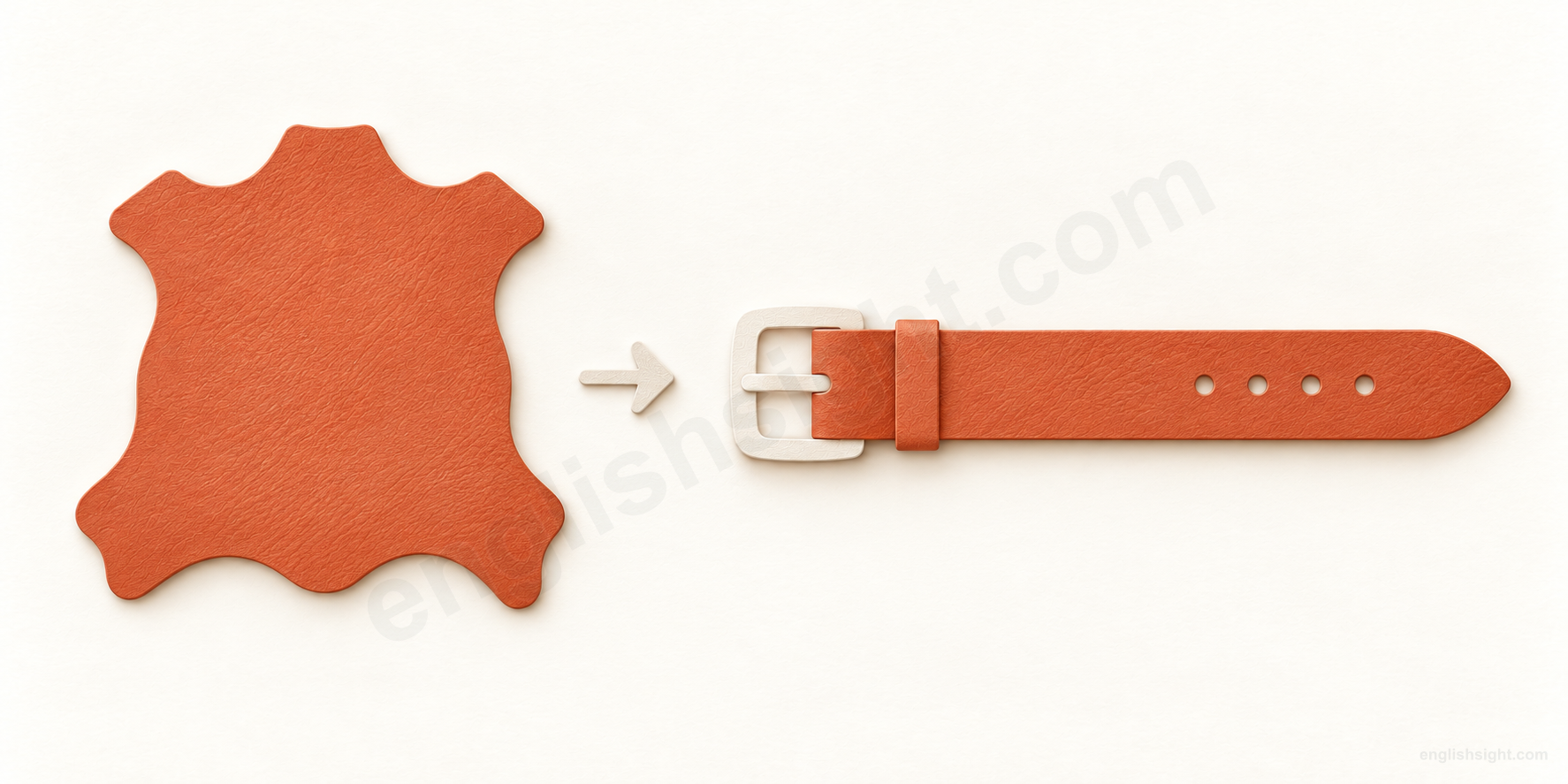
A piece of prepared leather
leather
A belt made of leather
The leather is cut and shaped into a belt.
A belt is one possible product; leather names its material, not its shape.
Leather is animal skin processed into a material that can be cut, shaped, or used to cover objects.
The drawing starts with already prepared leather and shows one possible use. It does not show tanning or suggest that all leather becomes belts.
A belt, a jacket, and a chair covering can all use leather. The word usually identifies what they are made of, rather than naming their shape or function.
The material connection helps organize everyday uses. Clothing plurals and fixed expressions need their own explanations; the picture cannot predict them.
01
Name the material and the object
Identify what something is made of, count pieces or finished items, and describe material choices.
01
something is made of / from leather
made of leather
identify leather as the material
Situation
A customer examines a belt.
What you communicate
The label identifies its material.
Leather names a material, while belt names the object.
Leather is animal skin prepared for use. Skin can name the covering of a living body; leather names the processed material. A hide is an animal skin, often a large one, considered as a material or raw skin.
In The belt is made of leather, the belt is the subject and leather follows of as the material. Made from leather is also possible; do not turn of versus from into an absolute rule about whether processing occurred.
In a sentence
Is this belt made of leather?
Watch the difference Ask about skin when discussing a person’s body, rather than calling their skin leather.
02
some leather; a piece / strip of leather; two leather + plural objects
a piece of leather
count a portion rather than the material itself
Situation
A maker needs material for two patches.
What you communicate
She cuts two pieces from a larger sheet.
Count pieces, strips, or objects; leather is normally a mass noun.
For an amount, say some leather or a piece of leather. Two pieces of leather counts portions. Two leather belts counts belts. A leather does not ordinarily mean one belt or one jacket.
Leathers can mean different types or varieties in trade and product descriptions: The workshop uses several fine leathers. That specialist plural differs from the ordinary material use and from a rider’s leathers.
In a sentence
We need two strips of leather for the handles.
Watch the difference Do not use two leathers to ask for two belts; name the objects.
03
leather + noun
a leather jacket
describe an object by its material
Situation
You compare a cotton jacket and another jacket.
What you communicate
You choose the jacket made of leather.
Leather before a noun identifies material, not ownership.
Leather can modify a noun directly: leather shoes, a leather wallet, a leather sofa. The following noun names the item and takes the plural ending: leather jackets. Leather goods groups products made of the material.
Some dictionaries label this an adjective; others treat it as a noun used as a modifier. Both descriptions account for the everyday pattern. For a simple statement about material, This jacket is made of leather is clear; This jacket is very leather is not a normal way to grade a material.
In a sentence
Her leather jacket has two inside pockets.
Watch the difference Do not write a leathers jacket or a leather’s jacket for a jacket made of leather.
04
available / covered / dressed in leather; an item in + description + leather
available in leather
describe a material option or covering
Situation
A chair comes with different coverings.
What you communicate
You ask for the leather version.
In introduces the material used for a version or covering.
A chair available in leather offers leather as a material option. Covered in leather describes its covering. A person dressed in leather is wearing leather clothing; the context changes what the preposition describes.
Compare a bag in brown leather with a bag in the cupboard: the first in phrase describes material, and the second describes location. The leather itself does not introduce this grammatical distinction.
In a sentence
Is this chair available in black leather?
Watch the difference In leather does not always mean inside leather; read the noun and the situation.
02
Compare finishes and describe condition
Words around leather tell you about imitation, surface, manufacture, or wear. They do not all name new meanings of leather.
05
real / genuine leather; faux / imitation / artificial leather
real leather / faux leather
distinguish animal-derived material from imitation
Situation
Two similar-looking bags carry different labels.
What you communicate
The buyer checks which uses actual leather.
Faux marks imitation; real or genuine emphasizes actual leather.
Real leather and genuine leather contrast actual leather with a substitute. Faux leather, imitation leather, and artificial leather describe material made to resemble it. Faux is pronounced like foe.
Do not infer a particular grade, lifespan, or manufacturing method from genuine alone. Likewise, the phrase faux leather tells you that the material imitates leather; it does not by itself identify its precise composition. Appearance alone does not settle the distinction.
In a sentence
The label says faux leather, although the bag looks like real leather.
Watch the difference Faux leather is not a special animal skin; faux changes the material claim.
06
patent leather + noun; suede + noun
patent leather / suede
recognize different leather surfaces
Situation
You compare glossy shoes with a soft-textured pair.
What you communicate
You name the surfaces more precisely.
Leather is a material category, not one fixed surface texture.
Patent leather has a glossy, hard surface, familiar on formal shoes and some bags. Here patent belongs to the established material name; it is not a claim about applying for a legal patent.
Suede is leather with a soft, velvety surface on one side. Thus suede and leather are not always opposing material categories: genuine suede is a kind of leather. Products described as imitation suede need a separate material check.
In a sentence
She wore black patent leather shoes to the concert.
Watch the difference Do not assume all leather is smooth and shiny or that all suede-looking fabric is animal leather.
07
a leather-bound + noun; a book is bound in leather
a leather-bound book
describe an object covered with leather
Situation
A book has a leather cover.
What you communicate
You describe the binding in a compact phrase.
Bound describes the book’s covering, not its printed pages.
A leather-bound book has a leather binding. Leather identifies the covering material; bound is the past participle of bind. The related full description is The book is bound in leather.
The compound is usually hyphenated before the noun. It does not say that the pages are made of leather. This is an ordinary material-plus-participle construction, not a phrasal verb with leather.
In a sentence
There is a leather-bound notebook on the desk.
Watch the difference Leather-bound does not mean tied up with a leather strap in this book context.
The adjective describes leather’s condition; it is not a separate sense.
Soft, supple, stiff, thick, thin, and cracked describe different properties or states. The leather has cracked reports damage to the material; a cracked leather seat names the object with that condition.
Treat, clean, and polish leather describe actions on the material, while tan refers to processing animal skins into leather. In The leather was treated, the passive comes from treat, not from a special passive form of the noun leather. Product-specific care instructions still matter.
In a sentence
The leather on the seat has cracked.
Watch the difference Do not treat polish leather as a phrasal verb; leather is the object of polish.
03
Clothing and fixed expressions
Recognize the plural clothing word and two established expressions. Learn their meanings and register as whole expressions.
09
wear / put on + possessive + leathers; in leathers
a rider’s leathers
refer to leather riding clothes
Situation
A motorcyclist prepares to ride.
What you communicate
She puts on her leather riding clothing.
The plural word can name clothing rather than several pieces of material.
Leathers means clothes made of leather, especially the protective clothing worn by motorcyclists. Collins COBUILD marks this clothing use mainly British. The rider put on her leathers refers to her clothing, not to loose skins. This is a material-for-product extension with an established clothing meaning.
Use plural agreement: Her leathers are hanging by the door. A leather jacket is one named item; leathers can refer collectively to the riding clothes. In a supplier’s list, different leathers may instead mean varieties of material.
In a sentence
Her leathers are hanging beside the helmet.
Watch the difference Do not use a leathers for a single jacket.
10
go / ride / run hell for leather; go hell for leather to + verb
go hell for leather
move or work at great speed
Situation
The team has little time left.
What you communicate
They work extremely quickly to finish.
The whole idiom expresses speed; leather alone does not mean fast.
Go hell for leather means to move or do something very quickly, sometimes with little care. Ride or run can also precede hell for leather. No actual leather object is required in the situation.
This is informal. Oxford additionally marks it British and old-fashioned, while Collins presents the idiom without that narrower label. Recognize it in stories and conversation; work as fast as possible is a plain alternative in formal instructions.
In a sentence
We went hell for leather to finish before the shop closed.
Watch the difference Do not explain the idiom as going somewhere in order to buy leather.
11
save shoe leather
save shoe leather
avoid walking and wearing out shoes
Situation
A trip would involve a long walk.
What you communicate
You take the bus instead.
Shoe material stands for the wear caused by walking.
Shoe leather literally names leather used in shoes. In save shoe leather, avoiding walking also avoids wearing out the shoes. The expression can refer to the walking effort saved, whether or not the speaker has checked the actual shoe material.
Collins lists this under British English. It is useful for recognition, rather than an essential request phrase for travel: Let’s take the bus is more direct. The ordinary verb save supplies the idea of avoiding expenditure or wear.
In a sentence
Let’s take the bus and save some shoe leather.
Watch the difference Do not read shoe leather here as money or confuse it with the speed idiom hell for leather.
Keep material, object, and expression apart
Sound and grammar
Leather is pronounced /ˈleðə(r)/, with the voiced th sound of this. The ordinary material noun is uncountable. Material modifiers stay singular, while the item can be plural: leather shoes.
A separate verb exists
Dictionaries also record leather as a transitive verb meaning cover with leather or beat with, or as if with, a leather strap. Its forms are leathers, leathered, leathering. These meanings are for recognition here; use cover with leather in everyday making instructions. Noun phrases such as leather care are not examples of the verb.
Scope and the teaching picture
The material-to-product sketch is a memory aid, not a universal mental picture. A dog’s ear flap, specialist equestrian uses, and specialized cultural labels are outside this introductory lesson. The idioms are included for recognition, not ranked as frequent everyday phrases.
Read the material and the construction
Choose the sentence or interpretation that fits the situation.
1. You need two narrow pieces of material to make handles. Which request fits?
2. A bag is labelled faux leather. What does the label tell you?
3. What does a leather-bound notebook normally have?
4. A motorcyclist says, “My leathers are still wet.” What is the likely meaning?
5. “They went hell for leather to finish.” What is being emphasized?
Sources and teaching notes
The sources below support the usage notes. Explanations and example sentences are original; the material-to-product diagram is a teaching interpretation.
The diagram is a teaching aid, not a picture shared by every native speaker.