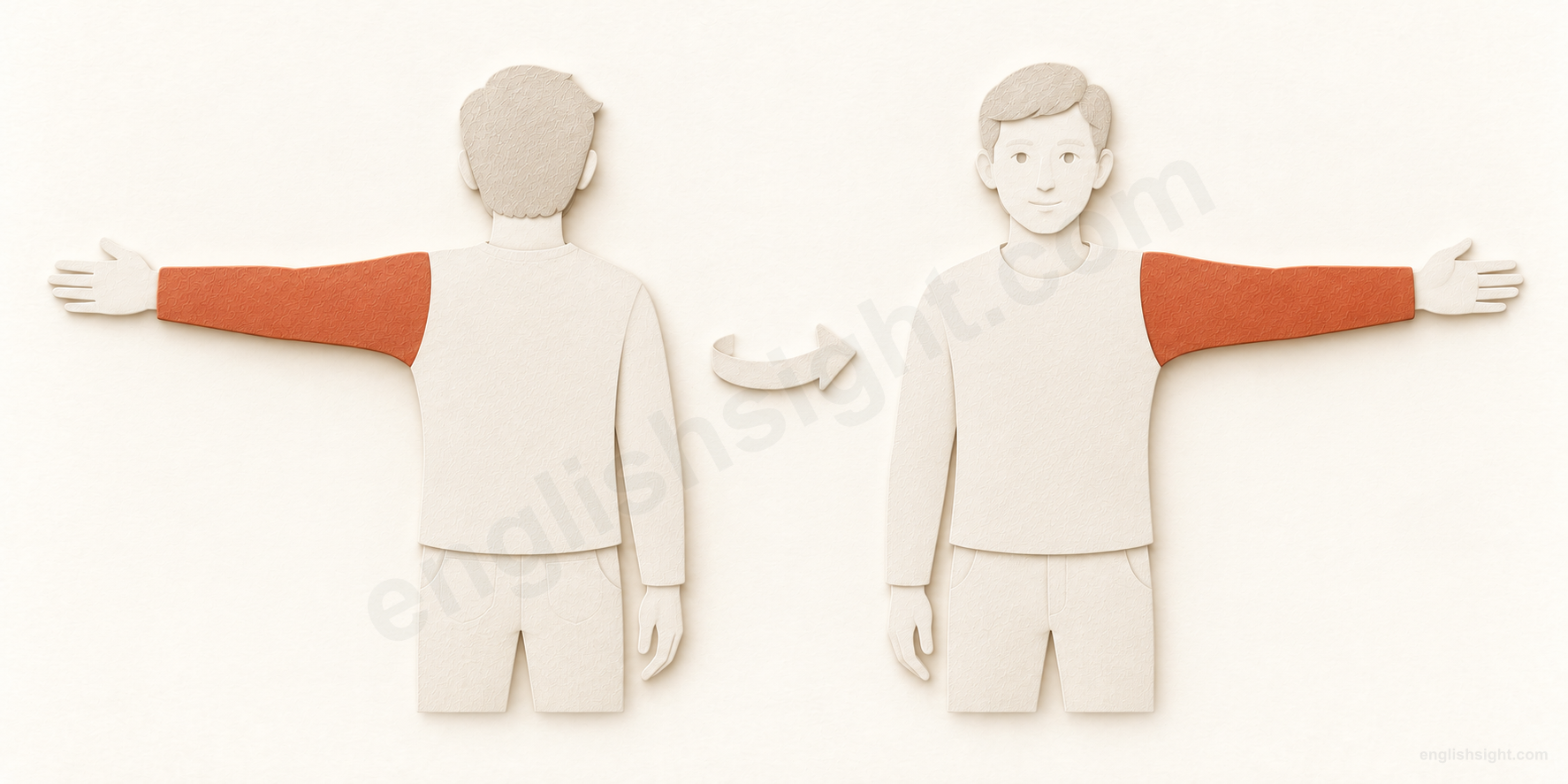
Find your bearings with left—and recognize the separate left that comes from leave.
Fix the viewpoint, then identify the side
Fix the viewpoint, then identify the side
Seen from behind, his left arm extends toward our left.
left
Facing us, his left arm extends toward our right.
He turns around while keeping the same left arm extended.
His left stays his left; turning changes which side of our view it appears on.
Spatial left picks out the side opposite right relative to an established orientation; a different viewpoint can put that side on a different part of the picture.
The person supplies the reference in the diagram. Political labels and idioms are conventional extensions; the verb form left and remaining-amount constructions belong to leave and need their own explanations.
Spatial left identifies one side in contrast with right. A body, a direction of facing, or a conventional layout supplies the reference: your left, the left side of a page, or a left turn.
The same spelling and pronunciation, /left/, also form the past tense and past participle of leave. Three tickets left and She left early belong to that separate verb family. They are not meanings predicted by turning a picture to the left.
The diagram offers a teaching reference for spatial left. It does not claim that every English speaker imagines the same picture.
01
A side, a position, or a direction
First establish the person, object, or page that supplies the viewpoint. Then choose an adjective, an adverb, or a noun phrase.
01
possessive + left + body part; left + shoe / glove
left hand / left foot
the body side opposite the right
Situation / reference
A person has two hands.
Meaning / result
You identify one hand by its side.
A person’s left stays their left when they turn.
Use left before a body-part noun: her left arm, my left knee. A left shoe or glove is made for the corresponding foot or hand; it does not mean a shoe that somebody forgot.
If someone faces you, their left is on your right. Establish whose body supplies the direction. Left and right name sides, not how skilled or strong someone is.
In a sentence
He raised his left hand to ask a question.
Watch the difference For an injury, say My left knee hurts; left describes knee, not the pain.
02
be left-handed; a left-handed + person / tool / action
be left-handed
normally use the left hand more easily, or be designed for it
Situation / reference
You choose scissors for someone.
Meaning / result
The tool matches the hand they normally use.
Left-handed describes a preference, design, or action; left-hand describes a side.
A left-handed person usually finds the left hand easier for writing or similar tasks. Left-handed scissors are designed for such a user. A left-handed throw is made with the left hand.
Compare the left-hand drawer, which is a drawer on one side, with a left-handed player, which describes hand use. Say I am left-handed, not I am left hand.
In a sentence
These left-handed scissors are easier for me to use.
Watch the difference A person can use their left hand once without being left-handed.
03
on the / your left; on / to the left of + reference
on your left / to the left of
locate something relative to a viewpoint or another thing
Situation / reference
You enter a building.
Meaning / result
You identify the desk on one side.
On often locates; to can also locate relative to a reference point.
On your left names the side from your viewpoint. To the left of the lift locates something relative to the lift. Both on the left of and to the left of can describe position; to does not always imply movement.
The left is a noun phrase. Use the in on the left, but a possessive replaces it in on my left. Add of for a named reference object: to the left of the door.
In a sentence
The reception desk is to the left of the lift.
Watch the difference Do not say on the my left or to the left the lift.
04
turn / go / look left; take / make a left; take the second left
turn left / take a left
change direction toward the left side
Situation / reference
You approach a junction.
Meaning / result
You enter the road on your left.
Left can follow a verb directly; a left names a turn.
Turn left uses left as an adverb, so it needs no preposition or article. Take a left uses a noun. Make a left is especially North American; hang a left is informal. The second left means the second road or turning on that side.
Go left and look left also specify direction. Drive on the left describes the side of the road used, not a turn. Neither instruction means west unless the starting direction makes it so.
In a sentence
Go past the bakery, then take the second left.
Watch the difference Turn left is not turn to left; turn to the left is also possible.
05
from left to right; second from the left; at the top left; the top-left corner
from left to right / top left
describe order or a position in a visual layout
Situation / reference
You read a row of pictures.
Meaning / result
You follow their order across the page.
The page supplies a stable reference frame.
From left to right gives the direction of reading or ordering. Second from the left identifies an item by counting from that edge. At the top left identifies a corner area; the top-left corner puts the description before a noun.
In the left column, left is an adjective. Pictured left can appear in a caption with the adverb left meaning on the left side. These uses locate content; they do not say that it has departed.
In a sentence
Select the second picture from the left.
Watch the difference Second from the left counts items; the second left in directions counts turnings.
06
stage left; the left bank of + river; on your left as you face…
stage left / the left bank
use a convention to decide the viewpoint
Situation / reference
A viewer and a performer face each other.
Meaning / result
Their left sides fall on different sides of the stage.
Some objects have a conventional orientation.
Stage left uses the performer’s viewpoint while facing the audience, not the audience’s viewpoint. The left bank of a river is identified while facing downstream. These conventions prevent a change of observer from silently reversing the label.
For ordinary furniture or a photograph, make the intended viewpoint clear when there could be doubt: on your left as you face the desk. The word left alone cannot supply every object’s orientation.
In a sentence
From the audience, stage left is on your right.
Watch the difference A map’s left edge is not automatically a river’s left bank.
02
Politics and fixed expressions
Some uses build on a contrast between left and right; others are conventional expressions whose meanings must be learned as a whole.
07
the left; on / to the left; left-wing / left-leaning + noun
the left / move to the left
refer to a political position or its supporters
Situation / reference
You compare parties or policies.
Meaning / result
You locate them on a political spectrum.
A political side is a conventional category, not a physical direction.
The left can name people and parties supporting progressive or socialist policies. On the left describes a position; move to the left describes a shift in policy. Left-wing and left-leaning describe a person, group, or publication.
The precise policies associated with the label depend on the country and comparison. Further to the left than another party is relative. A left-wing party need not sit on the left of a photograph.
In a sentence
The party moved to the left after the election.
Watch the difference Do not equate every use of left with a single party or one country’s politics.
08
have two left feet
have two left feet
be awkward in movement, especially dancing
Situation / reference
Someone invites you to dance.
Meaning / result
You jokingly admit that you move clumsily.
The whole idiom describes coordination, not anatomy.
Have two left feet is informal and often humorous. It can describe difficulty coordinating movements in dancing or sport. It does not literally count feet or diagnose a condition.
Left names a side in the image, but the awkwardness belongs to the established expression. Being left-handed does not imply being clumsy.
In a sentence
I enjoy the music, but I have two left feet on the dance floor.
Watch the difference Use the fixed plural feet, not two left foot.
09
verb + left, right and centre / center; right and left
left, right and centre
in many directions or places; very freely
Situation / reference
Discounts appear across many shops.
Meaning / result
You emphasize how widespread they are.
A list of directions becomes informal emphasis.
Left, right and centre means everywhere or in all directions, often suggesting a large amount of activity. American spelling uses center. Right and left is a shorter variant.
The phrase is usually figurative: complaints can arrive left, right and centre without coming from three literal positions. It is stronger and more conversational than in several places.
In a sentence
Shops were offering discounts left, right and centre.
Watch the difference Do not interpret the three words as an exact list of locations.
10
something + comes / came out of left field
come out of left field
happen or appear unexpectedly
Situation / reference
The discussion follows a familiar plan.
Meaning / result
A surprising suggestion changes its direction.
Unexpectedness belongs to the expression, not to left alone.
A question, idea, or decision that comes out of left field surprises people because they did not anticipate it. The expression is informal; the sentence need not concern sport.
Something unexpected may be excellent, unwelcome, or simply surprising. This expression by itself does not judge whether the idea is correct.
In a sentence
Her suggestion to move the meeting outdoors came out of left field.
Watch the difference Do not read this as a political label or assume it means a bad suggestion.
11
be (out) in left field; an idea out of left field
be out in left field
be unconventional, or be far wrong in an informal judgment
Situation / reference
An estimate differs sharply from the evidence.
Meaning / result
A speaker dismisses it as unrealistic.
Related left-field expressions have different uses.
Out in left field can describe an unusual, unconventional idea. In American slang it can also criticize a person or claim as completely mistaken. The surrounding judgment matters.
Your estimate is out in left field is much more dismissive than Your estimate is unexpected. Compare came out of left field, which can simply report surprise. Learn the phrase with its context.
In a sentence
At twice the actual cost, that estimate is out in left field.
Watch the difference Calling someone out in left field can sound insulting; it is not neutral technical feedback.
12
a left-handed / backhanded compliment
a left-handed compliment
apparent praise that also suggests criticism
Situation / reference
A remark begins like praise.
Meaning / result
Its wording also expresses a poor opinion.
This is a fixed social expression, unrelated to a person’s writing hand.
A left-handed compliment has a surface of approval but can be understood as an insult. Backhanded compliment is another common name; left-handed compliment is especially North American.
“Your talk was better than I expected” may imply that the speaker expected a poor talk. Tone and context decide whether a particular remark actually carries that implication.
In a sentence
“You are surprisingly good at this” sounded like a left-handed compliment.
Watch the difference A compliment given by a left-handed person is not automatically a left-handed compliment.
13
the right hand doesn’t know what the left hand is doing
the right hand doesn’t know what the left hand is doing
different parts of an organization fail to communicate or coordinate
Situation / reference
Two departments handle the same request separately.
Meaning / result
Their conflicting actions cause confusion.
The two hands stand for parts that should work together.
Use this saying to criticize poor communication within an organization. The hands represent different departments or people whose actions should be coordinated; the sentence does not describe a problem with someone’s actual hands.
For example, one department might confirm a booking while another cancels it. The criticism concerns the connection between the departments, rather than saying that the left-hand department alone is at fault.
In a sentence
Sales confirmed my order, but the warehouse cancelled it—the right hand doesn’t know what the left hand is doing.
Watch the difference This saying criticizes an organization’s coordination; it does not describe left-handedness or a political disagreement.
03
What remains available or unfinished
This left belongs to leave, not to the opposite of right. Read what remains, who has it, and whether an action still needs doing.
14
have + amount + left; there is / are + noun + left; what is left of…
have some left / there is none left
have an amount that still remains
Situation / reference
Some supplies have been used.
Meaning / result
You count what is still available.
Left follows the amount or thing that remains.
We have three apples left reports a remaining quantity. There is some water left reports existence; Is there any left? can omit the known noun. Nothing left and no time left report that the available amount is exhausted.
This is left from leave. The apples need not be on the left side of anything. Compare the left apple, which selects one by position, with the apple left, which identifies the one remaining.
What is left of the cake means the portion that remains after some has gone. Of names the original whole; it does not identify a location.
In a sentence
We have enough rice left for tomorrow.
Watch the difference Use some rice left for a remaining amount; left rice is not the ordinary equivalent.
15
have + noun + left to + verb; nothing left to do; time left until…
two things left to do
describe tasks or time still available before completion
Situation / reference
You finish most of a list.
Meaning / result
Two tasks remain unfinished.
The infinitive identifies the action that is still outstanding.
Two emails left to send means that sending two emails remains a task. There is nothing left to do means that no further action remains, at least in the situation being discussed.
Compare We have ten minutes left until the train leaves: the remaining item is time. Left to do is not a direction and does not itself tell us who assigned the task.
In a sentence
I have two emails left to send before lunch.
Watch the difference Two emails left to send describes unfinished work; I left two emails unsent describes a past result.
16
noun + be left over (from + event); have + noun + left over; there is / are + noun + left over
be left over from
remain after use or after an event
Situation / reference
You have finished a meal or project.
Meaning / result
Some food or material remains unused.
Over emphasizes a surplus after what was needed or used.
Food left over from dinner is the part that was not eaten. Material left over from a project can be kept for another use. The phrase works with possession too: We had some paint left over.
Compare some time left before a deadline with some food left over after a meal. Both involve a remainder, but over commonly highlights what survives the main use. It is not the direction over a barrier.
In a sentence
We made soup with vegetables left over from dinner.
Watch the difference Write left over as two words in There is some left over.
17
be left with + option / no choice; no choice but to + verb
be left with no choice but to…
have only one practical course of action remaining
Situation / reference
Other solutions become impossible.
Meaning / result
Only one action remains available.
With introduces the remaining situation; but introduces the sole alternative.
We were left with no choice but to cancel means that circumstances removed the other acceptable options. We were left with one option makes the remaining choice explicit.
The sentence can emphasize pressure rather than prove that literally no imaginable alternative existed. The action after but to is the remaining course: but to postpone, but to ask for help.
In a sentence
With the bridge closed, we were left with no choice but to turn back.
Watch the difference No choice but to turn back does not mean we decided to turn left.
04
Left as a form of leave
Left is both the simple past and the past participle of leave. These everyday patterns explain departure, what stays behind, a resulting state, and responsibility.
18
left + place; left for + destination; have / has / had left
left home / has left
went away; past and participle of leave
Situation / reference
A person is at home.
Meaning / result
They depart from home.
Auxiliaries distinguish the past participle from a simple-past verb.
She left at six is simple past. She has left uses the past participle with have. Left home names the starting place; left for work names the destination or purpose. Left can also mean ended an association: He left his job; she left her partner.
The base form is leave: Did she leave? She did not leave. The form is left, not leaved, for this verb. In She left the office and turned left, the first left is a verb and the second is a direction.
In a sentence
Maya left home at seven and headed for the station.
Watch the difference Left for Paris means departed toward Paris; left Paris means departed from Paris.
19
left + object + location; left + object + with + person
left my keys at home
let something stay somewhere, deliberately or accidentally
Situation / reference
You depart without an object.
Meaning / result
The object stays at a named place.
The object stays; the subject may move away.
I left my keys at home says where they remained. Context tells us whether this was accidental. I left the bag with reception can mean deliberately placing it in someone’s care.
Compare I forgot my keys, which emphasizes failure to remember. With a location, I left my keys at home is the natural pattern. Left here is the verb, not an adjective identifying one key’s side.
In a sentence
I left my umbrella on the bus, so I called the lost-property office.
Watch the difference Do not use I forgot my umbrella on the bus as the neutral location pattern; use left.
20
left + person + message; left + message + for / with + person
left a message for someone
record or provide information for later
Situation / reference
Someone cannot answer your call.
Meaning / result
A message is available for them to hear.
The message remains accessible after the contact attempt.
Left a message can mean recorded a voicemail, wrote a note, or gave information to someone to pass on. For introduces the intended recipient; with can name an intermediary.
I left Jo a note and I left a note for Jo can describe the same arrangement. A note left on the desk names its location instead of its recipient.
In a sentence
I left a message for Jo with the receptionist.
Watch the difference For Jo identifies who should receive it; with the receptionist identifies who currently has it.
21
left + object + adjective / -ing / on; object + was left + complement
left the door open / left it running
allowed something to remain in a state or activity
Situation / reference
You finish using an object.
Meaning / result
Its condition or operation continues.
The complement describes the object’s continuing state.
Left the window open gives an object plus adjective. Left the engine running gives an object plus -ing form. Left the lights on uses an adverb. These patterns say what continued, often after someone departed.
The object can become the subject of a passive: The window was left open. This describes its resulting condition and need not identify who was responsible. An accidental result and a deliberate arrangement are both possible.
In a sentence
Someone left the kitchen window open overnight.
Watch the difference Left it open describes the state; opened it describes the action that created that state.
22
event + left + object + adjective; left + mark / stain; be left with + result
left me tired / left a mark
caused a condition or effect to remain
Situation / reference
An experience affects a person or thing.
Meaning / result
An effect is present afterward.
The subject can be an event, not a person who departs.
The journey left me tired says that tiredness was the result. The leak left a stain names a lasting effect. We were left with a large bill describes what we had to face afterward.
No physical departure is required when an event causes a result. Compare left the door open, which can mean allowing an existing state to continue, with left us exhausted, which can describe a state created by an experience.
In a sentence
The long journey left us exhausted.
Watch the difference The journey did not walk away; it caused an aftereffect.
23
left + task / decision + to + person; left it (up) to + person + to do; be left to do
left it to someone to decide
gave someone responsibility or room to act
Situation / reference
A decision needs making.
Meaning / result
One person is responsible for it.
To can introduce either a responsible person or an action.
We left the choice to Sam assigns the decision to Sam. We left it up to Sam to decide makes that authority explicit. I was left to clean up says the task fell to me, possibly without help.
Left the rice to cook instead means allowed a process to continue. Compare I have rice left to cook, where the cooking is still an outstanding task. Word order and the preceding verb change the interpretation.
In a sentence
We left it to Sam to choose the restaurant.
Watch the difference Left to choose is not the same pattern as two choices left.
24
be left alone; left + person / thing + alone; be left to yourself
be left alone / left to yourself
be without company or free from interference
Situation / reference
Someone wants quiet.
Meaning / result
Others stop bothering them or go away.
Solitude and freedom from interference overlap but are not identical.
She was left alone may mean that others went away, leaving her without company. I want to be left alone often asks people to stop disturbing or interfering with you, even if they remain nearby.
Left to yourself can mean being alone or being allowed to do as you wish. Left the dog alone means did not bother it; left alone without an object can instead describe someone departing without companions.
In a sentence
I asked to be left alone while I finished the report.
Watch the difference Alone need not mean lonely: loneliness is a feeling, not simply absence of company.
25
left + person + property; left + property + to + person
left someone a house
gave property to someone through arrangements taking effect at death
Situation / reference
Someone makes arrangements for their property.
Meaning / result
A recipient inherits after that person’s death.
The context of death distinguishes inheritance from temporary placement.
Her aunt left her a house means that she inherited it from her aunt. Her aunt left the house to her uses to for the recipient. This is a particular meaning of leave, not a kind of directional left.
Compare Her aunt left her a key, which could simply mean put a key somewhere for her. An inheritance reading needs an appropriate context; the two-object pattern alone does not guarantee it.
In a sentence
In her will, my aunt left her house to her children.
Watch the difference A will or death context supports inheritance; a note or key left for someone may just be delivered.
05
Left behind, left out, and left off
The small word changes the relationship. Physical separation, exclusion, and stopping work are different meanings, even when the sentences look similar.
26
left + object + behind; be left behind
left behind
not taken along, outpaced, or put permanently in the past
Situation / reference
Others move on or make progress.
Meaning / result
A person, object, or earlier life remains behind them.
Behind can mark physical separation, slower progress, or a past stage.
I left my coat behind means I did not take it with me. I was left behind can mean the group departed without me. In The town was left behind economically, the meaning is failure to keep up with others’ progress.
She left her old life behind means she moved on from it permanently. These uses are related by separation, but they describe different situations. With a pronoun object, use left it behind, not left behind it.
In a sentence
Without training, new staff may be left behind as the software changes.
Watch the difference Left behind does not always mean someone physically forgot to collect you.
27
left + object + out (of + whole); be / feel left out
left out / feel left out
not included or mentioned
Situation / reference
A list, plan, or group is formed.
Meaning / result
Something or someone is missing from it.
Out marks exclusion rather than a position on the left.
They left my name out of the list reports omission. I felt left out reports the experience of being excluded from a group or activity. Deliberate exclusion and accidental omission are both possible.
Left out is a form of leave out. The noun object can come before or after out: left the name out, left out the name. A pronoun goes between them: left it out.
In a sentence
I felt left out when everyone discussed a trip I had not been invited on.
Watch the difference I left out can be incomplete; I was left out and I felt left out make the affected person clear.
28
where + subject + left off; left off + -ing; left + object + off + list
where we left off / left off the list
stopped at a point, or omitted from a list
Situation / reference
You stop reading partway through.
Meaning / result
You later resume at that point.
Off has a stopping use and an omission use.
Continue where we left off means continue from the point where we stopped. In informal English, left off working means stopped working. This use does not need an object naming an omitted item.
They left my name off the list is different: the name was not included on it. Compare left my name out of the report. With an object pronoun, use left it off, not left off it.
In a sentence
Let’s continue the story from where we left off yesterday.
Watch the difference Left the lights off means kept them switched off; it is a state complement, not omission from a list.
Read the whole construction
Three parts of speech for a direction
In the left door, left is an adjective; in turn left, it is an adverb; in on the left or take a left, it is a noun. These are grammatical choices within spatial meaning, not three unrelated pictures.
Two word families share /left/
The opposite of spatial left is right. The base form of the verb left is leave. Remaining left follows its noun or quantity: two tickets left. Directional left normally comes before a noun: the left ticket.
Questions, negatives, and passive forms
Use Did you leave? and I did not leave, with the base form after did. Have left is perfect; was left open is passive. Spatial left has no tense or passive form. Leave has progressive leaving, but left is not its -ing form.
Scope and limits
This lesson covers everyday spatial patterns, political labels, selected fixed expressions, and common uses of left from leave. It is not a complete leave course or a frequency ranking. Specialized sports positions, mathematical left operations, detailed political history, and long leave idioms are not expanded here.
Choose the meaning in context
Check the viewpoint, the position of left, and any auxiliary or following word.
1. A person faces you and raises their left hand. Which side of your view is it on?
2. You want the driver to change direction at the next junction. Choose the natural instruction.
3. Only two tickets remain available. Which sentence says that?
4. The travelers departed toward Rome. Which sentence gives Rome as the destination?
5. You still need to send two messages. Choose the sentence that presents them as outstanding work.
6. Nobody included you in a group activity, and you felt excluded. Which expression fits?
7. An idea came out of left field. What does that expression itself tell us?
Sources and teaching notes
Definitions and usage were checked against the sources below. Explanations, example sentences, and the diagram were written for this lesson; the visual connection is a teaching interpretation.
The spatial diagram is a teaching aid. It does not explain the separate verb form left or represent a picture shared by all speakers.