Learn the physical noun, its everyday extensions, and the phrases that need their own meanings.
A supporting limb
A supporting limb
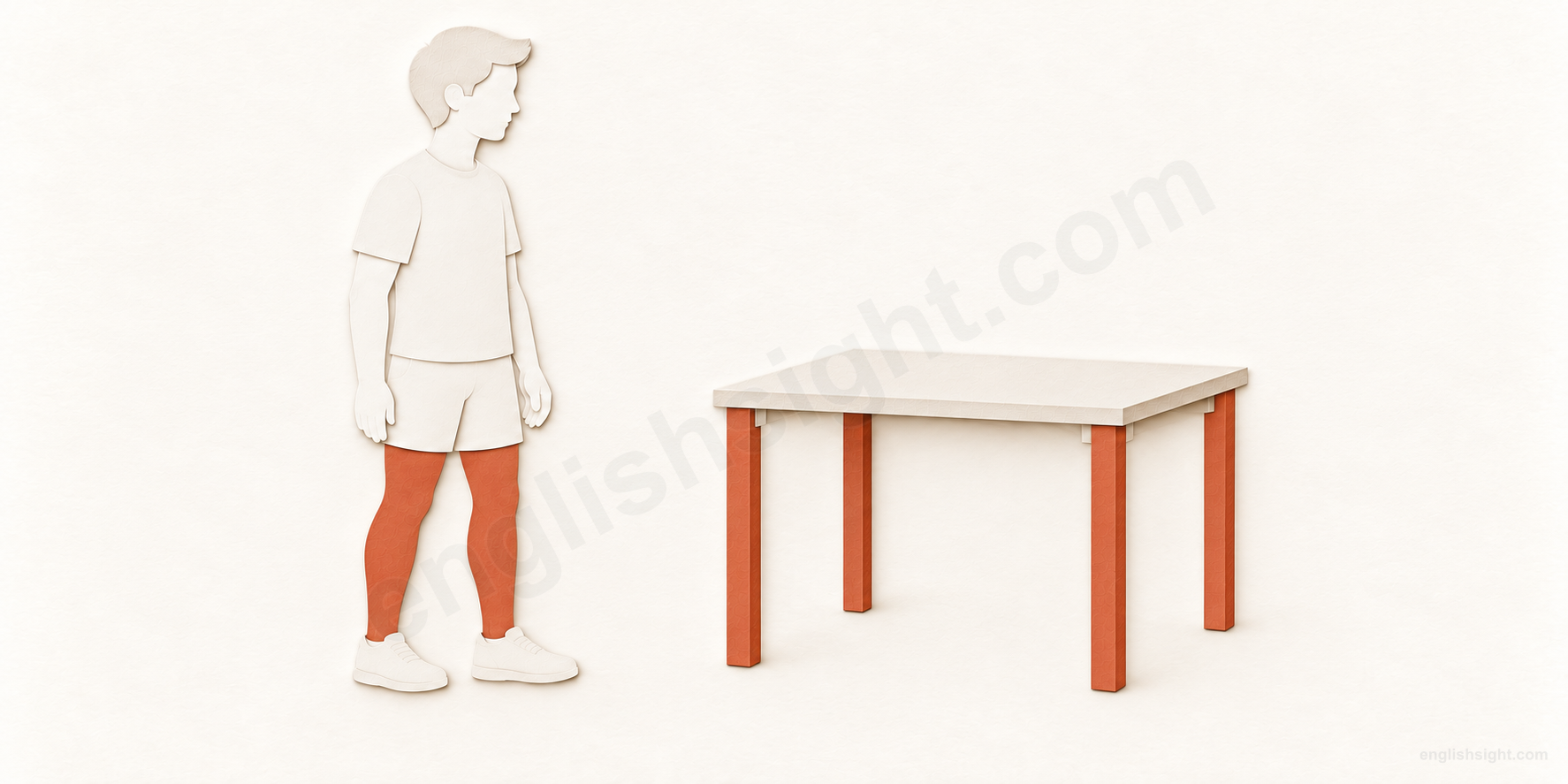
A standing person and a raised tabletop.
leg
The body and tabletop are held up.
Highlighted legs reach the ground beneath both.
A body's legs support it and enable movement; table legs share the support function. This comparison does not explain every meaning or idiom.
A leg is a body limb that supports the body and enables movement; furniture legs share the supporting function.
The sketch compares two supporting structures. It shows a relation rather than a before-and-after change. Clothing, meat, route stages, and idioms are explained separately in the lesson.
A leg can hold a body up and help it move. English also uses leg for a furniture support, the clothing over a limb, a cut of meat, and a stage in a journey or competition.
Some connections are easy to see; expressions such as pull my leg and break a leg must be learned as whole phrases. The diagram is a teaching comparison, not a claim that all English speakers share one mental picture.
01
Bodies, coverings, food, and supports
Start with the physical limb, then distinguish the meat, the clothing around it, and objects with a similar supporting shape.
01
a / one leg; two legs; my / your + left / right leg
my left leg
a limb used for standing and moving
Situation / starting point
You describe where your body hurts.
Meaning in this context
The listener knows which limb you mean.
A leg is the limb; the foot is its lower end.
In everyday English, leg normally names the limb from the hip down towards the foot, not just the part below the knee. Animals and insects have legs too: a dog has front and back legs; hind legs are the back pair.
Leg is usually countable: one leg, two legs. Use a possessive when identifying a person’s limb: My right leg hurts. A leg injury uses the singular noun leg before another noun. Long legs describes length, not necessarily a person’s overall height.
In a sentence
My left leg hurts when I climb the stairs.
Watch the difference Do not use foot when you mean the whole limb. Specialist anatomy may use leg more narrowly.
02
cross / bend / straighten + possessive + legs; with + possessive + legs crossed
cross your legs
put one leg across the other
Situation / starting point
You sit down on a chair.
Meaning in this context
One leg rests across the other.
The verb tells us what the legs do; leg still names the body part.
Cross your legs describes a position. Bend your legs changes their angle at the knees, while straighten your legs reverses that bend. These are ordinary verb-and-object combinations, not new meanings of leg.
She sat with her legs crossed describes the resulting position; She crossed her legs describes the movement into it. A broken leg describes an injury. None of these phrases requires a special figurative interpretation.
In a sentence
Maya sat down and crossed her legs.
Watch the difference Cross your legs and cross the road describe different actions because the objects differ.
03
a chicken leg; a leg of lamb; some leg of lamb
a chicken leg / a leg of lamb
the animal’s leg prepared as food
Situation / starting point
You choose pieces of meat for dinner.
Meaning in this context
You specify which cut or piece you want.
Food vocabulary names the body part that the meat comes from.
A chicken leg counts a piece of meat. A leg of lamb names the cut and uses of to identify the animal. This is a direct connection to the body sense, rather than a metaphor about supporting something.
We cooked two chicken legs counts pieces; some leg of lamb can refer to an amount of meat from the cut. Lamb here is the food name, so a leg of lamb does not require an article before lamb.
In a sentence
We roasted two chicken legs with potatoes.
Watch the difference A chicken leg is a cut of meat; it does not mean a whole chicken.
04
a trouser / pant leg; the legs of + trousers / jeans; too long in the leg
a trouser leg / a pant leg
one of the two clothing sections that cover the legs
Situation / starting point
One side of your jeans brushes wet paint.
Meaning in this context
Only the fabric around that leg is marked.
The covering takes its name from the body part it covers.
A trouser leg is one section of a pair of trousers; pant leg is usual in American English. The legs of your jeans are fabric, not parts of your body.
You can roll up a trouser leg or both legs of your jeans. If jeans are too long in the leg, the leg sections are too long for the wearer. The phrase concerns fit, not unusually long body parts.
In a sentence
There is blue paint on the left leg of my jeans.
Watch the difference Keep the whole garment and its parts separate: a pair of trousers has two legs.
05
a table / chair leg; the leg of + a table / chair
a table leg
a support underneath a piece of furniture
Situation / starting point
A table rocks when you put weight on it.
Meaning in this context
You find a loose support beneath it.
A furniture leg supports weight, like a body’s leg.
Tables, chairs, stools, and tripods can have legs. Here the resemblance is in shape and function: a narrow part holds something above the floor. A table leg does not need a knee or a foot shaped like a person’s.
A table leg and the leg of the table name the same kind of part. Compare a table top, which is the surface above the legs. Not every support is called a leg: a broad continuous base is usually just a base.
In a sentence
One leg of this table is loose, so the table wobbles.
Watch the difference The diagram illustrates support; it does not turn every supporting object into a leg.
06
number / description + -legged + noun
a three-legged stool
having the stated number or kind of legs
Situation / starting point
You describe the supports under a stool.
Meaning in this context
The description tells the listener how many it has.
The ending -legged turns a description of legs into an adjective.
A three-legged stool has three legs; a long-legged bird has long legs. These adjectives can describe furniture or living things. Use the ending -legged, not the plural noun legs: a three-legged stool, not a three-legs stool.
Before a noun, write the compound with a hyphen. With numbers, -legged is nearly always pronounced /leɡɪd/, with an extra syllable. In other adjectives, such as long-legged, either /leɡɪd/ or /leɡd/ is possible. The past-tense verb legged in We legged it home is pronounced /leɡd/.
In a sentence
A three-legged stool stands beside the workbench.
Watch the difference Three-legged is an adjective; it is not the plural form of leg.
02
Stages of journeys and competitions
Here leg names a section within a larger course or contest. Transport and sport supply the specific setting.
07
the first / next / final leg of + a journey / trip; on the… leg
the first leg of a journey
one stage of a longer trip
Situation / starting point
A trip includes a train ride followed by a bus ride.
Meaning in this context
You describe the train portion separately.
A leg can be a stage of a course, even without any walking.
The first, next, return, or final leg of a journey is a section of the larger trip, often between stopping or changing points. It may be made by train, plane, boat, or another form of transport.
We are on the final leg means we are currently in that stage. This is an established extension to a section of a route. The body-and-support sketch alone cannot predict it. Compare the last leg of a journey with on its last legs: the latter is a separate idiom about failing.
In a sentence
The first leg of our journey is a train ride to the coast.
Watch the difference A leg is one stage of the journey; it need not be the whole trip or a journey on foot.
08
run + the first / second / final / anchor leg of + a relay
run the final leg
complete one runner’s section of a relay race
Situation / starting point
Several runners share a relay race.
Meaning in this context
The last runner completes the final section.
A race leg divides a shared course into stages.
In a relay, each runner completes a leg before the next takes over. The final leg may also be called the anchor leg. The distance depends on the event.
A lap is one circuit of a track; a leg is one assigned section. They can coincide in a particular race, but they are not interchangeable definitions. One runner’s leg might include more than one lap.
In a sentence
Nora ran the final leg of the relay and crossed the line first.
Watch the difference Winning one leg and winning the whole relay are different claims.
09
the first / second leg; play / win + a leg; over two legs
a match played over two legs
one game in a contest decided across multiple games
Situation / starting point
Two teams will play one game at each home ground.
Meaning in this context
The results together decide the contest.
In this sporting use, a leg is a game within the larger contest.
Especially in British sports reporting, the first leg and second leg can be separate matches between the same opponents. A contest played over two legs is decided from the combined results under that competition’s rules.
The second leg is not the second half of the first match. Both legs may each have their own halves. A team can win one leg and still lose the contest overall.
In a sentence
We lost the first leg but won the second by enough goals to go through.
Watch the difference Read the competition’s rules; leg does not itself specify the scoring system.
03
Walking, hurrying, and finding balance
Some expressions stay close to moving the body. Others carry a conventional meaning and a particular conversational tone.
10
stretch + my / your / our / their + legs
stretch your legs
take a short walk after sitting
Situation / starting point
You have been sitting on a bus for hours.
Meaning in this context
You get off and walk for a few minutes.
The familiar phrase describes a walk that relieves inactivity.
Let’s stretch our legs often proposes a short walk during a break. It does not necessarily ask anyone to do a stretching exercise. Your legs move again after a period of sitting.
She stretched her legs out under the desk can instead describe straightening or extending them. Out and the location make the physical action clear. Context distinguishes the short-walk expression from the literal movement.
In a sentence
We stopped at a service station to stretch our legs.
Watch the difference Stretch your legs can mean a short walk; stretch your legs out may simply mean extend them.
11
leg it + to / across / along / home; legged it; legging it
leg it
go on foot, often quickly or by running
Situation / starting point
You notice that the last bus is about to leave.
Meaning in this context
You run towards the stop.
Leg becomes a verb in this fixed informal expression.
Leg it is an informal way to say go on foot, often by running or hurrying. It is especially familiar in British conversation and often occurs in escape scenes, but escape is not required. We legged it to the station can mean we hurried there. In another context, We missed the bus and had to leg it home can simply mean we had to walk home; speed is not always the point.
The forms are leg it, legs it, legged it, and legging it. It is part of the expression, not a movable object referring to the destination. As fast as your legs can carry you is another vivid way to say as quickly as you can.
In a sentence
We legged it to the bus stop when we saw the bus coming.
Watch the difference Keep it in place: leg it to the stop, not leg the stop it. Use walk or run for a neutral tone.
12
Shake a leg!; shake a leg = dance (older / playful use)
Shake a leg!
hurry up or start moving
Situation / starting point
Someone is taking too long to get ready.
Meaning in this context
You urge them to get moving.
The whole phrase gives a prompt; no literal shaking is required.
Shake a leg! is an informal, somewhat old-fashioned instruction to hurry or get started. It can sound playful with friends and impatient in another setting. We need to leave now is a more neutral alternative.
Shake a leg can also mean dance, especially in older or playful usage: They went out to shake a leg. The imperative about being late and the social invitation point to different meanings; neither meaning follows from shake alone.
In a sentence
Shake a leg, everyone—the taxi is waiting!
Watch the difference This is a fixed idiom. Shaking one leg as a physical action does not necessarily mean hurrying.
13
find / get + possessive + sea legs
find your sea legs
become steady and comfortable on a moving ship
Situation / starting point
The ship’s motion makes you unsteady and queasy.
Meaning in this context
You become accustomed to walking aboard.
Sea legs names an ability to cope with the ship’s motion.
Sea legs is a plural expression for being able to walk comfortably on a moving ship without feeling seasick. Find your sea legs describes acquiring that adjustment, not searching for missing body parts.
The possessive belongs to the traveler: I’m finding my sea legs; you have found your sea legs. The phrase does not mean that your legs become physically longer or stronger.
In a sentence
It took me a day aboard the ferry to find my sea legs.
Watch the difference This lesson teaches the shipboard use; the phrase is not a guarantee against all future seasickness.
04
Jokes, wishes, cost, and staying power
Learn these expressions as complete units. A support or movement comparison can help in some cases, but it cannot predict every idiom.
14
pull + someone’s / my / your + leg
pull someone’s leg
tease someone by telling them something untrue
Situation / starting point
A friend tells you an unbelievable story with a smile.
Meaning in this context
You suspect that it is a playful invention.
The person’s leg represents them inside a fixed teasing expression.
Are you pulling my leg? asks whether the speaker is joking or trying to fool you playfully. The person whose leg is mentioned is the target: I pulled her leg means I teased her.
The phrase is informal. I’m only pulling your leg can reveal the joke after someone believes it. Compare lying, which describes untruth more broadly and does not imply a playful intention. The support sketch does not explain this idiom’s origin.
In a sentence
You met the king at the supermarket? Are you pulling my leg?
Watch the difference Keep the possessive: pulling my leg. The usual idiom has singular leg even though a person has two.
15
Break a leg! (good-luck wish)
Break a leg!
wish someone success, especially before performing
Situation / starting point
A friend is about to go on stage.
Meaning in this context
You offer an informal good-luck wish.
A fixed wish can have a meaning opposite to its literal wording.
Break a leg! is a supportive expression, especially for a performer before a show. It is not a request or a wish for an injury. Learn it as a whole phrase rather than deriving the meaning from break plus leg.
She broke her leg during rehearsal reports an actual injury. The standalone wish before a performance and the statement about an accident belong to different situations. Good luck is a clearer choice if the listener may not know the idiom.
In a sentence
Your first show starts in ten minutes. Break a leg!
Watch the difference Do not interpret a literal injury report as a good-luck wish just because break and leg occur together.
16
something costs (someone) an arm and a leg; pay an arm and a leg for something
cost an arm and a leg
cost a very large amount of money
Situation / starting point
You ask about the price of a repair.
Meaning in this context
The quoted price seems extremely high.
Body parts express an exaggerated price in this whole idiom.
The repair cost an arm and a leg emphasizes how expensive it was. It does not specify a price or mean anyone paid with body parts. The exaggeration belongs to the full expression.
With cost, the thing has the price: It cost me an arm and a leg. With pay, the buyer pays: I paid an arm and a leg for it. The phrase is informal and often suggests that the amount felt painfully high.
In a sentence
Replacing the damaged screen cost me an arm and a leg.
Watch the difference Keep the articles in the familiar expression: an arm and a leg.
17
be on + my / your / its / their + last legs
be on your / its last legs
be exhausted or close to failing
Situation / starting point
An old printer repeatedly stops working.
Meaning in this context
You expect it to stop functioning altogether soon.
The idiom suggests that little capacity remains.
My printer is on its last legs means it is in very poor condition and may fail soon, even though the machine has no literal legs. A business on its last legs is likewise close to failure.
With a person, I’m on my last legs can express extreme exhaustion: I was on my last legs after the night shift. In a serious health context it can suggest approaching death, so be sensitive about using it of someone else. The final leg of a trip simply means its last stage.
In a sentence
This old printer is on its last legs; it stops after every page.
Watch the difference Use plural legs. On its last legs concerns remaining capacity; on the last leg of a journey concerns a stage.
18
not have / haven’t got + a leg to stand on
not have a leg to stand on
have no adequate support for a claim or position
Situation / starting point
Someone disputes your complaint.
Meaning in this context
You have no evidence or sound reason to back it up.
Physical support becomes a teaching comparison for argumentative support.
I don’t have a leg to stand on usually means I cannot adequately justify my position. The missing support may be evidence, a sound argument, or grounds for a complaint; it is not about the ability to stand physically.
The expression often occurs in negative forms, including You haven’t got a leg to stand on. A leg to stand on can also be used positively when support exists. The to-infinitive describes what the leg could support, and on belongs inside the fixed phrase.
In a sentence
Without a receipt or any record of payment, I don’t have a leg to stand on in this dispute.
Watch the difference This is an everyday expression, not a legal ruling about what evidence a court would accept.
19
give someone a leg up; a leg up in something; a leg up on someone
give someone a leg up
help someone climb, or help them advance
Situation / starting point
A beginner has ability but needs an opportunity.
Meaning in this context
Someone gives them useful help to get started.
A physical boost also supplies a comparison for practical help.
Literally, give someone a leg up can mean help lift them so they can climb: Could you give me a leg up onto this wall? The person receiving help is the object after give.
Figuratively, experience, advice, or an opportunity can give someone a leg up in a career. Having a leg up on someone means having an advantage over them. The advantage can help without guaranteeing success; up is part of the expression, not a particle you can move away from leg.
In a sentence
That short internship gave Leila a leg up when she applied for her first job.
Watch the difference Give someone a leg up helps that person; pull someone’s leg teases them. The verbs change the whole expression.
20
a story / idea / plan has legs; a story / idea with legs
have legs
have the potential to continue or succeed
Situation / starting point
People keep sharing a story after its first appearance.
Meaning in this context
You expect public interest to continue.
Continuing movement offers a memory aid for staying power.
A news story that has legs continues to attract attention. The story has legs is an informal assessment of its staying power, not a claim that the story can literally walk.
An idea or plan with legs has potential to work or develop: This repair service could have legs if local demand stays strong. The context may emphasize lasting interest or practical promise. A story can attract attention even when it is false, so do not treat has legs as proof of truth.
In a sentence
The story still has legs: a week later, people are sharing new details.
Watch the difference Use plural legs in this idiom; has a leg is not the usual expression for staying power.
21
come / go / return + with + possessive + tail between + possessive + legs
with your tail between your legs
feeling ashamed or defeated
Situation / starting point
Someone confidently predicts an easy victory.
Meaning in this context
After losing, they return embarrassed.
An animal posture supplies an image inside a fixed human expression.
Come back with your tail between your legs means return feeling defeated or ashamed. A person does not need a literal tail. The possessives refer to that person: He returned with his tail between his legs.
The phrase can sound mocking when used about someone else. It often accompanies leaving, returning, or retreating, but it describes the person’s humbled state rather than a particular direction of travel. This animal-posture metaphor is separate from the support relationship in the main diagram.
In a sentence
After boasting that he would win, he came home with his tail between his legs.
Watch the difference Keep tail singular and legs plural for one person: his tail between his legs.
Read the whole expression
Countable noun, with a food exception
The usual plural is legs. Use a leg, my leg, or two legs, not bare singular leg for an ordinary limb. Meat can also be uncountable when an amount is meant, as in some leg of lamb.
Leg, foot, and limb
In ordinary body description, the leg extends down from the hip and the foot is its lower end. Limb is a broader category including arms. Anatomical definitions may restrict leg to the region below the knee; this lesson starts from everyday use.
Constructions do different jobs
Leg is mainly a noun here. Cross your legs is an ordinary verb-object combination. Leg it is a fixed informal verb expression, with legged and legging. A three-legged stool contains an adjective. There is no need to invent passive, causative, or particle-verb families for this noun.
The picture has limits
A support comparison helps with table leg and a leg to stand on. Stages of a journey are an established extension. Good-luck wishes and teasing idioms are conventional; no diagram or single translation can reliably predict them.
Coverage and register
This is a selection of everyday meanings and useful expressions, with older shake a leg included for recognition. Technical geometry, sailing and cricket terms, old canal-boat legging, abbreviations, sexual slang, and separate words such as legwork are not expanded here.
Choose the meaning in context
Use the situation and the entire phrase. The same noun can name a body part, a stage, or part of a fixed idiom.
1. You spilled coffee on one leg of your jeans. What is stained?
2. The final leg of the trip is by plane. What does leg mean?
3. Your friend says “Break a leg!” just before you perform. What do they intend?
4. A friend tells a wild story, then says “I’m only pulling your leg.” What happened?
5. “The laptop is on its last legs.” Which meaning fits?
6. “The training gave me a leg up when I applied.” What did the training provide?
7. “The story has legs: people are still discussing it.” What can you conclude?
Sources and teaching notes
The dictionary pages below informed the coverage and usage checks. Explanations and examples are original; the support comparison is a teaching aid, not an etymological claim.
This diagram illustrates a useful connection; it is not a picture shared by every native speaker.