Separate alphabet letters, correspondence, and expressions about exact wording.
A written sign and a written communication
A written sign and a written communication
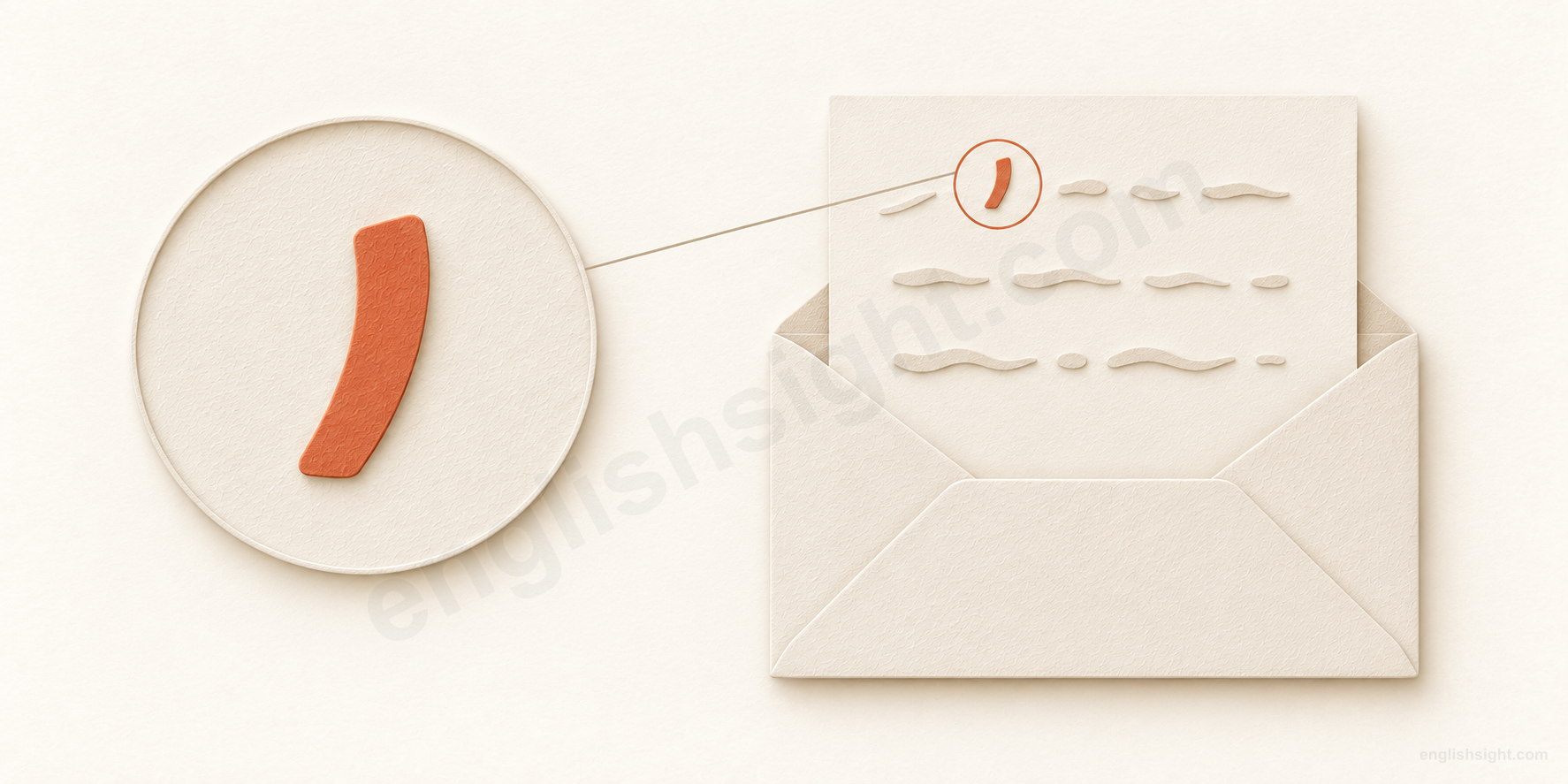
One schematic writing unit is isolated in a magnified detail.
letter
The page emerging from an envelope represents a complete letter to someone.
A plain reference line links the detail to the matching mark on the page; it shows scale, not change.
The schematic mark stands for one alphabet symbol; the page and envelope stand for a whole written message. This compares meanings, not stages.
Letter can name one alphabet symbol or a whole written message addressed to someone. Context decides which; some fixed expressions instead concern exact wording.
The two sides compare meanings, not stages of a transformation. The symbol belongs to the written text; the page and envelope stand for a complete communication. This is a teaching model, not a shared mental image claimed for every speaker.
A letter can be one part of a word, or a complete written communication to someone. First decide which scale the context selects: the individual symbol or the whole message.
Expressions about rules also use letter for exact wording. Other compounds and the North American sports use need their own contexts; no single envelope picture predicts all of them.
01
Alphabet symbols and ways of writing
Start with one written sign. Its shape, position, and use as a code are different questions from the meaning of a whole word.
01
a letter; the letter + name; letters of the alphabet; a word with + number + letters
a letter of the alphabet
one symbol used to write a language
Situation / starting point
You look at the written word lamp.
Meaning / result
You count four letters: l, a, m, and p.
Count the written symbols, not the words or spoken sounds.
In spelling, a letter is one alphabet symbol. Lamp is one word with four letters. The letter L names a particular member of the alphabet; naming the letters l, a, m, and p identifies several of them.
Writing and sound do not match one for one in English. Ship has four letters, although sh works together to represent one sound. In knee, the first letter is silent. A silent letter is still present in the spelling.
A letter is one kind of character. Digits and punctuation marks are characters too, so a request for letters only excludes 7 and !. The picture highlights a single symbol to keep that smaller unit visible.
In a sentence
The word lamp has four letters.
Watch the difference Do not use letter to mean an entire word, or assume that counting letters counts sounds.
02
a capital / uppercase / lowercase letter; in capital / lowercase letters; begin with the letter + name
capital / lowercase letters
the uppercase and lowercase forms of alphabet letters
Situation / starting point
A name has been entered as maya.
Meaning / result
You change its first letter to M.
Case changes the written form, not which letter it is.
M is a capital letter, also called an uppercase letter; m is a lowercase letter. They are two forms of the same alphabet letter. A capital is not simply any letter printed in a large size.
Use in when describing the form of the writing: in capital letters or in lowercase letters. You can also speak of the first letter of a name or a word beginning with a particular letter.
Letter case is about the symbols in the picture. It does not change a whole written message into a different kind of letter.
In a sentence
Write Maya with a capital M and lowercase letters after it.
Watch the difference Uppercase and lowercase are letter forms; they do not mean large and small font sizes.
03
write / print / fill in + something + in block letters / block capitals
in block letters
using clear, separate capital letters
Situation / starting point
A form asks for easily readable handwriting.
Meaning / result
You print each capital separately.
The instruction specifies how to form the letters.
On a form, write in block letters asks for separate, clear capitals such as MAYA rather than joined handwriting. Block capitals is another term, especially in British English.
This instruction concerns the shapes the reader must recognize. It does not ask you to draw boxes around the letters or use a bold font. If a form gives an example, follow its model.
In a sentence
Please print your surname in block letters.
Watch the difference Block letters describes a style of writing, not a letter sent as part of a group.
04
the initial letter(s) of + name; a letter grade; letters after somebody’s name
initial letters / a letter grade
alphabet symbols used as abbreviations, labels, or grades
Situation / starting point
A long name or a result needs a short written form.
Meaning / result
Letters stand for the name or grade.
The symbol carries a meaning assigned by a particular system.
The initial letter of a word is its first letter. A name such as River Art Club can be shortened to RAC using its initial letters. Here initial tells you which letters were selected.
A letter grade uses a symbol such as A or B to report a result. The scale depends on the school or course; the letter alone does not tell you every grading rule.
Letters after someone’s name can indicate a qualification, such as PhD. These uses still concern alphabet symbols; they do not mean several pieces of correspondence.
In a sentence
Our teacher gave the project a letter grade of B.
Watch the difference A code must be interpreted in its own system; B does not have one universal grade value.
02
Writing to people and organizations
A letter is also a complete written communication. Read the surrounding words to identify the writer, reader, delivery method, and purpose.
05
write / type / read / sign + a letter; a personal / handwritten / love letter
write a letter
compose a written communication addressed to someone
Situation / starting point
You want to tell a friend your news.
Meaning / result
You put the news into a letter for that friend.
A letter is the whole communication, not one alphabet sign.
A letter can tell personal news, express love, or deal with official business. It is commonly written or printed on paper. It can also be prepared as a document and sent as an email attachment.
Letter describes a recognizable kind of communication, not everything you write. A shopping list is writing but is not normally a letter; a short text is normally called a message or a text.
Use a letter for one complete communication and letters for more than one. A love letter is personal correspondence expressing love; a handwritten letter describes how it was produced.
In a sentence
I wrote a long letter to a friend who lives abroad.
Watch the difference Write a letter uses a noun object. The ordinary verb for composing correspondence is write, not letter.
06
a letter to / from / for + person; write somebody a letter; address a letter to + recipient
a letter to / from / for someone
identify the intended reader, writer, or recipient
Situation / starting point
Nora writes to you.
Meaning / result
You have a letter from Nora, addressed to you.
To points toward the reader; from identifies the source.
A letter to Nora is directed to Nora. A letter from Nora comes from her. There is a letter for you means you are the intended recipient. The prepositions, not letter alone, assign these roles.
Write Nora a letter and write a letter to Nora both name Nora as the recipient. A letter about Nora instead gives the subject of the communication; it need not be written by her or sent to her.
Address a letter to someone means put that recipient’s name or address on it. The surrounding grammar makes the participants clear even when an envelope is not being discussed.
In a sentence
There is a letter for you from Nora.
Watch the difference A letter of Nora is not the ordinary way to say a letter she wrote; use from Nora.
07
post / mail / send a letter; send somebody a letter; receive / get a letter
post / mail / receive a letter
send a letter through the postal system or get one
Situation / starting point
A letter is ready to leave the writer.
Meaning / result
The postal service carries it to the recipient.
These verbs describe delivery, not the content of the letter.
Post a letter is usual British wording; mail a letter is usual North American wording. Send a letter is a neutral choice across varieties. You can send someone a letter or send a letter to someone.
Receive a letter and get a letter describe the other end of the event. Get is ordinary conversational wording; receive is useful in more formal writing.
Writing and sending are different actions: I wrote the letter but haven’t posted it yet is natural. With letter as a countable noun, a letter can arrive, or several letters can arrive.
In a sentence
I posted the letter on Monday, and she received it on Wednesday.
Watch the difference Use a letter or letters when counting separate items; mail commonly refers to correspondence collectively.
08
answer a letter; reply to a letter
answer / reply to a letter
respond to a written communication
Situation / starting point
Someone has written to ask for information.
Meaning / result
You send an answer.
The response concerns the message, not its alphabet symbols.
Answer a letter and reply to a letter both describe responding to correspondence. You might answer a question, explain your decision, or simply thank the writer.
Keep the grammar of the response verb: answer takes the letter directly, while reply takes to. The choice of preposition comes from reply, not from a special meaning of letter.
In a sentence
Could you reply to the letter before Friday?
Watch the difference Say reply to the letter, not reply the letter. Answer the letter does not need to.
09
communicate / notify / reply + by letter; say / explain / mention + something + in a/the letter
by letter / in a letter
distinguish a communication method from the location of information
Situation / starting point
You choose how to communicate and what to put in the message.
Meaning / result
The method and the contents can be described separately.
By names the channel; in points to information inside a particular letter.
By letter describes the method: The office contacted me by letter. This fixed channel expression normally has no article. It contrasts with communicating by phone or by email.
In a letter and in the letter locate information in a written message: She explained the change in a letter. Use a when introducing one and the when the reader knows which one.
I sent it by letter stresses how I communicated. I mentioned it in the letter stresses where the statement appears. Both use the message branch of the diagram.
In a sentence
The college notified us by letter; the date was given in the letter.
Watch the difference By a letter is not the usual channel expression. In letter is not the usual way to refer to contents.
10
a letter of + complaint / apology / resignation; a complaint / thank-you / rejection letter
a letter of complaint / apology / resignation
name what a formal letter is meant to do
Situation / starting point
You need to complain, apologize, or resign in writing.
Meaning / result
The letter performs that communicative task.
Of introduces the purpose or kind of communication.
A letter of complaint raises a problem; a letter of apology says you are sorry; a letter of resignation formally says you are leaving a job or position. The noun after of supplies the specific purpose.
Complaint letter, apology letter, and resignation letter are also useful combinations. A thank-you letter expresses thanks, while a rejection letter communicates a refusal.
These are noun phrases, not phrasal verbs. Of complaint describes the letter’s function, whereas from a customer identifies the writer and about a delivery identifies the topic.
In a sentence
We sent a letter of complaint about the damaged delivery.
Watch the difference The letter’s type does not identify its writer or recipient; add from or to when needed.
11
send / include / attach + a cover letter / covering letter + with + documents
a cover letter / covering letter
an accompanying letter that introduces other documents
Situation / starting point
You have a CV and other application documents.
Meaning / result
A separate letter introduces what you are sending.
The letter accompanies and explains another item.
A cover letter, also called a covering letter especially in British English, accompanies something you submit. In a job application, it introduces you and connects your application to the job.
The CV or résumé lists relevant experience; the accompanying letter explains why you are sending it and why you fit the role. The word cover does not mean a physical protective wrapper here.
This is still a whole letter. Its relationship to the accompanying documents, rather than its transport in an envelope, identifies this type.
In a sentence
I attached a cover letter explaining why I wanted the role.
Watch the difference A cover letter is not the envelope, and it is not simply another name for a CV.
12
write / request / provide + a letter of recommendation; a recommendation / reference letter
a letter of recommendation
a written endorsement of someone’s suitability
Situation / starting point
An applicant needs another person to describe their strengths.
Meaning / result
A teacher or employer writes in support of the applicant.
The writer recommends a person; the applicant need not be the writer.
A letter of recommendation, also called a recommendation letter, supports someone’s suitability for a job, course, or similar opportunity. A teacher might discuss a student’s work; an employer might describe someone’s skills.
You write your own cover letter to introduce your application. A recommendation letter is normally written by someone who can speak about your abilities. Reference letter is another familiar term in this area.
The of phrase tells us the letter’s function. From my supervisor identifies who provides that assessment; it does not say the supervisor is applying for the position.
In a sentence
My tutor wrote a letter of recommendation for my course application.
Watch the difference Distinguish your own application letter from another person’s written assessment of you.
13
publish / sign + an open letter to + person or organization; write a letter to the editor
an open letter / a letter to the editor
use letter form for a public contribution or appeal
Situation / starting point
Residents want a person in authority and the public to hear their concerns.
Meaning / result
They publish an addressed letter.
A named addressee and a wider readership can coexist.
An open letter is addressed to a person or organization but made public, often to criticize a decision or call for action. Open refers to public access, not an envelope that has been unsealed.
A letter to the editor is submitted to a newspaper or other publication, often as a reader’s opinion for possible publication. It is not automatically an open letter to an authority: the phrases describe different aspects of public correspondence.
The written-message meaning remains. The important difference from an ordinary private letter is who is meant to be able to read it.
In a sentence
Residents published an open letter to the mayor about the park.
Watch the difference An open letter means public correspondence, not merely a letter somebody has physically opened.
14
send / receive + a form letter
a form letter
a standard letter used for many recipients
Situation / starting point
An organization must send the same kind of answer to many people.
Meaning / result
It reuses standard wording.
The wording is standardized instead of individually composed throughout.
A form letter uses a standard text for a number of recipients. It may insert each person’s name or a few individual details while keeping the main message the same.
A form letter can be used to answer repeated questions or communicate a routine decision. It is a letter, whereas a form is usually a document with spaces for information you supply.
The compound must be learned as a type of message. It does not mean a letter of the alphabet drawn in a special shape.
In a sentence
Each applicant received the same form letter with a different name at the top.
Watch the difference A form letter is a standard communication, not a blank application form.
15
receive / forward / pass on + a chain letter
a chain letter
a message asking its recipients to pass copies to further people
Situation / starting point
You receive a message telling you to send it on.
Meaning / result
More recipients are asked to repeat the same action.
The request to keep forwarding creates the chain.
A chain letter asks recipients to send the message, or copies of it, to more people. It can travel as paper correspondence or as an email.
An organization sending the same form letter to many people is different: those recipients are not necessarily asked to pass it on. Chain describes this repeated forwarding relationship, not a chain physically attached to a page.
In a sentence
The email was a chain letter asking me to forward it to ten friends.
Watch the difference A message sent to many people is not automatically a chain letter; the onward-copying request matters.
03
Exact wording and established expressions
Some expressions focus on written detail; others have meanings learned as a whole. An envelope alone will not explain these uses.
16
follow / keep to / stick to + the letter of the law; the letter and spirit of + a rule
the letter of the law
a law’s exact wording, often contrasted with its underlying purpose
Situation / starting point
A rule has both written terms and an intended purpose.
Meaning / result
Someone concentrates on what the terms literally require.
Letter here refers to wording, not correspondence.
The letter of the law concerns its explicit terms. The spirit of the law concerns the purpose or principle behind them. People may contrast the two when technically following a rule seems to miss its purpose.
This expression often carries criticism, but context decides the speaker’s attitude. It does not by itself establish whether any real action is lawful; here it is a language pattern for discussing rules.
The picture’s written symbols give a useful memory connection to wording. They do not explain every judgment about how a rule should be applied.
In a sentence
The decision followed the letter of the rule but ignored its spirit.
Watch the difference The expression does not mean a letter sent by a lawyer. Letter and spirit refer to different ways of understanding a rule.
17
follow / obey / carry out + instructions or orders + to the letter
follow instructions to the letter
carry out instructions with no detail changed or omitted
Situation / starting point
The instructions specify exactly what to do.
Meaning / result
You follow every specified detail.
To the letter describes exact compliance.
To the letter tells us how closely someone follows directions, orders, or a plan. It means the details were carried out precisely; it does not require anyone to send or receive a letter.
The whole phrase works as an adverbial after the action. Compare I followed the instructions carefully: to the letter makes the claim of exactness stronger.
The link to written detail is a memory aid. The fixed wording is singular the letter, even if there are many instructions.
In a sentence
We followed the assembly instructions to the letter, including the final safety check.
Watch the difference Keep the fixed phrase to the letter, not to a letter or to the letters.
18
a law / agreement + be / become + a dead letter; a dead letter [postal item]
a dead letter
a rule without practical effect, or an undeliverable postal item
Situation / starting point
A rule remains written down, but people no longer act on it.
Meaning / result
It exists on paper without being put into practice.
Context separates an inactive rule from a failed postal delivery.
Figuratively, a law or agreement that is a dead letter still exists but is ignored. Dead describes the absence of practical effect, not a person who has died.
The same compound has a postal sense, especially in North American English: a letter that cannot reach its intended recipient or be returned to its sender. A damaged address and no usable return address could produce such a situation.
These senses need different contexts. The ban had become a dead letter discusses enforcement; The postal service held the dead letter discusses delivery. Neither means an ordinary message containing sad news.
In a sentence
The old agreement became a dead letter when both groups stopped observing it.
Watch the difference Do not confuse a dead letter with any letter from a deceased writer, or any message announcing a death.
19
be + a red-letter day for + person or group
a red-letter day
a particularly important or happy day
Situation / starting point
Something good and memorable happens.
Meaning / result
You regard that date as special.
The entire expression marks a special occasion.
A red-letter day is a day made special by an important or happy event, such as a major achievement or celebration. You do not need to receive any correspondence that day.
The expression is linked historically to special dates being highlighted in red on calendars. That helps explain the wording, but present-day use does not require a red mark or even a paper calendar.
In a sentence
Opening our first shop was a red-letter day for the family.
Watch the difference Red-letter modifies day as a unit. It does not describe a letter written in red ink.
20
a + number-letter + word [length]; a four-letter word [swear word]
a four-letter word
literally a word of four letters, or an expression for a swear word
Situation / starting point
The context is either a spelling puzzle or a discussion of offensive language.
Meaning / result
You choose the literal count or the established expression.
The same form can describe length or refer to swearing.
In a puzzle, a four-letter word can mean exactly what it says: lamp has four letters. Before a noun, the number-plus-letter modifier keeps letter singular: a six-letter word, not a six-letters word.
In ordinary discussion of offensive speech, four-letter word is also an established way to refer to a swear word. Calling speech full of four-letter words normally comments on its language, not on a spelling count.
Read the situation. A perfectly ordinary word such as lamp is not offensive merely because it has four letters.
In a sentence
The reviewer warned that the film contained several four-letter words.
Watch the difference A four-letter spelling and the idiomatic reference to swearing are different interpretations.
04
Marking things and earning a school letter
The verb can put letters on a surface, assign letter labels, or refer to a particular North American school award.
21
letter + surface; be lettered + in + color / material
letter a sign / be lettered in gold
put written letters onto a surface
Situation / starting point
A sign has no visible wording.
Meaning / result
A maker adds carefully formed letters.
The object is the surface receiving the lettering.
As a transitive verb, letter can mean paint, print, sew, or otherwise add letters to something. A sign writer may letter a board. Here letter is about creating visible symbols, not composing correspondence.
The passive is especially useful: The sign was lettered in gold describes the finished lettering. In gold specifies its color or material; it does not name a recipient.
The regular forms are letter, letters, lettered, and lettering. Writing I am lettering the sign is possible for work in progress. In I write a letter, however, letter is a noun.
In a sentence
The artist lettered the shop sign in white.
Watch the difference For everyday correspondence say write to someone or write someone a letter; do not substitute letter someone.
22
be lettered + letter label(s)
items lettered A and B
give items alphabet-letter labels in a series
Situation / starting point
Several items need separate identifiers.
Meaning / result
Each has a letter label.
The letters identify items rather than spelling a message.
In diagrams, tests, or lists, an item can be lettered A, B, or C. The verb means assign a letter as an identifier. It is closely related to the alphabet-symbol meaning.
This use is often passive: the boxes are lettered A and B. A lettered label differs from a numbered label because it uses alphabet symbols. It need not form a word or sentence.
Compare The sign is lettered in white, which describes visible lettering and its appearance. In The boxes are lettered A and B, the following letters tell us the assigned identities.
In a sentence
The two sample bags are lettered A and B.
Watch the difference Lettered A names an identifier; lettered in red describes the lettering’s appearance.
23
earn / receive + a letter in + sport; letter / lettered in + sport
earn a letter / letter in a sport
receive a school or college award represented by a cloth letter
Situation / starting point
A student meets the school’s requirements in a team sport.
Meaning / result
The school awards a letter the student may wear.
This North American use names an award, not a written message.
In a North American school or college context, a letter can be a cloth emblem awarded for participation or achievement in a team activity, especially sport. It often uses an initial of the school’s name.
Earn a letter uses letter as a countable noun. Letter in basketball uses it as an intransitive verb: the student receives that award. In names the sport; it is not a separable verb particle.
This is a regional school tradition. A statement that someone lettered in a sport does not mean they wrote to the team or automatically won a competition.
In a sentence
She lettered in basketball during her final year at school.
Watch the difference Read the school-sport context and regional label; a letter here is an emblem rather than correspondence.
Choose the branch before using the pattern
Count the right unit
Two letters may mean two alphabet symbols or two separate communications. The surrounding topic decides. Letter and word are countable; mail often refers to correspondence collectively.
Symbols do not equal sounds
The English alphabet has 26 letters, but English spelling is not a one-letter, one-sound code. Capital and lowercase are forms of letters; a digit or punctuation mark is a different kind of character.
Noun and verb have different jobs
Most everyday uses here are nouns. The verb letter marks a surface, assigns labels, or names a North American school award. Lettered and lettering are regular forms; passive descriptions such as lettered in white are natural. Writing correspondence normally uses write.
Prepositions contribute their own relationships
To names the addressee, from the source, about the topic, and of often the purpose. By letter names a method; in the letter locates contents. None of these combinations is automatically a phrasal verb.
Scope of this lesson
This selection covers everyday noun patterns, useful compounds and idioms, the marking and labeling verbs, and the regional sports use. Literary letters meaning literature or scholarship, specialist official documents, historical printing senses, and the rare noun meaning someone who rents property to others are not expanded.
Read the whole expression
Use the context, the grammar, and the scale of the written item.
1. A puzzle says that lamp has four letters. What does letters refer to?
2. You receive a letter from Nora, addressed to you. Who wrote it?
3. Choose the ordinary pattern for responding to written correspondence.
4. You carry out every instruction exactly. Which expression fits?
5. A message asks every reader to send copies to ten more people. What type is it?
6. The sign was lettered in white. What happened?
Sources and teaching notes
The dictionary entries below support the meanings and usage patterns. Explanations and examples are written for this lesson. The comparison of a symbol with a whole communication is a teaching aid, not a claim that every use follows from one picture.
The diagram distinguishes two uses of letter; it does not represent an identical mental picture for every speaker.