From horizontal surfaces to amounts, standards, equality, and established expressions.
An even height, or a position to compare
An even height, or a position to compare
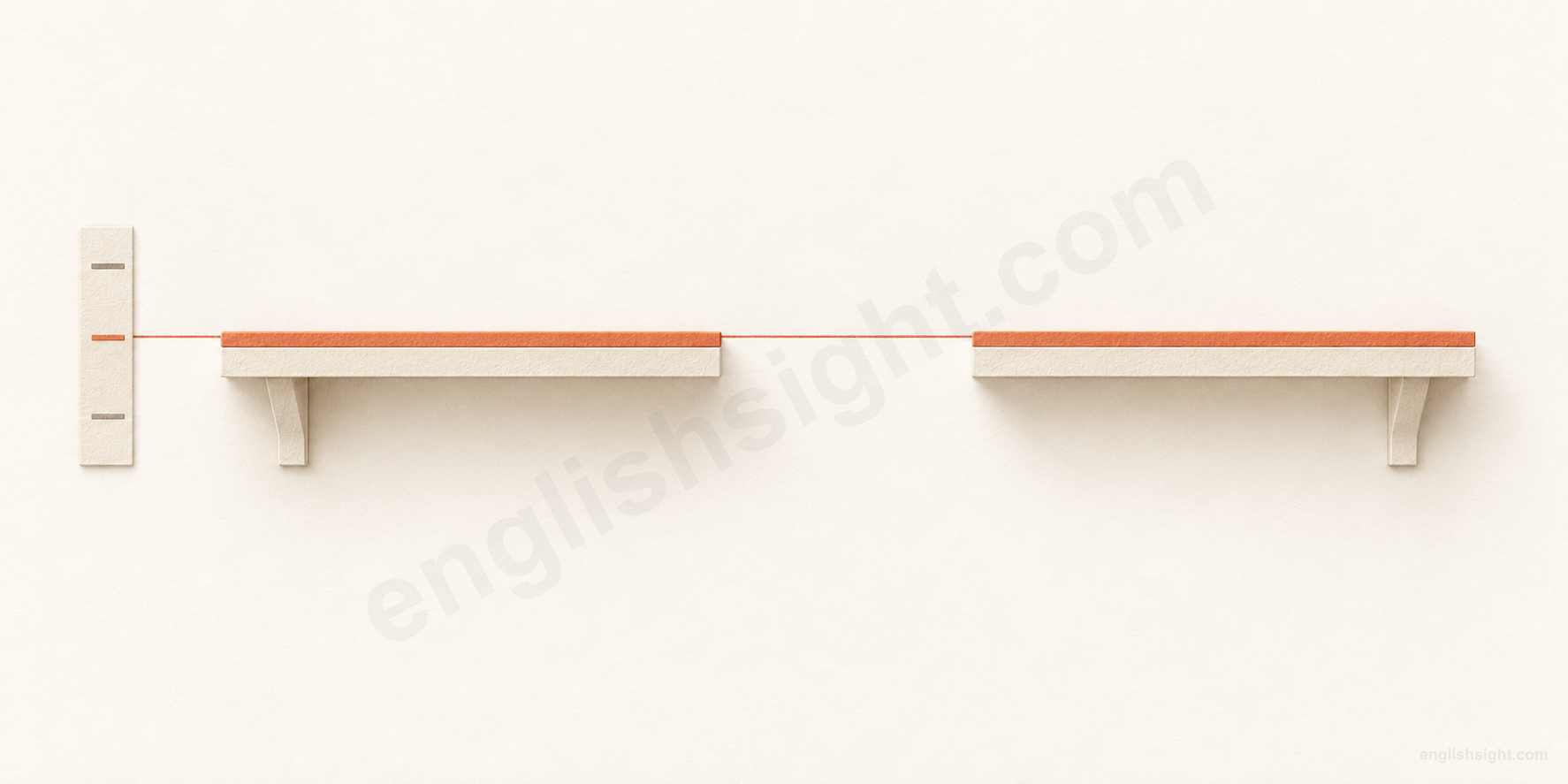
One shelf establishes a height.
level
The other shelf is at the same height.
Compare the tops along the horizontal reference line.
Each shelf is level, and the two tops are level with each other.
A level locates something at a height or a position on a scale; things that are level share an even height or matching standing.
The two shelf tops illustrate a physical relation: each is horizontal, and both are at the same height. Abstract scales extend the comparison idea. Honesty and effort idioms need their own explanations.
A level can be a height or a position on a scale. Things that are level have an even height, matching position, or equal standing in the relevant respect. This connection helps organize several uses without turning them into one interchangeable meaning.
The adjective describes a state; the verb can create a state or describe a change. The object and the surrounding words matter: level a floor, level a house, and level with a friend do very different jobs.
01
Heights, amounts, and positions on a scale
As a noun, level tells us where something stands: in physical space, on a scale, in an organization, or in a sequence.
01
the level of + liquid; at / above / below + reference + level
water level / at eye level
the height something reaches or occupies
Situation / reference
You compare a surface or object with a reference height.
State / interpretation
You locate it above, below, or at that height.
A level is a vertical position, not necessarily a quantity.
The water level is the height of the water’s surface. It can rise or fall. The level of water in a narrow bottle may be high even when the amount of water is small.
At eye level means at the height of someone’s eyes; above sea level uses sea level as a reference for altitude. Ground level refers to the height of the surrounding ground. These noun combinations identify the reference, not separate actions.
In a sentence
Hang the notice at eye level so visitors can read it.
Watch the difference Use at eye level for a height. On Level Two names a floor instead.
02
on + a / the / numbered level; go up / down + a level
on the same level
a floor or horizontal layer
Situation / reference
You need to locate a room in a building.
State / interpretation
You identify the floor rather than a measured height.
A countable level can be a whole floor or layer.
A building can have several levels. On the same level means on the same floor; go down a level means move to the floor below. A numbered label such as Level 3 follows the building’s own system.
Level can also name a layer at an excavation site. Neither use requires every room or every point in a layer to have exactly the same height.
In a sentence
The café and the bookshop are on the same level.
Watch the difference Floor numbering differs by country and building; level does not resolve that difference.
03
a high / low level of + noun; noun + level(s)
a high level of noise
an amount, intensity, or concentration
Situation / reference
You assess how much of something there is.
State / interpretation
You place that amount on a scale.
The scale may concern quantity or intensity rather than physical height.
A noise level describes how loud sound is. A stress level describes the degree of stress; blood-sugar levels describe concentrations. High and low depend on the relevant measure, so a high level is not automatically good.
Level of + noun is useful when naming the measure. Compound nouns such as noise levels and energy levels are also natural. Plural levels can refer to several readings, people, times, or varying amounts.
In a sentence
The noise level dropped after the machines stopped.
Watch the difference A level is a measured or understood degree; it is not a synonym for every countable number. Say the number of chairs, not normally the level of chairs.
04
at + a / an + adjective + level; on a level with + noun; sink to + possessive + level
at an advanced level
a standard of ability, quality, or difficulty
Situation / reference
You choose material for a learner.
State / interpretation
You match its difficulty to the learner’s ability.
A level can classify performance without giving an exact numerical measurement.
An advanced level is a high stage of ability or study. The level of difficulty describes the demands of a task; a high level of service describes its quality. State which scale you mean.
At the same level compares standards. On a level with, also on a par with, can compare quality or importance: Their work is on a level with the best in the class. The comparison can be favorable or unfavorable.
A standard can also concern behavior: sink to someone’s level means behave as badly as they do. For example, I will not sink to his level by spreading rumors. The movement downward is figurative and expresses disapproval, not a change of height or job rank.
In a sentence
The course is aimed at students at an intermediate level.
Watch the difference Level is a broad position on a scale; a grade may be a specific mark, school year, or named category.
05
at (the) local / national / board level; high-level + noun
at local level / high-level talks
a position in an organization or scale of importance
Situation / reference
A problem requires action by a particular part of an organization.
State / interpretation
You identify the tier responsible.
Level can locate authority or scope rather than ability.
At local level and at the local level both occur; the phrase identifies the scale on which decisions are made. At board level refers to a company’s board, not a physical floor.
Before a noun, compounds such as high-level talks concern seniority or importance. An entry-level job is at the lowest tier of a company and is typically intended for someone starting a career. High-level is a compound adjective here; it describes the participants’ seniority rather than the talks’ physical height.
In a sentence
The proposal needs approval at board level.
Watch the difference A senior position is a high level of authority; it does not by itself prove a high level of skill.
06
on a personal / practical / deeper level; on one level … on another …
on a personal level
a particular aspect or depth of understanding
Situation / reference
You have discussed an issue as part of your job.
State / interpretation
You add a comment about its personal meaning.
Different levels can be different ways to understand the same thing.
On a personal level introduces how something affects you as a person. On one level can introduce one interpretation, often followed by another: On one level it is a comedy; on another, it is about grief.
Here level is an aspect or layer of understanding. It does not say that a personal response is higher or better than a professional one.
In a sentence
On a personal level, I am grateful that you stayed.
Watch the difference Use the whole expression to signal perspective; do not translate level as a literal floor here.
07
complete / reach / unlock + a level; on level + number
complete the next level
a stage in a game
Situation / reference
You finish one set of game challenges.
State / interpretation
Another stage becomes available.
A level can be a playable stage, not just a player’s rating.
A game with ten levels has ten stages or sections. Completing a level concerns progress through those stages; being on level four identifies your current one.
A character’s level, by contrast, can measure power or experience. You might improve the character’s level while replaying the same stage. See level up for that change.
In a sentence
You unlock the next level by finding all three keys.
Watch the difference Do not assume that a game stage and a character’s experience level are the same system.
08
use + a (spirit) level; check something with a level
a spirit level
a tool that checks whether a surface is horizontal
Situation / reference
You want to check a shelf’s angle.
State / interpretation
A measuring tool shows whether it slopes.
A level can name the instrument used to check the horizontal relation.
A spirit level contains a small liquid-filled tube with an air bubble. Its marks let you check whether the tool, and the surface it rests on, is horizontal. In everyday building work it can simply be called a level.
This is a countable object: a level, two levels. It is different from the adjective in The shelf is level, which describes the shelf’s position.
In a sentence
We used a spirit level to check the shelf.
Watch the difference A level checks orientation; a ruler measures length.
02
Horizontal, aligned, equal, or steady
As an adjective, level can describe a surface without a slope, two things at matching positions, or a steady manner. Read what is being compared.
One end of a surface could be higher than the other.
State / interpretation
The surface stays horizontal across its length.
Level describes a surface’s orientation, not just its texture.
A level shelf does not slope upward or downward. Keep the shelf level asks you to maintain that position; level ground is suitable when you need a horizontal base.
A flat board can be tilted, so it is flat without being level. A smooth surface has little roughness; it can still slope. The diagram’s two shelf tops are both horizontal.
In a sentence
Keep the tray level while you carry it.
Watch the difference Level does not mean clean, polished, or necessarily smooth to the touch.
10
be level with + noun; make + object + level with + noun
be level with
at the same height as something else
Situation / reference
Two objects are separated in space.
State / interpretation
Their relevant edges align horizontally.
With names the object used for comparison.
The top of the desk is level with the window sill compares two heights. Both need not be connected. The diagram shows the same relation between separate shelf tops.
Be level describes a state. Make something level with something else describes an adjustment that creates it. On a level with can also compare height, while in other contexts it compares standard or importance.
In a sentence
The shelf is level with the top of the cabinet.
Watch the difference Say level with, not level to, for this ordinary comparison. This adjective pattern differs from the verb I will level with you.
11
a / two + level teaspoon(s) of + ingredient
a level teaspoon
a spoonful filled to its edge without a heap
Situation / reference
You measure a dry ingredient.
State / interpretation
The ingredient’s top is even with the spoon’s rim.
Level specifies how full the measuring spoon is.
A level teaspoon of sugar has no mound above the edge. A heaped teaspoon has a mound and therefore contains more. The ingredient’s surface gives this use a clear link to the horizontal model.
Level here modifies the measured spoonful: two level teaspoons of sugar. It does not tell you to use a different-sized spoon or to add the ingredient slowly.
In a sentence
Add two level teaspoons of sugar to the bowl.
Watch the difference Keep level before teaspoons: two level teaspoons, not two levels teaspoons.
12
draw / pull / come level with + person / vehicle
draw / pull level with
reach a position alongside someone or something
Situation / reference
One moving person or vehicle is behind another.
State / interpretation
It comes beside the other at the same point along the route.
The matching position is along a route, not necessarily a height.
Draw level with and pull level with describe catching up until you are alongside. Pull is especially natural with a vehicle. These uses are particularly associated with British English.
In The bus pulled level with us, pulled supplies the movement and level with describes the resulting alignment. Collins lists an adverb use in this pattern; Oxford groups matching positions under the adjective. That difference does not change the scene.
In a sentence
A cyclist drew level with the bus at the lights.
Watch the difference Drawing level is reaching the same position, not necessarily passing the other person.
13
be level (with + opponent); draw level; level + the score; level at + score
be level / level the score
have or make an equal score
Situation / reference
One team is behind.
State / interpretation
It catches up and both teams have the same score.
Distinguish the equal state from the action that creates it.
The teams are level describes a tie. They drew level says they caught up. They levelled the score uses level as a verb with an object; They levelled is possible when the scoring context is clear.
Especially in British sports reports, be level with another team, be level on points, and be on level terms all express equality in the relevant contest. Level pegging is another British expression for an equal score or standing.
In a sentence
A late goal levelled the score at two all.
Watch the difference A team can draw level during a match and later lose. Do not confuse this with drawing the match, which reports its final result.
14
a level voice / gaze; keep a level head; be level-headed
a level voice / keep a level head
steady and controlled in manner or judgment
Situation / reference
A difficult exchange could make someone sound upset.
State / interpretation
Their voice or thinking remains controlled.
The connection is steadiness, not literal height.
A level voice sounds calm and even; a level gaze is steady and does not display much emotion. These descriptions are common in narrative writing and do not necessarily mean the person feels calm inside.
Keep a level head means remain calm enough to think sensibly in a difficult situation. Level-headed describes a sensible, calm person. Learn these combinations rather than using level alone for every calm person.
In a sentence
Her voice stayed level as she explained the mistake.
Watch the difference A level voice is not simply a quiet voice: quiet describes volume, while level here describes steadiness and emotional control.
03
Make even, become steady, or move between standards
The verb and its particles describe different changes. Making a surface level, destroying a building, and improving a game character require different objects and contexts.
15
level + surface; level + object + off / out; level it off / out
level the ground / level it out
make a surface even or horizontal
Situation / reference
The ground has raised areas or a slope.
State / interpretation
Work changes it to a more even surface.
The object is the surface being changed.
Level the ground or level a floor means make it even or horizontal as the work requires. This is an action, so Workers are levelling the floor is natural; The floor is level describes the result.
Level something off or out can also describe smoothing a surface or removing an uneven top. With a pronoun, put it before the particle: level it off, level it out. The passive The ground was levelled leaves the worker unstated.
In a sentence
The builders levelled the ground before laying the paving.
Watch the difference The ground was levelled reports work done to it; the ground was level simply describes its state.
16
level + building / area; be levelled by + cause
level a building
destroy it by bringing it down
Situation / reference
Buildings are standing.
State / interpretation
They are knocked down or devastated.
With a building as object, level can mean destroy, not make a minor adjustment.
A storm levelled the houses means it destroyed them, typically leaving them knocked down. This strong verb is common in reports of disasters or demolition.
The connection to a low, flattened result is useful for memory, but the meaning belongs to this established object pattern. A building that was levelled was not merely made horizontal like a shelf.
In a sentence
The storm levelled several empty warehouses.
Watch the difference Read the object: level a floor usually means make it even; level a house usually means destroy it.
17
subject + level off / out; level + aircraft + off
the road / plane levels off
become horizontal after rising or falling
Situation / reference
A route or flight path slopes up or down.
State / interpretation
Its slope becomes approximately horizontal.
Off or out marks reaching a level stretch, not stopping all motion.
A road levels out after a hill when the slope ends. A plane levels off after climbing or descending when its flight path becomes horizontal. It can keep moving forward.
Oxford treats level off and level out together for these physical uses. There is no object in The road levels out. The pilot levelled the plane off has an object because the pilot brings about the change.
In a sentence
After the steep climb, the road levels out beside the lake.
Watch the difference Level off describes a change of slope; it does not mean that the road ends or the plane lands.
18
amount + level off / out (at + figure)
prices level off / out
stop changing sharply and become steady
Situation / reference
A figure has been rising or falling.
State / interpretation
It stays around a more stable amount.
The metaphorical line becomes flatter over time.
Prices level off when their earlier rise or fall stops and they become relatively steady. They may remain high or low. Level off at a figure names the amount around which they stabilize.
Level out is also used for this stabilization. Remain level describes an already steady state; level off highlights the transition after change. Intransitive Prices levelled off differs from someone deliberately levelling a surface.
In a sentence
Weekly orders levelled off at about two hundred.
Watch the difference Level off does not mean return to zero or become equal to a competitor.
19
level + standards / amounts + up / down; level them up / down
level standards up / down
make standards or amounts more equal by raising or lowering them
Situation / reference
Different groups have different standards or amounts.
State / interpretation
The gap is reduced toward a higher or lower point.
Up and down tell you how the equalizing change is made.
Level standards up means raise lower standards toward a higher one. Level standards down means reduce higher ones toward a lower one. The particles matter: equality alone does not tell you whether anyone improves.
These are separable patterns: level standards up or level up standards; level them up, not level up them. They occur in discussions of education, services, pay, and policy. Do not assume that every informal use of level up promises equality; in games it can simply mean advancement.
In a sentence
The scheme aims to level service standards up across the region.
Watch the difference Level down can imply reducing quality; it is not an ordinary synonym for calm down.
20
level up; level + character / skill + up; level up + character / skill
level up / level up a character or skill
advance in a game, or improve something as if advancing in a game
Situation / reference
A character earns experience or points.
State / interpretation
The character reaches a higher rank or gains abilities.
This is advancement, not necessarily equalization with anyone else.
In games, I levelled up means my character advanced. I levelled up my character makes the affected character explicit; I levelled her up uses a pronoun before up.
The new level may bring greater strength or new abilities according to the game’s rules. It does not necessarily unlock the next playable stage, and it need not mean that the character moves upward in space.
Outside games, level up is also used informally for improving skills, work, or a career: The workshop helped me level up my presentation skills. Here no game points or numbered ranks are required. The expression suggests advancement, not necessarily making everyone equal, and is common in encouraging or promotional language.
In a sentence
My character levelled up after the battle.
Watch the difference In a game, level up depends on its progression system and need not mean complete a stage. Outside games, it can simply mean improve, without a points system.
04
Directed criticism, honest talk, and fixed expressions
Some expressions have established meanings that a horizontal line alone cannot tell you. Learn their wording, participants, and tone together.
21
level + weapon + at + target; have + weapon + levelled at + person
level a gun at
raise and point a weapon toward a target
Situation / reference
A weapon is not aimed at the target.
State / interpretation
Someone brings it into an aiming position.
The weapon is the object; at introduces its target.
Level a gun at someone means bring it into a position pointing toward them. The direction is supplied by at. The construction describes aiming, not necessarily firing.
This directed physical use helps explain why English can speak of levelling criticism at someone. The criticism is figuratively directed, but it is not a physical object or an actual weapon.
In a sentence
In the film, the guard levelled a gun at the intruder.
Watch the difference Level a gun is an aiming action; it does not say that a shot was fired.
22
level + criticism / accusation + at / against + target; be levelled at / against
level criticism / charges at or against
direct criticism or an accusation toward someone
Situation / reference
Someone expresses blame.
State / interpretation
A particular person or organization becomes its target.
The criticism or charge is the object, not the person criticized.
Level criticism at the manager means criticize the manager. Level charges or accusations against someone is a more formal reporting pattern. At and against identify who is blamed; this wording does not establish that the accusation is true.
The passive is frequent: Criticism was levelled at the decision. It foregrounds the criticism and can leave out the critic. Compare the literal aiming use, but learn this as an established abstract construction.
In a sentence
Residents levelled criticism at the council’s handling of the repairs.
Watch the difference Do not say level the manager a criticism. Level criticism at the manager, or criticize the manager.
23
level with + person (about + topic)
level with someone
speak frankly and tell someone the truth
Situation / reference
A person could hide an awkward fact.
State / interpretation
They tell the other person plainly.
With introduces the listener; this is an informal verb expression.
I’ll level with you often introduces an honest admission, especially an unwelcome one. Level with me asks for frankness. The speaker is the subject and the listener follows with; about can introduce the topic.
This is an established meaning. The horizontal diagram can be a memory aid for directness, but it does not prove or predict the expression. Compare Our scores are level with yours: there level is an adjective expressing equality.
In a sentence
I’ll level with you: we cannot finish by Friday.
Watch the difference Keep the listener after with: level with me, not level me with.
24
be on the level
be on the level
be honest or legitimate
Situation / reference
You are unsure whether a person or offer can be trusted.
State / interpretation
You judge its honesty or legitimacy.
The fixed article the helps distinguish this idiom from comparison.
Is the offer on the level? asks whether it is honest or genuine. A person who is on the level is dealing honestly. This is informal wording, not a physical location.
On a level with the best compares quality. On the level concerns honesty. The article and the rest of the expression determine the interpretation.
In a sentence
Do you think that investment offer is on the level?
Watch the difference The phrase asks about trustworthiness; it does not guarantee that an offer is safe or worthwhile.
25
a level playing field (for + participants); level the playing field
a level playing field / level the playing field
fair conditions that give participants comparable opportunities
Situation / reference
One participant has an unfair advantage.
State / interpretation
The rules or conditions give participants a fair chance.
The field is a metaphor for the conditions of competition.
A level playing field describes fair opportunities in business, education, or another contest. Level the playing field means change conditions to create that fairness.
The picture of an even field can support this metaphor: one side does not start on an unfair slope. Equal opportunity does not promise an equal final score or identical results.
In a sentence
The grants help level the playing field for smaller firms.
Watch the difference A fair chance is different from a guaranteed win or equal outcome.
26
take + object + to the next level
take something to the next level
develop something beyond its current successful standard
Situation / reference
A project or skill already works reasonably well.
State / interpretation
Someone develops it further.
The next level is a higher stage in an abstract scale.
Take your work to the next level means improve or develop it further. The object is what develops; take is the verb and level is a noun in the destination phrase.
The expression is often encouraging or promotional and does not specify exactly what improvement will occur. To give practical advice, explain the change you want rather than relying only on this broad phrase.
In a sentence
Working with a coach took her performance to the next level.
Watch the difference This is broader development language, not necessarily a numbered game stage.
27
do / try + possessive + level best + to-infinitive
do / try your level best
make as much effort as you can
Situation / reference
Someone faces a difficult goal.
State / interpretation
They commit their strongest effort to it.
Level best is a fixed expression about effort.
I’ll do my level best means I will try as hard as I can. Try your level best to help uses the same intensifying expression before an infinitive describing the goal.
Best supplies the idea of maximum effort; level is fixed in this wording. It is not useful to derive the whole expression from a horizontal shelf, and the promise concerns effort rather than assured success.
In a sentence
I’ll do my level best to find a replacement before Monday.
Watch the difference Use my level best, your level best, or their level best. Do not replace level with levelly.
Let the construction choose the meaning
Noun, adjective, and verb
A level names a position or tool; is level describes a state; levels the ground describes an action. Collins also labels level an adverb in draw level. Oxford groups the resulting alignment with the adjective. Neither analysis makes levelly the ordinary word in this pattern.
Forms and spelling
The noun plural and third-person verb form are levels. British spelling normally has levelled and levelling; American spelling normally has leveled and leveling. Both variants have the same meanings. The examples here use British spelling.
Read the object and particle
Action uses can be progressive or passive: They are levelling the ground; The houses were levelled. Intransitive amounts level off; a speaker levels with someone. With is a preposition followed by the listener, so this honesty expression has no separable direct object.
A useful model with boundaries
Horizontal comparison connects physical heights, scales, equal scores, and steadiness. It is a teaching model, not a claim about every speaker’s mental image or a rule that predicts all idioms. Specialist surveying, mining, and physics meanings are outside this everyday course.
Choose the relation
Look at the object, the particle, and what changes.
1. A perfectly flat board is tilted upward at one end. Which description is accurate?
2. A colleague says, “I’ll level with you: the budget is gone.” What are they doing?
3. Orders rose quickly, then stayed around 300 a week. Which description fits?
4. A grant helps small companies compete with large ones on fairer terms. What does it help do?
5. A news report says a tornado levelled three warehouses. What happened?
6. A character gains a new ability after earning experience, while staying in the same game area. Which sentence fits?
Sources and teaching notes
Modern meanings and constructions were checked against the publisher pages below. Explanations, examples, and the diagram are original teaching material; the visual connection is a teaching interpretation.
The diagram illustrates a relation; speakers need not share one mental picture.