From taking a box’s weight to rides, encouragement, and the removal of limits.
Take the weight; change the position.
Take the weight; change the position.
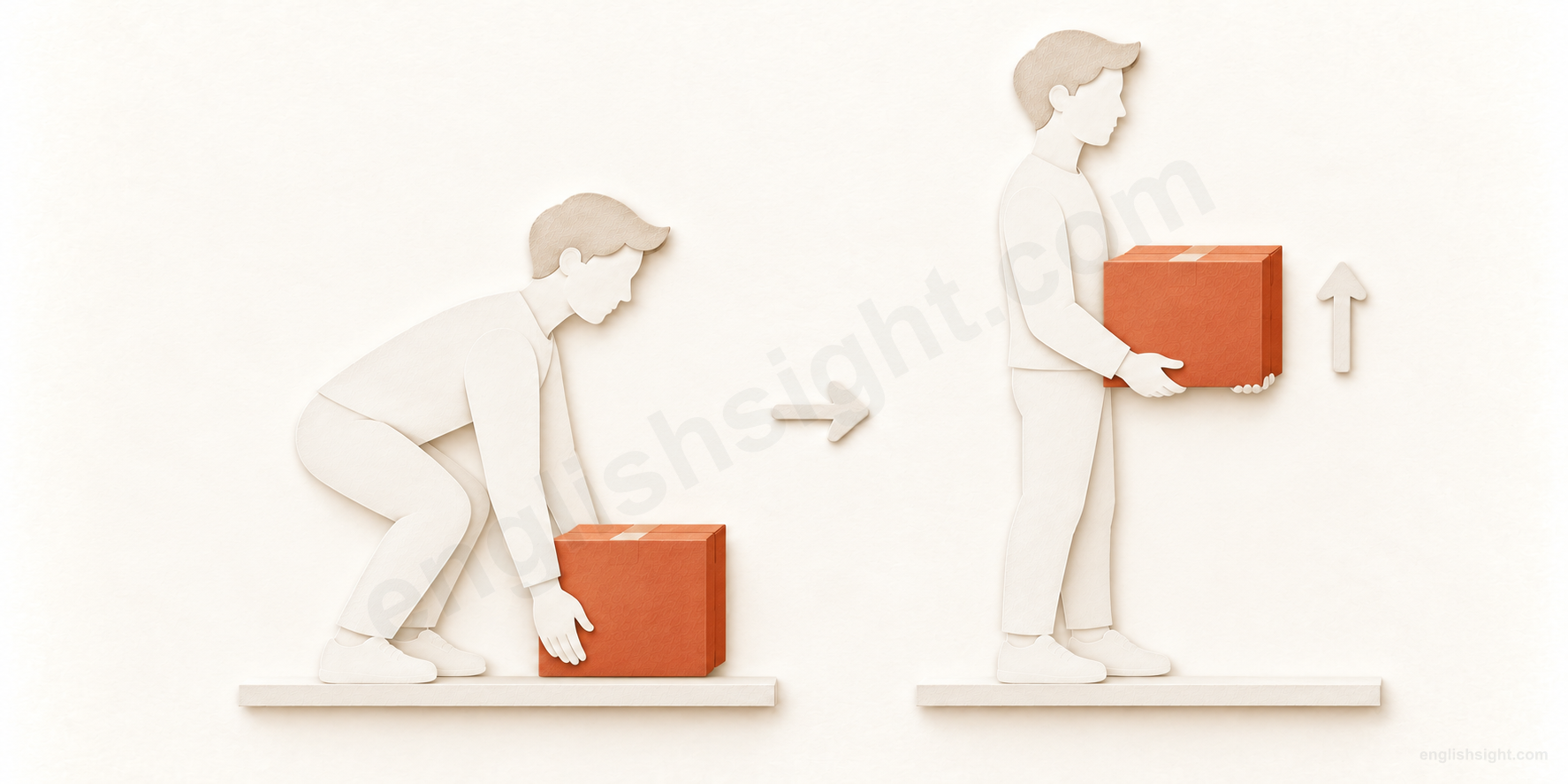
The box rests on the floor while the person crouches beside it.
lift
The person supports the same box at waist height, clear of the floor.
The person takes its weight and raises it.
The box leaves the floor as the person supports and raises it.
Apply support or force to move something away from where it rests, usually to a higher position.
The box shows the physical starting relation. Improvement and removing burdens offer useful connections, while a car ride, theft, and copying require their own learned context. A following direction can give a lower endpoint.
Imagine supporting a box so that it leaves the floor and moves higher. That gives us a useful starting relation for lift: apply support or force to move something away from where it rests, usually to a higher position.
The final place does not always have to be higher: you can lift a suitcase down from a rack. Other uses are established extensions or separate noun meanings. Learn the object, the following words, and the situation rather than translating every lift as upward movement.
This lesson connects verified uses through a teaching model. It does not claim that every English speaker pictures the same scene when hearing lift.
01
Objects, bodies, and physical movement
Start with taking weight, moving higher, or moving something clear. Direction words and the choice of subject tell you exactly what changes.
01
lift + object; lift + object + up; lift up + noun; be lifted (by + agent)
lift a box / lift it up
support something and move it higher
Starting situation
The box rests on the floor.
What changes or is meant
Your hands support the box above the floor.
The object changes position because someone or something supplies force.
In lift the box, the box is the object that moves. A person, a crane, or another force can be the subject. Lift need not mean that the object is heavy or that the action is difficult.
Up makes the upward direction explicit: lift the box up and lift up the box are both possible. With a pronoun, use lift it up, not lift up it. Up is optional in many literal raising situations.
The passive changes the viewpoint: The box was lifted by a crane. The box is still the thing moved; the by-phrase names the cause. Lifting a child means moving the child physically, not bringing the child up over several years.
The noun can also name physical help upward: Give me a lift onto the wall asks someone to support or boost you up. The destination onto the wall and the situation distinguish this from a car ride or encouragement.
In a sentence
Could you lift this box onto the table?
Watch the difference Lift describes the raising action; carry usually describes supporting something while moving it from place to place. You can lift a box and put it straight down without carrying it anywhere.
02
lift + object + out of / off / down from / over + place
lift something out / off / down
take hold of something and move it clear of its support or surroundings
Starting situation
A suitcase is resting on a high rack.
What changes or is meant
You support it while bringing it down to the seat.
The following direction tells us where the object goes; the endpoint need not be higher.
Lift the suitcase down from the rack is natural. Here lift focuses on taking its weight and moving it free; down supplies the final direction. A definition limited to ending higher would miss this use.
Compare lift the baby out of the cot, lift the cake off the tray, and lift the box over the fence. Out of names an enclosure, off names a supporting surface, and over names the route above an obstacle.
These are productive movement combinations, not a separate unpredictable idiom for every preposition. With a lid, lift it off means remove it; lift it up can mean raise it while it stays attached.
In a sentence
Maya lifted the suitcase down from the rack.
Watch the difference Say lift it out of the box, not lift out it of the box. Do not insist that lift down is a contradiction.
03
lift + possessive + body part; body part + lift; a lift of + body part
lift your head / eyes / hand
move a body part upward, or direct your gaze upward
Starting situation
You are looking down at a page.
What changes or is meant
You look toward the person who has spoken.
A possessive identifies whose body part moves.
Lift your head and lift your hand describe physical movement. Lift your eyes or gaze means look up; eyes here are not objects being removed from the body.
She lifted her eyes from the page gives the starting point of her attention. Her eyebrows lifted can describe their upward movement, often in surprise; a lift of the eyebrows names that movement as a noun.
Lift and raise overlap in these body movements. The rest of the sentence supplies the purpose: lifting a hand might be a greeting, a signal, or part of an exercise.
In a sentence
He lifted his head when he heard his name.
Watch the difference Normally say lift your head, with a possessive. Lift someone’s head means physically move that other person’s head; it does not simply mean attract their attention.
04
lift weights; lift + weight / load; a successful / heavy lift
lift weights / a lift
raise exercise weights; an act of raising a load
Starting situation
The athlete prepares a weight for an exercise.
What changes or is meant
The athlete completes one raising movement.
Weights are the equipment; a lift can be one action.
Lift weights describes strength training with weights, not trying to make your body weight go up. In conversation, someone may say I lift, leaving the familiar training activity understood.
A lift can name an individual effort in weightlifting or another act of raising a load: Her final lift was successful. The noun does not mean an elevator in that sports context.
Lifting heavy boxes describes a task; weightlifting names a sport or training activity. These related forms do not create a new general meaning each time the object changes.
In a sentence
She lifts weights twice a week.
Watch the difference Use weights for the exercise equipment. Lift weight on its own is not the usual name of this training activity.
05
thing + lift; thing + will not / won’t lift; be lifting
The lid lifts.
move upward or come away without naming an agent
Starting situation
A cover lies flat on the container.
What changes or is meant
It moves upward when its edge is pulled.
The thing that moves becomes the subject of an intransitive clause.
Compare I lifted the lid with The lid lifted. The first names an agent and an object; the second describes what happened to the lid. It need not mean that the lid moved by itself without any cause.
The lid won’t lift means it resists being raised or removed. In this construction, won’t describes failure to move as expected, not a decision by the lid.
A corner of the carpet is lifting can describe it coming away from the floor. This is a change in position or attachment, not the stealing sense.
In a sentence
The lid won’t lift because the paint has dried around the edge.
Watch the difference The lid lifted is active and intransitive; The lid was lifted is passive. Both can describe movement, but only the passive grammatically presents the lid as something acted on.
The aircraft is the subject, and off marks separation from the ground.
A rocket or helicopter lifts off when it leaves the ground. This intransitive phrasal verb has no object being picked up: The helicopter lifted off.
Lift the lid off is a different construction: someone raises and removes a lid. There, the lid is an object. In the flight expression, the vehicle itself is the subject.
Write the verb as two words, lift off. The related noun lift-off names the launch event: The crowd watched the lift-off. Take off is the broad everyday alternative for aircraft departing.
In a sentence
The helicopter lifted off just before sunrise.
Watch the difference Do not write The helicopter lift-off at dawn when a past-tense verb is needed; use lifted off. Lift-off can follow a determiner as a noun.
The gardening context supplies the established harvesting meaning.
In gardening, lifting potatoes means digging them out of the soil. Lifting bulbs may be done for storage or replanting rather than for eating.
The physical connection is removal from the ground, but a gardener does not normally mean merely raising the leaves. Learn the plant or crop object with this use.
This is useful recognition vocabulary for gardening instructions; it is not a claim that lift is the normal harvesting verb for every crop.
In a sentence
We lifted the potatoes before the soil became waterlogged.
Watch the difference Lift potatoes means take them out of the ground; grow or plant potatoes describes a different stage.
02
Machines, rides, and flight
The noun can name a building machine, a helpful car ride, or an aviation force. Compounds and context keep these uses distinct.
08
take / use the lift (to + floor); go up / down in the lift
take the lift
use the machine that carries people between floors
Starting situation
You are on an upper floor of a building.
What changes or is meant
The cabin carries you down to reception.
Lift is a countable noun naming a machine, not a direction of travel.
In British English, a lift is the machine called an elevator in American English. A building can have one lift or several lifts.
Take the lift to the fifth floor names a way of traveling inside the building. You can also take the lift down: the name stays lift whichever direction the cabin moves.
Use in the lift for your position inside it, get into the lift for entry, and get out of the lift for exit. A car ride called a lift is a separate noun use.
In a sentence
Let’s take the lift down to reception.
Watch the difference Take the lift does not mean pick up the elevator. In American English, use take the elevator for this building machine.
09
give / offer + person + a lift (to + place); get / have a lift (from + person); a lift home
give / get a lift
drive someone somewhere as a favor; receive that ride
Starting situation
Your friend has a car, and you need to reach the station.
What changes or is meant
You travel as a passenger in your friend’s car.
Give names the driver’s favor; get or have names the passenger’s ride.
Could you give me a lift to the station? asks for transport, usually without paying a fare. I got a lift from Jo presents the same event from the passenger’s side.
In British English this is an ordinary use of lift. American English also uses lift, while give someone a ride is a familiar alternative. It does not mean carrying the passenger upward in your arms.
Use a lift home, with no to before home, but a lift to the station. Hitch a lift or thumb a lift means obtain a ride by asking passing drivers, rather than arranging it with a friend.
Context distinguishes a car ride from encouragement: A neighbor gave me a lift home is transport; Her kind words gave me a lift is an emotional boost.
In a sentence
Could you give me a lift to the station after work?
Watch the difference Say give me a lift or give a lift to me, not give me lift. The indefinite article belongs to this countable ride.
10
take / use a ski lift; a lift pass
ski lift / lift pass
a machine that takes skiers uphill; permission to use it
Starting situation
A skier is at the bottom of the slope.
What changes or is meant
A machine takes the skier uphill for another run.
The compound identifies a particular kind of transport machine.
A ski lift takes skiers up a slope so they can ski down. It may pull people along or carry them; not every ski lift is a chair.
A lift pass lets you use the ski lifts. This use appears in ski resorts in both British and American contexts; the British lift/elevator difference concerns the building machine.
The uphill movement makes the connection to physical lifting clear, but ski lift is a compound noun, not an instruction to lift a ski.
In a sentence
We bought lift passes before joining the queue for the ski lift.
Watch the difference A ski lift transports skiers. Lift your ski means physically raise a piece of skiing equipment.
11
lift + people / supplies + to / from / out of + place; be lifted + to + place
lift people to safety
transport people or supplies by aircraft
Starting situation
Floodwater has left people stranded.
What changes or is meant
A helicopter carries them to a safe place.
The object is transported, rather than merely moved a few inches upward.
News reports can use lift for moving people or goods by air, especially during rescues or military operations. Airlift makes that method explicit.
The crew lifted the survivors to safety names the crew as agent. The survivors were lifted to safety puts the people first and may add by helicopter to identify the means.
Compare The helicopter lifted off, where the helicopter departs, with The helicopter lifted the supplies to the island, where supplies are the transported object.
In a sentence
The stranded walkers were lifted to safety by helicopter.
Watch the difference This use does not mean the people traveled in a building lift. Transport by air comes from the sense and context, not simply from the word to.
12
produce / generate / lose lift; lift on + wing
lift on a wing
the aerodynamic force that helps support an aircraft in flight
Starting situation
Air is moving around an aircraft’s wing.
What changes or is meant
An aerodynamic force helps support the aircraft.
Lift names a force here, not a machine or an act of carrying a passenger.
In discussions of flight, lift is an uncountable noun. You can say a wing produces lift or an aircraft loses lift without meaning that it loses an elevator.
In technical terms, aerodynamic lift acts perpendicular to the relative airflow. In ordinary level flight, it helps support the aircraft upward; upward is a useful simple picture for that situation, not a universal direction in every maneuver.
This lesson gives recognition of the aviation meaning, not a full account of how wings generate it.
In a sentence
The wing’s shape helps it generate lift as air flows past it.
Watch the difference Use lift without a/an for the force: enough lift. A lift normally refers to a machine, ride, boost, or individual lifting action.
03
Mood, confidence, and higher levels
Some familiar extensions treat feeling better or reaching a higher level as lifting. Learn the natural object and the register with each use.
make someone feel more cheerful, or become more cheerful
Starting situation
You feel discouraged after a difficult morning.
What changes or is meant
An encouraging message helps you feel happier.
An emotional state is treated as improving rather than physically moving.
A message can lift your spirits or lift your mood. The thing that helps is the subject; spirits or mood is the object. Spirits in this expression means your emotional state.
Your spirits lifted describes the change without an object. My heart lifted is another established way to express sudden happiness or hope.
The upward connection is a teaching metaphor for improvement. It does not imply a measurable height, permanent happiness, or a cure for a health condition.
In a sentence
The message from her sister lifted her spirits.
Watch the difference Say The news lifted my spirits or My spirits lifted. I lifted my spirits can describe helping your own mood, but does not simply mean that your mood improved without naming a cause.
14
give + person / team + a lift; get a lift from + event
give someone a lift
give someone extra confidence, energy, or cheer
Starting situation
A team is discouraged after several losses.
What changes or is meant
A small success makes the team feel more hopeful.
The noun lift names the boost, and the surrounding words identify what kind.
A kind remark, a success, or an enjoyable event can give someone a lift. This informal expression often means a welcome improvement in mood or confidence.
Compare It lifted our spirits with It gave us a lift. The first uses lift as a verb; the second makes lift a noun after gave.
The same words can refer to a car ride. Mentioning a destination, a car, or a driver usually selects transport; mentioning good news or renewed confidence selects encouragement.
In a sentence
That early goal gave the whole team a lift.
Watch the difference The goal did not drive the players anywhere. Interpret give someone a lift through the full situation, not through a single fixed translation.
15
lift + amount / level (+ to / by + number); sales / prices + lift; a lift in + sales / profits
lift sales / a lift in profits
make an amount or level greater, or become greater
Starting situation
Sales are below the company’s target.
What changes or is meant
A new product helps sales reach a higher level.
Lift can cause an increase, describe the increase itself, or name it as a noun.
A campaign can lift sales, and new equipment can lift productivity. This is figurative movement to a higher level; it is common in business and reporting language.
Lift can also have no object in reporting language: Sales lifted slightly in June. Here sales is the subject that increases. Compare The campaign lifted sales, which names a cause, and Sales were lifted by the campaign, which is passive. Rise or increase are clear alternatives.
Use to for the new total and by for the size of the change: lift the price to ten dollars versus lift the price by two dollars. The prepositions contribute this distinction.
A lift in profits is a noun phrase meaning an increase in profits. A ten percent lift in sales describes the size of a rise; it does not name a ride or an elevator.
Raise and increase are often neutral alternatives for amounts. The upward idea does not make all combinations interchangeable: raise money means collect funds, not lift money.
In a sentence
The new service helped lift sales by ten percent.
Watch the difference To ten percent gives an endpoint; by ten percent gives a change. Do not use lift money to mean collect donations.
16
lift + person + out of + difficult condition; lift oneself out of + condition
lift someone out of poverty
help someone escape a difficult condition
Starting situation
A family cannot afford basic necessities.
What changes or is meant
A reliable income helps the family escape poverty.
Out of names the condition being escaped, not a physical container.
An opportunity, policy, or source of income can lift people out of poverty. The subject is what helps; the object names the people whose circumstances improve.
People can also lift themselves out of a difficult condition. The reflexive pronoun refers back to the same people, unlike lift them, which points to somebody else.
This extends the movement pattern lift someone out of something to an abstract situation. It does not guarantee that any one action removes every difficulty.
In a sentence
Steady employment helped lift the family out of poverty.
Watch the difference Out of identifies what is left behind. Lift the family into poverty would point toward a very different outcome and is not the intended expression.
17
lift (up) + possessive + voice(s) + in song / praise
lift your voice in song
make your voice heard, especially in singing or praise
Starting situation
A group is about to sing together.
What changes or is meant
Their voices become audible in the song.
The object is a voice; the change concerns sound rather than height.
Lift your voice, or lift up your voice, can mean make your voice louder or begin to sound out. It is especially familiar in literary, ceremonial, or religious language about singing and praise.
Lifted their voices in song describes a group joining in audible singing. It does not require anyone to move their head or physically lift another singer.
For a simple everyday request, speak up is usually more natural. Raise your voice can describe speaking loudly, including in anger; the singing expression need not imply anger.
In a sentence
At the final verse, everyone lifted their voices in song.
Watch the difference Treat the register as part of the expression. Please lift up your voice may sound ceremonial where Please speak up would be an ordinary request.
04
Limits and burdens disappear
A restriction or siege can end, fog can clear, and a worry can be removed. Check whether the clause names an agent or simply a change.
18
lift + ban / restrictions / sanctions / curfew; a ban on + activity; be lifted
lift a ban / restrictions
officially end a prohibition or limit
Starting situation
A rule prevents people from entering the area.
What changes or is meant
The authority ends the rule, so entry is allowed again.
The restriction is removed; the forbidden activity is not being increased.
An authority can lift a ban, lift restrictions, lift sanctions, or lift a curfew. The object is the rule or control that stops applying.
The passive is useful in news and notices: The ban has been lifted. It presents the changed rule without requiring the authority to be named.
Lift a ban on swimming means swimming is no longer banned. On swimming belongs to ban and tells us what was prohibited. Partially lifting restrictions means only some limits end.
Removing an obstacle is a useful memory connection to physical lifting. This is nevertheless an established official sense, not a general instruction to replace remove with lift everywhere.
In a sentence
The council has lifted the ban on swimming in the lake.
Watch the difference Lift a ban means end it; impose a ban means introduce it. The apparent upward movement does not mean making the rule stricter.
19
lift + siege / blockade; a siege / blockade + be lifted
lift a siege / blockade
end a siege or blockade so that an area is no longer cut off
Starting situation
Forces surround a town and prevent supplies from entering.
What changes or is meant
The operation ends and supplies can reach the town again.
Lift concerns the ending of an obstruction, not raising the surrounding forces.
In news and historical accounts, lift a siege means end the operation that surrounds and cuts off a place. A siege may be lifted when the surrounding forces withdraw or when other forces break their hold.
Lift a blockade similarly means end the action preventing access or supplies. The passive The blockade was lifted leaves the agent unstated; the blockade is what ends.
This is related to lifting a ban through the idea of an obstacle ceasing to apply, but a military operation is not simply a written rule. The expression alone does not say that every danger or shortage has ended.
In a sentence
Food deliveries resumed after the siege of the town was lifted.
Watch the difference Lay siege to a town means begin surrounding it; lift the siege means end it. Keep the object of lift and the place under siege distinct.
fog becomes less dense or clears; a dark mood can also ease
Starting situation
Mist obscures the view across the valley.
What changes or is meant
The mist thins or clears, and the view opens up.
The fog is the subject; no person or object after lift is needed.
Fog, mist, or cloud lifts when it rises or becomes less dense so that the obscured view or weather begins to clear. It does not always mean a whole cloud visibly travels upward as a solid object.
The fog began to lift presents a change, while The fog had lifted says that it had already cleared by a later point in the story.
The same clearing image can be used figuratively: The gloom began to lift. This describes an easing of a dark emotional atmosphere; compare The joke lifted our spirits, which names what cheered us.
In a sentence
By midday, the fog had lifted and we could see the hills.
Watch the difference The fog lifted is an intransitive event, not a passive form. The fog was lifted would require a different context presenting some cause as acting on it.
21
a weight / burden + be lifted from / off + person’s shoulders
a weight lifted from your shoulders
a worry or responsibility stops burdening you
Starting situation
You have been carrying a serious worry.
What changes or is meant
The problem is resolved and you feel relieved.
Weight and shoulders create an established metaphor for mental burden.
A weight has been lifted from my shoulders means I no longer feel burdened by a worry or responsibility. No physical weight has to be present.
The passive places the burden first: A huge weight was lifted from her shoulders when the matter was settled. The situation that brought relief can follow when.
Compare That is a weight off my mind. Both expressions concern relief; give someone a lift can instead describe fresh confidence or energy without a specific worry ending.
In a sentence
When the bill was finally paid, it felt as though a weight had been lifted from my shoulders.
Watch the difference The shoulders expression is metaphorical. It does not by itself say someone physically lifted you or improved every part of your life.
05
Established expressions and taking
These uses need their full expression or context: winning a cup, no effort, public disclosure, theft, and copied material cannot be predicted from an upward arrow alone.
22
team / player + lift + the cup / trophy
lift the cup / trophy
win the competition for which the cup or trophy is awarded
Starting situation
Two teams are competing for a championship cup.
What changes or is meant
One team wins and receives the prize.
The winner’s act of raising the prize stands for winning it.
In a sports report, Our team lifted the cup can mean that the team won the competition. Lift the trophy is a related collocation. The expression may refer to the achievement rather than describe the exact moment someone holds a prize up.
A sentence such as The captain lifted the cup above her head can instead focus on the physical celebration. The competition, the subject, and any direction words help identify which aspect matters.
This is a learned sports expression connected with raising a prize. It does not make lift a general replacement for win with any object: say win a match, not lift a match.
In a sentence
After three narrow defeats in earlier finals, our club finally lifted the cup.
Watch the difference Lift a drinking cup is ordinary physical movement. Lift the cup in a championship report can state who won, even without describing the presentation ceremony.
23
not / never + lift a finger (to + verb); not have to lift a finger
not lift a finger
make no effort to help or do a task
Starting situation
There is work to share, but one person stays inactive.
What changes or is meant
The other people do the work without that person’s help.
Even the smallest imagined effort is absent.
He didn’t lift a finger to help criticizes a failure to help at all. The full idiom usually appears with a negative or a word such as never; it is not a report about the position of a real finger.
You can also hear You won’t have to lift a finger, meaning someone else will do all the work for you. That may be a welcome promise rather than criticism.
To help or to do something states the task. Raise a finger can appear as a variant in this idiom; outside it, lifting a finger can simply mean a literal small movement.
In a sentence
We cleaned the whole kitchen, but Dan didn’t lift a finger to help.
Watch the difference Do not interpret the negative idiom as a statement that the person could not move their hands. It concerns effort or participation.
24
lift the lid on + hidden issue / activity
lift the lid on something
reveal hidden, often unpleasant facts
Starting situation
Problems inside an organization are hidden from the public.
What changes or is meant
An investigation makes those problems known.
A cover being removed is a metaphor for disclosure.
An article or investigation can lift the lid on corruption, abuse, or another concealed problem. On introduces the subject being exposed.
Compare lift the lid off the pan, which describes moving a real lid. The idiom uses the lid and on something to frame hidden information as something previously covered.
Use the expression especially for revealing facts people did not want known. It does not simply mean open any document or explain any ordinary topic.
In a sentence
The report lifted the lid on unsafe conditions in the factory.
Watch the difference On the factory scandal selects the subject of an exposure. Off the pan normally names the physical object losing its cover.
25
lift + item (from + person / place); item + be lifted
lift a wallet
steal something
Starting situation
A wallet belongs to a passenger.
What changes or is meant
Someone takes it without permission.
This informal sense concerns dishonest taking, not upward direction.
In an informal crime context, lift can mean steal. Someone lifted my wallet says it was stolen; it need not tell us how the thief moved it.
The passive is also possible: Her phone was lifted on the bus. In contrast, The mechanic lifted the phone off the workbench may simply describe an innocent physical movement.
Shoplifting is related vocabulary for stealing goods from a shop. Not every use of lift with a valuable object implies theft; ownership and context matter.
In a sentence
Someone lifted his wallet while he was waiting in the queue.
Watch the difference This is informal. Use stole when you want to state the theft unambiguously; lift a suitcase can just mean physically pick it up.
26
lift + words / ideas / passage + from + source; be lifted from + source
lift a passage from a book
copy words or ideas from another source, often without proper permission or acknowledgment
Starting situation
A writer has produced a paragraph in an earlier work.
What changes or is meant
Another writer uses it as if it were their own.
From identifies the source being taken from.
A reviewer may say an author lifted a passage or an idea from an earlier work. In an accusation, the point is copying without proper permission or credit, not moving a physical page.
The phrase can be passive: Parts of the essay were lifted from a website. Context can sometimes use lifted from simply for taking material into a new setting, so the surrounding claim tells you whether plagiarism is alleged.
This belongs beside the taking sense, but the object is intellectual material. A physical raising diagram cannot establish whether use of a source was authorized.
In a sentence
Several paragraphs had been lifted from an online article without any credit.
Watch the difference Lift a book can mean physically raise it or, in a theft context, steal it. Lift a passage from a book concerns the text, not the book’s weight.
Choose by grammar and context
Forms and clause roles
Lift is pronounced /lɪft/ as both noun and verb. The forms are lift, lifts, lifted, lifted, lifting; lifted has two syllables, /ˈlɪftɪd/. It can take an object, appear in the passive, or describe a change without an object: The lid lifted; My spirits lifted. We are lifting the boxes is an ordinary progressive action. There is no general lift someone to do construction meaning persuade someone; use an appropriate verb such as help or persuade.
Lift, raise, rise, and carry
Lift and raise overlap for making something higher. Raise has other uses, such as collect money, mention an issue, and bring up children, which lift does not automatically share. Rise normally describes the thing moving or increasing without an object: Prices rose. Carry focuses on supporting something during transport; lift focuses on taking its weight or changing its position.
Up is not the explanation of every combination
Lift it up is separable, with a pronoun before up. Out of, off, over, and down from describe sources, separation, or routes in physical movement. Lift off as an aircraft departure is an intransitive phrasal verb. Lift the lid on and not lift a finger are idioms. Give someone a lift uses a noun and can mean a ride, encouragement, or physical help upward, depending on context.
Scope and register
The lesson covers the modern noun and verb, common movement patterns, major figurative uses, and selected recognition uses in gardening, skiing, singing, and aviation. It is a practical selection, not a frequency ranking or an exhaustive technical dictionary. Detailed surgical, forensic, mining, shoemaking, financial, and regional slang uses are outside the teaching scope.
Read the situation and the whole expression
Decide what lift means, who or what changes, and which words make the sentence natural.
1. You want a friend to raise a box. Which instruction puts the pronoun in its normal place?
2. Maya lifted the suitcase down from the rack. What happened?
3. The swimming ban has been lifted. What does the notice say?
4. Your colleague is driving toward your home. Which request naturally asks to travel in the car?
5. A kind message makes you feel more cheerful. Which sentence gives your spirits the subject role?
6. You won’t have to lift a finger; we’ll do everything. What is being promised?
7. The helicopter lifted off at noon. Which interpretation fits the grammar?
8. The essay lifted whole paragraphs from a website without credit. What is the criticism?
Sources and teaching notes
The dictionaries below were used to verify meanings, constructions, and register. The explanations, examples, and principle sketch were written for this lesson. Connections between uses are teaching interpretations, not claims that all meanings follow one rule.
The sketch illustrates a useful starting relation, not a shared picture in every English speaker’s mind.