Light makes things visible; light can also mean less heavy.
Separate illumination from low weight, then read what each construction adds.
From a source to a visible object
From a source to a visible object
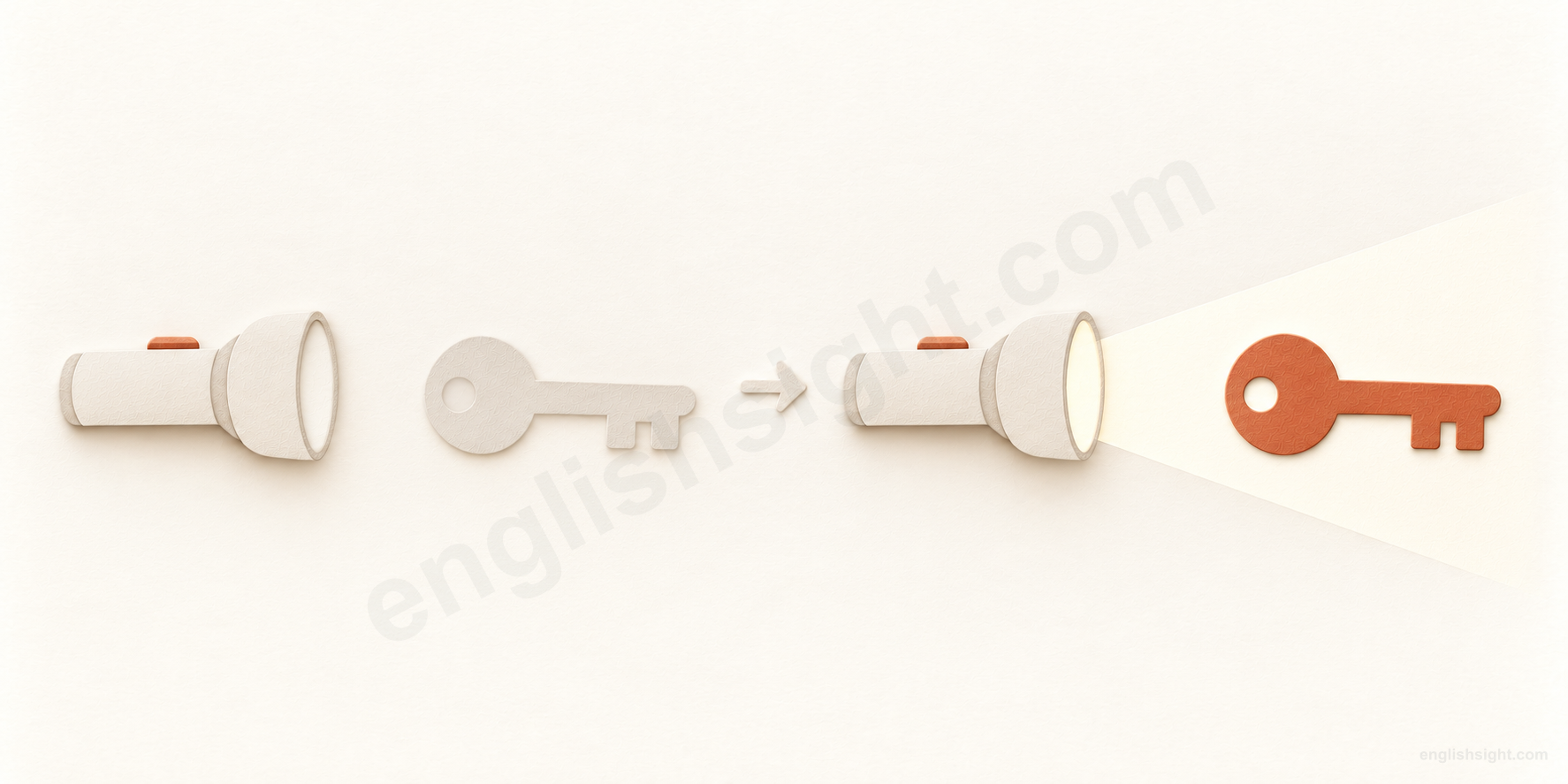
The torch is off; the key is hard to see.
light
The same key is easier to see.
The torch shines onto the key.
Light reaches the key and makes it easier to see.
Light from a source reaches an object and makes it possible to see that object.
The picture explains illumination. Information can metaphorically make a matter clearer, but the separate low-weight family and fixed idioms need their own explanations. This is a teaching model, not a claim about a shared mental picture.
Light names illumination, a source of it, and actions that supply it. This family helps explain familiar links between seeing, knowing, and understanding.
Another light means low in weight, amount, force, or seriousness. Treat it as a separate meaning family. A pale blue bag can be heavy; a light bag can be dark blue. The lesson connects uses where helpful without forcing them into one origin story.
01
Seeing, daylight, and lamps
Start with light as the energy that makes seeing possible, then distinguish a source, a bright place, and a pale colour.
01
light; light from + source; a beam of light
light from the window
illumination that enables sight
Situation / starting point
A curtain covers the window.
Meaning in this situation
Opening it makes the table easier to see.
Light is what reaches the object, not the object itself.
In ordinary descriptions, light names the illumination in which we see. You can discuss its source, strength, or direction: natural light, dim light, a beam of light, or light from a lamp.
This use is normally uncountable: The room needs more light. A soft light can instead describe a particular quality of illumination. Compare a light, which often means a lamp.
A painter can contrast light and shade: the lighter and darker areas of a picture help represent illumination and shape. This is not a claim that the paint itself emits light.
In a sentence
More light came through the window when I opened the curtain.
Watch the difference Use more light for illumination; more lights normally means additional lamps or other light sources.
02
a light / lights; turn on/off/out + light; lights come on / go out
turn the light on / off
operate a lamp or other light source
Situation / starting point
The lamp is off.
Meaning in this situation
You switch it on so you can read.
A light is a countable source of illumination.
A bedside light, bicycle light, and street light are sources. Turn on the light and turn the light on are both natural; with a pronoun say turn it on. Turn out the lights also means switch them off.
The lights came on reports the change of state. The lights went out says they stopped shining, perhaps because the power failed. A flashing warning light attracts attention; the lights can also mean traffic lights in a driving context.
In a sentence
Please turn the kitchen light off before you leave.
Watch the difference Light is the noun here. Turn on is the verb expression; this is not the phrasal verb light on.
03
it is / gets / stays light
It is still light.
there is enough daylight outdoors
Situation / starting point
Evening is approaching.
Meaning in this situation
The outdoor surroundings remain visible.
Light describes the surroundings; it is not a lamp.
It is light, it gets light, and it stays light describe daylight conditions. The it does not refer to an object. In winter it gets light late compares the time daylight begins.
Compare It is getting lighter, which describes increasing brightness, with The suitcase is getting lighter, which describes decreasing weight. Context selects the adjective’s meaning.
In a sentence
It was still light when we walked home at eight.
Watch the difference Say It gets light at six, not The light gets at six.
04
a light + room; room + be + light
a light room
a room with plenty of illumination
Situation / starting point
A room has large windows.
Meaning in this situation
Daylight fills the space.
A light room is bright, rather than low in weight.
With rooms and buildings, light often describes a pleasant supply of natural illumination: a light, airy kitchen. Bright is a useful alternative in this setting.
The room is light describes its brightness. The room is lit by two lamps identifies what illuminates it. The room has light walls describes colour instead.
In a sentence
We chose the light room at the front of the house.
Watch the difference A light bulb usually means the lamp component, not a bulb that weighs little. Read established noun combinations as units.
05
light + colour; light in colour
light blue
a pale shade of a colour
Situation / starting point
You compare two blue paint samples.
Meaning in this situation
You choose the paler one.
Light modifies the shade, not the amount of light in the room.
Light blue, light brown, and light green contrast with dark blue, dark brown, and dark green. The colour can be light even under a dim lamp.
A light blue shirt describes its colour; a light shirt may describe its weight or fabric. Add the colour word or more context when the difference matters.
In a sentence
She painted the door light blue.
Watch the difference Bright blue suggests a strong, vivid colour; light blue describes a pale shade. They are not interchangeable.
06
at first light; by the light of + source
at first light / by the light of…
use the beginning or source of illumination to locate an activity
Situation / starting point
The group waits overnight.
Meaning in this situation
They leave when daylight first appears.
The full expression supplies time or the means of seeing.
At first light means at the beginning of daylight. It is a useful time expression in accounts of travel or outdoor work. By the light of a candle means using its illumination to see.
Compare We read by candlelight with We left at first light: by identifies the illumination used; at locates the departure in time. These are noun phrases, not particle verbs.
In a sentence
We left the camp at first light.
Watch the difference First light is dawn, not the first lamp you encounter.
02
Starting a flame and making things bright
Light can be a verb. Its object and the particle up tell you whether something burns, becomes illuminated, or shows happiness.
07
light + object; object + light; lit / lighted
light a candle / a fire
cause something to begin burning
Situation / starting point
The candle has no flame.
Meaning in this situation
A flame begins at its wick.
The object is the thing made to burn.
Light a candle, light a match, and light a fire describe ignition. The material can also be the subject: The damp wood would not light. That means it failed to start burning.
Use lit or lighted for the past and past participle; lit is the usual everyday form. A lit candle and a lighted candle are both possible. Compare turn on a lamp, which operates it without normally describing ignition.
In a sentence
I lit a candle during the power cut.
Watch the difference Lighting is the -ing form of light. Lightning is a different noun for the electrical flash in a storm.
08
source + light + place; place + be lit by + source
light the room / be lit by…
provide illumination for a place or object
Situation / starting point
A corridor is dark.
Meaning in this situation
A ceiling lamp makes it visible.
The source shines; the room does not catch fire.
In A lamp lights the room, the lamp supplies illumination and the room receives it. The passive The room is lit by a lamp foregrounds the room. Here lit does not mean burning.
Well-lit and poorly lit describe how adequately a place is illuminated. Compare The room is light, a description of brightness, with The room is lit, which can describe its illumination or lighting arrangement.
In a sentence
The hallway is lit by a single ceiling lamp.
Watch the difference The object changes the interpretation: light a fire starts combustion; light a room supplies illumination.
09
something + light up; light up + object; light + object + up
light up / light something up
become bright or make something bright
Situation / starting point
The display is dark.
Meaning in this situation
Its illuminated surface becomes visible.
Up belongs to the verb expression; it does not mean upward movement.
The screen lit up has no object. A lamp lit up the screen has an object. The transitive expression is separable: light the room up or light up the room, but light it up with a pronoun.
The whole display can light up, or one source can light up a wider scene. Compare switch the lamp on: that names operating a device, while light up focuses on becoming bright.
In a sentence
The screen lit up when I pressed the button.
Watch the difference Say It lit up or I lit it up; do not put an object after up when the object is it.
10
face / eyes + light up; something + light up + face
her face lit up
show sudden happiness or excitement
Situation / starting point
A child hears familiar footsteps.
Meaning in this situation
Her expression becomes visibly happy.
Brightness describes an expression rather than electrical light.
A person’s face or eyes can light up when good news arrives or a loved person appears. Something can cause this too: A smile lit up his face.
The face is the subject in Her face lit up; a cause can be the subject in The news lit up her face. Neither sentence says a lamp shone on her.
The related noun phrase a light in her eyes describes an expression revealing a feeling. It is more literary than simply saying that she looked happy or interested.
In a sentence
Her face lit up when she saw her brother at the door.
Watch the difference Light up a room can also be a figurative compliment about someone’s presence; context must distinguish this from illumination.
11
have / give someone a light; light up (a cigarette)
Have you got a light? / light up
ask for a flame or begin smoking
Situation / starting point
Someone wants to light a cigarette.
Meaning in this situation
They ask whether a match or lighter is available.
A light can mean a means of ignition in this context.
Have you got a light? and Do you have a light? conventionally ask for a match, lighter, or flame, usually for a cigarette. They need not be asking for a lamp.
Light up also informally means begin smoking: He went outside and lit up. With an object, lit up a cigarette names what starts burning. This meaning depends on the smoking context.
In a sentence
“Do you have a light?” he asked, holding a cigarette.
Watch the difference The smoking sense of light up is distinct from a screen lighting up or a face showing happiness.
03
Little weight, force, or demand
This is a separate meaning family. Read the noun to decide what is low: weight, amount, effort, depth, or seriousness.
12
light + noun; be lighter than; light enough to + verb
a light bag / lighter than…
have relatively little weight
Situation / starting point
You compare two bags of the same size.
Meaning in this situation
One is easier to lift because it weighs less.
Physical lightness is a separate branch from illumination.
A light bag is low in weight. It need not be small or pale. Light clothing can mean thin clothing suitable for warm weather; light equipment can be designed to be portable.
Use lighter and lightest for comparison: This bag is lighter than mine. Light enough to carry connects weight with a practical limit; too light can mean the weight is insufficient for a particular purpose.
In a sentence
This bag is light enough for me to carry with one hand.
Watch the difference The opposite is heavy here. Dark is the opposite for illumination or colour.
13
travel light
travel light
travel with little luggage
Situation / starting point
You plan a short trip.
Meaning in this situation
You pack only a small bag.
Light describes how much luggage you take.
Travel light is an established expression with adverbial light. It means taking little luggage, not travelling while daylight lasts.
I travel light describes your packing habit. My suitcase is light describes the suitcase’s weight. Someone can take one heavy bag and still have relatively little luggage, so these descriptions are related without being identical.
In a sentence
We are travelling light this weekend, with just one small backpack each.
Watch the difference Keep the established form travel light; travel lightly normally invites a different reading.
14
light + rain / traffic / breeze
light rain / traffic
a small amount or low intensity
Situation / starting point
Only a few vehicles are on the road.
Meaning in this situation
Driving involves little traffic.
The noun tells you what is relatively limited.
Light traffic means relatively few vehicles; light rain means rain of low intensity. A light breeze is gentle. These uses concern amount or strength rather than the weight of individual cars, drops, or air.
The comparison depends on the situation. Light traffic for a city centre may still involve more cars than normal traffic on a country lane. Light is an assessment, not an exact measurement.
In a sentence
Traffic was light, so the bus arrived early.
Watch the difference A light rain is not necessarily brief. Light describes intensity; short describes duration.
15
a light + touch / knock; touch / knock + lightly
a light touch / knock
use little force or pressure
Situation / starting point
A surface is delicate.
Meaning in this situation
You handle it gently.
The action is gentle rather than physically bright.
A light touch means using little pressure; a light knock is a gentle knock. In writing or managing people, a light touch can also describe an approach that avoids being heavy-handed.
Light is an adjective in a light touch. Lightly is the usual adverb in Touch it lightly or Knock lightly. The adjective describes the action or contact; the adverb modifies how you perform it.
Someone who is light on their feet moves quickly and gracefully: The dancer is light on her feet describes her movement, not necessarily her body weight.
In a sentence
Use a light touch when you clean the old photograph.
Watch the difference Say Press lightly, not Press light, in ordinary instructions about pressure.
16
light + work / duties / exercise
light work / light exercise
require relatively little physical effort
Situation / starting point
A worker cannot yet manage heavy lifting.
Meaning in this situation
They return to less demanding tasks.
Light concerns the effort involved in the activity.
Light work, light duties, and light exercise contrast with physically strenuous activity. Sorting papers can be light work even when the decisions themselves require attention.
The phrase does not mean the work has no value. A light workload focuses on the amount of work; light work often focuses on how demanding the tasks are.
In a sentence
He returned to light duties before taking on heavy lifting again.
Watch the difference Easy can refer to mental difficulty too; light work commonly contrasts with physical strain.
17
a light meal; light + soup / cake
a light meal / a light cake
a small or easily digested meal, or an airy texture
Situation / starting point
You do not want a large lunch.
Meaning in this situation
You choose a modest portion.
With food, quantity, richness, and texture are distinct possibilities.
A light meal can be small or easy to digest. A light soup can have a delicate flavour. A light cake instead often has an airy texture, in contrast with a dense cake.
The noun and context decide what is light. A large slice of an airy cake need not be a light meal. A label such as light or lite may advertise a reduced component; read the label to learn what is reduced.
A light beer may be lower in alcohol or calories than a regular version. The intended reduction depends on the product and context; the adjective alone does not specify a measured nutritional value.
In a sentence
We had a light lunch because dinner would be early.
Watch the difference Do not assume that light always means low in calories, fat, sugar, and alcohol at once.
18
a light sleeper; light sleep; sleep lightly
a light sleeper / light sleep
be easily awakened or not deeply asleep
Situation / starting point
A small sound occurs during the night.
Meaning in this situation
The sleeper wakes easily.
The relevant scale is depth of sleep.
A light sleeper wakes easily. Light sleep is sleep that is not deep. Neither expression describes someone’s body weight, and a light sleeper does not necessarily sleep for only a few hours.
Compare a heavy sleeper, who is hard to wake, with a short sleeper, which concerns duration. Sleep lightly is the corresponding adverb pattern.
In a sentence
I am a light sleeper, so I heard the door open.
Watch the difference Light sleep and little sleep are different: depth versus amount.
19
light + reading / entertainment; keep something light; on a lighter note
light reading / on a lighter note
entertain without great seriousness or change to a less serious tone
Situation / starting point
A conversation has become serious.
Meaning in this situation
A speaker introduces something cheerful.
The weight is the seriousness or mental demand.
Light reading or light entertainment is intended to be enjoyable without demanding deep concentration. Keep the conversation light asks people to avoid an overly serious tone.
On a lighter note introduces a less serious topic after something serious. It does not necessarily mean the earlier subject was unimportant. A light voice can describe a gentle or delicate sound, rather than the seriousness of the words.
A light heart suggests freedom from worry: She left with a light heart describes a relieved or cheerful mood. This is the burden metaphor, not a statement about the organ’s physical weight.
In a sentence
On a lighter note, our office plant has finally flowered.
Watch the difference Light reading does not simply mean a physically thin book.
20
a light + sentence / punishment; no light matter; take something lightly
a light sentence / no light matter
less severe punishment, or something too serious to dismiss
Situation / starting point
A court imposes a relatively mild penalty.
Meaning in this situation
The punishment is described as light.
The relevant scale is severity or seriousness.
A light sentence or light punishment is not very severe compared with what might be expected. This is a judgment about the penalty, not the length of a written sentence.
It is no light matter means it is a serious issue. The negative expression reverses the low-seriousness idea. The related adverb appears in Do not take this lightly: do not treat it as unimportant.
In a sentence
Losing the only copy of the records is no light matter.
Watch the difference A light sentence is a mild penalty; a short sentence can instead describe either its duration or the length of a piece of writing.
21
be light on + noun
be light on details
contain or provide relatively little of something
Situation / starting point
A proposal makes many promises.
Meaning in this situation
It offers few concrete details.
Light is an adjective; on introduces what is scarce.
A report that is light on details does not provide many details, often fewer than the speaker wants. The subject is the report; details are what it lacks.
Compare The writer lit on an idea: there lit is a past-tense verb meaning happened to find. Be light on and light on/upon have different grammar and meanings despite their shared spelling.
In a sentence
The proposal sounds promising but is light on practical details.
Watch the difference Do not confuse is light on details with lights on the wall, where lights is a plural noun.
04
Information, viewpoints, and hope
Many established expressions connect visibility with knowing. Learn their grammar as well as the useful metaphor.
22
shed / cast / throw (new) light on + issue
shed / cast / throw light on…
help someone understand an issue
Situation / starting point
The reason for a delay is unclear.
Meaning in this situation
New records clarify what happened.
Information makes a question easier to see through intellectually.
Shed light on, cast light on, and throw light on introduce information that clarifies a problem. The subject is often a report, study, or discovery; on introduces the issue clarified.
More light or new light can suggest added understanding. Clarification does not necessarily solve the whole problem: a receipt may establish a time without explaining someone’s motive.
In a sentence
The delivery records shed light on why the parcel arrived late.
Watch the difference Keep on before the issue. Shed light the problem is incomplete in this meaning.
23
something + come to light; bring + something + to light
come to light / bring something to light
become known, or cause information to become known
Situation / starting point
Nobody knows about an error.
Meaning in this situation
An inspection reveals it.
The subject distinguishes discovery from revealing.
An error came to light means it became known. The inspection brought an error to light names what revealed it. The error is the subject of came, but the object of brought.
The passive An error was brought to light is possible because bring takes an object. Unlike shed light on a known question, these expressions focus on previously unknown information becoming known.
In a sentence
The inspection brought several old errors to light.
Watch the difference Say The errors came to light, not The errors were came to light.
24
in (the) light of + information / circumstances
in (the) light of…
take information into account
Situation / starting point
You receive a new weather forecast.
Meaning in this situation
You reconsider an outdoor plan.
The information supplies a reason for reassessment.
In the light of the new forecast and in light of the new forecast mean considering that forecast. The version with the is especially associated with British English; both versions are used.
This phrase normally introduces facts, circumstances, or evidence relevant to a decision. In light of what we now know uses what we now know to name the information being considered. It does not describe literal illumination.
In a sentence
In light of the forecast, we moved the picnic indoors.
Watch the difference Distinguish in light of the report, meaning considering it, from shed light on the report, meaning clarify it.
25
see / view / present / put + object + in a particular light
see / present something in a different light
view or portray something in a particular way
Situation / starting point
You learn the reason for a decision.
Meaning in this situation
Your judgment of it changes.
The facts are being interpreted from a viewpoint.
See someone in a new light means understand or judge them differently. Present something in a good or bad light means portray it so that it makes a favourable or unfavourable impression.
This use can concern honest reassessment or deliberate presentation. A favourable portrayal does not by itself establish that the underlying action was good.
In a sentence
Hearing her explanation made me see the decision in a different light.
Watch the difference Use in a different light for a viewpoint; under a different light may instead suggest different physical illumination.
26
see the light; the light dawns on + person
see the light
finally understand or accept something
Situation / starting point
You resist a sensible explanation.
Meaning in this situation
You finally recognize its point.
Seeing stands for recognition; the expression is established.
See the light often describes finally accepting a truth or recognizing a mistake. It can carry the speaker’s attitude that the answer should have been obvious.
A separate religious use refers to coming to belief. Do not assume that sense when the context is an everyday disagreement. The light dawned on me is another established way to describe sudden understanding.
In a sentence
I finally saw the light and stopped trying to repair the broken cable.
Watch the difference With a person as subject, see the light commonly concerns understanding or acceptance. With an object or work, see the light (of day) can concern visibility or publication.
27
something + see the light of day
see the light of day
be produced, made public, or brought out of storage
Situation / starting point
A manuscript remains in a drawer.
Meaning in this situation
It is eventually published.
The focus is coming into existence or view.
A plan, report, or piece of writing that never sees the light of day is never realized or made public. The intended meaning depends on what kind of thing it is.
Compare bring a fact to light, which reveals information, with a film finally seeing the light of day, which can mean it is finally released. The wording does not require an actual daylight scene.
An object that sees the light of day may also simply be taken out of storage: The old vase rarely sees the light of day means it is usually kept away. The shorter see the light can occur in this visibility or publication family too; read the subject and context.
In a sentence
Her early stories did not see the light of day until years later.
Watch the difference See the light commonly means understand or accept when the subject is a person. With a stored object or unpublished work, it can instead concern becoming visible or public; of day makes that reading clearer.
28
see (a) light at the end of the tunnel
light at the end of the tunnel
a sign that a difficult period may be ending
Situation / starting point
Repairs have continued for months.
Meaning in this situation
The final work is now scheduled.
The image presents a way out of prolonged difficulty.
This expression introduces hope of reaching the end of a difficult period. It is useful for long projects, recovery, or financial trouble, rather than any small pleasant event.
Seeing light at the end of the tunnel does not necessarily mean the work is finished. It means there is an encouraging sign that an end is approaching.
In a sentence
With only one repair left, we could see light at the end of the tunnel.
Watch the difference The tunnel belongs to this idiom; it is not a universal model for light.
29
give someone the green light; get the green light; give the green light to + plan
give / get the green light
give or receive permission to proceed
Situation / starting point
A project is waiting for approval.
Meaning in this situation
The responsible person authorizes it.
A traffic signal provides the metaphor for permission.
Give someone the green light gives permission; get the green light receives it. Give the green light to a plan names the approved plan after to.
This expression concerns authorization. It does not guarantee that the project will succeed or that every remaining condition has disappeared. A literal green light on a machine may simply indicate its operating status.
In a sentence
The team got the green light to start the new project.
Watch the difference The whole phrase means permission; light alone does not.
05
Fixed expressions and contrasts
These phrases have meanings carried by the whole expression. Neither the illumination picture nor the weight idea can predict every one.
30
make light of + issue
make light of…
treat something as less serious or important
Situation / starting point
A person mentions a real problem.
Meaning in this situation
Someone responds as though it scarcely matters.
The expression reduces the importance assigned to an issue.
Make light of a problem can involve joking about it, brushing it aside, or presenting it as minor. A person may do this to reassure others, but it can also seem dismissive.
Compare make the bag lighter, which reduces physical weight. In make light of the problem, light is part of a fixed expression; it does not describe a physical change to the problem.
In a sentence
Do not make light of her worries about the move.
Watch the difference Keep of. Make light of the work means treat it as unimportant; it does not mean complete it easily.
31
make light work of + noun / -ing
make light work of…
complete a task quickly and easily
Situation / starting point
A pile of work is waiting.
Meaning in this situation
A capable team finishes it with little difficulty.
The whole expression describes performance, not dismissal.
Make light work of a task means deal with it quickly and easily. The subject can be a skilled person, a team, or a suitable tool: a good machine can make light work of a repetitive job.
Compare make light of a problem, which treats the problem as unimportant. Make light work of a problem says that someone handles it easily. The extra word work changes the construction and the message.
The saying Many hands make light work means that a job becomes easier when more people help. It emphasizes shared effort, whereas make light work of something describes how easily someone or something handles a task.
In a sentence
The new scanner made light work of copying the old records.
Watch the difference Keep work if you mean easy completion. Make light of the records instead suggests treating them as unimportant.
32
go / be out like a light
go out like a light
fall asleep very quickly
Situation / starting point
Someone is exhausted after a long day.
Meaning in this situation
They fall asleep almost immediately.
The comparison is with a light suddenly going out.
Go out like a light informally describes falling asleep very quickly. Be out like a light can describe already being deeply asleep or unconscious, depending on context.
The literal The light went out reports that a source stopped shining. The person in He went out like a light is the subject of a comparison, not a lamp.
In a sentence
After the long hike, I went out like a light.
Watch the difference This does not mean being a light sleeper; a light sleeper wakes easily.
33
be in + possessive + light
be in someone’s light
block illumination someone needs
Situation / starting point
Someone is reading by a lamp.
Meaning in this situation
Another person stands between the lamp and the page.
In marks a position that obstructs the useful light.
You are in my light draws attention to the fact that someone is blocking the illumination you need. Please move; you are in my light is a request to change position.
Compare You are in my way, which concerns obstructing an action or path more generally. Being in someone’s light can happen even when no walking path is blocked.
In a sentence
Could you move a little? You are in my light.
Watch the difference The possessive identifies whose access to illumination is obstructed, not necessarily who owns the lamp.
34
set light to + object
set light to…
make something start burning
Situation / starting point
A spark reaches a dry object.
Meaning in this situation
The object catches fire.
The whole construction expresses ignition.
Set light to something, especially British English, means make it begin burning. The object follows to: A spark set light to the paper. Set fire to is another expression for the same kind of event.
It may describe accidental or deliberate ignition. The spark can be the subject, so the expression does not by itself imply a person intended to start a fire.
In a sentence
A falling ember set light to the dry grass.
Watch the difference Set light to the grass means ignite it; shine a light on the grass means illuminate it.
35
in the cold light of day
in the cold light of day
when considering something calmly and realistically
Situation / starting point
An idea feels exciting late at night.
Meaning in this situation
The next day you examine its practical problems.
The idiom contrasts excitement with a clearer reassessment.
In the cold light of day asks you to judge something without the earlier excitement, emotion, or flattering impression. It often concerns the following morning, but the central point is realistic reassessment.
Compare in the light of new evidence, which names information being considered. The cold light of day need not introduce new evidence; your attitude may simply have become calmer.
In a sentence
In the cold light of day, the expensive plan seemed less attractive.
Watch the difference Cold does not require low outdoor temperature in this expression.
36
light on / upon + object
light on / upon an idea
happen to notice or find something
Situation / starting point
A writer is searching through old notes.
Meaning in this situation
An unexpected idea catches her attention.
This literary verb pattern concerns chance discovery.
Light on or light upon something means happen to find or notice it. It is literary in the dictionaries used here; come across or happen on is generally easier in everyday conversation.
Her eyes lit upon a note makes the eyes the subject of noticing. She lit upon an idea describes an unexpected discovery. Compare The report is light on detail, where light is an adjective about scarcity.
In a sentence
Looking through old notes, she lit upon an idea for a story.
Watch the difference Keep on/upon before the object: she lit on it, not she lit it on, in this discovery sense.
Choose the family before choosing the expression
A source, illumination, and an adjective differ
Light is normally uncountable for illumination, countable for a lamp, and an adjective in a light room or a light bag. A quality such as a soft light can also be countable. Decide from the construction, not from spelling alone.
Verb forms and related spellings
The verb forms are light, lights, lighting, and lit or lighted. Lighter and lightest compare the adjective. A lighter can also be a device that produces a flame. Lightly is the usual adverb for gentle pressure or a casual manner; travel light is an established exception. Lighten is a separate verb used for making something less heavy, less dark, or less serious. Lightning names an electrical flash.
Read the object and particle
Light a candle starts burning; light a room supplies illumination. Light up can describe brightness, visible happiness, or beginning to smoke. Be light on details uses an adjective, while light on an idea uses a literary verb. Do not treat every expression containing a small word as the same phrasal verb.
Scope and limits
This lesson selects common modern uses and a clearly marked literary contrast. Technical radiation categories, specialist light machinery and soil classifications, architectural lights meaning windows, historical senses, and longer literary sayings are not expanded. It does not rank uses by frequency or claim to cover every compound containing light.
Choose the meaning and construction
Use the noun, object, and surrounding words to select the intended meaning.
1. A room is too dim to read in. You mean illumination, rather than additional lamps. Which request says that?
2. Which sentence says that something starts burning?
3. Which sentence directly describes low weight?
4. A girl sees an old friend and her face lights up. What happens?
5. An inspection reveals a previously unknown fault. Which sentence makes the inspection the cause of discovery?
6. Which sentence says a report contains too few practical details?
7. Someone dismisses a colleague’s serious worries. Which expression describes that response?
Sources and teaching notes
The publisher sources below support the meanings and expressions. The explanations, examples, comparisons, and visual model were written for this lesson.
The picture illustrates illumination. It does not replace the separate explanations of weight and fixed expressions.