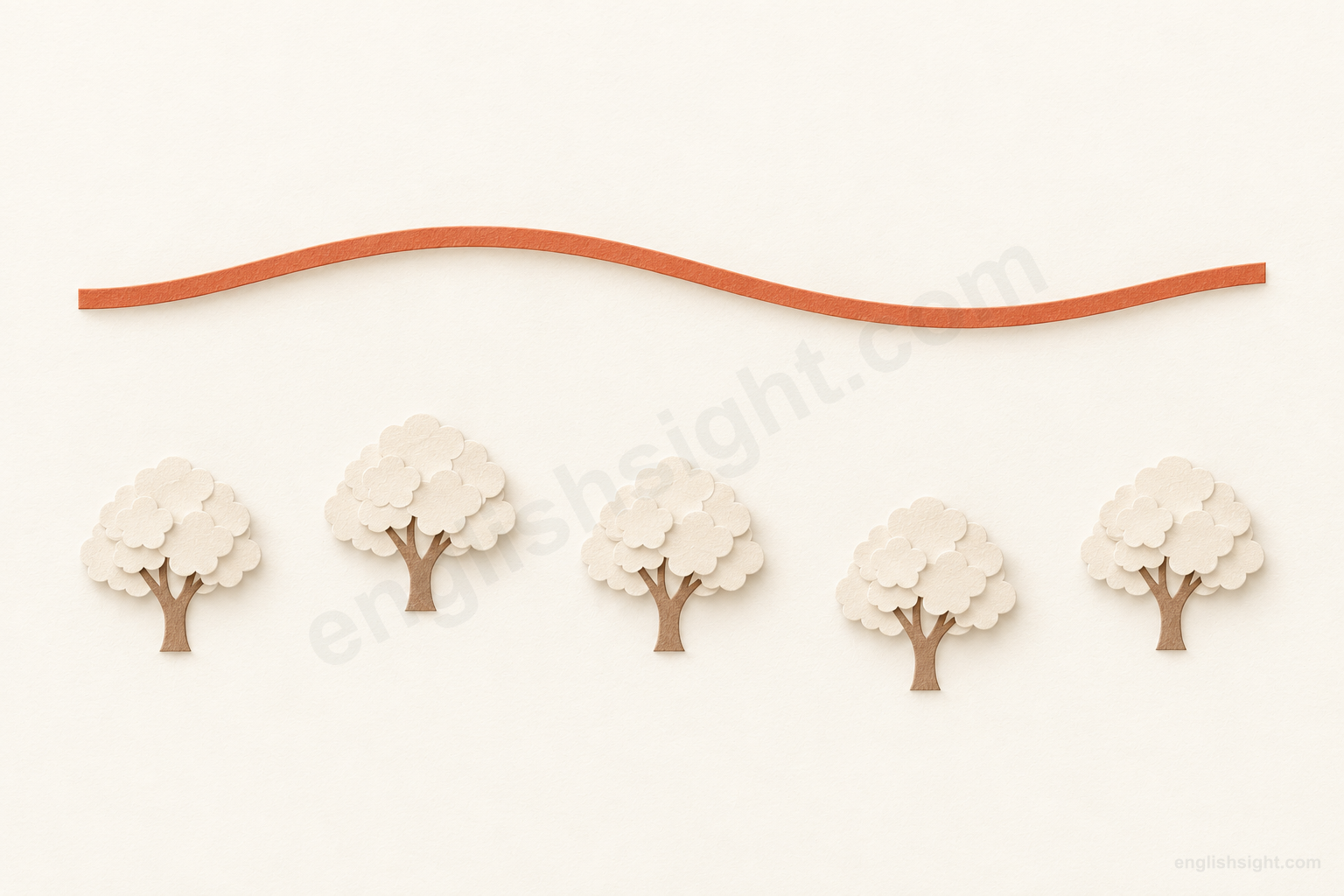
A narrow course can become a row, a route, or a limit.
Follow the connections between line’s everyday meanings, and learn where the whole expression matters.
One course, continuous or in a row
One course, continuous or in a row
Above: a continuous curved trace.
line
Below: five separate trees arranged in a curved row.
Compare two arrangements along a narrow course.
A continuous trace and a row of separate trees can both form a line.
A line extends along a narrow course, continuously or as an ordered row.
The sketch compares two arrangements, not a before-and-after event. Routes, limits, and sequences provide useful teaching connections; they do not predict every idiom or the inner-covering verb.
Start with something extended along a narrow course: a drawn trace, a cord, or separate things in a row. That relation helps connect many uses of line without making them interchangeable.
Other uses organize words, activities, products, or ideas. The verb meaning add an inner layer is a separate branch. Established expressions must be learned with their grammar and context.
01
Marks, shapes, and boundaries
Start with a narrow mark or course, then distinguish a physical edge from a limit used to classify or judge.
01
draw / trace + a line; a straight / curved / dotted line
draw a line
make or identify a long, narrow mark
Situation or starting point
A diagram needs a visible divider.
Meaning in this context
A narrow mark separates the two parts.
A line need not be straight, solid, or perfectly thin.
Use adjectives to specify the mark: a straight line, a curved line, a dotted line, or a horizontal line. Draw names the action; line names its visible result.
For a drawing task, compare Draw a line under the heading with Underline the heading. A mathematical line has a stricter technical meaning than a pen mark; the everyday noun does not promise infinite length.
Example in context
Draw a curved line from the star to the moon.
Watch the difference A line is not necessarily a straight line.
02
lines around / on + body part; the lines of + object
lines around the eyes; the lines of a building
describe narrow creases or an object’s contours
Situation or starting point
You notice a face or a building’s shape.
Meaning in this context
You describe its creases or defining contours.
The surrounding noun tells you whether these are wrinkles or outlines.
Fine lines around someone’s eyes are small creases, often associated with age. Here fine means delicate or small, not excellent.
The clean lines of a building describe the design’s outlines and shapes. These lines need not be drawn on its surface. Compare a line on the wall, which may simply be a mark.
Example in context
The architect kept the building’s lines simple.
Watch the difference Do not interpret every use of plural lines as writing or a queue.
03
cross + the line; a boundary / state / finish line
cross the line; a state line
locate a physical or administrative limit
Situation or starting point
A race or region has a defined boundary.
Meaning in this context
Someone passes from one side to the other.
The line may be painted or imaginary.
A starting line or finish line identifies where a race begins or ends. A state line separates states; it does not have to be painted across the ground.
Cross the line can describe literal movement across such a boundary. In a discussion about conduct, the same words can mean going beyond what is acceptable. Identify the kind of boundary before choosing a meaning.
Example in context
We crossed the state line just before sunset.
Watch the difference Crossing a finish line and crossing an ethical line are different events.
04
a fine line between + noun / -ing + and + noun / -ing
a fine line between…
describe a distinction that is easy to cross or hard to judge
Situation or starting point
Two kinds of behavior are close to one another.
Meaning in this context
You identify a subtle distinction.
Fine describes a narrow conceptual boundary.
There is a fine line between helping and interfering says that a small difference in behavior can change the judgment. It does not say that the two are identical.
Draw a line between A and B means distinguish the categories. Blur the line between them makes the distinction less clear. These are teaching connections with a boundary, not literal claims about visible marks.
Example in context
There is a fine line between confidence and arrogance.
Watch the difference Use between to name the two sides, not a line among confidence and arrogance.
02
Rows, waiting, and succession
Separate things can make a line through their arrangement. Context decides whether they are waiting, aligned, or following one another in time.
05
a line of + plural noun; stand / sit / arrange + in a line
a line of trees; in a line
describe things arranged along a course
Situation or starting point
Several trees are planted beside a path.
Meaning in this context
Their positions form a row.
A spatial arrangement does not necessarily involve waiting.
A line of trees, cars, or people names a row. The members can be side by side or one behind another. In a line describes the arrangement without naming the members again.
Compare a line of parked cars with a line of customers waiting to pay. Both are arrangements, but only the second is necessarily a queue. With ordinary agreement, a line of trees runs along the path treats line as the singular head.
Example in context
A line of trees runs beside the footpath.
Watch the difference Line does not by itself mean that each member is waiting for a turn.
06
wait / stand / get + in line; a line for + service
wait in line; get in line
wait in an ordered queue
Situation or starting point
Other customers reached the counter first.
Meaning in this context
You join them and wait your turn.
Queue meaning is especially associated with North American line.
Wait in line and stand in line are ordinary American expressions; British English commonly uses wait in a queue or queue. Get in line means join the queue; at the front or back of the line locates your position.
Compare in line for tickets, where people are physically waiting, with in line for promotion, where someone is likely to receive an opportunity. The object after for helps establish the situation.
Example in context
We waited in line for twenty minutes to buy tickets.
Watch the difference In line is a general American choice; on line for a queue is regional, not the only correct form.
07
a long line of + plural noun; next in line for + noun
a long line of; next in line
connect generations, events, or positions in an order
Situation or starting point
One person or event follows another.
Meaning in this context
You describe the sequence or the next position.
The order may be in time or status rather than in physical space.
A long line of musicians in a family refers to successive generations. The latest in a long line of mistakes is a new member of a series. Neither requires people standing together.
Next in line for the job can identify the next candidate; in line for a promotion can indicate a likely recipient. A line of succession describes an ordered right to inherit a position. It is not the same as a confirmed appointment.
Example in context
She comes from a long line of musicians.
Watch the difference Do not assume next in line means already chosen or already appointed.
03
Writing, performance, and messages
A line can organize words on a page or identify a spoken unit. Familiar expressions add specific conversational meanings.
08
a line of + text / poetry / code; on + the next line; line by line
a line of text; on the next line
identify a row or unit of written language
Situation or starting point
You need to locate part of a document.
Meaning in this context
You specify the row or start a new one.
A written line is not necessarily a complete sentence.
A line of text is a row of characters. A sentence can run over several lines, and a short line can contain only part of a sentence. The same organizing unit appears in a line of poetry or a line of code.
On the next line tells a writer where to put text. An email subject line is the field identifying the topic. Line by line describes examining each row or unit in sequence, not reading only the main idea.
Example in context
Put your email address on the next line.
Watch the difference Keep line and sentence distinct; changing the display width can change line breaks.
09
learn / rehearse / forget + one’s lines; a line from + work
learn your lines
memorize the words of a role
Situation or starting point
An actor prepares for a rehearsal.
Meaning in this context
The actor knows what the character must say.
Lines belong to the spoken role, not the actor’s ordinary conversations.
An actor’s lines are the scripted words they have to deliver. Learn or forget your lines refers to remembering that material. A memorable line from a film can be a single quotation.
The connection with written rows is useful, but a spoken line is not defined by the layout on one printed page. A line may also be sung in a song.
Example in context
Nora rehearsed her lines on the train.
Watch the difference Learn your lines does not mean study how to draw straight marks.
10
a chat-up / pickup line; give + person + that line about + noun / -ing
a chat-up line; Don’t give me that line.
recognize a remark used to produce an effect
Situation or starting point
Someone uses a familiar flattering remark or excuse.
Meaning in this context
You identify the remark as a deliberate tactic.
Informal line can imply rehearsed or unconvincing talk.
A chat-up line in British English, or a pickup line in American English, is a remark intended to attract someone romantically. It can sound playful, awkward, or insincere depending on context.
Don’t give me that line about being too busy challenges an explanation as unconvincing. The criticism comes from the full situation and expression; line is not a neutral synonym for every statement.
Example in context
Don’t give me that line about losing your phone again.
Watch the difference This conversational use is informal and can sound dismissive.
11
drop + person + a line
drop someone a line
send a short written message
Situation or starting point
You want a friend to send news after a trip.
Meaning in this context
You ask for a brief note or email.
The whole informal expression names an act of writing.
Drop me a line is a friendly request to write briefly. It can refer to a note or email, so it does not require paper or exactly one printed row.
The person is the recipient: Drop Sam a line when you arrive. Compare Give Sam a call, which asks for a phone call instead. Do not translate drop as physically letting a line fall.
Example in context
Drop me a line when you settle into your new flat.
Watch the difference Keep the recipient before a line in this pattern: drop me a line.
04
Cords, connections, and routes
A thin physical length can carry, connect, or mark a route. Some uses name a service rather than a visible object.
12
a fishing / washing line; on + the line; a length of + line
a fishing line; hang washing on the line
name a cord, string, or rope used for a purpose
Situation or starting point
A fisherman or household needs a thin supporting length.
Meaning in this context
The length holds or connects something.
The purpose identifies what sort of physical line is meant.
A fishing line is the thin length attached to the hook. A washing line or clothesline supports clothes while they dry. On the line in a laundry context describes their physical position.
Line can be countable for a particular length or installation, or uncountable when treated as material: a reel of fishing line. Do not replace every string with line; the established purpose matters.
Example in context
The wind blew a towel off the line.
Watch the difference The laundry context makes on the line literal, not the idiom meaning at risk.
13
a power / gas / water / supply line
a power line; a gas line
name a wire or pipe carrying a supply
Situation or starting point
A neighborhood depends on connected infrastructure.
Meaning in this context
Electricity or another supply travels through a fixed connection.
Line may mean a cable or a pipe, depending on what it carries.
Power lines carry electricity; gas or water lines carry a fluid. Here the physical line is a route for a supply, not simply a mark drawn on a map.
A supply line can also describe a route used to move goods. Keep the noun before line: a gas line is a pipe carrying gas, whereas a line of gas is not the ordinary name for that pipe.
Example in context
A fallen branch damaged the power line.
Watch the difference A line is not always a visible piece of string.
14
hold / stay on + the line; be on + the line; the line is busy / engaged
hold the line; on the line
refer to a telephone connection or service
Situation or starting point
You call an office and the receptionist checks who is available.
Meaning in this context
You remain connected while waiting.
A connection can be called a line even when no wire is visible.
Hold the line or stay on the line asks a caller to wait without ending the call. Someone on the line is currently connected by phone. A busy line, also an engaged line in British English, cannot take your call at that moment.
An advice line or information line is a service reached by telephone. The line went dead means the connection failed. Compare My job is on the line, where job selects the risk idiom, and hold the line on prices, which means resist an increase.
Example in context
Please hold the line while I check your booking.
Watch the difference Hold the line here asks you to wait, not to grip a cable.
15
a railway / bus / shipping line; take / change + lines
a railway line; take the Green Line
identify tracks, a transport route, or an operator
Situation or starting point
You plan a journey on a transport network.
Meaning in this context
You select the appropriate route or track.
A service route and the physical track are related but distinct.
A railway line can mean the track; a tree on the line can therefore stop trains. A named metro line is a route through a set of stations, so changing lines means changing routes or services.
A shipping line can name a company operating ships. The word in front and the situation determine whether line refers to infrastructure, a route, or an operator. A bus line does not require rails.
Example in context
Take the Green Line and change at Central.
Watch the difference Do not assume every transport line is a painted line or a railway track.
16
a line of sight / fire; move / travel + in a straight line
a line of sight; in the line of fire
identify a direction or course between positions
Situation or starting point
A wall may block the view from a seat.
Meaning in this context
You assess whether the visual path is clear.
A line can be an imagined path without a drawn mark.
A clear line of sight means an unobstructed view along a direction. In a straight line describes a course without turns, rather than a line painted on the ground.
In the line of fire literally puts someone in the path of shooting. Figuratively, it can place them where criticism is directed. The figurative criticism belongs to that established expression; a line of sight does not imply danger.
Example in context
From this seat, I have a clear line of sight to the stage.
Watch the difference Sight refers to seeing; do not confuse it with site, meaning a location.
05
Work, products, and approaches
In business and discussion, line often names a category, a sequence of operations, or a course of action or thought.
17
a line of work / business; be in + a line of work; not one’s line
a line of work; not my line
describe a profession or kind of activity
Situation or starting point
Someone asks about your job or interests.
Meaning in this context
You identify a field or an activity that suits you.
Line organizes activity into a recognizable kind.
What line of work are you in? asks what kind of work you do, not which queue you have joined. In this line of business can introduce a feature of a trade or occupation.
That’s not really my line is an informal way to say an activity is outside your interests or abilities. It can concern a hobby rather than employment. Compare I work on a production line, which identifies a workplace process.
Example in context
What line of work did you go into after college?
Watch the difference Work is uncountable here: a line of work, not a line of works.
18
a product line; a line of + products
a product line
identify a type or range of goods sold
Situation or starting point
A company adds related goods to its catalogue.
Meaning in this context
Customers can buy a new range.
These goods form a commercial category, not a physical queue.
A line of shoes or a product line is a kind or related range offered by a business. A new line can exist even when the products are stored on different shelves.
Compare a production line, which is the sequence of operations that makes goods. Launching a product line concerns what is sold; opening a production line concerns how it is made.
Example in context
The company launched a new line of waterproof bags.
Watch the difference A product line and a production line name different things.
19
work on + a production / assembly line
a production line; an assembly line
organize manufacturing into successive stages
Situation or starting point
A factory makes many identical products.
Meaning in this context
Each product passes through a sequence of operations.
The sequence is central; a straight physical layout is not the only issue.
On a production line, workers or machines perform successive tasks as a product moves through the process. An assembly line focuses on putting parts together.
Line in this combination names the organized process and equipment. It does not mean a row of finished products waiting to be sold. Someone who works on the line works at those manufacturing stages.
Example in context
Each bicycle frame moves along the assembly line.
Watch the difference Use on a production line for the work process; in line usually suggests a queue.
20
a line of thought / reasoning / inquiry / attack
a line of thought; a line of inquiry
follow a connected approach to thinking or investigation
Situation or starting point
A discussion or investigation develops through related steps.
Meaning in this context
You describe the direction of that reasoning.
The connection is a course through ideas rather than a visible route.
A line of reasoning is a connected way of reaching a conclusion. I don’t follow your line of reasoning says the speaker cannot see how the ideas fit together; it does not necessarily mean the final conclusion is false.
A line of inquiry is a direction for investigation, and a line of attack can be a way of tackling a problem. Choose the noun after of to identify what activity follows the course.
Example in context
The new evidence opened up another line of inquiry.
Watch the difference A new line of inquiry is an investigative possibility, not proof of a conclusion.
21
take / adopt + a hard / firm line on + issue; the official / party line
take a hard line; the party line
state or maintain an attitude or policy
Situation or starting point
An organization decides how to respond to a problem.
Meaning in this context
It states a firm or official position.
This line is a position to follow, not a drawn boundary.
Take a hard or firm line on an issue means adopt a strict attitude toward it. The company line or party line is the official view an organization expects its members to express.
The choice of hard, firm, or official adds the particular quality. Line alone does not make a policy harsh. Compare toe the line, which describes complying with expectations rather than deciding the policy.
Example in context
The school takes a firm line on bullying.
Watch the difference A hard line is an attitude; a deadline is a time limit.
22
along the lines of + noun / quoted wording; along similar lines; along + category + lines
along the lines of; along similar lines
describe an approximate idea or a shared method
Situation or starting point
You suggest a rough wording or compare two designs.
Meaning in this context
The listener understands the general approach.
Plural lines can identify a broad pattern rather than exact words.
Say something along the lines of… introduces approximate wording. She said something along the lines of “We need more time” does not promise an exact quotation.
A workshop organized along similar lines follows a similar method or plan. Divide people along age lines groups them by age. These uses concern a pattern or organizing principle, not distance along a physical mark.
Example in context
Could we build something along the lines of a community library?
Watch the difference Do not use approximate wording as if it were a verified word-for-word quotation.
23
a line of credit; open / obtain / draw on + a line of credit
a line of credit
name an arrangement allowing borrowing up to an agreed limit
Situation or starting point
A business needs access to funds when required.
Meaning in this context
A bank agrees how much it may borrow.
This financial expression concerns available borrowing, not money already earned.
A line of credit lets a person or business borrow up to a specified maximum. The expression is especially associated with North American English. It can also refer to the permitted amount.
Open a line of credit describes arranging that access; draw on it describes using it. An available credit line does not mean the whole amount has already been borrowed. Learn the expression as a financial combination, rather than trying to infer it from a drawn line.
Example in context
The bank approved a line of credit for the business.
Watch the difference Available credit and money already borrowed are different amounts.
06
Arrange, border, and add an inner layer
The verb has several constructions. Line up concerns arrangement; line a street and line a tin have different subjects, objects, and results.
24
line up; line + object + up; line up + noun object
line up; line them up
form a row or put people and things into one
Situation or starting point
Objects are scattered before a photograph.
Meaning in this context
Someone puts them in an orderly row.
Line up can describe either the arrangement happening or someone causing it.
People line up to wait or prepare; a teacher can line the children up. The noun object can go before or after up: line the bottles up or line up the bottles.
A pronoun goes between the verb and particle: line them up. Up belongs to the phrasal verb; it does not require upward movement. Compare line the road, which means border it, without up.
Example in context
Please line the jars up before you take the photo.
Watch the difference Say line them up, not line up them.
25
line + object + up with + reference; things line up
line something up with something
make positions correspond precisely
Situation or starting point
Two holes need to match for a bolt to fit.
Meaning in this context
The openings align.
Alignment concerns relative position; it need not create a queue.
Line the holes up with each other means adjust their positions so that they match. The holes line up describes the resulting relation without naming an agent.
With introduces the reference object. Keep the pronoun inside the particle construction: line it up with the mark. Compare put it in line with the others, a noun phrase that describes a similar spatial result.
Example in context
Line the holes up with the marks on the wall.
Watch the difference With marks the reference; up alone does not say which reference to use.
26
line up + person / event; have + object + lined up; line + person + up for + event
line up a speaker; have something lined up
arrange people, events, or opportunities in advance
Situation or starting point
An event still needs a guest speaker.
Meaning in this context
You arrange for a speaker to participate.
The arrangement is practical preparation, not necessarily a row.
We’ve lined up a speaker means we have arranged for someone to speak. Have three interviews lined up means they are arranged or scheduled. It does not mean the interviews have already happened.
The particle construction remains separable: We lined her up for the opening session. A line-up or lineup is a related noun for an assembled group of performers or participants; the verb is written as two words. A police line-up instead presents people to a witness for identification; it does not mean a programme of performers.
Example in context
We’ve lined up two speakers for Saturday.
Watch the difference We have them lined up describes preparation, not completed talks.
27
line up behind + person / group / proposal; line up with / alongside + ally; line up against + person / group / proposal
line up behind; line up against
take a position supporting or opposing someone
Situation or starting point
Groups consider a proposal.
Meaning in this context
They publicly support or oppose it.
The preposition determines which side is being taken.
Line up behind a proposal means support it; line up against it means oppose it. With or alongside can also introduce the person or group supported.
A physical line of supporters may help as a memory image, but the idiom does not require anyone to stand in a row. It is not the same construction as lining an object up with a mark.
Example in context
Several local groups lined up against the closure.
Watch the difference Against marks opposition; behind commonly marks support.
28
people / things + line + place; place + be lined with + people / things
trees line the road
extend along the sides or edges of a place
Situation or starting point
Trees grow beside both sides of a road.
Meaning in this context
You describe the road’s borders.
The trees are the subject; the road is the place they border.
Trees line the road describes where the trees stand. In The road is lined with trees, the road becomes the subject and with introduces what borders it. A tree-lined road is a compact description.
People can line the streets to watch a parade. They are distributed along the edges; they are not necessarily waiting in a queue. Keep this transitive line distinct from line up.
Example in context
Small shops line the narrow street.
Watch the difference Shops line the street, but customers line up outside a shop.
29
line + container / garment + with + material; be lined with + material
line a tin with paper
cover an inside surface with a layer
Situation or starting point
A baking tin needs a protective inner layer.
Meaning in this context
Paper covers its inside before the mixture is added.
This verb describes an inner covering, not a row or route.
Line the tin with baking paper names the container as the object and the covering after with. The tin is lined with paper is the passive description. In Paper lines the tin, the material itself is the subject.
A lined coat has an inner layer, often for comfort or warmth. Learn this as a separate branch: drawing a narrow line does not predict it. Lining is the related noun for the inner material.
Example in context
Line the baking tin with paper before adding the mixture.
Watch the difference Line the tin with paper does not mean fill it completely with paper.
30
lined + paper / page / notebook; a surface lined with + marks
lined paper
describe a surface marked with lines
Situation or starting point
A sheet needs guides for handwriting.
Meaning in this context
Printed horizontal marks guide the writing.
Lined can describe visible marks as well as an inner covering.
Lined paper has lines to help keep writing in rows. Here lined describes marks on the sheet; it does not mean that another material covers its inside.
Compare a lined notebook, whose pages have writing guides, with a lined jacket, which has an inner layer. The object helps distinguish the marking branch from the inner-covering branch.
Example in context
Please use lined paper for the handwritten report.
Watch the difference A lined page has guide marks; a lined coat has an inner layer.
07
Established expressions in context
Learn these as whole expressions. A line image may help you remember them, but does not supply every idiomatic meaning.
31
draw the line at + noun / -ing
draw the line at…
state a limit beyond which you refuse to go
Situation or starting point
You are willing to help but reject one demand.
Meaning in this context
You make the limit explicit.
The whole expression turns a boundary into a refusal.
I draw the line at working every Sunday marks the activity you will not accept. At introduces a noun or an -ing form naming that limit.
Compare draw a line between work and home, which distinguishes two areas. Draw the line at stresses refusal; draw a line between stresses a distinction. Neither needs a pen.
Example in context
I can work late sometimes, but I draw the line at cancelling my plans every weekend.
Watch the difference After at, use cancelling, not to cancel.
32
be in line with + standard; bring + object + into line with + reference
in line with; bring into line with
describe agreement, consistency, or adjustment to a standard
Situation or starting point
A price is compared with the market.
Meaning in this context
It matches the expected range or is adjusted to match it.
A spatial alignment becomes a comparison with a reference standard.
In line with expectations means consistent with what was expected. Bring our prices into line with our competitors’ prices means adjust ours until they are comparable. In describes the state; into describes the change toward it.
The phrase can also be literal: keep the wheels in line. A standard, rule, or forecast after with usually indicates the abstract comparison. It does not mean people are waiting in a queue.
Example in context
The final cost was in line with our estimate.
Watch the difference In line with an estimate does not necessarily mean exactly the same amount.
33
be out of line; be out of line with + reference; step out of line
out of line; out of line with
identify misalignment, inconsistency, or unacceptable behavior
Situation or starting point
A remark breaks normal standards of respectful discussion.
Meaning in this context
You challenge the behavior.
Read whether the subject is a physical object, a comparison, or a person’s conduct.
A crooked tile can be out of line physically. Prices out of line with the local market are inconsistent with the reference range. These uses do not accuse a tile or price of disobedience.
You were out of line to insult her criticizes unacceptable conduct. Step out of line similarly means break expected rules or behavior. This direct criticism can sound strong; it is more than a neutral statement of difference.
Example in context
Your comment about her accent was out of line.
Watch the difference Different from my opinion is not automatically the same as out of line.
34
toe + the line / the party line
toe the line
conform to rules or an authority’s expectations
Situation or starting point
Members are expected to follow an organization’s policy.
Meaning in this context
They comply with the required position.
This expression concerns obedience rather than deciding the rule.
Toe the line can mean behave as people in authority require. Toe the party line specifically concerns following a party’s official position. The expression can suggest pressure to conform.
The spelling is toe, the body-part word. Tow the line would use a different verb meaning pull. The whole expression carries the obedience meaning; it is not a productive pattern for any verb plus line.
Example in context
New members were expected to toe the party line.
Watch the difference Write toe the line, not tow the line.
35
read between + the lines
read between the lines
infer a message that is not stated directly
Situation or starting point
A reply sounds polite but avoids a clear yes.
Meaning in this context
You infer reluctance from the wording and omissions.
The inference goes beyond the explicit words.
Read between the lines asks you to notice implied meaning. In a hesitant reply, the literal words may leave a possibility open while the tone or omissions suggest reluctance.
The expression works for spoken communication too; it does not require written rows. An inference can be mistaken, so explain which clues support it instead of treating it as an exact quotation.
Example in context
Reading between the lines, I think they want us to delay the launch.
Watch the difference Use plural lines in this fixed expression.
36
be on + the line; put + job / career / reputation + on the line
put something on the line
expose something valuable to possible loss
Situation or starting point
A decision could damage your professional standing.
Meaning in this context
You accept or describe that risk.
The valuable thing is at stake, not connected to a phone.
My reputation is on the line means the outcome may damage it. Put your job or career on the line means risk losing or harming it through an action.
Compare She is on the line, said by a receptionist: she is connected by phone. The subject and situation select the meaning. The risk expression does not mean the loss has already occurred.
Example in context
She put her reputation on the line by backing the untested plan.
Watch the difference At risk is not the same as already lost.
37
the bottom line is + (that) + clause; improve + the bottom line; one’s bottom line
the bottom line
identify the decisive point, net result, or minimum acceptable outcome
Situation or starting point
A discussion contains many competing details.
Meaning in this context
You state the factor that ultimately decides the issue.
The full compound has meanings beyond a row at the foot of a page.
The bottom line is that we need more time states the central practical conclusion. In business, the bottom line can mean net profit or loss after costs; higher sales do not guarantee a better bottom line.
In negotiation, My bottom line is £500 states the least acceptable amount for that speaker. Context distinguishes a key conclusion, a financial result, and a minimum condition.
Example in context
The bottom line is that we cannot afford another delay.
Watch the difference The financial bottom line is not simply revenue before costs.
38
somewhere along + the line; further / later down + the line
somewhere along the line; further down the line
locate an event within a developing process
Situation or starting point
A project has gone through several stages.
Meaning in this context
You locate an unclear earlier stage or a later one.
A course through space provides a memory model for a course through time.
Somewhere along the line, the message changed means it changed at some stage in transmission or development, without identifying exactly when.
Further down the line can mean at a later stage: We may need more staff further down the line. Along and down do not specify a calendar date; the ongoing process supplies the timeline.
Example in context
We may add more languages further down the line.
Watch the difference Down the line here concerns development over time, not downward movement.
39
in + the line of duty
in the line of duty
say an event occurs while carrying out official work
Situation or starting point
An officer is performing required duties.
Meaning in this context
An event happens as part of that work.
The expression links the event to the person’s responsibilities.
In the line of duty is especially used about police, military, and emergency workers. An injury in the line of duty happens while carrying out the job, rather than during a private activity.
The expression is formal and often accompanies reports of danger or harm. The phrase itself identifies the relation to duty; it does not say the event was planned or deserved.
Example in context
The officer was injured in the line of duty.
Watch the difference Do not replace duty with job inside this fixed expression.
40
sign on + the dotted line
sign on the dotted line
formally commit by signing a document
Situation or starting point
You have considered a contract.
Meaning in this context
You sign and formally accept its terms.
A physical signature line stands for the act of commitment.
Sign on the dotted line can refer to literally signing a marked place on a form. As an expression, it emphasizes formally agreeing by signing an official document.
Read the conditions before you sign on the dotted line is therefore advice to understand the commitment before accepting it. The idiom does not depend on the printed line actually consisting of dots.
Example in context
Check the cancellation terms before you sign on the dotted line.
Watch the difference Signing a document and merely discussing it are different stages.
41
line + one’s own pockets; line + someone else’s pockets
line your pockets
make money in a dishonest or unfair way
Situation or starting point
Someone controls money intended for a public project.
Meaning in this context
They divert benefits to themselves.
The expression is critical; it does not simply mean earn a salary.
Line your own pockets accuses someone of enriching themselves dishonestly or unfairly. Line someone else’s pockets extends the accusation to benefiting another person.
Although pockets suggest money and lining suggests filling or covering an inside, learn the disapproving meaning as a whole idiom. A coat with lined pockets is a literal clothing description and makes no accusation.
Example in context
The officials used the project to line their own pockets.
Watch the difference Avoid this expression for honest ordinary earnings; it carries disapproval.
42
draw a line under + matter / event
draw a line under something
treat a difficult matter as finished and move on
Situation or starting point
An old dispute keeps taking attention away from new work.
Meaning in this context
The people agree to close that chapter.
Under changes the expression from setting a limit to closing a matter.
Draw a line under the dispute means treat it as over so you can continue. The expression is particularly associated with British English. It may express a wish to move on rather than prove that every disagreement has disappeared.
Compare draw the line at another delay, which refuses something, and literally draw a line under a heading, which underlines text. The preposition and object decide which reading fits.
Example in context
The agreement lets us draw a line under the dispute.
Watch the difference Draw a line under a dispute does not mean refuse to discuss every future problem.
43
the end of the line for + person / activity
the end of the line
the point where something can no longer continue
Situation or starting point
A project depends on a final source of funding.
Meaning in this context
Losing that source leaves no way to continue.
A route’s endpoint provides a useful connection to a final stage.
For a train passenger, the end of the line is the final stop. In a discussion about a business or project, it can mean the stage beyond which further progress or continuation is impossible.
The end of the line for this project therefore signals a serious ending, not just a pause between tasks. The phrase identifies an endpoint; it does not say everything ended successfully.
Example in context
Without new funding, this could be the end of the line for the project.
Watch the difference An endpoint can represent failure or closure; it is not automatically a successful completion.
44
lay it on the line + (to / for + person)
lay it on the line
speak plainly and directly
Situation or starting point
Hints have failed to convey how serious a problem is.
Meaning in this context
You state your position without avoiding difficult details.
The informal whole expression concerns frank speech.
Let me lay it on the line introduces a direct statement, often one the listener may not enjoy. Here it refers to what is being made clear; it is not a physical object being placed on a mark.
Compare put your reputation on the line, which names what is being risked. Some dictionaries also record money-payment uses of lay it on the line; that is outside this conversational focus.
Example in context
Let me lay it on the line: we cannot keep paying these extra costs.
Watch the difference Frankness is the meaning here; the expression does not make an accusation true or justify rudeness.
45
the first line of defence / defense against + threat
the first line of defence
identify an initial or principal method of protection
Situation or starting point
Several measures protect a place or system.
Meaning in this context
You identify the one relied on first.
A protective line can be a measure rather than a physical barrier.
The first line of defence is a first or main way of dealing with a threat. In American spelling, write defense. In everyday discussion, the expression can describe a safeguard without referring to soldiers.
The gate is our first line of defence against intruders identifies the gate’s protective role. First does not guarantee complete protection; other measures may still be needed. Against introduces the threat, rather than the people being protected.
Example in context
The locked gate is our first line of defence against intruders.
Watch the difference First line of defence names a protective role, not guaranteed safety.
46
hold + the line; hold the line on + prices / spending
hold the line on prices
maintain an existing position or situation
Situation or starting point
Costs are rising and a shop faces pressure to increase prices.
Meaning in this context
It tries to keep prices at their current level.
Holding a position differs from waiting on a telephone call.
Hold the line can mean resist change and maintain the present situation. Hold the line on prices means keep prices from increasing; on names the area in which the position is maintained.
Compare Please hold the line during a call, which means stay connected and wait. The same expression has different conventional readings. Prices or spending after on usually points to maintaining a level, not a telephone connection.
Example in context
The shop is trying to hold the line on prices despite higher costs.
Watch the difference Hold the line on prices does not mean put customers on hold.
Read the construction as well as the image
Countability and forms
The plural noun is lines. Most specific marks, rows, routes, and categories are countable; rope or string used as material can be uncountable. Verb forms are line, lines, lined, lining: drop the final e before -ing. Transitive uses permit passives, as in The tin was lined with paper; intransitive line up has no object to passivize.
In, on, and up select different relations
Wait in line concerns a queue; work on a production line concerns manufacturing; line up can form a row or arrange an event. On the line may describe laundry, a telephone connection, or something at risk. Choose by the object and the situation, not by one translation of line.
Row, queue, and sentence
A row can run side by side; a queue specifically involves waiting for a turn. Line can describe either arrangement in the appropriate context. A written line follows the page layout, whereas a sentence is a grammatical unit. These categories overlap without being identical.
The model has limits
The image is a teaching comparison, not a shared mental picture asserted for all native speakers or an account of every word’s history. The inner-covering verb and fixed idioms need their own explanations. This lesson covers common modern uses, not every specialist, historical, or regional entry.
Choose by the situation
Look at the participants, the object, and the words around line.
1. A friend asks what profession you entered. Which question asks that?
2. The jars need to form a row. Replace the jars with them. Which request is natural?
3. A recipe says Line the tin with paper. What should you do?
4. During a call, the receptionist says Please hold the line. What is being requested?
5. You will help on Saturday but refuse to work every weekend. Which statement marks that limit?
6. A company reports higher sales but lower net profit. Which conclusion can still be true?
Sources and teaching notes
Dictionary headword and expression entries were consulted for meanings and constructions. The explanations, examples, practice, and visual comparison are original teaching material; the image is not dictionary evidence.
The diagram offers a teaching comparison, not a picture shared by every native speaker.