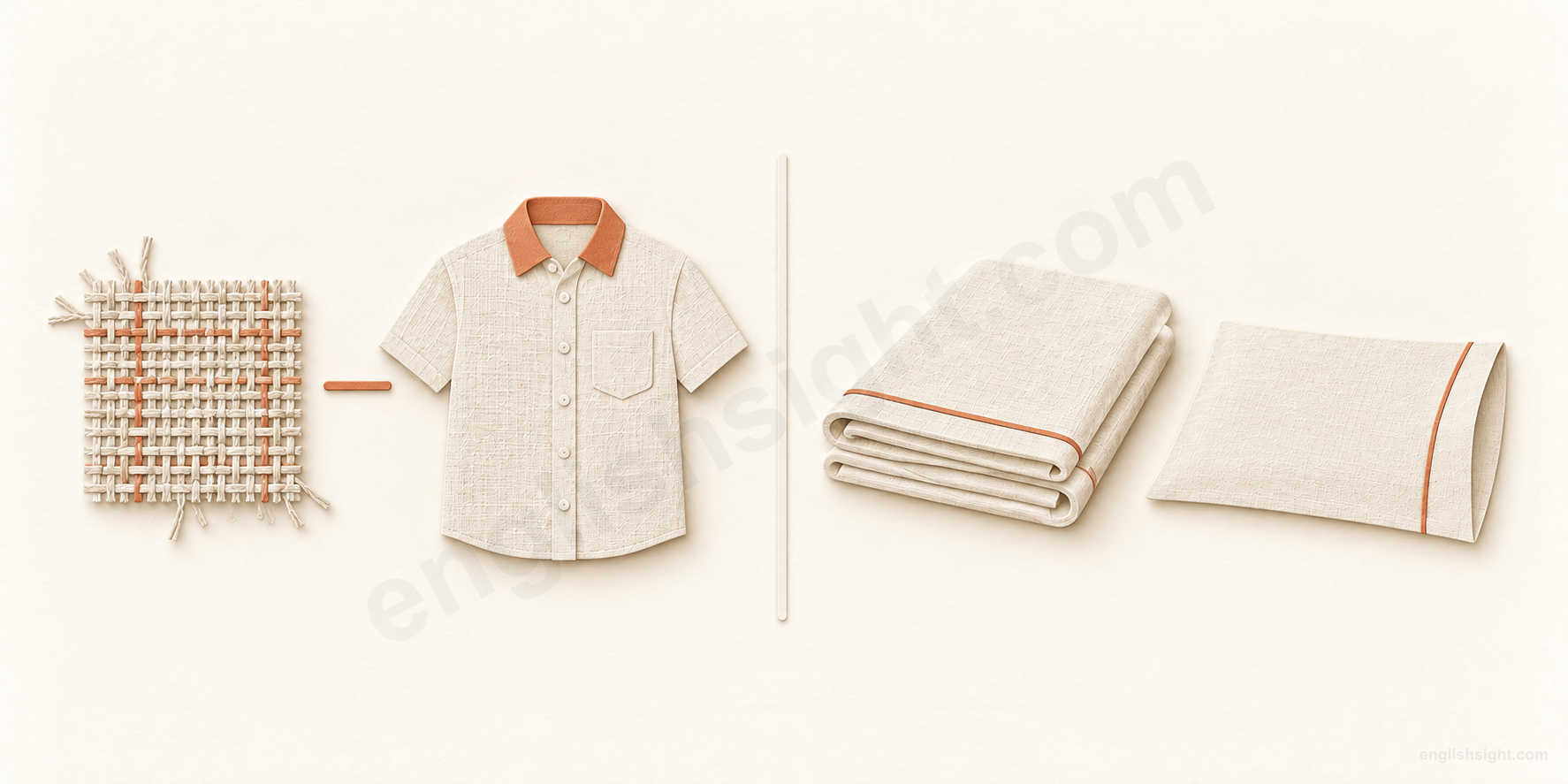
Distinguish flax cloth from the sheets and tablecloths called linen, and recognize the privacy idiom.
From cloth to a category of cloth items
From cloth to a category of cloth items
Flax cloth as a material
linen
Sheets and pillowcases as a household category
Context distinguishes material from household items.
The swatch and shirt illustrate linen as a material; the separate bed items illustrate the household category, which need not be made from flax.
Linen names cloth made from flax; it also names a household category of cloth items whose actual fibers can vary.
The material and household uses are related meanings, not a rule that every sheet or tablecloth is flax. The dirty-linen idiom needs its full expression and context.
In a linen shirt, linen identifies a material. In change the linen, it usually identifies household cloth items. The two uses are related, but a household item called linen need not be made from flax.
This lesson organizes common uses and practical distinctions. The visual is a teaching aid, not a claim that every English speaker imagines the same picture.
01
Linen as a material
Identify flax cloth and describe what clothing is made from. Read the following noun to find the object being described.
01
be made of linen; some / a piece of / a length of linen
made of linen
made from a particular plant-based cloth
Context / question
You want to know the fabric of a jacket.
Meaning in this context
You identify it as linen, rather than cotton or wool.
Here linen answers “What material is it?”
Linen is cloth made from flax fibers. In this material meaning, it is normally uncountable: some linen, pure linen, or a piece of linen. A length of linen measures fabric; a linen by itself is not the ordinary way to name one garment.
Compare The jacket is made of linen with We bought linen to make a jacket. The first names the material in a finished object; the second names fabric as a supply. Neither sentence uses linen as a verb.
You may encounter linens for different kinds of linen fabric in textile or retail discussions. For everyday requests, name the amount or the object: two metres of linen or two linen shirts.
In a sentence
This jacket is made of linen, but the lining is cotton.
Watch the difference Do not use linen as a general word for all cloth. Cotton is a different material.
02
linen + clothing noun; in a linen suit; a linen blend
a linen shirt
a shirt described by its material
Context / question
Two shirts have the same shape but different fabrics.
Meaning in this context
Linen identifies the fabric of one shirt.
The following noun names the object; linen describes its material.
A linen shirt, a linen suit, and linen trousers are ordinary material descriptions. The clothing noun names the item and determines its number; linen does not change to agree with it. Say two linen shirts, not two linens shirts.
Dictionaries differ in whether they list this use as an adjective or as a noun used before another noun. The useful pattern is the same: linen comes before the clothing noun. In She arrived in a linen suit, in describes what she is wearing; it is not a special linen idiom.
Check the full fabric description when shopping. A linen blend contains linen together with another fiber; the expression alone does not mean that every part is pure linen.
In a sentence
I packed two linen shirts for the trip.
Watch the difference A linen shirt names a material. A white shirt names a color; linen need not be white.
02
Linen as a household category
Sheets, tablecloths, and related items form a category even when their fabric is cotton. Context, compounds, and verbs tell you which items and actions are meant.
03
linen is …; linens are …; provide linen / linens
linen / linens
household cloth items considered as a group
Context / question
A holiday rental lists the household supplies it provides.
Meaning in this context
Linen or linens refers to cloth items such as sheets and pillowcases.
In this sense the category does not guarantee flax fiber.
Linen also names a household category. Linens is a familiar plural form for these articles, particularly in American English and in accommodation or shopping descriptions. Linen can be collective and uncountable; linens takes plural agreement: The linen is clean; the linens are clean.
These items can be made of cotton or another suitable fabric. This is why cotton bed linen is meaningful. The word has broadened from a material name to a category of things; do not infer fabric composition from the category alone.
An accommodation list may mention linen and towels separately. Ask what is included if that matters: Are sheets and towels provided? To count individual items, use two sheets or three pillowcases rather than treating every object as a linen.
In a sentence
The cottage provides linens, but guests need to bring beach towels.
Watch the difference Linen in a rental description does not necessarily mean sheets made of flax.
04
bed linen; a set of bed linen; cotton bed linen
bed linen
sheets, pillowcases, and related cloth covers for a bed
Context / question
You are preparing a bed for a guest.
Meaning in this context
You choose the washable cloth items used on the bed.
Bed narrows the household category by its use.
Bed linen commonly refers to sheets and pillowcases; related bed covers may also be included in a particular context. The compound names a use, not necessarily a material: cotton bed linen is perfectly natural.
Bed linen is normally uncountable. A set of bed linen gives you a countable unit. You may also see bed linens, especially in American usage. When exact contents matter, list the items rather than assuming that the term promises a duvet, blanket, or mattress.
Bedding is a broader useful word and can include blankets or other things used on a bed. Bed linen focuses on the cloth items rather than the entire bed and everything on it.
In a sentence
We bought a set of cotton bed linen for the spare room.
Watch the difference A mattress is not a piece of bed linen. Name the item if a shopping list needs precision.
05
table linen / table linens; a linen tablecloth
table linen
cloth items used when setting a dining table
Context / question
A restaurant is preparing its dining tables.
Meaning in this context
The tablecloths and cloth napkins are ready.
Table tells you what the cloth items are used for.
Table linen groups tablecloths and cloth napkins. It works like bed linen: the first noun identifies the setting, and linen names the cloth category. It does not promise a particular fiber.
Use table linen for the category and a tablecloth or a napkin for one object. The plural table linens also occurs, especially when discussing a collection or range of products.
Compare a linen tablecloth and table linen. The first describes the material of one tablecloth; the second groups the cloth items used on a table. The order of the words changes what is being classified.
In a sentence
The restaurant sends its table linen to a laundry each evening.
Watch the difference Table linen does not include plates or cutlery simply because they are on the table.
replace used household cloth items with clean ones
Context / question
A guest has checked out of a room.
Meaning in this context
The used sheets and pillowcases have been replaced.
Change supplies the replacement action; linen names what is replaced.
In a bedroom or hotel, change the linen usually means remove used sheets and pillowcases and put clean ones on. It does not mean change the fiber from linen to cotton. The room context tells you which items are involved.
Fresh linen means clean linen ready for use, often freshly washed. Clean linen and dirty linen are literal descriptions in a laundry context. Wash the linen names cleaning; change the linen names replacement. One action does not automatically state the other.
The definite article in the linen identifies the relevant room’s or household’s items. Some fresh linen introduces an unspecified supply. You can ask for fresh sheets if you want to be more specific.
In a sentence
Please change the linen before the next guest arrives.
Watch the difference Fresh linen is clean household cloth, not newly grown flax or necessarily brand-new fabric.
07
a linen cupboard / closet; a linen basket
linen cupboard / linen closet
a storage place for household cloth items
Context / question
You need a clean pillowcase.
Meaning in this context
You find it on a shelf with the spare sheets.
Linen identifies the usual contents, not the construction material.
A linen cupboard is the usual British term; linen closet is the usual North American term. These are cupboards or closets for sheets, towels, and similar household supplies. A linen cupboard is not a cupboard made from linen.
The compound is countable because cupboard or closet is countable: a linen closet, two linen cupboards. Linen remains unchanged before the head noun.
A linen basket similarly names a basket for household cloth or laundry. The basket need not be made of cloth, and the contents need not all be flax fabric. Use laundry basket when you simply mean a container for clothes waiting to be washed.
In a sentence
You’ll find spare pillowcases in the linen cupboard beside the bathroom.
Watch the difference Compare a linen shirt, where linen describes material, with a linen cupboard, where it describes purpose.
03
A fixed expression about privacy
One familiar figurative expression uses household washing as an image. Learn its full form, context, and tone.
08
air / wash + possessive + dirty linen / laundry + in public
air / wash your dirty linen in public
expose private, embarrassing matters to other people
Context / question
Two relatives have a private disagreement.
Meaning in this context
They discuss it where outsiders can hear or read it.
The whole expression is figurative and often critical.
This established idiom concerns personal problems or embarrassing private matters becoming public. Dirty linen is an image for those matters; no actual fabric or washing is required. Oxford records air and wash with both dirty linen and dirty laundry. Collins marks wash your dirty linen in public as British.
Change your to match the people involved: our dirty linen, their dirty linen. In public can mean online as well as in a room full of people. The speaker commonly disapproves of the disclosure, so the expression can sound judgmental.
The metaphor can help you remember the idiom, but it does not make every mention of dirty linen figurative. There is dirty linen in the basket is normally about laundry. Read the full expression and the situation.
In a sentence
They argued about the inheritance online and washed their dirty linen in public.
Watch the difference The idiom expresses a critical viewpoint; it is not a neutral label for every public discussion of a problem.
Choose the meaning from the whole phrase
Material, category, and grammar
Linen is normally uncountable for fabric and for the collective household category. Linens can name household articles or, in a more specialized context, kinds of linen fabric. Name a sheet, shirt, or set when counting specific items. There is no everyday verb linen or productive family of linen phrasal verbs to learn here.
Linen, cotton, cloth, and laundry
Cloth is a general material word; linen and cotton identify different fibers or fabrics. In bed linen and table linen, linen identifies household uses. Laundry focuses on things being washed or the washing task, including ordinary clothes. The categories can overlap without being identical.
The diagram has a boundary
The fabric swatch and shirt illustrate material use. The separate bed items illustrate a household category, not proof of their fiber content. Linen can be dyed; the simple pale drawing does not make whiteness part of the word’s meaning.
Specialist extensions
Dictionaries also record flax yarn or thread, and paper made with linen fibers or given a linen-like finish. Merriam-Webster also records an adjective use meaning resembling linen, so a specialist finish description need not guarantee flax content. These textile and stationery extensions are outside the main everyday lesson; linen paper does not mean a washable household cloth.
Choose the meaning and form
Use the situation and the whole phrase to decide what linen means.
1. A label says “a linen shirt.” What does linen primarily identify?
2. A shop advertises “cotton bed linen.” Is the wording contradictory?
3. You are describing several clean household sheets and pillowcases. Which plural form fits?
4. A hotel supervisor asks you to “change the linen.” What should you do?
5. After a family dispute appears in public posts, someone says, “They washed their dirty linen in public.” What is the criticism?
Sources and teaching notes
Dictionary entries below support the meanings, constructions, and usage notes. The teaching explanations, examples, and compatibility sketch were created for this lesson; the sketch is not a completed AI illustration.
The visual connects two uses; it does not show a picture shared by every native speaker.