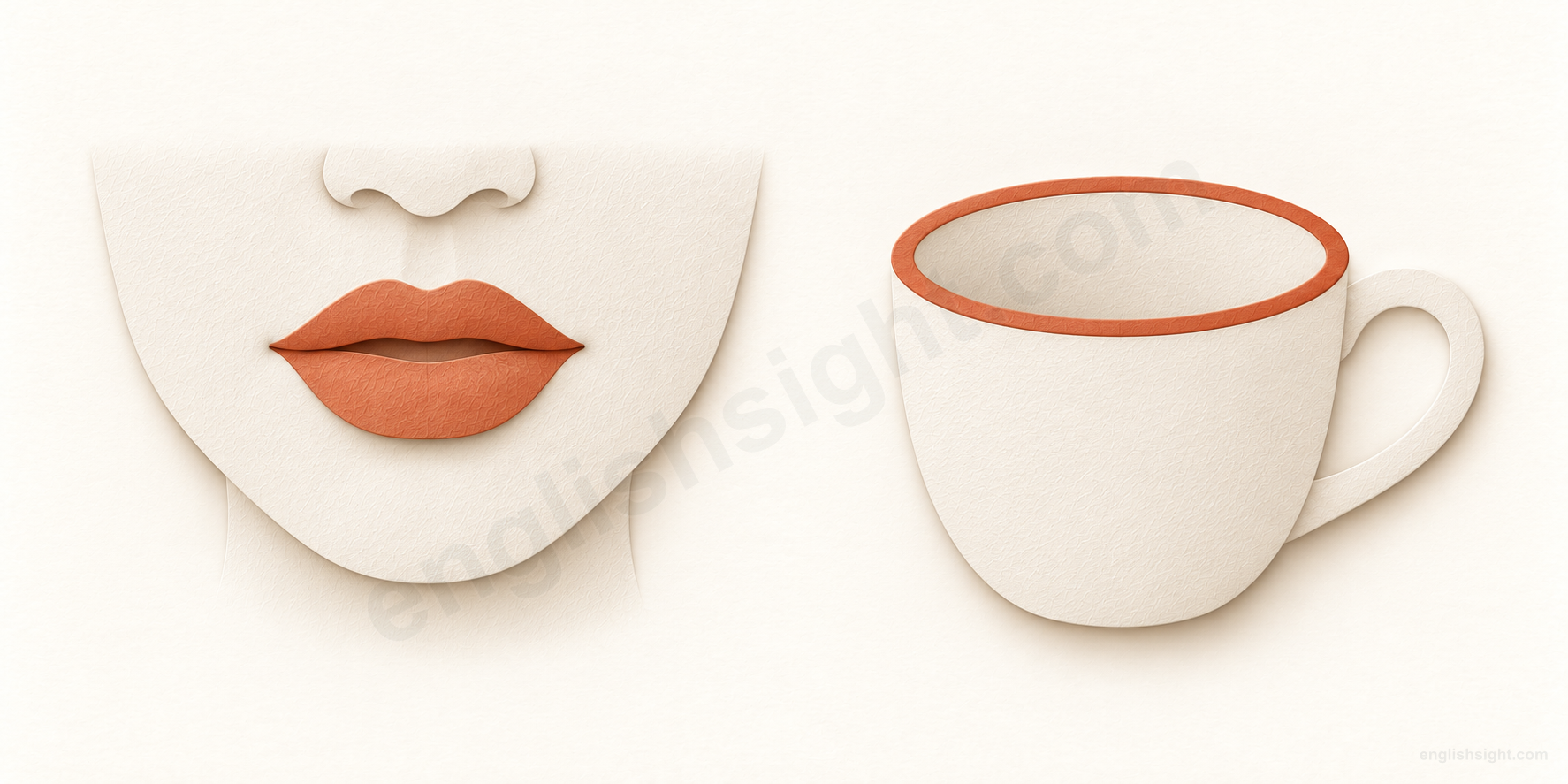
From upper and lower lips to a cup’s rim, spoken words, and familiar idioms.
An edge around an opening
An edge around an opening
Upper and lower lips frame the mouth.
lip
The cup’s lip is the rim around its opening.
Compare the edges bordering the openings.
Lips frame the mouth; a cup’s lip borders its opening.
A lip is one of the soft edges framing the mouth; a similar edge on a container or hollow place can also be called a lip.
The shape links the physical senses. Speech and feeling expressions build on the role of the lips, but their particular meanings are established uses, not rules for inventing new phrases.
Start with your mouth: each lip forms part of its soft outer edge. English also uses lip for an edge resembling that shape, such as the rim of a cup.
Because lips move when we speak and show feelings, many expressions use them to stand for speech, silence, or emotional control. Learn the whole expression: the body part alone does not predict the idiom.
01
Body, movement, and shape
Name the body part, describe its condition or movement, and recognize the related edge sense.
01
someone’s upper / lower lip; someone’s lips; on the lips
upper lip / lower lip
the two soft edges of the mouth
Situation
You identify a particular part of the mouth.
What is expressed
You distinguish one lip from the pair.
Lip names the edge; mouth names the opening and the larger body part.
Use lip for either member of the pair and lips for both. My lower lip is sore selects one; My lips are sore refers to the pair. Upper and lower are useful when describing location.
In kiss someone on the lips, on marks the place of contact: She kissed him on the lips. A smile on her lips describes the visible expression around her mouth. Neither use makes lip mean the entire face.
Full lips are relatively thick or rounded; thin lips are narrower. The ending -lipped forms adjectives describing the lips: thin-lipped means having thin lips. Tight-lipped also has an established information-withholding sense, explained below.
In a sentence
There was a little flour on his upper lip.
Watch the difference Say Her lips are dry, with plural are; lip and mouth are not interchangeable in every phrase.
02
dry / chapped / cracked lips; put lip balm on your lips
chapped lips / lip balm
describe irritated lips and a product for them
Situation
Cold wind leaves your lips dry and rough.
What is expressed
You describe their condition and apply a product.
Lip can identify the body part that a product is for.
Dry lips lack moisture; chapped lips are rough or cracked. The adjective describes their condition, while lip balm names a product applied to the lips for protection. This is vocabulary for describing a situation, not a treatment recommendation.
In lip balm, lip is a noun modifier and stays singular. The main noun is balm: some lip balm refers to the substance; different lip balms can refer to different products.
In a sentence
I packed some lip balm because my lips were chapped.
Watch the difference Use lip balm, not lips balm. A sore lip is a body part that hurts; balm is a product.
03
purse / part + possessive + lips; press + possessive + lips + together
purse your lips / part your lips
draw the lips together or open them slightly
Situation
A story describes a change around someone’s mouth.
What is expressed
The chosen verb tells you the movement.
The movement comes from purse or part, not from lip alone.
Purse your lips means draw them together into a small, tight shape, which can suggest thought or disapproval. Part your lips means separate them slightly. Press your lips together emphasizes closing them firmly.
He pursed his lips before replying describes a visible action. It does not prove what he thinks. Context supplies the emotion; the same movement can occur for different reasons.
In a sentence
She parted her lips to answer, then changed her mind.
Watch the difference Part her lips means open them slightly; it does not mean remove or divide a body part.
04
the lip of + container / hollow place
the lip of a cup / crater
an edge bordering a container or hollow place
Situation
You inspect a cup’s opening or a hollow in the ground.
What is expressed
You name the edge around it.
A similar shape motivates the extension from mouth to rim.
In the lip of a cup, lip is the rim at the opening. The same noun can describe the upper edge of a crater. There need not be two lips: this sense selects an edge resembling a mouth’s border.
Edge is more general. The edge of a sheet of paper is ordinary English, but calling it a lip normally needs some special projecting or rim-like feature. Do not replace every occurrence of edge with lip.
In a sentence
A small crack ran along the lip of the bowl.
Watch the difference Lip does not name the whole bowl, its contents, or every possible type of boundary.
05
lick / smack + possessive + lips; lick your lips at + prospect
lick your lips / smack your lips
move the lips or show eager anticipation
Situation
Something pleasant is present or expected.
What is expressed
You describe a physical reaction or figurative eagerness.
The full expression can move from eating to anticipating another reward.
Literally, lick your lips means move your tongue across them. Smack your lips describes a noisy movement of the mouth associated with enjoyment or appetite. Licking does not necessarily produce that sound.
In informal figurative use, people can lick or smack their lips at an attractive prospect: The investors were licking their lips at the prospect of a large profit. No actual tongue movement is required in that use. Context distinguishes physical action from an image of eagerness.
In a sentence
The children smacked their lips after tasting the warm pudding.
Watch the difference Licking dry lips can be a simple physical action; it does not always express greed or anticipation.
02
Holding back words and feelings
These expressions differ in purpose: controlling emotion, keeping a secret, choosing silence, or refusing to give information.
06
bite + possessive + lip; bit / bitten
bite your lip
hold back words or a visible emotion
Situation
You feel a strong urge to react.
What is expressed
You restrain the response.
The expression links a mouth action with holding something back.
You may literally bite your lip accidentally. In the established expression, biting your lip suggests effort not to say something or show anger, distress, or another feeling. The surrounding situation supplies what is being restrained.
I bit my lip instead of arguing describes a withheld response, not agreement. Compare I bit my lip while eating, where physical injury is the intended meaning.
In a sentence
I bit my lip when he blamed me for the mistake.
Watch the difference The past tense is bit: I bit my lip. Use bitten after have: I have bitten my lip.
07
my / our + lips + are sealed
My lips are sealed.
promise to keep information secret
Situation
Someone shares private news.
What is expressed
You promise not to reveal it.
Sealing the lips is a metaphor for keeping information from being spoken.
My lips are sealed is a conversational assurance that you will keep a secret. It can be said warmly or playfully; it does not describe glue, a medical condition, or an inability to speak.
The plural subject requires are. The phrase promises silence about the relevant information, not complete silence on every topic.
In a sentence
“Please don’t tell anyone about the party.” “My lips are sealed.”
Watch the difference Do not treat this as a claim that the speaker cannot talk. The speaker is choosing confidentiality.
08
button + possessive + lip
button your lip
keep quiet when you would like to speak
Situation
You are tempted to make a comment.
What is expressed
You choose not to say it.
Buttoning is an imagined closure, not a physical instruction.
Button your lip means keep silent despite wanting to speak. Lip is singular in this established wording. It focuses on suppressing speech, while bite your lip can also describe holding back a visible emotion.
As a command, Button your lip! is blunt and can sound rude. Keep that detail to yourself is a more neutral request when discussing private information.
In a sentence
I wanted to complain about the seating, but I buttoned my lip.
Watch the difference This is an idiom with button as its verb, not a phrasal verb made from lip.
09
keep + a stiff upper lip
keep a stiff upper lip
remain outwardly composed during difficulty
Situation
A person experiences pain or distress.
What is expressed
They try not to show it.
The expression concerns the display of emotion, not its absence.
Keep a stiff upper lip describes maintaining composure while facing trouble. Someone may feel deeply upset while keeping that feeling hidden. A relaxed or happy situation does not normally motivate the expression.
The phrase is often associated with a traditional British ideal of emotional restraint, though it is also used elsewhere. It describes an attitude rather than proving that hiding feelings is always desirable.
In a sentence
She tried to keep a stiff upper lip when the farewell speech began.
Watch the difference Keep the full expression, including a and upper; it is not a general phrase for a rigid facial muscle.
10
be / remain + tight-lipped + about something
remain tight-lipped about something
refuse to reveal information; also keep the lips pressed together
Situation
People ask for details.
What is expressed
The person gives little or no information.
An apparently closed mouth supplies an image for withholding information.
Tight-lipped is an adjective. Remain tight-lipped about the plan means be unwilling to discuss it. It does not necessarily mean the person is angry or has promised to protect someone’s secret.
It can also describe lips held tightly together, especially with anger. A tight-lipped reply may still contain words: the description can convey restrained expression rather than absolute silence.
In a sentence
The director remained tight-lipped about the release date.
Watch the difference Use tight-lipped, with -ed, after remain; tight-lip is not the adjective.
03
Words, emphasis, and performance
Read the full construction to distinguish rude talk, public discussion, statements, empty support, and matching recorded speech.
11
give + person + (some / any) lip
give someone lip
speak disrespectfully to someone
Situation
Someone objects to the way another person answers.
What is expressed
They describe the answer as rude or insolent.
Uncountable lip stands for a particular kind of talk.
In informal English, lip can mean disrespectful talk, especially a reply treated as insolent. Don’t give me any lip is a reprimand. It is confrontational, so it is useful to recognize its tone before using it.
Here lip is uncountable: some lip, any lip, your lip. Compare a cut on your lip, where the same singular form refers to one countable body part. Backtalk is a useful paraphrase of the talk sense.
In a sentence
“Don’t give me any lip,” the coach snapped.
Watch the difference Any lip here means rude talk, not a request involving someone’s mouth.
12
name / question / topic + be + on everyone’s lips
be on everyone’s lips
be widely talked about
Situation
Many people discuss the same name or question.
What is expressed
The topic becomes prominent in conversation.
Lips stand for the people speaking about a topic.
A name, question, or event can be on everyone’s lips when it is a frequent topic of conversation in the relevant community. Everyone is usually a broad conversational generalization, not a literal count of all people.
The subject is the thing discussed: The new café is on everyone’s lips. This does not by itself mean people like the café. The attention might be positive, negative, or simply curious.
In a sentence
After the final, one player’s name was on everyone’s lips.
Watch the difference Keep plural lips and possessive everyone’s. The phrase describes discussion, not food on people’s mouths.
13
word / food / drink + not pass + possessive + lips
not pass someone’s lips
remain unsaid, or remain uneaten or undrunk
Situation
You consider what someone has said or consumed.
What is expressed
Something has not crossed the mouth’s boundary.
The subject distinguishes speech going out from food or drink going in.
With words as subject, not pass someone’s lips means not be spoken: No word of criticism passed her lips. With food or drink as subject, it means not be consumed: No wine passed his lips that evening.
The two readings share a mouth boundary but differ in what crosses it and in which direction. The negative wording is more expressive than simply did not say or did not drink; use the subject to interpret it.
In a sentence
His name never passed my lips during the interview.
Watch the difference No wine passed her lips concerns drinking. Do not automatically interpret every example as speech.
understand visible speech, or demand attention to a statement
Situation
A listener watches a speaker or is being asked to take a statement seriously.
What is expressed
The situation selects a literal skill or an emphatic idiom.
Visible lip movements are different from a demand to listen carefully.
Literally, read someone’s lips and lip-read mean understand speech by watching the mouth move. She can lip-read describes a skill; the verb does not claim that every word can always be recovered from sight.
Read my lips followed by a statement is also an informal, emphatic way to say listen carefully and believe what I am saying. It can sound forceful or impatient and does not require actual lip-reading.
In the compound verb, the written past form is also lip-read, pronounced with /red/ in the read part. This is a compound verb, not read followed by a separable particle.
In a sentence
Read my lips: I am not selling the house.
Watch the difference The emphatic idiom is not a polite request for help hearing; context and tone make the difference.
15
pay / give + lip service + to + idea / cause
pay lip service to something
express support without backing it with action
Situation
An organization says an idea matters.
What is expressed
Its actions fail to support the claim.
Lips represent spoken support that remains only words.
Pay lip service to an idea criticizes the gap between stated support and real commitment. The object after to names the principle, goal, or cause supposedly supported.
Give lip service to is also used. Pay is part of an established expression here and does not imply transferring money. Compare pay attention to, which concerns directing attention, not empty public support.
In a sentence
The company pays lip service to teamwork but rewards only individual sales.
Watch the difference Use to after lip service: pay lip service to fairness. Do not confuse this with give someone lip, which means talk rudely.
16
lip-sync to + recording; lip-sync + song; lip-synced; lip-syncing
lip-sync to a song
match mouth movements to recorded sound
Situation
A recording plays during a performance.
What is expressed
The performer moves their mouth in time with it.
Lip identifies the visible movement; sync supplies the matching in time.
Lip-sync means move your mouth to match recorded words or singing without producing that speech or singing yourself at that moment. People may do it for a stage act, a short video, or a performance using a recorded vocal track.
Use lip-sync to a song or lip-sync a song. The spelling lip-synch is also found. Unlike lip-reading, the person lip-syncing is performing the visible movements rather than interpreting someone else’s speech.
In a sentence
We lip-synced to a favorite song for the school video.
Watch the difference Matching the words on a recording is the key; ordinary live singing is not lip-syncing merely because the lips move.
Keep the noun and the expression distinct
One lip, two lips
Lip /lɪp/ is normally countable for a body part or a rim: an upper lip, two lips, the lip of a bowl. Lips takes plural agreement. Informal lip meaning disrespectful talk is uncountable: some lip or any lip, not a lip in that meaning.
Read the whole combination
Bite, lick, purse, and read are the verbs in their respective combinations; lip remains a noun. Lip balm is a compound noun, tight-lipped an adjective, and lip-read and lip-sync are compound verbs. These are not all phrasal verbs, and there is no shared particle-placement rule.
Scope of this lesson
This selection covers the everyday noun, familiar idioms, and a few useful compounds. Technical anatomy, botany, instrument technique, golf uses, rare standalone verbs, and the traditional cup-and-lip proverb are not developed here. The picture is a teaching comparison, not a claim about a universal mental image.
Choose the meaning in context
Look at what surrounds lip: the noun form, the verb, and the situation all matter.
1. A potter smooths the lip of a bowl. What is being smoothed?
2. The club praises accessibility but refuses to make any changes. Which sentence criticizes this?
3. A friend tells you a surprise and asks you not to reveal it. Which reply promises secrecy?
4. A character complains about disrespectful replies. Which sentence uses lip as uncountable talk?
5. “No coffee has passed her lips today.” What does this mean?
Sources and teaching notes
The linked dictionary entries support the usage inventory. Explanations and examples are original; the comparison between shapes is a teaching aid.
The picture highlights a useful connection; different speakers need not imagine the same scene.