Use liquid for a substance or its state, then recognize financial and descriptive extensions.
A shape supplied by the container
A shape supplied by the container
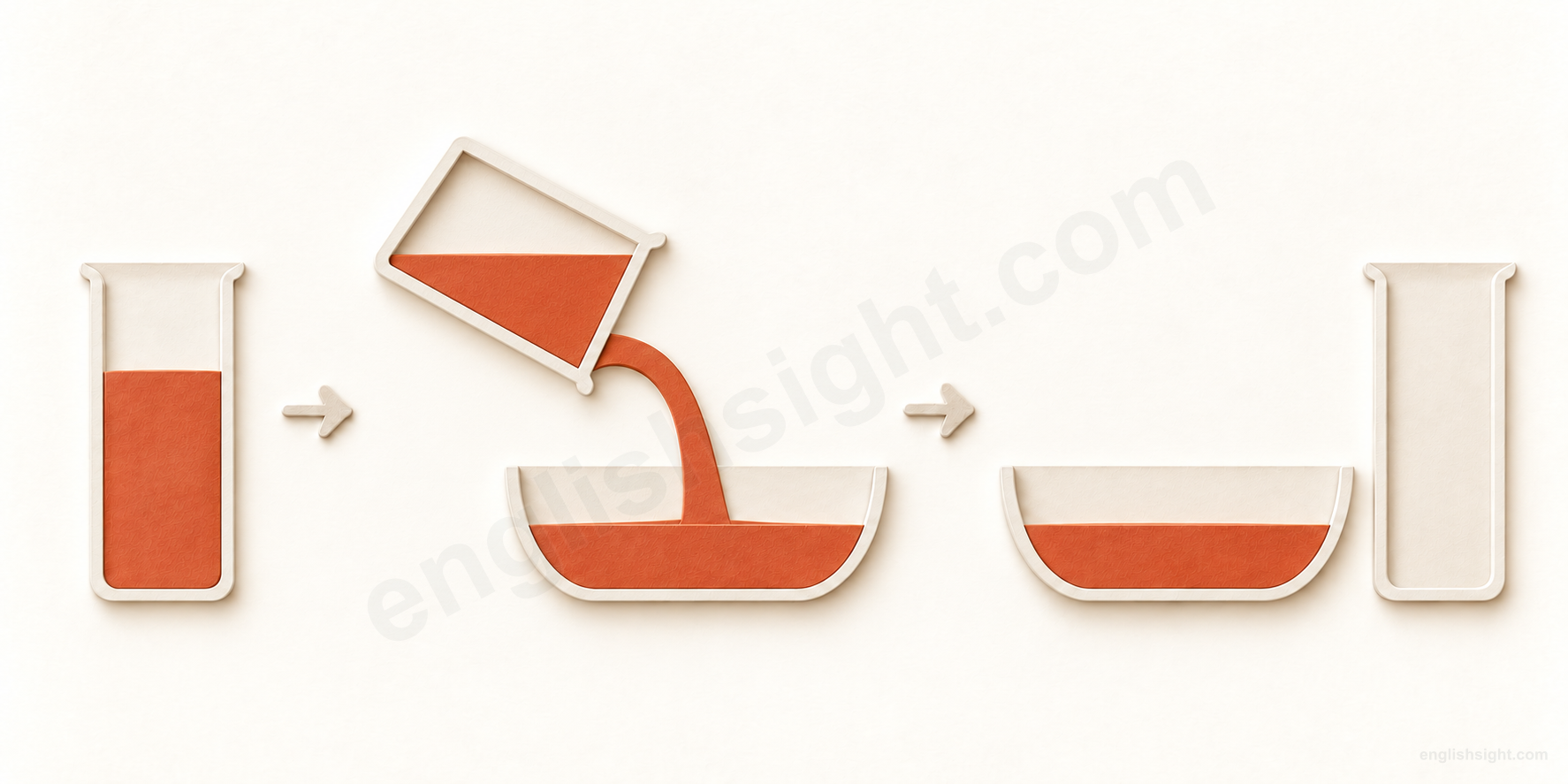
A liquid rests deep in a narrow beaker.
liquid
It rests wider and shallower in the bowl; the beaker is empty.
The liquid flows from the tilted beaker into a wide bowl.
A liquid flows and takes the shape of the container it occupies.
A liquid can flow and take the shape of the part of a container it occupies while keeping roughly the same volume under the same conditions.
The sketch compares the same amount before and after transfer between two containers. It illustrates the physical meaning; cash availability and literary qualities are established extensions.
Picture the same amount of water in a tall vessel and a wide bowl: the shape changes with the container. This offers a useful starting point for the physical meaning of liquid.
The noun and adjective share that physical starting point. Financial and literary meanings need their own context; the picture is a teaching model, not a mental image shared by every English speaker.
01
A substance, an amount, or a state
First distinguish the noun from the adjective. Then use the surrounding words to describe quantity, form, or a change of state.
01
a liquid; something is a liquid
a liquid
a substance with no fixed shape of its own
Situation / starting point
A sample sits in a narrow container.
Meaning / result
It takes a wider shape in a bowl.
The noun names the kind of substance.
Water, milk, and oil are liquids. They flow and take the shape of the part of a container they occupy. Unlike a gas, a liquid does not spread out to fill all the available space.
In Water is a liquid, a liquid classifies water. In Water is liquid, liquid is an adjective describing its state. The article changes the grammatical job, not the substance.
In a sentence
Oil is a liquid, even when it flows slowly.
Watch the difference Being easy to pour is a useful clue, not a complete test: dry rice can be poured too.
02
some / a little / much liquid; a drop of liquid; different liquids
some liquid / different liquids
refer to an amount or to separate kinds
Situation / starting point
A recipe needs an amount; a lesson compares substances.
Meaning / result
The grammar marks which distinction matters.
Use uncountable liquid for an amount and countable liquids for distinct substances.
Add a little liquid treats it as material. A drop of liquid and two cups of liquid measure that material; the measuring word takes the number.
Water and oil are two liquids counts kinds. A travel notice about liquids can group liquid products together. Two liquids does not normally mean two glasses of one drink.
In a sentence
We compared two liquids: milk and cooking oil.
Watch the difference For the amount use less liquid; for a smaller number of kinds use fewer liquids.
03
liquid + noun; be liquid; in liquid form
liquid soap / in liquid form
describe the physical form of a substance
Situation / starting point
A shop offers soap in bars and in bottles.
Meaning / result
You specify the liquid version.
The adjective can come before a noun or after be.
Liquid soap and liquid detergent name products in this state. In The soap is liquid, the same adjective follows be. In liquid form contrasts with forms such as powder or tablets.
The state depends on conditions: liquid nitrogen names nitrogen in its liquid state, not its usual state in ordinary air. Liquid does not mean that something must be water, transparent, or safe to drink.
In a sentence
This soap comes in liquid form.
Watch the difference Wet describes something with moisture on or in it. A wet towel is not a liquid.
04
turn into a liquid; become / turn / remain liquid
turn into a liquid / become liquid
describe a change of physical state
Situation / starting point
A solid is warmed.
Meaning / result
The material becomes liquid.
The verb supplies the change; liquid supplies the resulting state.
Turn into a liquid uses a noun phrase after into. Become liquid and turn liquid use an adjective. These patterns describe a change; remain liquid describes a continuing state.
In everyday contexts, melt is the usual verb for a solid becoming liquid. The reverse change is freeze or solidify. Liquid itself is not the ordinary verb for either process.
In a sentence
The wax became liquid as it warmed.
Watch the difference Use became liquid or became a liquid, not became into liquid.
02
Cooking, cleaning, and meals
These combinations apply the physical meaning to familiar tasks. Expressions about alcohol need their own explanation.
05
pour / drain off / reserve + the liquid; cooking liquid
pour / drain / reserve the liquid
handle the flowing part of food or a mixture
Situation / starting point
Cooked beans sit in their cooking water.
Meaning / result
You separate the beans and keep the water for later.
The verb tells you what to do with the liquid.
Pour the liquid moves it out of a container. Drain off the liquid removes it from food; reserve the liquid tells you to keep it for later. Cooking liquid is the liquid used or produced during cooking.
Liquid remains an ordinary noun in these combinations. Pour supplies the action of moving it, drain off supplies removal, and reserve supplies keeping it for later. Drain off is a phrasal verb; liquid is its object, not part of the verb. Thick liquid can flow slowly; thin liquid flows more readily.
In a sentence
Drain the beans and reserve the cooking liquid.
Watch the difference Reserve means keep for later, not throw away. The liquid is not necessarily water.
06
some washing-up liquid; a bottle of dishwashing liquid
washing-up liquid / dishwashing liquid
name liquid detergent for washing dishes
Situation / starting point
The dishes need washing.
Meaning / result
You ask for the appropriate cleaning product.
This compound names a product and has a regional wording difference.
Washing-up liquid is British English; dishwashing liquid is the North American equivalent. Both refer to liquid soap used for dishes and pans.
The compound is uncountable: some washing-up liquid or a bottle of dishwashing liquid. Compare liquid soap, which says the form of soap but does not by itself specify washing dishes.
In a sentence
There is a bottle of washing-up liquid beside the sink.
Watch the difference Do not count the product as two washing-up liquids when you mean two bottles.
07
be on / put someone on + a liquid diet
a liquid diet
name a diet based on liquids
Situation / starting point
A person discusses what food they are having.
Meaning / result
They describe a restricted form of diet.
Liquid modifies diet; the whole phrase is the name of an eating plan.
A liquid diet restricts food to liquids and sometimes certain soft or semisolid foods. The precise allowed foods depend on the particular plan; liquid alone does not specify that list.
Be on a liquid diet describes following the plan; put someone on a liquid diet describes arranging it. This is a literal food expression, unlike the humorous liquid lunch.
In a sentence
The character in the story is on a liquid diet.
Watch the difference A liquid diet does not simply mean having a drink with ordinary meals.
08
have a liquid lunch; liquid refreshment
a liquid lunch / liquid refreshment
recognize a joke about alcohol and a formal word for drinks
Situation / starting point
Someone says lunch consisted mainly of drinks.
Meaning / result
Their choice of phrase signals the intended tone.
The special meaning belongs to the full expression liquid lunch.
A liquid lunch is a humorous expression for drinking alcohol at lunchtime instead of eating a normal meal. It is not the ordinary name for a bowl of soup or a prescribed liquid diet.
Liquid refreshment is a more playful or formal way to say drinks. It does not necessarily mean alcohol. The noun and the context determine the interpretation.
In a sentence
“Just soup?” “No—by a liquid lunch, I meant drinks at the pub.”
Watch the difference Do not infer alcohol from liquid alone: liquid soap and liquid diet have no such meaning.
09
some / a little liquid courage
liquid courage
confidence associated with drinking alcohol
Situation / starting point
Someone is nervous about speaking to another person.
Meaning / result
A narrator attributes their boldness to alcohol.
The full expression refers to alcohol-related confidence, not a physical form of courage.
Liquid courage names the confidence some people feel after drinking alcohol before doing something they find difficult or frightening. The expression is associated with US English; Dutch courage is a British equivalent.
Use it as an uncountable expression: some liquid courage. The alcohol link belongs to the established expression, as it does in liquid lunch; it cannot be predicted from liquid alone. It describes perceived confidence, not proof of good judgment.
In a sentence
The narrator calls his sudden confidence “liquid courage.”
Watch the difference Do not use liquid courage to mean any drink that helps you relax, or to mean courage in general.
03
Money and descriptive language
Financial uses concern access to cash. Literary uses borrow qualities such as clarity and smooth flow; they do not describe actual liquid.
describe wealth available as cash or readily changed into cash
Situation / starting point
Someone owns valuable things but has bills to pay.
Meaning / result
They distinguish readily available funds from hard-to-sell property.
Financial liquid concerns access to cash, not physical state.
Liquid assets are cash or possessions that can readily be converted into cash. A valuable house may contribute to wealth while being much less liquid than money in an accessible account.
Keep some money liquid means keep it readily available. The link with physical flow is a memory aid; this financial meaning is established usage, not a rule for inventing new expressions.
In a sentence
They kept part of their savings liquid for unexpected expenses.
Watch the difference Liquid does not mean profitable or risk-free. Someone can be wealthy without having much readily available cash.
11
liquid + eyes
liquid eyes
describe eyes as clear and shining
Situation / starting point
A writer describes someone’s eyes.
Meaning / result
The image emphasizes clarity and shine.
This is a literary comparison, not a physical classification.
In literary description, liquid eyes suggests eyes that look clear and shining, like water. The word adds an impression rather than naming a different kind of eye.
This is a marked descriptive use. In an ordinary practical description, clear or bright eyes is more direct. The expression alone does not say that the person is crying.
In a sentence
The portrait gives the child large, liquid eyes.
Watch the difference Do not translate this as eyes made of liquid, or assume that tears must be present.
12
liquid + voice / notes / song
a liquid voice / liquid notes
describe clear, smooth, flowing sound
Situation / starting point
A listener describes singing or birdsong.
Meaning / result
The description emphasizes a smooth musical quality.
The flowing quality is metaphorical.
A liquid voice or liquid notes can describe a clear, pleasing sound that seems to flow smoothly. This use is found especially in literary or expressive description.
Compare a loud voice: loud concerns volume, while liquid concerns the quality and flow of the sound. It does not mean that the speaker has liquid in their mouth.
In a sentence
Liquid notes drifted through the open window.
Watch the difference Do not use liquid as a general substitute for loud, quiet, or fluent.
13
liquid + movement / grace
liquid movement
describe exceptionally smooth, flowing movement
Situation / starting point
A writer watches a dancer move.
Meaning / result
The description focuses on an unbroken, graceful flow.
This descriptive extension concerns manner, not substance.
Liquid movement presents movement as smooth and unconstrained, as if it flowed. It is expressive language rather than a basic technical label for how someone moves.
In The dancer moved with liquid grace, liquid modifies grace. Use smoothly for a plain everyday report. Do not assume that every flexible object or changing situation is naturally called liquid.
In a sentence
The dancer crossed the stage with liquid grace.
Watch the difference Use a natural phrase such as moved smoothly, not moved liquid, when you need an adverb.
Keep the physical meaning and its extensions distinct
Liquid, wet, and fluid
Liquid names a state or a substance in that state. Wet describes the presence of moisture: wet sand is not itself a liquid. In scientific usage, fluid is broader and can include gases. Powder can be poured but is made of solid particles.
The grammar changes with the job
The noun has singular liquid and plural liquids; it can also be uncountable. The adjective stays liquid before singular or plural nouns: liquid soap, liquid products. There is no everyday liquid verb or family of phrasal verbs to learn here.
Recognition is not a frequency claim
Financial liquid is established business vocabulary; liquid eyes, voice, and movement are descriptive extensions. The phonetic term liquid consonant (especially l and r), specialized technology names, and derived words such as liquidity, liquefy, and liquidate are outside the main lesson.
Read the grammar and the context
Choose the expression that matches the intended distinction.
1. You need to say which form of soap is sold, rather than classify soap as a substance. Which sentence fits?
2. A recipe needs a smaller amount of the same cooking liquid. Which instruction fits?
3. A company owns an expensive building but needs money quickly. What do liquid assets provide?
4. A humorous account says someone had a liquid lunch at a pub. What is suggested?
5. A novel describes the liquid notes of a song. What quality does liquid emphasize?
6. A narrator says a shy adult found some liquid courage before starting a conversation. What is suggested?
Sources and teaching notes
The linked dictionary entries support the usage distinctions. Explanations, examples, and the visual comparison were written for this lesson; the diagram is a teaching aid.
The visual comparison is a teaching aid, not an image shared by every native speaker.