Small on a scale; the wording changes the message.
Explore size, age, amounts, degree, and familiar expressions with little.
A small extent, with different constructions
Notice the scale and the construction
Choose a relevant reference
little
Small relative to that reference
Compare size, amount, or degree
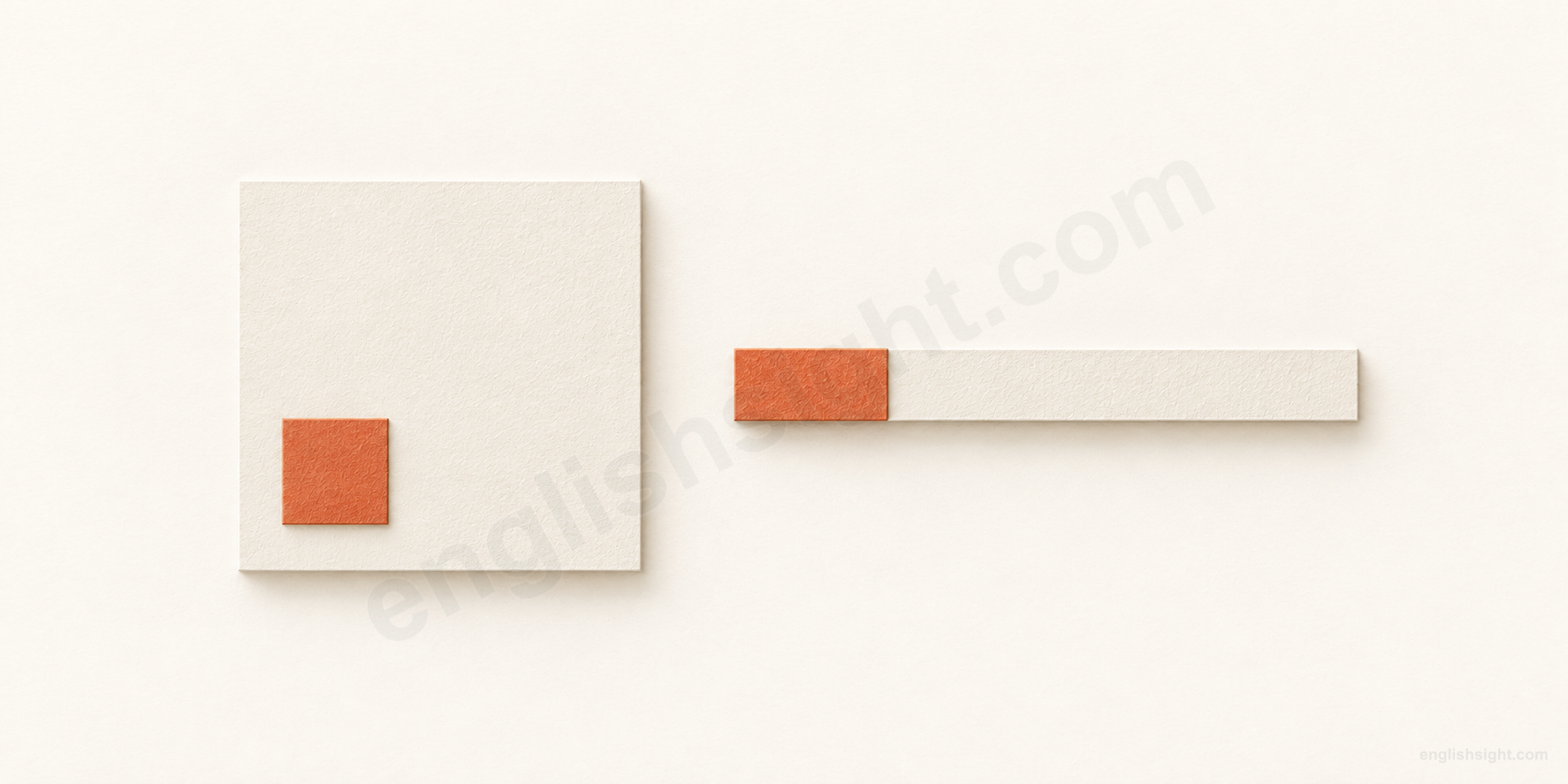
The squares compare size; the short segment represents a small amount or degree. These are comparisons, not stages of shrinking.
Ask what is small: an object, an age, a stretch of time, an amount, or a degree. Then check the article, the noun, and the whole expression.
Smallness is relative to the situation. Little need not mean zero, insufficient, unimportant, or pleasant; those readings depend on the wording and context.
A little cup, a little water, and a little tired all involve smallness, but their grammar differs. A cup is one small object; water is an amount; tiredness has a degree. Little can also express affection, dismissal, or a judgment about importance.
A useful starting picture is a small extent compared with a relevant reference. This is a teaching model, not a report of what every native speaker pictures. It cannot predict the meanings of established idioms.
01
Small things, young people, and attitude
Before a noun, little often describes size or extent. With people and evaluations, it can also signal age or a speaker’s attitude.
01
a / the / my + little + noun; little + plural noun; the little one
a little house / little houses
small in physical size
Situation / reference
A house occupies much less space than the houses nearby.
Meaning in this context
You describe its size with little.
The object is small; the phrase does not say there are few objects.
Little describes a noun, usually from a position before it. A little house is one small house; little houses are small houses. In a little group, the group itself is small, often because it has few members.
The little one selects the smaller or small item already being discussed: I’ll take the little one by the window. One replaces a countable noun. For a neutral statement after be, The house is small is usually the easier choice.
Original example
We rented a little house beside the canal.
Choose carefully Little houses describes size; few houses describes number. Small is more neutral when size alone matters.
02
be little; little + child; one’s little brother / sister; the little ones
when I was little / my little sister
young, or younger within a family
Situation / reference
You recall childhood or identify a younger relative.
Meaning in this context
Little locates a person by age rather than necessarily by height.
Young age and relative family age are connected but distinct.
When I was little means during my childhood. Little children are young children, and the little ones can refer to the children in a family or group.
My little sister means my younger sister. She may now be an adult and taller than you. My sister is little would not normally communicate that same family relationship.
Original example
My little sister is thirty now, but I still remember teaching her to ride a bike.
Choose carefully Little sister does not necessarily mean short sister. Use younger when you want a neutral age comparison.
03
(for) a little while; a little while later; a little way + direction
a little while / a little way
a short stretch of time or distance
Situation / reference
The wait or the remaining walk has a limited length.
Meaning in this context
You describe that extent as short.
The relevant scale is duration or distance.
A little while is a short period. Wait a little while asks for a brief wait; a little while later places an event shortly after another event.
A little way is a short distance. Walk a little way past the bridge describes how far to go. These phrases do not give an exact number of minutes or metres.
Original example
We walked a little way along the river and then stopped.
Choose carefully The article in a little while belongs to the noun phrase. Do not assume that every a + little sequence is an uncountable quantity.
04
give / let out + a little + gesture or sound noun
a little smile / a little nod
a brief or slight expression, movement, or sound
Situation / reference
Someone acknowledges an answer without a large movement.
Meaning in this context
A small gesture communicates the response.
Smallness can concern the duration or strength of an action.
A little nod, laugh, cry, or smile presents a brief or restrained action. The noun names an event rather than a physical object. Context decides whether brevity, intensity, or both matter.
“She gave a little laugh” describes one brief laugh. “She laughed a little” describes a limited amount of laughing. They can report similar events, but the grammar differs.
Original example
Ravi gave a little nod and closed the notebook.
Choose carefully A little cry need not be happy: the noun and context determine the emotion.
05
evaluating adjective + little + noun; a little something for someone
a lovely little café / a nasty little remark
add warmth, sympathy, or contempt
Situation / reference
You evaluate something as well as describing it.
Meaning in this context
Little helps communicate your attitude.
Smallness can become a way of presenting something emotionally.
A lovely little café can sound affectionate or approving. Poor little dog can express sympathy. Little often follows another adjective in these phrases.
A nasty little remark sounds dismissive or contemptuous. This does not measure the remark’s physical size. Used about an adult, even a positive phrase such as a clever little worker may sound patronizing.
Here’s a little something for you modestly presents a small gift. The wording can play down the gift rather than report its exact size.
Original example
We found a lovely little café behind the station.
Choose carefully Little is not automatically affectionate. The adjective, relationship, and tone matter.
06
little + problem / thing / detail; every little + singular noun
little things / every little detail
minor matters, or even the smallest detail
Situation / reference
You distinguish small issues from major ones.
Meaning in this context
Little describes their perceived importance or extent.
Small importance is a judgment, not a guarantee of small consequences.
Little problems and little things can mean minor matters. Don’t argue over little things asks someone not to make minor issues into a dispute.
Every little detail emphasizes that even small details are included. In “The little things made her feel welcome,” those small actions may matter greatly. Little does not force the conclusion that they are worthless.
Original example
She checked every little detail before sending the invitation.
Choose carefully A little mistake can cause a serious problem. Do not infer the outcome from little alone.
07
the little guy; protect / stand up for + the little guy
the little guy
an ordinary person with little social or economic power
Situation / reference
An ordinary person faces a powerful organization.
Meaning in this context
Little describes limited influence rather than height.
The scale concerns power or resources.
The little guy is an informal expression, especially in North American English, for an ordinary person without much power. It often appears when contrasting individuals or small operators with large institutions.
The phrase can express sympathy for someone at a disadvantage. In another context, a little guy may literally be a small boy or a small man, so check whether the discussion concerns power or physical description.
Original example
The new complaints service aims to help the little guy challenge large companies.
Choose carefully The little guy in this social sense does not specify someone’s height.
02
Some, hardly any, and comparisons
As a quantity word, little usually concerns an uncountable amount. A little and little can describe similar amounts while directing attention differently.
08
a little + uncountable noun; a little bit of + uncountable noun
a little water / a little help
some amount, though not a large amount
Situation / reference
There is a small amount available or needed.
Meaning in this context
You draw attention to that amount being present.
A little presents a positive amount rather than emphasizing scarcity.
Use a little with an uncountable noun: water, time, money, help, or information. “Could I have a little water?” requests some water. “A little help would be useful” asks for some help without presenting it as a large demand.
“We have a little time left” highlights time still available. It does not promise that the time is sufficient; “We have a little time, but not enough to eat” is natural.
For separate countable objects use a few: a few bottles, a few minutes. A little bottle means one small bottle, with little functioning as an adjective.
A little bit of water is a conversational alternative to a little water. Bit is a noun here, so use of before the material: a little bit of advice. Compare a little bit tired, where the phrase modifies an adjective and needs no of.
Original example
I have a little time before my next meeting, so we can talk.
Choose carefully Say a little advice or a few suggestions, not a little suggestions.
09
little + uncountable noun; know / understand little; little is known about…
little time / little doubt
not much; a limited amount
Situation / reference
You consider how limited an amount is.
Meaning in this context
Little emphasizes its smallness or near absence.
The negative quantity reading need not make the whole message bad.
“We have little time” warns that not much time is available. Bare little is often more formal than not much in ordinary conversation. It can suggest insufficiency, but does not always assert it.
“There is little doubt” means there is hardly any uncertainty, so the speaker is fairly sure. Little damage can be good news. The emotional value depends on what there is little of.
Little can stand without a noun: I know little about the subject. “Little is known about the building’s first owner” is a passive sentence with little as its subject, not a special passive form of the word.
Original example
There is little doubt that the repairs will take several weeks.
Choose carefully Little time and a little time direct attention differently. Little does not simply mean none.
10
(a) little of + identified noun phrase / pronoun; the / what little + noun + clause
a little of it / the little money we had
a small portion, or the small total already identified
Situation / reference
The material, money, or information is already identified.
Meaning in this context
You specify a portion or refer to its limited total.
Of and the organize the reference; they are not decorative additions.
Use a little of the soup, a little of my time, or a little of it for a portion of something identified. Little of the soup means not much of that soup. Without a following noun, “Give me a little” relies on context.
The little money we had means all of our money, presented as a small total. It is different from a little of the money we had, which selects only some of that money.
Little of what she said refers to a limited amount of her message. What she said supplies the material being measured.
What little money we had also presents the whole amount as small: We saved what little money we had. Without a noun, “I did what little I could” means I did all I could, although I could do very little.
Original example
We spent the little money we had on bus tickets.
Choose carefully Use a little milk for an unspecified amount; a little of the milk for a portion of identified milk. Avoid a little of milk.
11
very / too / so / how little + uncountable noun; only a little; a very little
very little / too little / so little
emphasize a small amount or judge it against a need
Situation / reference
An amount is small, insufficient, or surprisingly limited.
Meaning in this context
A modifier makes that judgment explicit.
Very, too, and so contribute different information.
Very little emphasizes a tiny amount: There was very little noise. Too little says the amount falls below what is needed: We brought too little water for the hike.
So little can express surprise or introduce a result: There was so little light that I couldn’t read the map. How little asks about or exclaims at a limited amount.
Only a little limits the amount while retaining the idea of some. A very little is also possible for an especially small amount: Add a very little salt. Very a little is not the order.
Original example
We added too little water, and the mixture stayed dry.
Choose carefully Very little does not automatically mean too little. Too judges adequacy, while very emphasizes degree.
12
less + uncountable noun + than…; the least + uncountable noun; a little more / less + noun
less money / the least money
compare amounts rather than object sizes
Situation / reference
You compare how much different options require.
Meaning in this context
Less marks a smaller amount; least marks the smallest.
Amount comparison uses less and least, while size normally uses smaller and smallest.
“This route costs less money than the other one” compares two costs. “This route costs the least money” selects the smallest cost among the routes being considered. The noun may be omitted when clear: This one costs less.
For physical size, a smaller cup is the usual comparison with a little cup. Littler and littlest occur, especially in speech about size or children, but they do not replace less and least for an amount.
A little less money means a slightly smaller amount. A little more time means a slightly greater amount. Here a little measures the difference, not the total amount.
Little more than ten pounds means only a small amount above ten pounds. In little more than a guess, the phrase dismisses something as not much beyond a guess. The bare little emphasizes how limited the difference is.
Original example
The early train costs a little less money than the evening one.
Choose carefully Use less money, not littler money. Fewer applies to number in careful standard usage: fewer coins.
13
little or no + uncountable noun; little or nothing + to-infinitive / about…
little or no… / little or nothing
almost none, possibly none at all
Situation / reference
Something may exist only in a tiny amount, if it exists at all.
Meaning in this context
You allow both a small amount and zero.
Or no / or nothing makes the possibility of zero explicit.
Little or no training means hardly any training, perhaps none. Little or nothing to report similarly leaves open that there is no reportable information.
The alternative a little training says some training exists. It does not normally include no training. These are quantity constructions, not particle verbs.
Original example
The new device needs little or no maintenance.
Choose carefully Do not add the article a when you intend the negative message of little or no. A little emphasizes some; little emphasizes how limited the amount is.
14
as little as + stated amount / measurement
as little as five pounds
a named amount is strikingly small
Situation / reference
An offer makes a low price or short duration possible.
Meaning in this context
You highlight how small that figure is.
This construction names an amount; it does not ask for the minimum possible.
As little as five pounds presents five pounds as a notably low amount. It is useful in offers and comparisons: an item can cost as little as five pounds. The figure is stated, while little tells us how the speaker views it.
“You can rent a bicycle for as little as five pounds an hour” means that this low rate is available; it does not say every bicycle or every rental plan has that price. As little as ten minutes similarly emphasizes a short duration.
Compare spend as little as possible, which asks for a minimum without naming a figure. For a number of separate objects, as few as three bags is the usual careful choice; money and time measurements use little.
Original example
You can rent a bicycle here for as little as five pounds an hour.
Choose carefully As little as five pounds does not mean less than five pounds, and it does not mean five small coins.
03
How much does a state or action change?
A little can soften a description or mark a small difference. Bare little usually has a negative sense, and sentence position can change the grammar.
15
a little (bit) + adjective / adverb / comparative; a little too + adjective
a little tired / a little more slowly
to a small degree or by a small difference
Situation / reference
A state is mild or two degrees differ slightly.
Meaning in this context
A little reduces the strength of the description or the size of the difference.
The phrase measures degree, not an uncountable object.
A little tired means slightly tired. A little bit tired is a conversational alternative. A bit is especially familiar in British English; a little and a little bit also work in both British and American English.
A little more slowly means slightly more slowly. A little too warm still means warmer than wanted: a little reduces the excess but does not cancel too.
Bare little is not the ordinary modifier for an everyday adjective such as tired. Compare a little better, slightly better, with little better, hardly better. In little better than a guess, the result is being judged as close to merely a guess.
Original example
Could you speak a little more slowly?
Choose carefully Say a little tired, not little tired. Keep a when you mean slightly better; little better often has a negative reading.
16
verb + (object) + a little; a little + direction / about…
rest a little / move a little
do something for a short time, distance, or limited amount
Situation / reference
A person needs a brief rest or a small movement.
Meaning in this context
A little limits the action in the relevant way.
The verb and context tell us what is being measured.
Rest a little normally means rest for a short time. Move a little to the left limits distance. Talk a little about your trip limits the amount of talking, without naming an exact duration.
A little follows the verb or its object in these examples: Open the window a little. It can make a request less demanding. Compare Wait a little with Wait a little while: while explicitly names a period of time.
The familiar combination little and often contrasts a small amount on each occasion with frequent repetition: They water the seedlings little and often. It does not mean rarely. Often supplies the frequency; little limits the amount each time.
Original example
Move the chair a little to the left, please.
Choose carefully A little does not always mean a short time: in move it a little, distance may be what is limited.
17
verb + (very) little; be little + participle; a little-known + noun
sleep very little / little known
do something only slightly, rarely, or not much
Situation / reference
An activity or its extent is very limited.
Meaning in this context
Bare little presents the limitation negatively.
This is little with a verb or participle, not little describing object size.
“I slept very little” reports a small amount of sleep. “We see each other very little” can mean we meet rarely. The action determines whether amount, duration, or frequency is in view.
“The building is little known” means not many people know about it. Before a noun, a little-known building uses a hyphen to keep little and known together. This does not mean a slightly familiar small building.
Everyday conversation often uses not much or not very often instead of bare little: I don’t travel much. A little after the verb instead emphasizes some activity: I slept a little.
Original example
I slept very little because the room was so hot.
Choose carefully Very little emphasizes how limited an amount or activity is; a little emphasizes that there is some. Keep this distinction in both quantity and adverb uses.
18
Little + did / does + subject + know / realize + clause
Little did I know…
I did not realize what was coming or what was true
Situation / reference
A narrator looks back on an event without knowing its significance at the time.
Meaning in this context
The narration reveals the earlier lack of awareness.
Fronted negative little triggers auxiliary–subject inversion.
Little did I know that… is a familiar dramatic storytelling pattern. It often introduces a later surprise: the narrator did not realize the fact then. It is more marked than I didn’t know that….
Because negative little is at the front, did comes before I, and know stays in its base form. “Little does she realize…” follows the same principle in the present. This is inversion in a statement, not a question.
The more literary “I little suspected…” also puts little before a verb of awareness. It does not describe a small object.
Original example
Little did I know that the quiet visitor would become my closest friend.
Choose carefully Use Little did I know, not Little I knew or Little did I knew.
19
not one little bit + adjective; negative clause + one little bit
not one little bit
not at all, with emphasis
Situation / reference
Someone asks whether you are worried or displeased.
Meaning in this context
You deny even the smallest degree.
The negative construction rejects the small degree instead of asserting it.
“I’m not one little bit worried” emphatically says I am not worried at all. With an ordinary verb, use a negative clause: I didn’t enjoy the journey one little bit. One little bit strengthens the denial.
This is different from I’m a little worried, which admits some worry. It also differs from the established formal expression not a little worried, which means considerably worried. Learn the whole wording rather than treating all negatives near little alike.
Original example
I’m not one little bit worried about tomorrow’s interview.
Choose carefully Not one little bit worried means no worry; not a little worried can mean considerable worry.
04
Progress, judgments, and familiar idioms
Some expressions build on a small amount or degree; others have a conventional meaning. Learn what the complete expression does in its situation.
20
clause + little by little; Little by little, + clause
little by little
gradually, in small stages
Situation / reference
A change does not happen all at once.
Meaning in this context
Small changes accumulate over time.
The repeated phrase presents gradual progress or change.
Little by little describes a process taking place in small stages. It can describe improvement or deterioration; it does not itself promise a good result.
You can put it at the end or beginning: The room grew darker little by little; Little by little, the room grew darker. Learn the repetition as an established expression rather than freely replacing by with another preposition.
Original example
Little by little, we learned to repair the old bicycle ourselves.
Choose carefully A little means a small amount or degree; little by little describes a gradual process.
21
as little + uncountable noun + as possible; verb + as little as possible / as you can
as little as possible
keep an amount or activity to the minimum
Situation / reference
You want to minimize waste, cost, or disclosure.
Meaning in this context
You aim for the lowest practical amount.
As…as sets the target, and possible supplies its limit.
Use as little money as possible to minimize spending, or say as little as possible to limit what you say. The construction sets an aim; it does not state how much was actually spent or said.
As little as you can has a similar function. For a count of separate things, use as few as possible: Take as few bags as possible. The change to few follows the counting distinction.
Original example
We packed carefully to waste as little space as possible.
Choose carefully As little as possible is a minimum, not a demand to use some fixed small amount.
22
not a little / no little + noun; more than a little + adjective
not a little / more than a little
a considerable amount or degree
Situation / reference
A speaker uses an understated negative or comparison.
Meaning in this context
The message is stronger than a small amount.
These fixed wordings can reverse the expectation of smallness.
Not a little concern means a considerable amount of concern. No little concern has a similar formal use. These expressions are more at home in formal writing than in an ordinary request for something.
More than a little worried means quite worried, often with deliberate understatement. It is stronger than a little worried. Do not read either phrase as simply no concern or no worry.
Quite a little money can also mean a considerable amount. This established quantity reading differs from a little money; do not infer the amount by treating quite as a simple synonym for slightly.
Original example
The unexpected delay caused not a little concern among the passengers.
Choose carefully Not a little is not the same as not much. The established expression points to a substantial amount.
23
think little of + person / thing / -ing; make little of + problem / information
think little of / make little of
give something a low value or play down its importance
Situation / reference
Someone evaluates a person, action, or difficulty.
Meaning in this context
They treat it as unimpressive or unimportant.
Little can describe the value assigned, not the amount of thinking.
Think little of someone’s work can mean have a poor opinion of it. Think little of doing something can instead mean regard that action as no great difficulty or concern: She thinks little of cycling twenty miles to work.
Make little of a problem means play down its importance. “He made little of the warning” presents him as dismissing it, not creating a small warning.
In a different context, “I could make little of the faded handwriting” means I could understand very little of it. The object and situation distinguish interpretation from downplaying. These are established verb expressions with of, not a universal meaning of little.
Original example
The manager made little of the warning, but the fault soon stopped production.
Choose carefully I thought a little about it describes some thought. I thought little of it may express a low opinion; context matters.
24
it is little / no wonder (that) + clause
It is little wonder that…
the result is unsurprising given the circumstances
Situation / reference
You know a reason for someone’s reaction or an outcome.
Meaning in this context
You present the outcome as understandable.
A small amount of wonder means little reason for surprise.
“It is little wonder that the team is exhausted” links their exhaustion to an obvious cause. No wonder is a familiar shorter alternative: No wonder they’re exhausted.
That may be omitted in It’s little wonder they left early. Wonder here concerns surprise, not the act of wondering what the answer is.
Original example
After three nights without proper sleep, it is little wonder that Jo feels unwell.
Choose carefully Little wonder does not mean a small question. It comments on how unsurprising the situation is.
25
a little bird told me (that) + clause
A little bird told me.
someone told me, but I am not identifying the person
Situation / reference
You know a piece of news and want to keep its source unnamed.
Meaning in this context
You answer playfully without naming the informant.
The whole idiom conceals a source; little does not create that meaning alone.
A little bird told me is an informal, often playful response when asked how you learned something. It can also lead into the news: A little bird told me that you’re moving.
It does not normally report an actual bird speaking. The expression avoids naming the source, but it does not guarantee secrecy or prove the information is reliable.
Original example
A little bird told me that you’ve won a place on the course.
Choose carefully Use this playful wording with suitable relationships and situations; it may sound evasive in a serious inquiry.
26
wrap / twist / wind + someone + around + one’s little finger; have someone wrapped around one’s little finger
wrap someone around your little finger
easily persuade someone to do what you want
Situation / reference
One person has strong influence over another.
Meaning in this context
They can get that person to agree or comply easily.
The finger belongs to the person with the influence.
The little finger is the smallest finger, also called the pinky. In wrap someone around your little finger, the wrapping is figurative: you have enough personal influence to get what you want.
Twist or wind can replace wrap. “She has him wrapped around her little finger” describes the resulting relationship. It can be affectionate teasing or criticism of manipulation; it is informal.
Original example
Nia has her grandfather wrapped around her little finger; he agrees to every extra bedtime story.
Choose carefully With a female persuader and a male target, use her little finger, not his. The expression is not physical restraint.
27
try / work / ask…, to little avail; be of little avail
to little avail / of little avail
with little success, or of little use
Situation / reference
An effort is made or a resource is considered.
Meaning in this context
The effort achieves little, or the resource helps little.
To describes the result of trying; of describes usefulness.
“We called repeatedly, to little avail” means the calls achieved little success. The noun avail is formal; without much success is a plainer alternative.
“The advice was of little avail” means the advice was of little use. To no avail and of no avail strengthen the result to no success or no use. The whole prepositional phrase supplies the function.
Original example
We searched the online records for hours, to little avail.
Choose carefully Use to little avail for an unsuccessful effort, and of little avail for something of limited use.
28
be little short of + noun / strong adjective
little short of…
almost, or effectively equal to, a strong description
Situation / reference
An event comes close to an extreme description.
Meaning in this context
You emphasize how nearly that description applies.
What is small is the gap from the description, not the event itself.
Little short of a miracle says the result was nearly miraculous or deserves that strong description. Little short of disastrous can similarly describe a very bad outcome.
The short of construction supplies the idea of a gap. Little makes that gap tiny. Nothing short of is an even more direct emphatic expression. These are established evaluations, often in writing or emphatic speech.
Original example
Restoring the flooded library in one week was little short of a miracle.
Choose carefully This does not mean a small miracle. Little measures the shortfall from the strong description.
29
there is little / nothing to choose between + alternatives
little to choose between A and B
the alternatives have very little difference in quality or suitability
Situation / reference
You compare two closely matched options.
Meaning in this context
There is little basis for preferring one.
The small quantity is a difference relevant to the choice.
“There is little to choose between the two phones” means they are closely matched, not that only a few phones are on sale. There is nothing to choose between them strengthens the comparison.
The phrase does not say making a decision is impossible. Other considerations may still determine which option someone chooses.
Original example
At the same price, there is little to choose between these two printers.
Choose carefully Few options to choose from describes a limited selection. Little to choose between describes similarity.
30
there is little / no love lost between A and B
little / no love lost between them
they dislike each other
Situation / reference
Two people or groups have an unfriendly relationship.
Meaning in this context
You describe their mutual lack of affection.
The idiom expresses hostility or dislike, not successful preservation of love.
“There is little love lost between them” means they do not like each other. The very familiar variant no love lost has the same basic function.
Learn the full phrase: a literal reading of lost can misleadingly suggest that their love stayed intact. Between identifies the two sides of the relationship.
Original example
There is little love lost between the two rival coaches.
Choose carefully No love lost is not a compliment about a lasting loving relationship.
31
clothing + leave(s) little / nothing to the imagination
leave little to the imagination
reveal a great deal, especially with revealing clothes
Situation / reference
Clothing reveals much of a person’s body.
Meaning in this context
Very little is left for a viewer to imagine.
Little measures what remains concealed or unspecified.
Of clothes, leave little to the imagination means that much of the body is visible or clearly outlined. Nothing can replace little for a stronger version.
This familiar expression is evaluative and can sound critical or intrusive when used about someone’s appearance. It is not a neutral technical description of garment size.
Original example
The reviewer said the stage costume left little to the imagination.
Choose carefully The phrase does not say the wearer lacks creativity. It concerns what the clothes reveal.
32
every little helps; every little bit helps
Every little helps.
even a small contribution is useful
Situation / reference
Someone thinks a contribution is too small to matter.
Meaning in this context
You encourage or acknowledge the contribution.
Small does not have to mean useless.
Every little helps is a fixed saying that values small contributions. It can acknowledge a small donation or a small saving without claiming that it solves the whole problem.
Every little bit helps makes the small contribution explicit with bit. In the shorter saying, do not treat the wording as a general rule allowing every before any uncountable quantity phrase.
Original example
We can only spare five pounds, but every little helps.
Choose carefully Helps is the verb here. Every little helps is not a phrase about several small helpers.
33
be too little, too late; a case of too little, too late
too little, too late
an inadequate response that also comes too late
Situation / reference
People needed effective action before a problem became serious.
Meaning in this context
The eventual response is criticized for both its extent and its timing.
Too judges the response as insufficient; too late adds a missed opportunity.
Too little, too late criticizes action that was insufficient and delayed until a problem was already serious. The phrase combines a judgment about what was done with a judgment about when it was done.
It can follow be or appear in a case of too little, too late. A small action taken promptly is not necessarily too little, too late: the established criticism requires both inadequacy and delay.
Original example
A small refund after months of ignored complaints was too little, too late.
Choose carefully This phrase does not merely mean a small amount arriving late; it criticizes the response as inadequate for the situation.
Keep these distinctions in view
A little is not the same message as little
A little highlights some amount; little highlights how limited it is. Neither fixes an exact quantity, and a little does not guarantee enough. Little doubt expresses near certainty because the thing in short supply is doubt.
Count objects or measure an amount
Use a little water and little water, but a few bottles and few bottles for number. In little bottles, little is an adjective describing bottle size. A little bottle is one small bottle: its a belongs to the singular noun phrase.
Position and comparison
Size little usually comes before a noun; The room is small is a neutral size description. He is still little can describe a young child. For physical size, smaller/smallest are usual; littler/littlest occur, particularly in speech. For amount use less/least, not littler/littlest.
Tone and boundaries
Little can sound warm, modest, dismissive, or patronizing. Calling someone a clever little person may sound belittling. The lesson covers modern adjective, quantity, and adverb uses with selected established expressions; it is not a ranking by frequency or an exhaustive list of compounds.
Read the whole phrase
Choose the expression that matches the intended meaning, not just the word small.
1. You want to emphasize that some time remains, although not a lot. Which wording fits?
2. You mean three bottles, with no claim about their size. Which phrase fits?
3. You spent all your money, and the total was small. Which phrase makes that clear?
4. Your little brother is now taller than you. Is the phrase little brother still appropriate?
5. The shoes are a little too big. What does that mean?
6. Choose the standard dramatic storytelling pattern for an earlier lack of awareness.
7. A rescue was little short of a miracle. What is small here?
8. There is little to choose between two laptops. What is the speaker emphasizing?
Sources and teaching notes
Publisher entries were checked for meanings and patterns. Explanations, examples, and the scale sketch are original teaching material; the sketch is not dictionary evidence.
The diagram is a teaching aid; speakers do not all share one mental picture.