From door security to fixed positions and firm commitments, read what is being held and how.
Engage a restraint
A restraint changes what is free to move
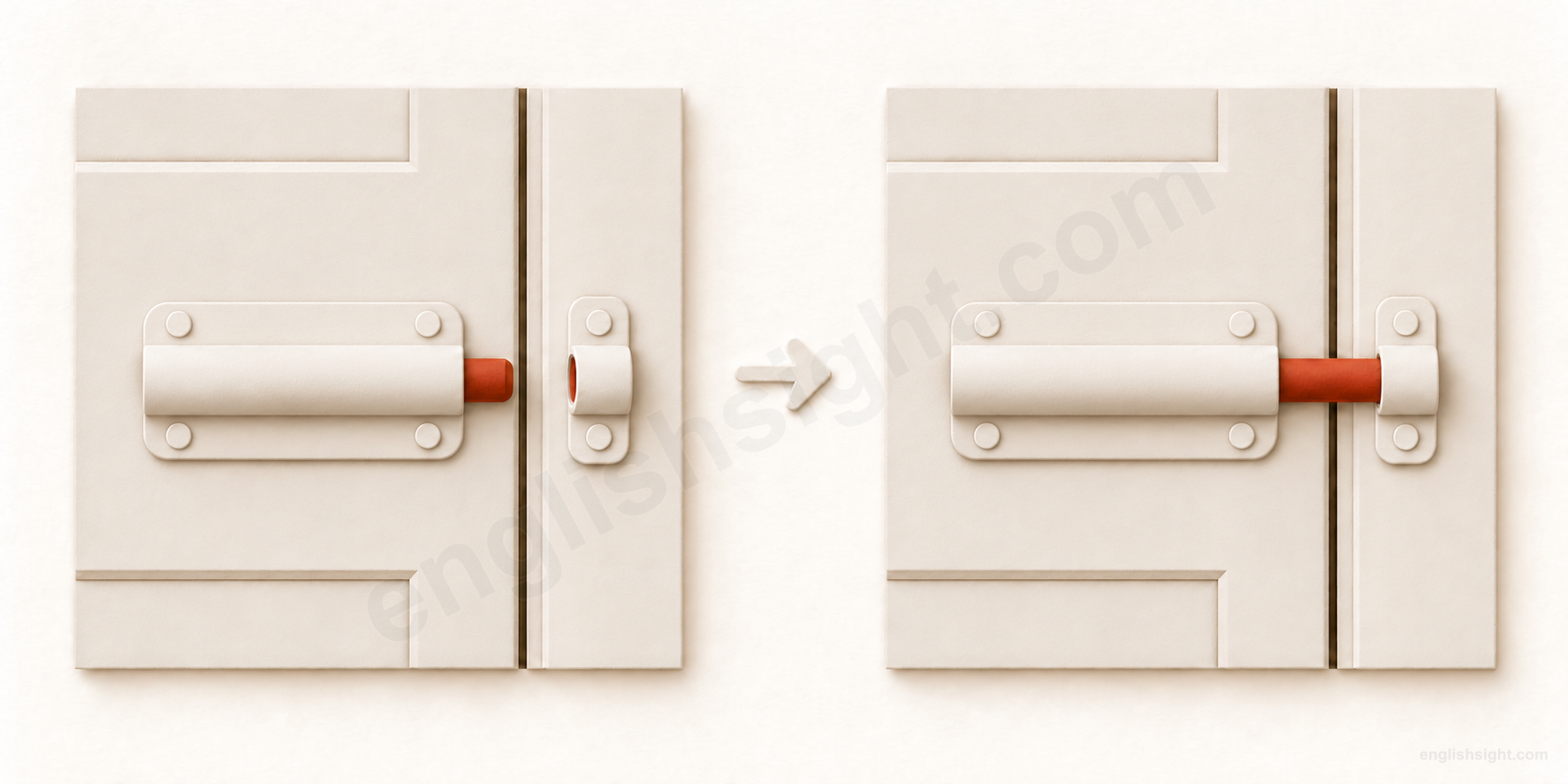
The door is closed; the bolt stops short of the keeper.
lock
The engaged bolt holds the door shut.
The bolt extends across the seam into the fixed keeper.
Locking adds a restraint against opening. This fastening model does not explain the separate hair or canal senses.
Engage a restraint so that opening, movement, access, or change is no longer free.
The sketch uses a sliding door bolt to show restraint being engaged. It supports the fastening and fixed-position family; established idioms and independent noun meanings still need their own explanations.
A lock can stop a door opening; to lock is to engage that kind of restraint. From there, English also uses lock for holding parts together, restricting access, and making a position or arrangement difficult to change.
These connections form a teaching model, not a rule that predicts every phrase. A canal lock needs a water-level explanation, and a lock of hair belongs to a separate noun branch. No single picture is shared by all English speakers.
01
Fastening and controlling access
A lock can be a device or a protective feature. The verb says you engage that protection, rather than merely close a door or switch off a display.
01
a lock on + object; change / pick / force + a lock
a lock; change the locks
a device that controls opening or use
Starting situation
A door needs protection against unwanted entry.
Result or relation
A fitted device requires the right key or code.
The noun names the fastening device, not the action of shutting the door.
Use a countable noun: a lock on the door, two locks, or the lock on my bicycle. A key operates a lock; a combination lock uses a sequence of numbers instead. A bicycle lock stops someone from easily taking or using the bicycle.
Change the locks means replace the locking devices, often so old keys no longer work. Pick a lock means open its mechanism without its proper key; force a lock means overcome it by force. These verbs describe different ways of dealing with the same device.
In a sentence
We changed the locks after a spare key went missing.
Watch the difference Say a lock on the door or the door lock; the key and the lock are different objects.
02
lock + door / window / car; object + be locked; keep + object + locked
lock the door
secure something so it cannot be freely opened
Starting situation
The door is shut, but the fastening is not engaged.
Result or relation
You engage the lock.
Closing changes the door’s position; locking adds a restraint against opening.
In Please lock the door, the person acts and the door is the object. Lock the car or lock the house can refer to securing its entrances, rather than putting a separate lock around the entire object.
A closed door may still be unlocked. She locked the door reports an action; The door is locked often describes the resulting condition. The door was locked by the caretaker explicitly presents the passive action. Keep the door locked asks for that condition to continue.
In a sentence
Please close the back door and lock it before you leave.
Watch the difference Shut and lock are not interchangeable; a door can be shut without being locked.
03
door / case + lock; will not / does not + lock
The door locks automatically.
become locked, or allow a lock to work
Starting situation
No person needs to turn a key.
Result or relation
The mechanism engages when the door closes.
The door itself can be the subject of intransitive lock.
The door locks automatically describes the mechanism’s normal behavior. The door won’t lock can mean that you cannot make its lock engage, even if the door closes properly.
Compare The door won’t open: that concerns opening, and might be caused by a working lock or by some other obstruction. The door doesn’t lock says the locking function is unavailable; it does not mean the door is always open.
In a sentence
This door locks automatically, so take your key with you.
Watch the difference Do not add an object when the subject is the thing that becomes locked.
04
lock + screen / phone / file; a security lock
lock your screen
restrict access to a device or its information
Starting situation
You leave your desk with work on the computer.
Result or relation
Other people need authorization to get back into the session.
Digital locking restricts access; it need not involve a physical key.
Lock your screen, lock your phone, and locked files extend the security idea to digital access or changes. The relevant restriction depends on the system: a file may be protected against editing, viewing, or both.
Locking a screen normally leaves the session available for an authorized user to resume. Turning off the display or closing a laptop lid does not, as a matter of language, guarantee the same security setting. Read lock as the access restriction, not as a promise that every device behaves alike.
In a sentence
I locked my screen before stepping away from the desk.
Watch the difference Lock does not automatically mean shut down, delete, or encrypt.
05
lock + object + to + anchor; with + fastening
lock a bicycle to a rack
fasten an object securely to an anchor
Starting situation
Your bicycle stands beside a fixed rack.
Result or relation
A lock holds it to the rack.
To introduces the object that serves as the anchor.
The bicycle is the thing secured; the rack is what it is secured to. This is a spatial construction with lock, not an idiom meaning that the bicycle is inside the rack.
With can name the tool: I locked it to the rack with a chain. Compare lock the bicycle in the shed: in names the enclosure. The preposition changes the relation even though both actions can protect the bicycle.
In a sentence
She locked her bicycle to the rack outside the library.
Watch the difference Use to for attachment and in for containment; do not treat them as interchangeable particles.
02
Keeping things in and people out
In, out, away, and up change the relation. Notice who is inside, who cannot enter, and whether the object is a person, a possession, or a whole building.
06
lock + object + away / up; lock away / up + noun; lock + object + in + place
lock something away / up
put something in secure storage
Starting situation
Important documents are lying within easy reach.
Result or relation
They are in a locked storage place.
The possession is the object; away or up emphasizes keeping it securely stored.
Lock the documents away and lock away the documents are both possible. With a pronoun say lock them away, not lock away them. Lock them up can carry the same storage meaning.
A place can be added: lock the documents away in a cabinet. Lock the documents in a cabinet directly names the enclosure. Away need not mean far away geographically; the important point is that the items are put out of ordinary access.
In a sentence
We lock the original documents away in a cabinet.
Watch the difference Lock away can also have people or money as objects, with different meanings taught below.
07
lock + person / reflexive pronoun + in; lock + person + in + room
lock somebody / yourself in
keep a person inside by locking the exit
Starting situation
Someone is inside a room.
Result or relation
The locked door prevents ordinary exit.
In concerns the person remaining inside, not being unable to enter.
They locked him in means they secured the exit so he could not leave. I locked myself in my room can instead describe choosing privacy; the person who locks the door and the person inside are the same.
Without the place, lock her in is a separable particle pattern. With the place, lock her in the room specifies the location. The words do not by themselves tell us whether locking was accidental or deliberate; the situation does.
In a sentence
I locked myself in my study so I could finish the recording.
Watch the difference Use myself when I perform the action affecting me; lock me in names a different actor unless the wider grammar says otherwise.
08
lock + person / reflexive pronoun + out (of + place)
lock yourself out of the house
end up unable to enter a locked place
Starting situation
You leave your keys indoors.
Result or relation
You are outside with no way to open the locked door.
Out places the affected person on the excluded side of the door.
I locked myself out usually describes an accident: my own action left me unable to get in. You can also lock someone else out deliberately. The subject’s intention is separate from the meaning of exclusion.
Use lock me out or lock me out of the house. Out can end the phrase when the location is understood; of introduces the place when you name it. Compare locked in: a person cannot get out rather than get in.
In a sentence
I locked myself out of the flat while taking the rubbish downstairs.
Watch the difference Say locked myself out of the flat, not locked out myself from the flat.
09
be / get locked out of + service / opportunity
be locked out of something
be prevented from using or joining something
Starting situation
A person wants access to an opportunity or service.
Result or relation
A barrier prevents participation or access.
A figurative locked door can exclude a person without a literal door.
People can be locked out of the job market when barriers prevent them from finding work. A user can be locked out of an account after unsuccessful password attempts. The subject is the excluded person, not the thing being stored.
In I was locked out, the passive leaves the cause unstated. My account was locked instead makes the account the subject and describes its restricted state. Neither wording alone says the restriction is permanent.
In a sentence
After several wrong passwords, I was locked out of my account.
Watch the difference Locked out describes exclusion; logged out simply describes having ended or lost a session.
10
employer + lock + workers + out; a lockout
lock workers out
exclude employees as part of a labor dispute
Starting situation
Employees and an employer disagree over working conditions.
Result or relation
The employer prevents employees from entering work.
In the labor sense, the employer imposes the exclusion.
The company locked the workers out is a specific industrial-relations use. Workers strike when they withhold their labor; an employer locks them out when it prevents them from working as pressure in a dispute.
The corresponding event noun is a lockout, normally one word. Keep the verb as two words: lock out. This sense can overlap with physical exclusion but carries the additional employment-dispute context.
In a sentence
The factory locked its workers out during the pay dispute.
Watch the difference A lockout is not simply another word for a strike.
11
lock up; lock up + building / vehicle; lock + object + up
lock up before leaving
secure a building or vehicle, or complete that task
Starting situation
The shop is closing for the night.
Result or relation
Its entrances are secured.
Up presents the securing task as a whole; it does not mean upward movement.
Can you lock up? is natural when everyone knows which premises are involved. You can also lock up the shop or lock the shop up. With a pronoun use lock it up.
This differs from lock the documents up: the shop is the place being secured; the documents are items put into secure storage. Closing a business for the day and physically locking its doors are related events, but close can describe the business schedule without saying anything about locks.
In a sentence
I will turn off the lights if you lock up.
Watch the difference Up adds no destination above the building.
12
lock + person + up / away; be locked up
lock somebody up / away
put somebody in prison or secure confinement
Starting situation
A person is free to leave.
Result or relation
The person is confined by the authorities.
With a person, up or away can mean imprisonment rather than safe storage.
They locked him up is informal wording for putting him in prison. The phrase does not itself specify the legal charge, length of imprisonment, or whether a trial has taken place.
Compare He locked himself away to work: that can describe self-chosen isolation, not prison. The object and context matter. Lock up the shop, lock up the papers, and lock up a prisoner therefore should not be learned as one undifferentiated translation.
In a sentence
The report says he was locked up for several years.
Watch the difference Put a pronoun before the particle: lock him up, not lock up him.
13
lock down; lock + area / people + down; a lockdown
lock down an area
impose strong restrictions on people’s movements
Starting situation
A dangerous situation threatens an area.
Result or relation
Movement is restricted while it is dealt with.
Down belongs to an established restriction expression, not a downward path.
Authorities may lock down an area in response to danger. The verb can also occur without an object: the area locked down. The practical rules vary with the event; the expression alone does not list them.
Lock the area down and lock it down put the object between verb and particle. The event or condition is a lockdown, one word. Lock down is broader than locking one door: it concerns restrictions across an area or community.
In a sentence
The area was locked down while the emergency was investigated.
Watch the difference Use two words for the verb and one for the noun: lock down an area; a lockdown.
03
Holding a position, connection, or commitment
A physical part can stop moving; a price, investment, or relationship can become difficult to change. The object and surrounding words distinguish these uses.
14
part + lock into place; lock + object + in / into position
lock into place
become securely fixed, or make a part stay fixed
Starting situation
A movable part is not yet secured.
Result or relation
It engages and no longer moves freely.
Lock can describe successful fixing without a key or a separate padlock.
The lid locks into place makes the part the subject. Lock the lid into place makes the person the actor and the lid the object. Into highlights the change to an engaged position; in place can describe the resulting position.
Locked is not always the same as broken or stuck. A folding mechanism can lock exactly as intended. The bolt sketch illustrates this holding relation, although real devices can use many different mechanisms.
In a sentence
Push the handle until it locks into place.
Watch the difference Do not assume every use of lock involves a key.
15
wheels / brakes + lock; locked + mechanism
The wheels locked.
stop moving freely through a locking or jamming action
Starting situation
The wheels are turning.
Result or relation
They stop rotating even though the vehicle may still slide.
An unintended lock can prevent normal movement rather than provide useful security.
The wheels locked describes a loss of rotation, not a person securing a car door. A mechanism that locks can be working as intended or failing; context decides.
This shares the fixed-position idea with a lid locking into place, but the result can be unwelcome. Do not replace locked with stopped in every context: the car stopped concerns the vehicle’s movement, while the wheels locked concerns whether its wheels could turn.
In a sentence
The wheels locked, and the car slid across the wet road.
Watch the difference Locked wheels do not imply that the whole car has already come to a safe stop.
16
computer / application + lock up
The computer locked up.
a computer or application stopped responding
Starting situation
You are working in a responsive application.
Result or relation
It freezes and no longer responds normally to input.
An unresponsive system is different from a screen deliberately locked for privacy.
My computer locked up describes an unwanted failure to respond. The computer or application is the subject, and no object is needed. Up belongs to this established failure expression; it does not describe a destination.
Compare I locked my screen: I deliberately restricted access. The computer locked up: it became unresponsive. The wording reports the symptom, not its technical cause, and does not by itself tell you whether any work was lost.
In a sentence
The application locked up while I was editing the photograph.
Watch the difference Do not assume a locked-up computer is merely waiting for a password.
17
lock + arms / fingers (together); be locked in + embrace
lock arms / fingers; be locked in an embrace
join parts closely or hold someone tightly
Starting situation
Two people or body parts are separate.
Result or relation
They form a firm connection or close hold.
The body-part construction expresses a close physical connection.
Friends can lock arms by linking their bent arms together. You can lock your fingers together by interlacing them. These are verb-plus-object constructions; arms and fingers are not particles.
They were locked in an embrace describes people holding each other closely. The embrace supplies the kind of hold; lock adds firmness. It does not say that someone used a key or that the people are unable ever to separate.
In a sentence
They locked arms and walked down the path together.
Watch the difference Lock arms names a particular physical connection; it is not a general substitute for touch.
18
be locked in / into + dispute / struggle / situation
be locked in a dispute / struggle
remain deeply involved in a hard-to-escape conflict
Starting situation
Two sides cannot resolve their disagreement.
Result or relation
They remain caught in the same struggle.
The fixed situation can be social rather than physical.
The teams are locked in a dispute says the disagreement holds them in a continuing difficult situation. In this construction the passive-like form foregrounds their condition; it need not identify a person who literally locked them there.
In or into can introduce a situation that is hard to leave. The phrase is common in reports about negotiations and conflict. It is stronger than merely discussing a subject: it suggests sustained involvement or an impasse.
In a sentence
The two departments are locked in a dispute over the budget.
Watch the difference Do not interpret in a dispute as a physical location.
19
lock in + price / rate; lock + object + in; lock + person + into + agreement
lock in a price / rate
secure an arrangement so it will not change in the specified way
Starting situation
A quoted price may change before you commit.
Result or relation
An agreement fixes the price for a stated period or purpose.
The restraint applies to a term of an agreement rather than a physical door.
Lock in a rate focuses on securing that rate against later changes under the arrangement. You can say lock the rate in or lock it in. It does not mean the rate is low; that depends on the offer.
Compare lock someone into a contract: the person is committed to terms that may be hard to leave. Lock in a favorable price can sound beneficial, while be locked into an expensive contract can sound restrictive. The object and viewpoint produce the contrast.
In a sentence
We locked in the quoted price before the offer expired.
Watch the difference Lock in does not mean that every term lasts forever; the agreement determines its scope.
20
lock in + moisture; lock + it + in
lock in moisture
help prevent something from escaping or being lost
Starting situation
Moisture can leave a surface.
Result or relation
A barrier or treatment helps retain it.
In presents something as retained within a boundary.
In product descriptions, lock in moisture means help keep moisture from escaping. The phrase applies the containment idea without requiring a literal lock.
It is the product, layer, or treatment that is said to lock something in. The expression describes the intended effect in ordinary language; it does not prove a particular product’s performance. Do not confuse moisture retention with locking in a price, which concerns an agreement.
In a sentence
The label says the cream helps lock in moisture.
Watch the difference In this use, lock in means retain, not create new moisture.
21
money / capital + be locked up / away + in + investment
money locked up / away in an investment
money not readily available to spend
Starting situation
Money is placed in assets or a long-term arrangement.
Result or relation
It cannot easily be accessed as cash.
Restricted access can concern funds rather than a container of banknotes.
Our money is locked up in the business describes funds committed there and not easily withdrawn. A bank account may similarly lock money away for a period. This is about availability, not necessarily a physical safe.
It does not automatically mean the investment has lost value. It contrasts with money that is readily available for spending. In names where the value is committed; up or away contributes the idea that ordinary access is restricted.
In a sentence
Most of their money is locked up in the family business.
Watch the difference Locked up money is not necessarily stolen, worthless, or stored as notes.
22
lock on; lock on to / onto + target
lock on / onto a target
acquire a target and keep tracking it
Starting situation
A tracking system is searching.
Result or relation
It follows a selected target.
The connection is maintained on a target rather than on a door.
A radar or tracking system can lock on to a target or lock onto it. Lock on can also stand alone when the target is already clear. The idea is maintaining a tracking relation, not preventing the target from moving.
With onto, keep the target after the preposition: lock onto it. This differs from the separable storage pattern lock it up. Technical details differ among systems; the expression itself does not explain how tracking works.
In a sentence
The tracking system locked onto the aircraft.
Watch the difference Lock onto it is the pattern; do not move it into lock it onto for this tracking meaning.
04
Established expressions
Learn these combinations as expressions. Their meanings are supported by ideas of holding, restriction, or completeness, but cannot all be predicted from a door lock.
23
lock horns with + person + over + issue
lock horns with somebody
enter an argument or contest of opposition
Starting situation
People disagree over a decision.
Result or relation
They confront each other over it.
Horns belongs to the established conflict expression; the people do not need actual horns.
Lock horns with a colleague means argue or clash with that person. Over can introduce the issue: lock horns with someone over a proposal. The animal image helps recall confrontation, but the complete expression carries the social meaning.
Compare be locked in a dispute: that describes an ongoing difficult condition. Lock horns often highlights the confrontation or the fact that two sides clash, although tense and context can describe repeated or continuing arguments.
In a sentence
I locked horns with my manager over the new timetable.
Watch the difference Use with for the opponent and over for the subject of disagreement.
24
people + lock eyes; lock eyes with + person
lock eyes with somebody
look directly into each other’s eyes
Starting situation
Two people notice one another.
Result or relation
Their gazes meet and hold for a moment.
The connection is between gazes, not a mechanism shutting the eyes.
We locked eyes and I locked eyes with her describe direct mutual eye contact. The expression can occur in an affectionate, tense, or simply noticeable encounter; it does not by itself mean romance or hostility.
Do not confuse it with close your eyes, which means shut your eyelids. The link to the fixed-connection model is a teaching comparison; the ordinary collocation, rather than the diagram, establishes how English uses eyes here.
In a sentence
We locked eyes across the room, and she smiled.
Watch the difference The expression uses plural eyes; it does not mean shut your eyes.
25
keep / put + object + under lock and key; be under lock and key
under lock and key
securely locked away, or confined in prison
Starting situation
Something must be kept out of ordinary access.
Result or relation
It is held in a secure locked place.
Under is part of a fixed expression for secure keeping or confinement.
Keep medicines under lock and key means keep them securely locked away. No specific container is named. In news or narrative, a person under lock and key is in secure confinement, often prison.
The expression is more emphatic than simply saying put away. It does not say that an object is physically underneath a lock or a key, and digital security can perform a similar function without making every use of the idiom a technical description.
In a sentence
The original records are kept under lock and key.
Watch the difference Keep the fixed singular wording lock and key, not locks and keys, in this idiom.
26
verb + object + lock, stock and barrel
lock, stock and barrel
completely, including all the parts
Starting situation
A business and its contents are being sold.
Result or relation
The whole operation changes hands.
The whole phrase means everything; it is not a list of required modern objects.
Sell a business lock, stock and barrel means sell the whole business, including its contents or assets in the relevant context. The phrase can also emphasize a complete move or takeover.
Learn it as a fixed idiom. It does not mean only the locks were sold, and stock here should not be interpreted as a requirement that the business own company shares. American writing often adds a comma before and; that does not change the meaning.
In a sentence
They sold the café lock, stock and barrel and moved abroad.
Watch the difference Do not generalize this meaning of completeness to lock used by itself.
27
be like locking the stable door after the horse has bolted
lock the stable door after the horse has bolted
take precautions only after the harm has happened
Starting situation
A preventable problem has already occurred.
Result or relation
Someone introduces the protection that was needed earlier.
The proverb criticizes the timing of a precaution, not the use of locks itself.
This British expression compares a late precaution with securing a stable after the horse has escaped. Bolted here means ran away suddenly. The lesson is about the order of events: protection comes after the loss.
It can be used figuratively for records, equipment, or other preventable problems. It does not necessarily say that precautions have no future value; it criticizes failing to take them in time to prevent the event being discussed. Learn the full saying rather than assigning the meaning too late to lock alone.
In a sentence
Buying a backup drive after losing all the files was like locking the stable door after the horse had bolted.
Watch the difference Bolted in this saying means escaped, not fastened with a bolt.
28
have a lock on + market / position / outcome
have a lock on something
have a very strong hold on an outcome or area
Starting situation
Others have little chance of competing successfully.
Result or relation
One person or organization effectively controls the position.
Here a lock is a figurative hold, not a physical fastening on an abstract object.
In North American usage, have a lock on a market or position describes strong, sometimes practically exclusive control. Have a lock on the prize can instead present winning it as very likely or assured.
This is a noun construction: have + a lock + on. Compare a tracking system locks onto a target, which is a verb pattern. Context tells you whether the hold is actual control or a confident prediction, and the speaker may still turn out to be wrong.
In American usage, They have the election locked up similarly presents victory as effectively secured. Locked up here concerns a result; it does not mean that voters or candidates are in prison.
In a sentence
One company has a lock on the local delivery market.
Watch the difference Keep a in have a lock on; this is not the verb phrase lock on.
05
Other noun meanings
A canal lock, a lock of hair, and a lock in a prediction need their own contexts. The fastening diagram is not an explanation of every noun use.
29
a lock on a canal / river; go / pass through a lock
a canal lock
a gated water chamber that raises or lowers boats
Starting situation
A boat needs to reach a stretch of water at a different level.
Result or relation
Water in a chamber changes level with the boat inside.
The noun names the chamber and gate system, not just a lock fitted to one gate.
A canal lock has gates at both ends and a controlled water level. A boat enters, the gates close, and changing the water level lets it move between higher and lower stretches of the waterway.
Use a countable noun: one lock, several locks, through the lock. This is a distinct waterway meaning. The main sketch can remind you of controlled gates, but it does not show the water-level process and should not be treated as a diagram of a canal lock.
In a sentence
Our boat waited beside the lock until the gates opened.
Watch the difference A canal lock is not a bridge, dam, or ordinary door-lock mechanism.
30
a lock of + hair; possessive + locks; locks / locs in hairstyle contexts
a lock of hair; locks / locs
a small section of hair, or a hairstyle context
Starting situation
Some hairs hang together or are kept as a small bunch.
Result or relation
You refer to that section as a lock.
The hair noun is a separate branch, not hair fastened with a key.
A lock of hair is a small group of hairs lying or hanging together. It can also be a cut piece kept as a memory. A strand can be one hair, whereas a lock normally refers to a small section rather than a single hair.
Locks can mean someone’s hair collectively in literary descriptions such as her dark locks. In hairstyle contexts, locks or locs can refer to rope-like sections of hair and the hairstyle formed from them. Ordinary a lock of hair does not necessarily refer to that hairstyle.
In a sentence
She tucked a loose lock of hair behind her ear.
Watch the difference Do not infer that every lock of hair is a loc, or explain the hair sense as a security device.
31
be a lock to + verb; be a lock for + award / selection
be a lock to win
be regarded as certain to succeed
Starting situation
People are predicting a competition’s result.
Result or relation
They treat one candidate as a sure winner.
The noun describes confidence in an outcome, not a guarantee issued by an authority.
In informal North American English, She is a lock to win means people regard her as certain or very likely to win. A lock for the award similarly names an expected winner or selection.
This differs from a canal lock or a lock of hair. It relates more closely to having a firm hold on an outcome, but the expression reports a judgment: an unexpected result can still overturn the prediction.
In a sentence
The commentators called her a lock to win the final.
Watch the difference This informal prediction is not literal proof that the outcome cannot change.
32
on / at full lock; from lock to lock
on full lock
with a vehicle’s steering turned as far as it can go
Starting situation
A driver turns the steering wheel to maneuver.
Result or relation
The front wheels reach the limit of their turning angle.
British driving usage concerns steering angle, not a car door’s security.
On full lock means with the steering turned fully to one side. You may read it in British driving instructions or vehicle reviews. Turning from lock to lock covers the full steering range from one extreme to the other.
Contrast The wheels locked in the mechanical entry: that describes wheels unable to rotate freely. Full lock concerns how far the steering turns them left or right; it does not say the wheels have stopped rolling.
In a sentence
The steering was on full lock as we eased out of the narrow space.
Watch the difference Full lock and locked wheels describe different kinds of movement.
Check the object, the construction, and the context
Forms and sounds
The forms are lock, locks, locked, locking. Locked ends in /t/: /lɒkt/ in British English and /lɑːkt/ in American English. Is locking describes an action in progress; is locked often describes a resulting state. Unlock means release a lock, not simply open a door that was never locked.
Particles and prepositions do different jobs
Use lock it up / away / in / out / down in the relevant separable patterns, not lock up it. In lock it in the safe, in introduces the storage place. In lock onto it, onto keeps its following object. Learning the whole pattern is more useful than treating every small word as the same kind of particle.
Grammar can add the person who arranges the task
I had the locks changed means I arranged for someone to replace them. I got locked out describes becoming excluded, often accidentally. Neither is a new dictionary sense of lock. Lock does not normally take a person plus to-infinitive to mean persuade them; use a suitable verb such as persuade or ask.
Coverage boundary
This lesson selects current useful senses and recognizable expressions, without a frequency ranking. Rugby positions, wrestling techniques, firearm mechanisms, specialist engineering and printing uses, pub lock-ins, and extended security terminology need additional context and are not developed here.
Choose the relation
Look at the object and the surrounding words before choosing.
1. The door is shut, but anyone can turn the handle and enter. Which description fits?
2. You left your keys indoors and cannot enter your flat. What happened?
3. You want to store important papers in a locked cabinet. Which pronoun pattern is standard?
4. A seller agrees to keep today’s quoted price for your purchase. Which sentence describes securing that term?
5. Their money is locked up in property. What is the main point?
6. Someone brushes a lock of hair away from her forehead. What is the lock?
7. A British driving description says the steering is on full lock. What does it tell you?
Sources and teaching notes
Dictionary meanings and constructions were checked against the sources below. The lesson’s explanations and example sentences are original. The diagram is a teaching model; the Collins collocation pages supply usage evidence rather than separate definitions.
The diagram illustrates a useful relation; it is not a picture shared by every English speaker.