Explore physical length, time, useful extensions, and the separate verb of strong desire.
Extent between two ends
Extent between two ends
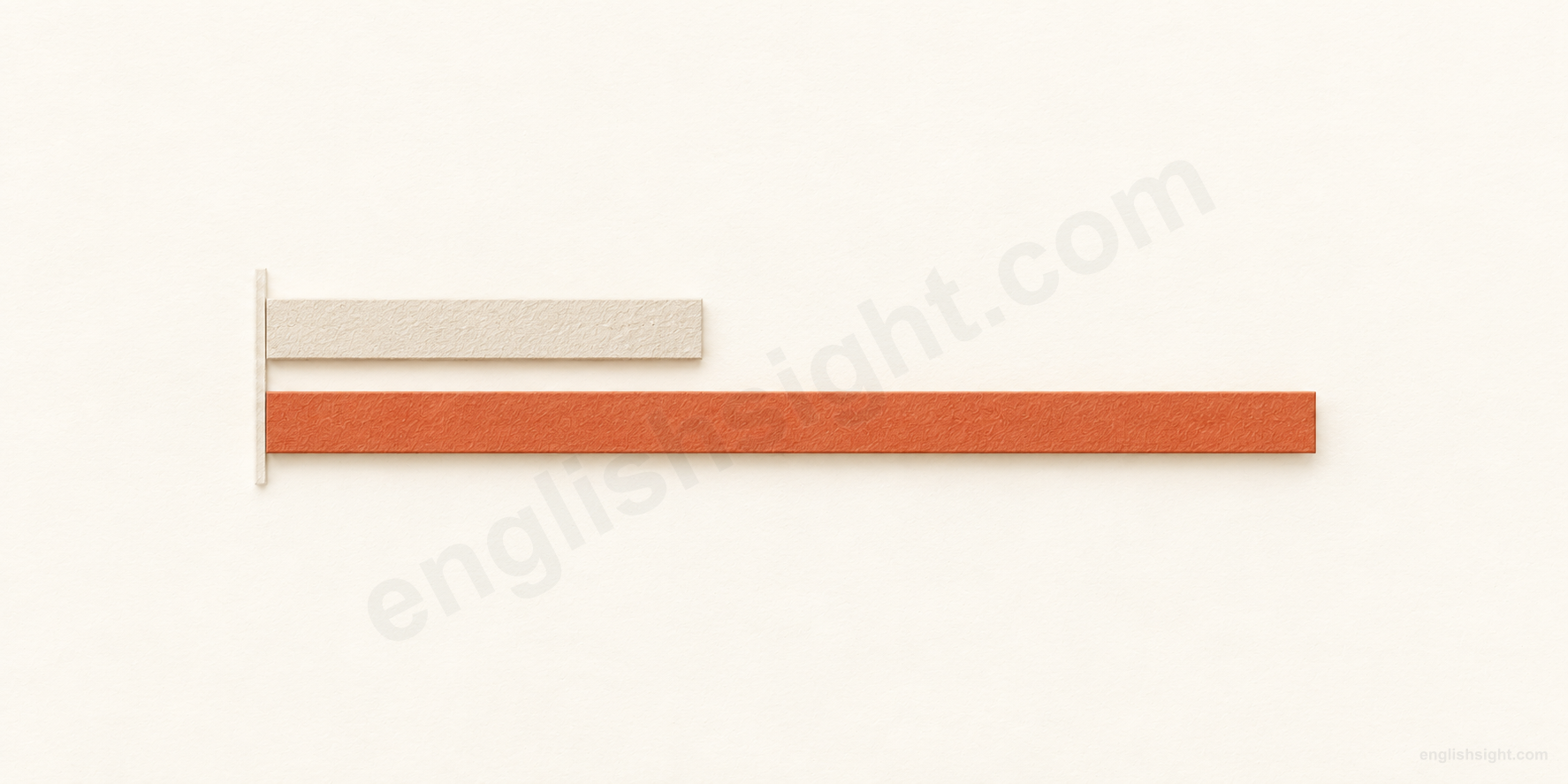
A short upper strip provides a reference.
long
The lower orange strip has a greater end-to-end length.
Compare the span from the shared left edge to each right end.
Long concerns an end-to-end span in space or time. Here the lower strip is longer; this is a comparison, not growth.
Long directs attention to an end-to-end span in space or from beginning to end in time; without an exact measurement, the relevant standard comes from context.
The two strips compare extent. Neither strip grows or moves. The model helps connect spatial length and duration; it does not independently explain a long shot, a long face, or the verb of desire.
Long often asks us to consider a span: how far something extends or how much time passes between its beginning and end. It can compare that span with what is usual, or simply give its measurement.
The diagram offers a teaching model for extent, not a claim about a picture shared by all English speakers. Fixed expressions need their own explanations, and the verb long for is taught as a distinct branch.
01
Physical length, distance, and comparison
Choose the dimension: end-to-end length, a route, or the extent of a text. Exact measurements do not automatically mean unusually large.
01
long + noun; subject + be + long
a long rope / long hair
a large distance from one end to the other
Situation / reference
You compare ropes for tying a load.
Meaning in context
One rope reaches much farther than another.
Long describes extent along the object, not its total size.
A rope can be long and thin. A box can be long but narrow. Long selects the end-to-end dimension; big gives a broader judgment about size.
The relevant direction depends on the object: long hair hangs down, and long sleeves cover more of the arms. A long skirt reaches farther down the legs. No movement or stretching event is required.
For a person’s overall height use tall in ordinary descriptions: a tall woman with long arms. Long is natural for individual body parts.
In a sentence
We need a long rope, but it must fit through this narrow hole.
Watch the difference Long and tall are not interchangeable descriptions of a person.
02
be + number + unit(s) + long; a + number-unit-long + noun
two metres long / how long?
state or ask for an exact length
Situation / reference
You measure a shelf before buying it.
Meaning in context
Its length is two metres.
A measurement plus long can be neutral about whether the object is unusually long.
Two metres long reports a dimension. It does not automatically mean very long for a shelf. How long is the shelf? asks for that dimension; How wide? asks across it.
Put the unit phrase before long after be: The shelf is two metres long; this ruler is one metre long. The unit agrees with the number. Before a noun use a compound modifier with a singular unit: a two-metre-long shelf. American spelling uses meter.
In a sentence
The shelf is two metres long, so it will not fit in the car.
Watch the difference Use a two-metre-long shelf, not a two-metres-long shelf.
03
longer than; the longest; (number times) as long as
longer than / as long as
compare lengths or durations
Situation / reference
You have an old cable and a replacement.
Meaning in context
You compare their lengths.
Comparison concerns the chosen dimension, whether physical length or time.
Use longer and longest for the usual comparison: This cable is longer than that one. The longest cable identifies the maximum in the relevant set. Much longer, a little longer, and twice as long make the comparison more precise.
As long as the old one compares equal length here. With a meeting or a wait, the same comparison concerns duration: The second call lasted twice as long. This is different from conditional as long as you agree.
In a sentence
The new cable is twice as long as the old one.
Watch the difference Use much longer, not much more long.
04
a long way from + place; take the long way (round / around)
a long way / the long way round
a considerable distance or a less direct route
Situation / reference
A direct path is blocked.
Meaning in context
You take a route covering more distance.
Long describes the extent of a journey or route, not necessarily its speed.
A long walk, drive, or flight can cover substantial distance and usually takes time too. A long way from the station says that a place is far from it. Ordinary conversation usually prefers a long way to a long distance in this pattern.
The long way round means the longer, less direct route; American English also uses the long way around. We took the long way home can be deliberate, perhaps for the view, rather than a mistake.
Long-haul describes transport over a great distance: She is tired after a long-haul flight. Compare a long flight, which can simply emphasize how much time it took.
In a sentence
The bridge was closed, so we took the long way round.
Watch the difference A long journey can be fast; long and slow do not mean the same thing.
05
long + list / book / report; be + number + pages long
a long list / a long book
many items or a substantial amount of content
Situation / reference
You open a repair report.
Meaning in context
There are many faults to work through.
Length can concern the extent of a text or sequence.
A long list contains many entries; a long book has substantial content and takes time to read. A report that is ten pages long has a specified extent, whether or not ten pages is unusual.
A list as long as your arm is informal exaggeration for a very long list. You do not measure the list against someone’s real arm. The expression adds emphasis rather than an exact unit.
In a sentence
The caretaker gave us a long list of repairs.
Watch the difference A long list concerns the number or extent of entries, not the duration of each repair.
02
How much time?
Use long for duration, then distinguish a plain statement, a question, a limit, and emphasis on a whole period.
06
a long time; long + period / event; work long hours
a long time / long hours
a substantial period or more hours than usual
Situation / reference
You work from early morning until late evening.
Meaning in context
The work occupies a large part of the day.
Time has a beginning and an end, just as an object has two ends.
A long wait, a long silence, and a long holiday describe duration. The standard for long depends on the activity: a long pause in a conversation may last only seconds.
Work long hours means work for many hours, often more than usual. A long day can also express how tiring or difficult the day felt; it need not contain more than twenty-four hours.
A long memory is an established extension: someone remembers events far back in the past, sometimes especially a hurt or offence. It does not mean a single act of remembering lasts a long time.
In a sentence
I am tired because I have been working long hours this week.
Watch the difference Do not infer an exact number of minutes or hours from long alone.
07
how long + question; be + time measurement + long
How long does it take?
ask about duration rather than a point in time
Situation / reference
You need to plan time for a task.
Meaning in context
You ask how many minutes or hours it requires.
How long measures an interval; when locates an event.
How long does the repair take? asks for a duration. When will it be ready? asks for a completion time. How long have you lived here? asks about time from the move until now.
The course is six weeks long describes the course with an adjective. The course lasts six weeks expresses duration with last; long is optional there. Before a noun write a six-week-long course.
In a sentence
How long will it take to copy these files?
Watch the difference An answer such as About ten minutes gives duration; At ten o’clock gives a time.
08
(not) + verb + (for) long; verb + (for) a long time
wait long / for a long time
choose a natural way to describe duration
Situation / reference
You ask whether someone has been waiting.
Meaning in context
You learn whether much time has passed.
Bare long is especially natural in questions and negative clauses.
Have you been waiting long? and I did not wait long are ordinary conversational patterns. In a plain positive statement use I waited a long time or I waited for a long time; I waited long sounds marked or literary.
Bare long is possible with modifiers and comparisons: I waited too long; We stayed longer; I cannot stay that long. Formal writing can also put long before a main verb, as in They have long supported the plan.
Negative scope matters: I have not been here long normally means I arrived recently. I have not been here for a long time can mean that my last visit was long ago. Context and emphasis help distinguish these readings.
In a sentence
Have you been waiting long? I could not find the entrance.
Watch the difference Prefer We stayed for a long time to the unmodified positive We stayed long.
09
long enough to + verb; too long (to + verb); so long (that + clause)
too long / long enough / so long
judge time or length against a need or expectation
Situation / reference
You choose a cable to connect two devices.
Meaning in context
It reaches both devices without falling short.
Enough sets a minimum; too marks excess; so marks degree.
The cable is long enough to reach describes sufficient physical length. We waited long enough to hear the answer describes sufficient time. Enough follows long, while too and so precede it.
Too long means more length or time than is suitable, not merely very long. The meeting was so long that we missed dinner describes degree and a consequence. It took so long can express surprise or irritation without a following that-clause.
You can leave out a repeated activity: I cannot wait that long means I cannot wait for the amount of time just mentioned.
In a sentence
The cable is long enough to reach the printer.
Watch the difference Say long enough, not enough long; very long does not itself mean excessively long.
10
all + time noun + long; the whole + time noun + long
all day long
emphasize the whole period
Situation / reference
The rain starts early and continues until evening.
Meaning in context
You emphasize how much of the day was rainy.
Long after the time phrase reinforces duration across that period.
All day long and the whole night long emphasize the entire relevant period. Depending on the activity, this may mean continuous action or repeated action: The phone rang all morning long need not mean one uninterrupted ring.
Compare a long day: that evaluates a day as tiring or time-consuming. All day long tells us how the activity fills the day.
In a sentence
The children kept asking about the trip all day long.
Watch the difference Do not interpret repeated activities as necessarily occurring every second.
03
Time relationships and conditions
Word order and the whole construction decide whether an event is soon, far in the past, finished, continuous, or conditional.
11
before long; not be long; it is / was not long before + clause
before long / it will not be long
something happens soon or after a short wait
Situation / reference
You are waiting for the bus.
Meaning in context
You expect it to arrive soon.
The whole expression points to a short interval before an event.
Before long means soon, including soon after a past reference point: Before long, everyone knew her name. It does not mean a long time before something.
I won’t be long usually means I will return, finish, or be ready soon; the context supplies the action. It wasn’t long before the room filled up similarly says that little time passed first.
The bus will be here before long is reassuring, but it gives no exact arrival time.
In a sentence
I will not be long; I just need to collect my coat.
Watch the difference Before long means soon; long before means much earlier than a reference event.
12
long before / after + noun or clause; long ago; have / had long since + past participle
long before / long after / long ago
place events far apart in time
Situation / reference
The museum opened in 1950; the town existed much earlier.
Meaning in context
You emphasize a large gap between the events.
Long measures temporal separation around a reference point.
Long before the museum opened places something much earlier than its opening. Long after closing time places it much later. These phrases need a stated or understood reference point.
Long ago looks back from now; not long ago means quite recently. Long since commonly appears with a perfect construction: They had long since left when we arrived means their departure was much earlier.
The letter is long overdue means it should have arrived or been written much earlier. Long gone says someone or something has been gone for a considerable time. These are descriptions, not instructions to wait.
In a sentence
The shop had closed long before we reached the village.
Watch the difference Keep the word order: long before the meeting is not before long.
13
no longer + main verb; be + no longer; negative clause + any longer
no longer / not any longer
a previous situation has stopped being true
Situation / reference
A shop used to offer free delivery.
Meaning in context
It now charges a delivery fee.
The phrase contrasts an earlier continuing situation with its ending.
The shop no longer offers free delivery means that its earlier policy has ended. Put no longer before an ordinary main verb, after be, or usually after the first auxiliary: It is no longer free; They can no longer deliver here.
The shop does not offer free delivery any longer gives the same change with a negative verb and any longer at the end. Do not add not to no longer in ordinary standard English.
Compare I did not wait long, which says the wait was short. I could not wait any longer says I could not continue waiting beyond that point.
In a sentence
This shop no longer offers free delivery.
Watch the difference Do not say does not no longer offer when you mean the service has stopped.
14
(for) as long as + clause; as long as possible
stay as long as you need
continue for the time required or allowed
Situation / reference
A guest needs a place to work.
Meaning in context
You allow the guest to stay for the necessary period.
The as…as construction can set duration by another situation.
Stay as long as you need means stay for the amount of time you need. For as long as I can remember extends a statement across the period covered by your memory.
As long as I live can mean throughout my remaining life. In real sentences duration and condition can overlap: I will help as long as you need me can mean both while the need continues and on that condition. Read the surrounding situation.
In a sentence
You can use this room for as long as you need it.
Watch the difference Not every as long as introduces a condition; it can compare or specify duration.
15
main clause + as / so long as + clause
as long as / so long as
set a condition or relevant continuing circumstance
Situation / reference
A friend wants to borrow your bike.
Meaning in context
You agree on a condition about its return.
Conditional as long as is learned as a whole connective.
You can borrow it as long as you bring it back tonight makes returning it a condition of permission. So long as can replace as long as in this conditional use; it is not a measurement of the borrowing period.
For a future condition, the ordinary pattern uses a present form in the as-long-as clause: I will come as long as the roads are clear. The main clause can describe a future action.
As long as you are here, could you check this? can instead take your presence as a given circumstance, close to since you are here. Context decides whether the speaker is imposing a condition or using an existing situation as a reason.
In a sentence
You can borrow my bike as long as you bring it back tonight.
Watch the difference Do not translate conditional as long as as a comparison of lengths.
16
at long last + clause; clause + at long last
at long last
an awaited event finally happens
Situation / reference
A replacement part has been delayed repeatedly.
Meaning in context
It finally arrives.
Long highlights the wait that precedes the result.
At long last adds a feeling of relief, impatience, or frustration to finally. The focus is the end of a wait, not simply the last item in a sequence.
Put it before or after the clause as needed: At long last, the parts arrived; The parts arrived at long last. Ordinary at last has a similar meaning with less explicit emphasis on the length of the delay.
In a sentence
At long last, the replacement part arrived.
Watch the difference At long last concerns eventual arrival; before long predicts or recounts a short wait.
04
Progress, resources, and evaluation
These established extensions compare development, usefulness, or future consequences with an extended span. Learn their full patterns.
17
in the long run / term; long-term + noun; take the long view
in the long run / long-term
consider later consequences over an extended period
Situation / reference
A durable tool costs more today.
Meaning in context
You compare its costs over years of use.
The relevant span extends beyond the immediate result.
In the long run asks how things work out after time has passed. In the long term similarly places attention on an extended future period. Neither expression guarantees a good outcome.
A long-term plan is a plan for an extended period. Compare a long meeting, which simply occupies much time. To take the long view is to judge a decision with future consequences in mind; to play the long game is to pursue eventual success rather than immediate rewards.
In a sentence
The stronger tool costs more now but should save money in the long run.
Watch the difference Use in the long run, not on the long run, for eventual consequences.
18
have come a long way (since…); have a long way to go (before…)
come a long way / have a long way to go
describe progress made or progress still needed
Situation / reference
You compare a learner’s first recording with a recent one.
Meaning in context
You notice substantial improvement.
A journey supplies a metaphor for development, not a literal trip.
You have come a long way recognizes substantial progress from an earlier stage. You still have a long way to go says much more development is needed before reaching the goal.
These can both be true: The team has come a long way, but it still has a long way to go. Be careful with tone when telling someone they have far to go; it can sound discouraging without context.
A long haul describes a task or journey requiring much time and effort: Learning to read again after the injury was a long haul. Here the journey image emphasizes sustained effort, rather than simply the amount of progress already made.
In a sentence
Your pronunciation has come a long way since January.
Watch the difference Come a long way can be literal in travel; the subject and context identify the progress metaphor.
19
a little / a small amount of + noun + goes a long way
a little goes a long way
a small amount provides substantial use or effect
Situation / reference
A cleaning product is highly concentrated.
Meaning in context
A small amount cleans a large surface.
The metaphor connects a small resource with a large reach.
A little of this cleaner goes a long way means little is needed for useful results. Money goes a long way when it buys a lot or lasts well; the phrase does not promise that every budget will be sufficient.
A little kindness goes a long way applies the same expression to a helpful effect on people. Context identifies what benefit or coverage the resource provides.
In a sentence
Use just a drop; a little of this cleaner goes a long way.
Watch the difference This use concerns effectiveness or economical use, not necessarily movement or elapsed time.
20
go a long way towards / toward + noun or -ing
go a long way towards doing
make a substantial contribution to a goal
Situation / reference
A project is behind schedule.
Meaning in context
Extra help reduces the remaining work.
Towards identifies a goal; the expression does not claim complete success.
The donation goes a long way towards repairing the roof means it contributes substantially to that work. It may still leave a funding gap.
Towards is a preposition, so use a noun or an -ing form: towards the repairs; towards repairing the roof. Toward is also standard, especially in American English.
In a sentence
These extra volunteers will go a long way towards finishing the work on time.
Watch the difference A substantial contribution is not a guarantee that the entire goal will be achieved.
21
comparative / superlative + by a long way; not by a long shot
by a long way / not by a long shot
emphasize a large difference or reject a near comparison
Situation / reference
You compare two routes by travel time.
Meaning in context
One route is much quicker.
An imagined distance can express a margin between results.
This route is quicker by a long way emphasizes a large difference. This is the cheapest by a long way can compare one option with a whole set.
Not by a long shot means not nearly or certainly not: Is the work finished? Not by a long shot. British English also uses not by a long chalk. These are emphatic informal expressions, not statements about firing a weapon.
In a sentence
This route is quicker by a long way.
Watch the difference A long shot means an unlikely attempt; not by a long shot means not nearly or not at all.
22
people + go back a long way
go back a long way
have known someone for many years
Situation / reference
You meet an old friend at a reunion.
Meaning in context
You explain that your friendship began years ago.
Back connects the present relationship to a distant past.
We go back a long way usually means we have known each other for a long time. It can explain familiarity, loyalty, or shared memories without giving a date.
Compare We went a long way back along the road, which describes literal travel. The fixed relationship expression commonly has people as its subject and uses the present simple.
In a sentence
Nora and I go back a long way; we met at school.
Watch the difference Go back a long way does not necessarily mean the people are old; the span is relative.
23
be long on + noun (but short on + noun)
long on ideas, short on details
have plenty of one quality but little of another
Situation / reference
A proposal makes many promises.
Meaning in context
You find very little explanation of implementation.
Long on is an informal pattern of abundance, often in contrast with short on.
The proposal is long on promises but short on detail criticizes an imbalance. Promises are plentiful; practical detail is limited. The adjective is followed by on plus a noun.
This is an established evaluative use. It does not say the written word promises is physically long, and the abundant quality need not be admirable.
In a sentence
The proposal is long on promises but short on practical detail.
Watch the difference Keep on in this pattern; long for means strongly desire.
24
think long and hard about + noun; take a long, hard look at + noun
think long and hard / take a long, hard look
consider something carefully before deciding
Situation / reference
You receive a job offer in another country.
Meaning in context
You consider its consequences seriously.
Extended attention supports a careful assessment.
Think long and hard about something combines duration with careful thought. It does not mean that the issue is physically hard.
Take a long, hard look at the figures can mean examine them critically and thoroughly, not merely stare at a page. The object may be a plan, a habit, or a problem rather than something literally visible.
In a sentence
We need to think long and hard about moving abroad.
Watch the difference These expressions recommend serious thought; they give no exact thinking time.
05
Idioms and social formulas
A long story, a long face, and a long shot perform different jobs. Their meanings cannot be predicted from the adjective alone.
25
it is a long story; to cut / make a long story short; the long and the short of it is…
It is a long story / long story short
manage how much of an explanation to give
Situation / reference
Someone asks why you changed jobs.
Meaning in context
You decide whether to give the background or only the outcome.
The whole expression controls the amount of explanation.
It’s a long story can signal that the reasons are complicated and you would rather not explain them now. It need not be a promise to tell a lengthy story later.
To cut a long story short is common in British English; to make a long story short is the usual North American form. Informal long story short introduces a compressed result: Long story short, we missed the train.
The long and the short of it is… introduces the essential facts or conclusion. Learn the complete expression; long and short alone do not carry this conversational function.
In a sentence
To cut a long story short, we missed the train and stayed another night.
Watch the difference It’s a long story may politely postpone an explanation rather than actually begin one.
26
have / wear / pull a long face; why the long face?
a long face
an unhappy or disappointed expression
Situation / reference
A match has just ended badly for someone.
Meaning in context
Their expression shows disappointment.
This fixed expression describes mood, not face measurements.
Why the long face? is an informal way to ask why someone looks sad or disappointed. It can sound friendly or teasing depending on the relationship and tone.
He had a long face after the result describes how he looked emotionally. A physically long face is also possible in a description of appearance; context decides which meaning is intended.
In a sentence
Why the long face? Did your team lose?
Watch the difference Do not assume someone’s facial shape tells you their mood.
27
be a long shot; it is a long shot, but + clause
a long shot
an attempt or possibility with little chance of success
Situation / reference
You try an unlikely source for a missing ticket.
Meaning in context
You recognize the chance is small but decide to try.
The idiom evaluates likelihood, not the duration of an attempt.
It’s a long shot, but… acknowledges that success is unlikely before proposing an attempt. It can apply to a guess, an application, or a possible explanation.
The phrase does not mean impossible. Compare It’s not worth trying, which discourages action more directly. A long-distance shot in sport and a camera long shot showing a subject from a distance are separate uses.
Long odds means that an outcome is considered unlikely, especially when discussing betting or chances: The team won despite the long odds against it. Odds, rather than elapsed time, supplies the context.
In a sentence
It is a long shot, but the café may still have your umbrella.
Watch the difference A long shot is unlikely; not by a long shot means not nearly.
28
Long time no see!; So long!
Long time no see! / So long!
greet an old acquaintance or say goodbye informally
Situation / reference
You meet someone you have not seen for months.
Meaning in context
You acknowledge the gap in contact.
These are fixed social formulas, not productive grammar models.
Long time no see! is a familiar informal greeting after a period without meeting. Its unusual word order is part of the fixed expression; it is not a pattern for building other sentences.
So long! is an informal goodbye. In contrast, Why did it take so long? uses so long to describe a large amount of time. The standalone farewell is recognized from the situation and intonation.
In a sentence
Long time no see! How have you been?
Watch the difference Use these with an appropriate informal tone; do not use So long! to mean See you in a long time.
29
Long live + person / institution / ideal!
Long live…!
express a wish for continued life or success
Situation / reference
A crowd celebrates a valued institution.
Meaning in context
They express hope that it will continue.
The fixed wish construction is separate from the verb long meaning desire.
Long live the library! expresses hope that the library will continue to exist and thrive. The phrase can celebrate a person, institution, or ideal.
Live is the verb in this formula; long concerns duration. The order is conventional, so do not treat it as an ordinary statement with subject first. It is emphatic and often ceremonial or playful.
In a sentence
Long live our community library!
Watch the difference This is a wish, not a prediction that the institution will survive.
06
The verb: a strong wish
Long for and long to describe emotional desire. Keep this verb branch distinct from the adjective and adverb of extent.
30
person + long for + person / thing
long for someone / something
feel a strong, often emotional desire for someone or something
Situation / reference
You have been away from home for months.
Meaning in context
You strongly wish for familiar company and surroundings.
The verb describes a desire, not a measurement of time.
Long for home, peace, or a friend expresses strong, often emotional desire. The desired thing may be absent or difficult to obtain. It need not be physically far away.
The person experiencing the desire is the subject. For introduces what is wanted: She longs for quiet. Unlike want, long does not ordinarily take a direct object in this meaning.
The length diagram is only a memory association here: desire can feel like reaching beyond the present situation. That metaphor is not a rule proving this verb’s meaning or predicting every use.
In a sentence
After months abroad, I longed for the familiar sounds of home.
Watch the difference Say I long for peace, not I long peace.
31
long to + verb; long for + person / thing + to + verb
long to do / long for someone to do
strongly want an action or situation to happen
Situation / reference
You are separated from your family.
Meaning in context
You strongly wish to see them again.
The complement identifies whose action is desired.
I long to see them makes I the understood subject of see. I long for them to visit makes them the subject of visit. For is needed before the other person in the latter pattern.
I’m longing to see them is natural: this emotional verb can occur in the progressive. The forms are long, longs, longed, longed, and longing. These are verb forms, while longer and longest compare the adjective or adverb.
Compare I want to leave, a neutral statement of a wish, with I long to leave, which emphasizes strong feeling. Long for and long to are complement patterns, not a family of separable particle verbs.
In a sentence
I am longing for my family to visit.
Watch the difference Do not say I long them to visit; use I long for them to visit.
Choose the sense and the whole pattern
Long, tall, far, and slow
Long normally measures an object along its length or an event in time. Tall is usual for a person’s height; far describes distance in patterns such as How far is it? A long journey is not automatically a slow one.
Adjective, adverb, and verb
The adjective and adverb compare as long, longer, longest. The verb of desire has longs, longed, and longing. Adjectives and adverbs have no passive or causative forms; the desire verb is intransitive in the patterns taught here. Use lengthen or make something longer for increasing length or duration.
A model with limits
An extended span helps organize length, time, and some metaphors. It cannot generate the meanings of every idiom. These are selected modern common uses, not an exhaustive inventory or a frequency ranking.
Specialist uses
Sport can use long for a shot travelling far or beyond the boundary. Pronunciation teaching uses long vowel in technical ways; it is not always just a sound held longer. Financial long positions, verse, clothing-size nouns, and archaic long meaning belong are outside this general lesson.
Choose the intended meaning
Read the complete pattern and identify length, duration, a condition, or desire.
1. You expect a reply soon. Which sentence says that?
2. Your friend may use your bike only if they return it tonight. Which meaning fits as long as?
3. The shop used to open on Sundays, but that policy has ended. Which sentence fits?
4. You want a neutral positive statement describing a lengthy wait. Which is the ordinary choice?
5. You strongly want your sister to visit. Which pattern is correct?
6. A plank is two metres long. What does this necessarily tell you?
Sources and teaching notes
The dictionary pages below were read to check senses and constructions. Explanations and examples are original; the span diagram is a teaching interpretation.
The diagram is a teaching model for extent, not an image shared by every native speaker.