Follow look from chosen visual attention to search, judgment, and familiar expressions.
Directed visual attention
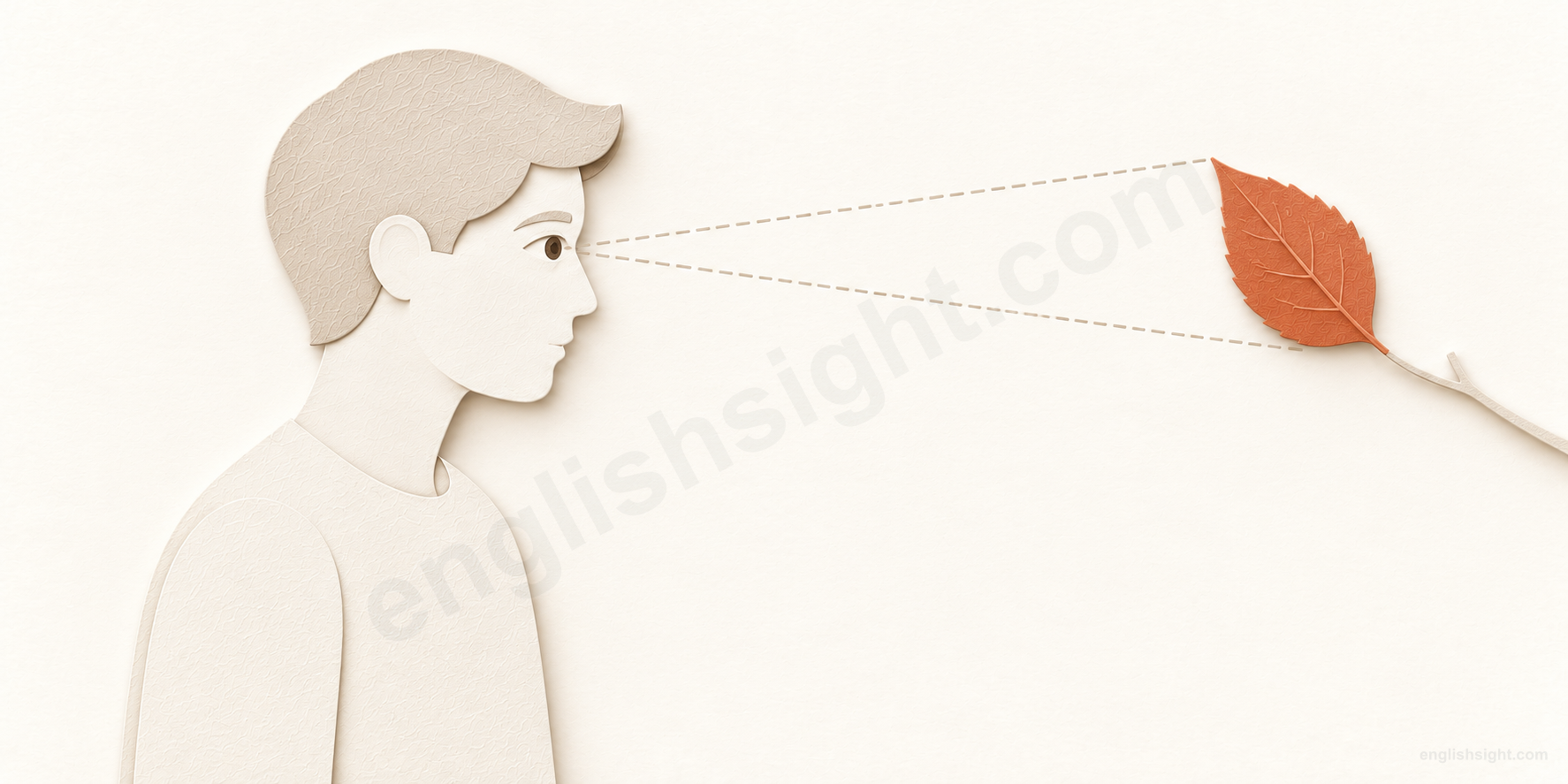
A person directs their eyes toward a target
A person and a stationary leaf are separate.
look
The leaf is the focus of the person's gaze.
The person directs their eyes toward the leaf.
Look directs the eyes toward a target; the dashed lines mark gaze, not movement.
To look is to direct your eyes toward something; in the appearance construction, the subject instead presents an impression to an observer.
The diagram illustrates deliberate visual attention. It does not show that the observer has understood the target, and it does not encode the separate meanings of every fixed expression.
In Look at the tree, a person directs their eyes toward a target. In The tree looks healthy, the tree presents an appearance to an observer. Keep those two sentence roles distinct before exploring the combinations.
The visual relationship is a useful starting point for learning, not a formula that generates every meaning. Expressions such as look after and look forward to have established meanings and grammar of their own.
01
Directing your eyes and attention
Start with a person choosing where to look. A direction, an object after at, or an instruction tells you where attention goes.
01
look; look at + person / thing; look + person + up and down
look at something
turn your eyes toward a target
Situation / intention
A small bird lands near the window.
Action / interpretation
You choose to direct your eyes toward it.
The person looks; at names the target.
The diagram shows the deliberate direction of the eyes. Look can stand alone when the target is obvious. At supplies a person or thing: look at the bird, look at me.
Looking is an activity; seeing is perceiving something. You can look for a bird without seeing it. Watch usually suggests sustained attention to movement or developments: watch the bird building a nest.
A fixed scanning pattern allows a direct person object: She looked me up and down before commenting on my muddy clothes. It means she examined my appearance from head to foot, often carefully or critically. Keep the order look + person + up and down; this does not make ordinary look me a substitute for look at me.
In a sentence
Look at the bird on the wall.
Watch the difference Keep at before an ordinary target: look at me, not look me.
02
look + direction; look + direction + at + target
look up / down / away / back
direct your eyes in a particular direction
Situation / intention
You hear a sound above you.
Action / interpretation
Your gaze turns upward.
The direction word tells you where the eyes turn.
Up, down, away, back, and out can give a literal direction. She looked away means she turned her eyes away; She looked back at the door means she turned to see something behind her.
Look out of the window directs the eyes through an opening. Look up at the ceiling is literal; look up a word is an established information-search expression. The following grammar and object distinguish them.
In a sentence
I heard a noise and looked up at the landing.
Watch the difference Literal look up has no information object between look and up.
03
building / window + look (out) over / onto + place
look out over / onto
face a place or offer a view
Situation / intention
The kitchen window faces the yard.
Action / interpretation
The yard is visible from that window.
A building or window faces outward; it has no eyes.
With a room, house, or window as subject, look can describe its orientation or view. Our window looks onto the yard means it faces that space.
This is a spatial extension of the visual relationship. Compare We look out of the window, where people actually direct their eyes through it. Out over often introduces a broad view.
In a sentence
Our kitchen window looks onto a small yard.
Watch the difference Do not interpret the window as an observer performing an action.
04
Look!; Look, + clause; look what / how + clause
Look! / Look, … / look what…
draw someone’s attention to a sight or a point
Situation / intention
You need another person to notice something.
Action / interpretation
You bring the sight or your argument to their attention.
An attention signal can ask for noticing or for listening.
Look! can introduce something visible. Look at the time! draws attention to lateness. Look what happened last time directs attention to evidence, even when that past event cannot now be seen.
At the start of speech, Look, we need more time asks the listener to attend to a point. It can sound firm, impatient, or explanatory. Tone and context matter; it is not automatically a polite request.
In a sentence
Look, we need more time to check these figures.
Watch the difference A conversational Look does not necessarily ask someone to turn their eyes.
05
look for + person / thing; look + place / direction + for + target
look for someone / something
try to locate or obtain what you want
Situation / intention
Your keys are missing.
Action / interpretation
You search, whether or not you find them.
For introduces the wanted target, not an object already in view.
Look for means search: I am looking for my keys. It also covers seeking a job, an answer, or a way to solve a problem; these need not be visible objects.
Compare look at the keys: their location is available and you direct your eyes toward them. Look for does not guarantee find. I looked everywhere tells us about searching even without an explicit for phrase.
In a sentence
I am looking for my keys under the sofa.
Watch the difference Keep the object after for: look for them, not look them for.
06
look around / round + place; be just looking; look around for + target
look around / round
explore a place or browse
Situation / intention
You enter a shop without a buying decision.
Action / interpretation
You examine what is there.
Attention moves among parts of a place.
Look around a house or museum means explore its different parts. Look round is also used in British English. You can omit the place if it is understood.
In a shop, I’m just looking, thanks says that you are browsing and are not ready to buy. Look around for a flat adds a wanted target and means search in different places.
In a sentence
“Can I help?” “I’m just looking, thanks.”
Watch the difference Browsing does not promise a purchase; round here is a British alternative to around.
07
look + person + in the eye / eyes
look someone in the eye
meet someone’s gaze directly
Situation / intention
You need to admit a mistake to a friend.
Action / interpretation
You face them and make direct eye contact.
The person after look is part of a fixed eye-contact construction.
Look someone in the eye describes direct eye contact and can suggest openness or confidence. Unable to look someone in the eye can suggest shame or discomfort, depending on context.
This construction exceptionally puts the person directly after look: look her in the eye. It does not license ordinary look her for look at her, and eye contact is not proof that a statement is true.
In a sentence
I looked Mia in the eye and admitted my mistake.
Watch the difference Use the eye or the eyes in this expression, not in her eye.
02
What someone or something seems like
Here the subject presents an appearance. It need not be doing any looking: a tired person, a useful plan, or dark clouds can all look a certain way.
08
look + adjective; look your age / the part; not look yourself
look tired / good / your age
present a particular appearance
Situation / intention
A friend’s eyes are heavy after a long trip.
Action / interpretation
You describe the impression they give.
The subject is being described, rather than directing its eyes.
In You look tired, look links the subject to an adjective. Tired describes you; it does not describe how you move your eyes. Compare You looked carefully at the map, where carefully describes an action.
You’re looking well today is natural for someone’s current appearance. This does not make every appearance expression progressive. You don’t look yourself means you do not have your usual healthy appearance.
You don’t look your age means your appearance does not match your actual age. Look the part means have the appearance suitable for a role. These noun expressions are learned patterns; British English also allows descriptions such as look a fool.
In a sentence
You look tired after the overnight journey.
Watch the difference Use an adjective for the impression: look happy; happily belongs to an action such as look happily at someone.
09
look like + noun phrase / pronoun; What does … look like?
look like someone / something
resemble a person or thing
Situation / intention
You see a cloud with an unusual outline.
Action / interpretation
Its shape reminds you of a boat.
Like introduces the thing the subject resembles.
A cloud can look like a boat without being one. Look like introduces a noun phrase or pronoun: like a boat, like her. The subject does not have to be alive or able to see.
What does he look like? asks for a description of appearance. How does he look? asks about his present appearance or impression. What is he like? can ask about personality or general character.
In a sentence
That cloud looks like a small boat.
Watch the difference Do not combine the two question frames as How does he look like?
10
look as if / as though + clause; informal look like + clause
look as if / as though
describe an apparent situation with a clause
Situation / intention
Someone walks slowly and keeps yawning.
Action / interpretation
You infer that they slept badly.
The clause supplies what seems to be true.
You look as if you slept badly presents an inference about the person. As though works similarly. This links appearance to an interpretation; the inference may be right or wrong.
Look like plus a clause is common in informal conversation, especially in North American English: You look like you need a rest. As if or as though is a useful choice in more formal writing. It looks to me as if… makes the observer explicit.
In a sentence
You look as though you need a rest.
Watch the difference After as if or as though, give a clause with its own subject and verb.
11
it looks like + noun / clause; look + adjective; look to be + complement; look like + -ing form
It looks like rain. / look likely to…
judge a situation or likely development
Situation / intention
Dark clouds gather while you prepare to leave.
Action / interpretation
You think rain is likely.
Look can report a prospect rather than a visible resemblance.
It looks like rain means rain seems likely. It looks as if the train will be late similarly assesses a situation. It here is a grammatical subject; it need not identify an object.
Things look good or bad assesses prospects; It looks bad to leave without thanking her can instead judge behavior. The context tells you whether good or bad concerns likely results or social judgment.
Look likely to win, look set to win, and look to be winning describe apparent prospects. In The door looks to be locked, to be introduces an apparent state; this differs from We’re looking to move, which expresses an aim.
Look like can also be followed by an -ing form to assess a likely outcome: With only a minute left, our team looks like winning. This predicts a possible result; it does not describe the team’s intention. Compare We’re looking to win, which expresses an aim.
In a sentence
It looks as if our train will be late.
Watch the difference An apparent outcome is not a guarantee; do not confuse look to be with the intention pattern be looking to do.
03
Finding information and examining things
Use the whole expression to distinguish a general inspection, an investigation, a search through materials, and a reference lookup.
12
look at + thing / issue; look at + thing + from a viewpoint
look at a problem / machine
examine, study, or consider something
Situation / intention
A printer has stopped working.
Action / interpretation
Someone checks it to understand the fault.
Attention becomes purposeful examination.
Could you look at the printer? can ask someone to inspect it, not merely glance toward it. Look at the report can mean read some of it. The object and situation determine the depth of examination.
We need to look at the costs means consider or study them. Look at it from her point of view asks for a way of judging it. These mental uses extend attention beyond literal eyesight; they do not automatically imply a full investigation.
In a sentence
Can you look at the printer before I call a technician?
Watch the difference Keep at with a pronoun: look at it. In formal writing, The costs must be looked at is also possible.
13
look into + issue / noun / -ing form
look into something
investigate facts or explore a possibility
Situation / intention
Several customers report the same error.
Action / interpretation
The team examines the cause.
Into marks an established investigation expression.
Look into a complaint means investigate it. Look into buying a new computer means examine whether that option is practical; it does not say the purchase has happened.
The visual metaphor is attention going beneath the surface, but the investigative meaning belongs to the whole expression. Compare look into the box, which can simply mean direct your eyes inside it.
In a sentence
The team is looking into the repeated booking errors.
Watch the difference Keep the object after into: look into it, not look it into.
14
look over + noun; look + noun / pronoun + over
look something over
give something a general inspection
Situation / intention
A draft is ready for a colleague’s comments.
Action / interpretation
The colleague checks it before you send it.
Over contributes the established idea of reviewing the whole item.
Look over a document, room, or piece of equipment means examine it to get an overall idea or check it. It often suggests a fairly quick inspection; context can add how carefully it is done.
A noun can follow over or come between look and over: look over the draft, look the draft over. A personal pronoun goes between them: look it over.
In a sentence
Could you look this draft over before I send it?
Watch the difference In the separable pattern, put a personal pronoun before over: look it over.
15
look through + papers / book / collection
look through something
read or search a set of materials
Situation / intention
You need a receipt from last week.
Action / interpretation
You examine the papers in a folder.
Through suggests examining material across its contents.
Look through a folder can mean search among its contents. Look through a magazine can mean read or browse it; it does not promise that every page has been read carefully.
Look through the glass can be literal vision through a transparent surface. Look through someone has a separate social meaning, explained later. The object helps distinguish these uses.
In a sentence
I looked through the folder for last week’s receipt.
Watch the difference Keep the object after through: look through it, not look it through.
16
look up + information; look + information / pronoun + up
look something up
find information in a reference source
Situation / intention
You do not know a word’s pronunciation.
Action / interpretation
You consult a dictionary entry.
Up is part of an information-retrieval expression, not a gaze direction.
Look up a word, address, or fact means consult a reference source, including an online one. It differs from look for a dictionary: that searches for the source rather than information inside it.
Both look up the word and look the word up are possible. With a pronoun, say look it up. Looking up at a sign instead describes where your eyes point.
In a sentence
I looked the word up to check its pronunciation.
Watch the difference Use look it up, not look up it.
04
Care, warning, and support
These established combinations direct attention toward needs or risks, but their meanings must be learned with after, out for, or to.
17
look after + person / thing / responsibility
look after someone / something
provide care or take responsibility
Situation / intention
A neighbor is away for a few days.
Action / interpretation
You care for their cat during that time.
After marks responsibility rather than following with your eyes.
Look after a child, an animal, or a plant means provide what it needs. Look after the accounts or arrangements means take responsibility for handling them; it is not necessarily physical care.
This is an established meaning, not a predictable result of after meaning later. Look after yourself is a familiar parting wish asking someone to take care of their health or safety.
In a sentence
I’m looking after my neighbor’s cat this week.
Watch the difference Do not separate after from its object: look after it, not look it after.
18
Look out!; look out for + danger
Look out!
warn someone about immediate danger
Situation / intention
A bicycle approaches someone stepping into its path.
Action / interpretation
You warn them to react quickly.
The whole exclamation means be careful.
Look out! is a short warning that danger is near. It does not require the listener to look outside a building. Watch out! often works as a similar warning.
Compare Look out of the window, a literal instruction about gaze. The object and following preposition separate that physical use from the danger warning.
In a sentence
Look out! There’s a bike behind you!
Watch the difference Do not interpret out here as a command to go outdoors.
19
look out for + person / thing / sign
look out for something
stay alert so you will notice something
Situation / intention
A friend will arrive on a busy platform.
Action / interpretation
You watch for their arrival.
Out for asks for readiness to notice an expected target.
Look out for our friend means stay alert so you notice them. You can also look out for a turning, a special offer, or signs of a problem.
Looking for a lost bag emphasizes searching. Looking out for a red bag can emphasize noticing it if it appears. Be on the lookout for is a related expression, though lookout is a separate noun.
In a sentence
Look out for the blue sign near the station.
Watch the difference Keep for with the target: look out for it, not look it out for.
20
look out for + person / yourself
look out for someone
protect someone’s interests or welfare
Situation / intention
A new colleague is unfamiliar with the workplace.
Action / interpretation
You help ensure that they are treated fairly.
Here attention serves another person’s interests.
Look out for someone can mean watch over their interests, rather than wait to spot them. A friend saying I’m looking out for you may be explaining advice intended to protect you.
The same words can ask you to notice an arriving person. The surrounding situation distinguishes protection from detection. Look out for yourself can mean take care of your own interests.
In a sentence
We look out for each other when work gets difficult.
Watch the difference A person after for does not automatically select the protection meaning.
21
look to + person + for + support; look to + person + to-infinitive
look to someone for help
expect or rely on a source of support
Situation / intention
A group needs someone to organize transport.
Action / interpretation
They rely on one member to arrange it.
To names the expected provider; for names what is needed.
Look to someone for advice means expect or rely on them to provide it. Look to someone to do something names the expected action. These uses are relatively formal.
Compare look at the guide, which directs attention to them, and look for a guide, which searches for one. The provider does not move anywhere simply because the sentence uses to.
In a sentence
The group looked to Ana to arrange the transport.
Watch the difference In look to Ana to arrange it, the second to starts the action expected of Ana.
05
Past experience and future plans
Attention can be directed to a time or a goal. Pleasure, planning, intention, and remembering are different functions.
22
look forward to + noun / pronoun / -ing form
look forward to something
anticipate something with pleasure
Situation / intention
A friend has arranged a visit next week.
Action / interpretation
You feel pleased about the coming meeting.
The full expression adds positive anticipation.
Look forward to a holiday or to seeing someone means welcome the thought of the future event. It is more than simply expecting it. In business contexts it can also express an expectation of a positive development.
To is a preposition here, so an action takes the -ing form: look forward to meeting you. I look forward to hearing from you is conventional in correspondence; I’m looking forward to… is common in conversation.
In a sentence
I’m looking forward to seeing you next week.
Watch the difference Use to seeing, not to see, after look forward.
23
look ahead (to + future time / event); look to the future
look ahead / to the future
think about the future and prepare
Situation / intention
A project is ending, but new work will follow.
Action / interpretation
You consider the next stage.
Future-directed attention need not imply excitement.
Look ahead means think about what is coming, often to make plans. Look ahead to next year names the future time or event. Look to the future is another way to direct thought forward.
Compare look forward to next year: that normally adds positive anticipation. A team can look ahead to difficult changes without looking forward to them.
In a sentence
We need to look ahead and plan next year’s training.
Watch the difference Ahead expresses future consideration; forward to commonly expresses pleasure about what is coming.
24
look back on / at + past event; looking back, + clause
look back on / at something
think about past events
Situation / intention
You remember your first week in a new city.
Action / interpretation
You consider it from your present position.
Back directs attention to earlier experience.
Look back on a period or event means remember and reflect on it. Look back at is also used. Looking back can introduce a present assessment of an earlier situation.
This mental use differs from turning your head to look behind you. The past-time object makes the intended interpretation clear.
In a sentence
Looking back on that winter, I understand why we were tired.
Watch the difference Keep on before its object: look back on it, not look it back on.
25
be looking to + base verb
be looking to do something
aim or try to arrange to do something
Situation / intention
Your family wants a larger home.
Action / interpretation
You are considering a move.
The infinitive names an intended action.
We’re looking to move means moving is an aim or plan being considered. This can occur in practical conversations and business language. It does not mean looking at the action with your eyes.
Compare We look likely to move, an assessment of probability, and We’re looking forward to moving, positive anticipation. Intention, likelihood, and pleasure are different.
In a sentence
We’re looking to move closer to the station.
Watch the difference Use the base verb after this to: looking to move; reserve moving for looking forward to moving.
26
situation / things + be looking up
Things are looking up.
a situation is improving
Situation / intention
Orders have been low for several weeks.
Action / interpretation
New orders suggest better conditions.
The situation improves; no one is turning their eyes upward.
Things are looking up is informal and reports improvement in circumstances. Business is looking up can describe increasing orders or a more encouraging outlook.
This use has no information object and often appears in a progressive form. Look up the sales figures instead tells someone to retrieve information, which need not show improvement.
In a sentence
We have three new orders, so things are looking up.
Watch the difference Do not add an object after up for this improvement meaning.
27
never / not look back (since / after + turning point)
never look back
continue becoming successful after a turning point
Situation / intention
Someone starts a small bakery that does well.
Action / interpretation
The bakery grows steadily afterward.
This idiom describes continuing success, not literal gaze.
After a successful change, She never looked back means her progress continued. The expression is often used with since or after to identify the turning point.
It is different from look back on childhood, which concerns remembering. The idiom does not claim that the person has no memories or never turns around physically.
In a sentence
She opened a bakery five years ago and has never looked back.
Watch the difference Use context to distinguish an idiom about success from literally not looking behind you.
06
Attitudes, participation, and contact
The same small words can create social meanings: admiring someone, ignoring them, observing without joining, or visiting them.
28
look on (as / while + event clause)
look on
watch without taking part
Situation / intention
Workers lift a sculpture into position.
Action / interpretation
Other people watch the operation.
On makes someone an observer rather than a participant.
Look on while something happens means watch it without participating. The observer may be interested, worried, or indifferent; the expression alone does not specify an emotion.
Compare Visitors looked on, which describes watching, with We look on her as a friend, which describes how someone is regarded. The as phrase changes the construction and meaning.
In a sentence
Several visitors looked on while the workers moved the sculpture.
Watch the difference Do not omit as from the separate regard-as construction.
29
look on / upon + person / thing + as + noun; look favorably on + proposal
look on / upon someone as…
regard someone or something in a certain way
Situation / intention
A neighbor has helped your family for years.
Action / interpretation
You think of that neighbor as a friend.
As introduces the role or category assigned in your judgment.
Look on her as a friend and look upon her as a friend both describe how you regard her. Upon can sound more formal. You are not necessarily looking at her at that moment.
Look favorably on a proposal means regard it positively; look unfavorably on it means regard it negatively. The attitude comes from the whole construction, not physical eye direction.
In a sentence
We look on our neighbor as part of the family.
Watch the difference Keep the person after on/upon: look on her as a friend, not look her on.
30
look up to + person
look up to someone
admire and respect someone
Situation / intention
A teacher has inspired you for years.
Action / interpretation
You regard that teacher with admiration.
The upward relationship is social evaluation, not physical height.
Look up to someone means admire or respect them. The person need not be older or physically above you, though older role models are a common context.
Compare look up at someone: that can mean raise your eyes toward a taller person. To rather than at selects the established admiration expression.
In a sentence
I have always looked up to my first music teacher.
Watch the difference Keep the pronoun after to: look up to her. This is not the separable lookup pattern.
31
look down on / upon + person
look down on someone
regard someone as inferior
Situation / intention
Someone dismisses others because of their jobs.
Action / interpretation
Their attitude places those people below themselves.
Down on expresses a judgment of social worth.
Look down on someone conveys a superior or dismissive attitude toward them. It commonly criticizes that attitude rather than endorsing the judgment.
Look down at someone can simply describe gaze direction. A person on a balcony may look down at a friend while respecting them; physical height does not establish disdain.
In a sentence
He never looked down on people who earned less than he did.
Watch the difference Keep both down and on for the attitude meaning: look down on them.
32
look (straight / right) through + person
look through someone
look toward someone without acknowledging them
Situation / intention
You greet a person in a corridor.
Action / interpretation
They do not seem to recognize or acknowledge you.
The gaze passes as if the person were not there.
She looked straight through me means she looked in my direction without showing recognition. It can suggest deliberate coldness, or that she was distracted; context must settle that.
Compare look through a magazine, which concerns reading or searching material. The person object selects the social interpretation rather than a collection of pages.
In a sentence
I said hello, but he looked straight through me.
Watch the difference The expression does not prove that the lack of recognition was deliberate.
33
look in (on + person)
look in on someone
pay a short visit
Situation / intention
A neighbor is recovering at home.
Action / interpretation
You stop by briefly to see them.
In on marks a visit rather than looking inside a container.
Look in on someone means visit them briefly, often while going elsewhere or to check how they are. Look in can stand alone when the intended person or place is understood.
Compare look in the cupboard, where in simply gives the search location. The on phrase and visiting context identify the social meaning.
In a sentence
I’ll look in on our neighbor on my way home.
Watch the difference Use look in on her, not look her in on.
34
look up + person; look + person / pronoun + up
look someone up
contact or visit a person after time apart
Situation / intention
You travel to a city where an old friend lives.
Action / interpretation
You arrange to see the friend there.
A person object can turn lookup into renewed contact.
Look me up when you’re in town invites someone to get in touch or visit. It often concerns someone you have not seen recently.
Look her up online can instead mean find information about her. The object alone is not enough: a visit invitation and a reference-search context select different meanings. In both separable patterns a personal pronoun comes before up.
In a sentence
Look me up next time you’re in the city.
Watch the difference Look me up here is an invitation to contact me, not necessarily to search for my name.
35
look the other way
look the other way
deliberately ignore something wrong
Situation / intention
A manager knows staff are breaking a rule.
Action / interpretation
The manager chooses not to act.
Turning attention aside becomes avoidance of responsibility.
In the idiom, look the other way means ignore a problem or wrongdoing that should be addressed. It usually conveys criticism of the person avoiding it.
The same words can literally tell someone to turn their gaze in another direction. A context involving known misconduct makes the idiomatic meaning clear.
In a sentence
The manager knew about the cheating but looked the other way.
Watch the difference The idiom concerns choosing not to address something, rather than simply failing to notice it.
07
A look, an expression, and appearance
As a noun, look can name an act of looking, a visible expression, or a style. Plural looks often refers to personal appearance.
36
have / take a look at + target; have a look for + wanted item
have / take a look
perform an act of looking or examining
Situation / intention
A friend wants you to check a photo.
Action / interpretation
You examine it briefly.
A look names a bounded act of visual or mental attention.
Have a look and take a look are everyday ways to suggest looking or checking. Use at for the target, around for exploring a place, and for for a search: I had a look for the receipt.
A closer look can reveal detail; take a long, hard look at a proposal asks for careful thought rather than a glance. Adjectives and context control the amount of attention.
In a sentence
Could you take a look at this photo?
Watch the difference Use a look as a countable noun here: take a look, not take look.
37
give + person + a(n) + adjective + look; a look of + feeling
give someone a look
show a feeling through the face or eyes
Situation / intention
A friend hears a surprising claim.
Action / interpretation
Their expression shows doubt.
A look can be a visible expression directed at someone.
A puzzled look or a look of surprise names an expression. Give someone a dirty look is informal and means show annoyance or disapproval through the way you look at them.
Friends can exchange looks without speaking. Give here does not transfer a physical object: the other person receives a visible signal. The expression’s meaning still depends on context.
In a sentence
She gave me a puzzled look when I mentioned the extra ticket.
Watch the difference A dirty look means an annoyed expression, not a face covered in dirt.
38
a(n) + adjective + look; the look of + thing
a new look
a particular appearance or style
Situation / intention
A room is redecorated with light colors.
Action / interpretation
It presents a different overall appearance.
The noun names what is presented to an observer.
A room, website, or outfit can have a new look. The word refers to its overall visible style, not to an act performed by its eyes.
The look of silk describes resemblance in appearance. I don’t like the look of that food expresses concern based on appearance; it need not be a judgment about fashion.
In a sentence
Light curtains gave the room a fresh look.
Watch the difference A look may describe an overall style; it need not be a person’s facial expression.
39
someone’s looks; good looks; looks + plural verb
looks / good looks
personal appearance, especially attractiveness
Situation / intention
A speaker discusses how people choose a partner.
Action / interpretation
They distinguish appearance from character.
Plural looks can refer to someone’s physical appearance.
In She is known for her good looks, looks is a plural noun concerning attractiveness. It is different from She gives me strange looks, where looks counts separate expressions or acts.
Looks is also the third-person singular verb in She looks happy. Grammar distinguishes the plural noun from that verb form: Her looks are familiar; she looks familiar.
In a sentence
He cares more about kindness than good looks.
Watch the difference Good looks is plural: her good looks are…, not her good looks is….
40
by / from the look(s) of + person / thing; from the looks of things
by / from the look(s) of…
judge from the apparent evidence
Situation / intention
The ground is wet when you open the door.
Action / interpretation
You infer that rain has fallen.
The phrase marks appearance as the basis of a conclusion.
By the look of it and from the looks of things introduce a judgment based on what is apparent. Both singular look and plural looks occur in these established frames.
The evidence may support the conclusion without proving it. This noun construction connects to It looks as if…, but its grammar is different: a preposition introduces the basis for the statement.
In a sentence
By the look of the ground, it rained during the night.
Watch the difference Do not treat the looks of things as separate deliberate glances by the things.
08
Established advice and recommendations
These familiar expressions work as whole units. Use their conventional meaning and tone rather than translating each word separately.
41
look on the bright side
look on the bright side
focus on a situation’s advantages
Situation / intention
A picnic is cancelled because of rain.
Action / interpretation
Someone points out a pleasant alternative.
Attention shifts to a positive aspect of the situation.
The bright side means a favorable aspect, not a surface receiving more light. Look on the bright side encourages a positive view when something disappointing has happened.
It can be friendly reassurance, but may sound dismissive when someone needs their difficulty acknowledged. The full idiom supplies the positive-perspective meaning.
In a sentence
Look on the bright side: we can have a quiet afternoon at home.
Watch the difference This is an idiom about attitude, not an instruction about lighting.
42
look no further (than + recommended option)
look no further
stop searching because a suitable answer is here
Situation / intention
Someone wants a quiet place to study.
Action / interpretation
You recommend the library as a suitable answer.
The expression presents the search as satisfied.
Look no further is often used in recommendations and advertising: If you need a quiet room, look no further. Than can introduce the recommended choice.
It claims that the proposed option meets the need; it is not independent proof that it is the best. The phrase extends the search use of look rather than the appearance use.
In a sentence
For a quiet place to study, look no further than the library.
Watch the difference Further relates to continuing the search, not necessarily a greater physical distance.
43
Look before you leap.
look before you leap
consider risks before acting
Situation / intention
A tempting offer requires a large payment today.
Action / interpretation
You pause to consider its possible consequences.
Looking stands for checking before committing to action.
Look before you leap is a saying that advises thought about consequences or risks before action. It applies to decisions such as changing jobs or spending money, without any literal jumping.
The visual connection helps memory: inspect the situation before committing. The saying is conventional advice, not a grammar rule that gives every look + before phrase this meaning.
In a sentence
The offer sounds attractive, but look before you leap.
Watch the difference Treat the saying as a whole; leap does not require physical movement here.
Choose the construction, then the meaning
Look, see, and watch
Look usually emphasizes directing attention, see emphasizes perceiving, and watch commonly involves following something over time. These are useful contrasts, not a ban on established expressions such as see a film.
Action and appearance have different subjects
I look at the soup makes me the observer. The soup looks good describes the soup. Appearance does not guarantee reality, but it does not imply that the impression is false either.
Forms, progressive uses, and passive constructions
Forms are look, looks, looked, looked, looking; looked is pronounced /lʊkt/. I’m looking for it is an ongoing search. You’re looking well is a natural current-appearance description. Resemblance uses are normally simple, as in She looks like her sister. Bare linking look has no object to passivize, but prepositional uses can: The problem is being looked into; the child is well looked after. Make someone look foolish uses make as the causative verb; it does not make look itself mean cause.
Small words do different grammatical jobs
Look at and look for keep their objects after the preposition. Look it up and look it over use separable patterns. Look up to her, look after her, and look forward to seeing her keep their full order. Not every verb plus a small word has the same grammar.
Read the situation and choose
Identify who is looking, whether something merely appears a certain way, and what the whole expression means.
1. You know where the photograph is and ask someone to direct their eyes toward it. Which fits?
2. You want to describe the impression a room gives, rather than tell someone to inspect it. Which fits?
3. You feel pleased about a future visit. Which form is natural?
4. You need a dictionary’s information about a word. Replace the word with it.
5. A friend says, “I’m looking out for you,” while helping you avoid an unfair deal. What do they mean?
6. Which sentence expresses an aim rather than pleasure about a future event?
Sources and teaching notes
Usage was checked against the publisher pages below. Explanations and examples are original; the diagram is a teaching model of directed visual attention.
The diagram is a learning aid, not a claim that all English speakers share one mental picture.