Connect loose attachments, roomy clothes, flexible arrangements, and familiar expressions without forcing them into one meaning.
Loose can still be attached
Less tightness, less restraint
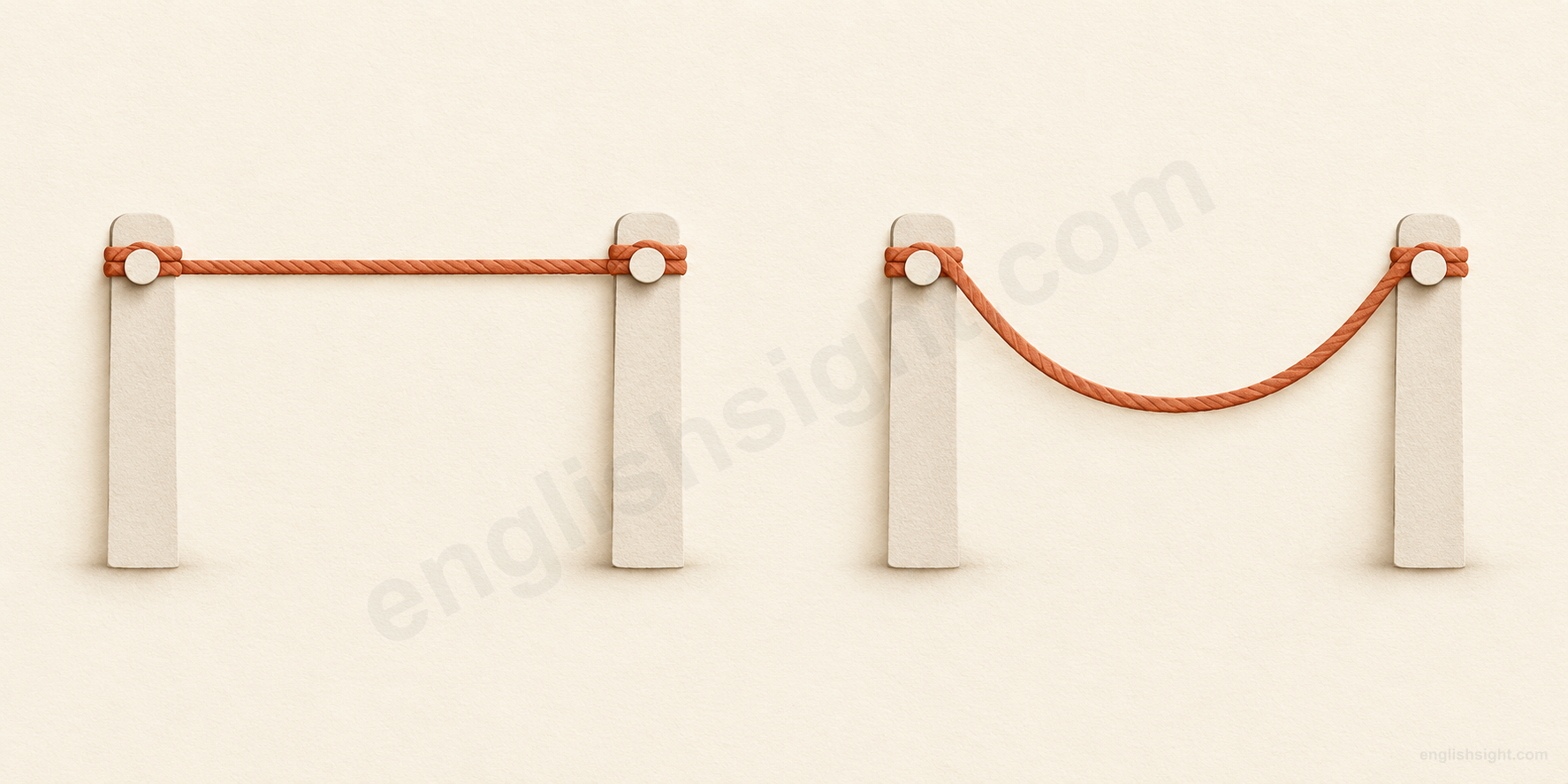
The rope is stretched straight between the posts.
loose
The rope hangs loose between the posts.
More slack allows the rope to sag without detaching its ends.
The hanging curve shows slack. Loose can mean not tight while still attached.
Loose describes something not held, fitted, or organized tightly, leaving room for movement or variation. The kind of constraint depends on the noun and construction.
A loose rope can remain attached at both ends. Some uses concern physical slack, others weak control or precision; idioms and bodily descriptions need separate explanations. The visual comparison is a teaching model, not a claim about every speaker’s mental image.
Loose is usually an adjective. A tooth can move in its socket, a shirt can leave room around your body, and a plan can leave details flexible. Ask what kind of tightness, attachment, or control is absent.
This connection helps organize several established uses; it is not a rule for inventing combinations. Fixed expressions and the less usual formal verb need their own patterns.
01
Attachment, fit, and separate pieces
Ask what is being held tightly: a fastening, a rope, clothing around a body, or pieces held together. Loose describes their condition; it need not mean completely detached.
01
be / feel loose; come / get loose (from something); pull something loose
a loose tooth / come loose
not securely fixed in position
Situation / comparison
The handle should be firmly attached to the drawer.
State / interpretation
It moves when you touch it.
Loose describes insecure attachment, not necessarily complete separation.
A loose tooth, button, screw, or handle is not as firmly fixed as expected. It may still be attached. A missing screw, by contrast, is no longer there.
The handle is loose describes a state. The handle has come loose describes a change into that state. Get loose can also express becoming free or less securely attached; from names what it separates from.
In I pulled the handle loose, loose describes the result of pulling. In I tightened the loose handle, loose describes the handle before the action. The adjective does not itself supply an action.
In a sentence
The handle has come loose from the drawer.
Watch the difference Do not use loose to mean lost: a loose key is not necessarily a key you cannot find.
02
a loose + rope / knot; make something looser
a loose rope / knot
not pulled tight or tied firmly
Situation / comparison
A rope stretches tightly between two posts.
State / interpretation
With extra slack, it hangs in a curve.
A rope can be loose while both ends remain attached.
Here the contrast is loose versus tight or taut. A loose knot has not been pulled firmly together; a loose rope has slack. Neither description requires an end to be completely untied.
Make the rope looser means reduce its tightness. Loosen the rope expresses the action with a verb. Looser and loosest are the ordinary comparative and superlative forms of the adjective.
In a sentence
The rope is too loose to hold the cover in place.
Watch the difference Loose describes a state; loosen usually describes making that state develop. Do not write Please loose it when a neutral Please loosen it is intended.
Loose clothing does not fit closely; it need not be the wrong size.
Loose describes the fit of clothes around the body. The opposite is tight. A deliberately loose shirt can be comfortable and fit exactly as its designer intended; too loose adds the judgment that there is excessive room.
Loose-fitting is a compound adjective: a loose-fitting jacket. Compare loose shoes, which may move around on your feet, with a loose button, which is insecurely attached to a garment.
In a sentence
I wear a loose cotton shirt when I work in the garden.
Watch the difference A large shirt gives its size; a loose shirt gives its fit. Large and loose are not interchangeable in every context.
04
wear / leave your hair loose; hair hangs loose
wear your hair loose
leave hair hanging without tying it back
Situation / comparison
Her hair is gathered in a ponytail.
State / interpretation
She removes the band and lets it hang.
The hair is unrestrained, not falling out of the head.
She wears her hair loose describes how she arranges it: it hangs freely rather than being tied back. Loose hair or a loose strand can also describe hair that has escaped a tie or arrangement.
In wear your hair loose, hair is the object and loose describes its state. Let your hair loose describes releasing it. Neither construction normally means losing hair.
In a sentence
Maya usually wears her hair loose at home.
Watch the difference Do not confuse hair hanging loose with hair loss: loose is not the past tense of lose.
separate items rather than a bound or packaged set
Situation / comparison
Pages are bound into a notebook; vegetables are packed in bags.
State / interpretation
Individual pages or vegetables can be handled separately.
Loose here concerns grouping or packaging, not whether an item is lost.
Loose sheets are not bound into a book. Loose vegetables are sold individually or by weight rather than in a prepared pack. Loose-leaf paper consists of separate sheets for a binder; loose tea is tea leaves rather than tea in individual tea bags.
Loose change is an established uncountable expression for coins carried in a pocket or bag. It does not mean an alteration that is not tight, and it does not cover every form of available money. Loose cash can instead mean money readily available rather than locked away or set aside; this expression is not restricted to coins.
Loose powder is powder in free particles rather than a pressed cake. The particular item tells you which kind of binding or packaging is absent.
In a sentence
I found some loose change beside a few loose sheets of paper.
Watch the difference Say some loose change, not a loose change, when you mean coins. Loose items can still be inside a bag.
06
loose + soil / gravel; a loose weave
loose soil / a loose weave
not closely packed or woven together
Situation / comparison
Particles are pressed together, or threads lie close together.
State / interpretation
There are spaces between the particles or threads.
Loose describes the structure of the material.
Loose soil or gravel is not firmly compacted into a solid surface. A loose weave has relatively large spaces between its threads. The pieces need not all be moving.
This differs from a loose tile: the tile itself is a solid object with an insecure attachment. With loose soil, the looseness is in the arrangement of the material’s particles.
In a sentence
The path was covered with loose gravel.
Watch the difference Loose does not automatically mean soft: loose gravel may consist of hard stones.
07
a loose ball; the ball is loose
a loose ball
a ball that no player currently controls
Situation / comparison
A player has possession of the ball.
State / interpretation
It rolls free before another player reaches it.
In sport, control means possession, not a tight physical fastening.
A loose ball is available for a player to win because no player has it under control. The expression is common in reporting games such as football or basketball.
The ball may have bounced away after a challenge. Loose does not say it is damaged, underinflated, or outside the playing area.
In a sentence
Nina reached the loose ball before the goalkeeper.
Watch the difference A loose ball is different from a lost ball, which may be missing or no longer available for play.
02
Freedom and release
People, animals, and reactions can escape restraint. Read the whole construction to see whether something escapes, someone frees it, or someone simply relaxes.
08
be loose (in / on a place); run / roam loose
run loose / be loose
move around without being confined or restrained
Situation / comparison
Animals are normally kept within a field.
State / interpretation
They are moving freely on the road.
Loose describes freedom from confinement, which may be unwanted.
An animal is loose when it is not secured or confined as expected. Run loose and roam loose describe its movement in that condition; loose does not name the speed or manner of running.
A loose dog is possible, especially when it means an unrestrained dog. With this meaning, be loose and run loose are particularly useful everyday patterns. Freedom here is not necessarily permission or safety.
In a sentence
Two goats were running loose on the road.
Watch the difference Do not replace loose with freely in every expression: run loose points to lack of restraint, not simply easy movement.
09
be / remain / still be on the loose
on the loose
escaped and not yet caught or brought under control
Situation / comparison
A captive animal has escaped.
State / interpretation
People are still trying to find and contain it.
The whole phrase emphasizes an escape and continuing freedom.
On the loose often describes an escaped animal or a person being pursued. It can sound more dramatic than simply free and commonly carries concern about someone not being caught.
Oxford lists the expression under the noun loose, whereas some dictionaries place it among the adjective’s idioms. Learn on the loose as a fixed phrase rather than treating loose as a general noun meaning freedom.
In a sentence
The escaped leopard is still on the loose.
Watch the difference Keep the article: on the loose, not on loose. This is not the neutral way to say you have a free afternoon.
A boat is secured; a group depends on outside control.
State / interpretation
The boat or group becomes free of that connection.
From names the attachment or influence left behind.
A horse can break loose from a tether without anyone releasing it. Someone can cut a boat loose from its mooring: the object becomes free through that person’s action. Cut does not always describe literally cutting a rope.
The same patterns extend to influence: a group can break loose from its sponsors, and someone can cut themselves loose from an organization. The issue is independence, not a physical journey.
Break loose can have no object: The horse broke loose. Cut something loose has an object, including a pronoun: cut it loose. Do not rearrange that as cut loose it.
In a sentence
The club cut itself loose from its former sponsors.
Watch the difference Distinguish spontaneous escape from causing release: broke loose and cut it loose assign different roles to the subject.
11
let / set somebody or something loose; let somebody loose on a task / in a place
let / set somebody loose
release someone or give them freedom to act
Situation / comparison
An animal is restrained, or a worker has tightly limited tasks.
State / interpretation
It is freed, or the worker receives freedom within a task.
The object receives freedom; the subject allows or causes it.
Let the dog loose and set the dog loose mean release it from restraint. In let it loose, the object it comes between let and loose. Loose describes the object’s resulting freedom.
Let someone loose on a project gives them considerable freedom to work on it. Let someone loose in a kitchen gives them freedom in that place, often with a playful suggestion that they will be enthusiastic or hard to control.
In She was let loose on the design, the passive puts the person receiving freedom first. The expression grants freedom; it does not guarantee a good result.
In a sentence
They let the new designer loose on the website.
Watch the difference Let loose is not always about escape: someone may deliberately give permission. With a pronoun use let her loose, not let loose her.
12
let loose; cut loose
let loose / cut loose
relax and behave with fewer inhibitions
Situation / comparison
People have been working under pressure.
State / interpretation
They dance, laugh, and enjoy themselves freely.
With no object, these informal expressions can describe uninhibited enjoyment.
Let loose can mean stop holding yourself back and have fun. Cut loose has this sense too, especially in North American English. This need not involve being physically released by another person.
Compare They let Sam loose in the studio: someone gives Sam freedom. Sam let loose at the party describes Sam’s own behavior. Context distinguishes enjoyment from more disruptive loss of control.
In a sentence
After the final exam, we cut loose and danced all evening.
Watch the difference Cut loose from a company means gain independence from it; it does not necessarily mean have a party.
13
let loose + sound / words; let loose with + sound / words
let loose a shout / let loose with
suddenly express a loud sound or strong words
Situation / comparison
Someone has been holding in a reaction.
State / interpretation
A shout or stream of words suddenly comes out.
The released thing is a sound or expression, not a person.
Let loose a shout or a stream of complaints presents an outburst. Here the noise or words form the object. The subject produces them rather than freeing another person.
Let loose with a shout is another pattern: with introduces what the person bursts out with. These expressions can convey criticism, excitement, or anger; they are not restricted to having fun.
In a sentence
When our team scored, Dad let loose a delighted shout.
Watch the difference Let a person loose and let loose a shout have different object types and meanings. Learn the whole pattern.
03
Organization, accuracy, and speech
Tightness becomes a useful comparison for strict organization or careful control. These are established abstract uses, not physical changes.
14
a loose arrangement / alliance; loose guidelines
a loose arrangement / alliance
organized or controlled without strict rules
Situation / comparison
People agree on a few broad aims.
State / interpretation
They cooperate while keeping considerable independence.
Loose describes how weakly the organization or agreement is constrained.
A loose arrangement leaves details flexible. A loose alliance brings people or groups together without tightly unifying their activities. This can be useful flexibility or a weakness, depending on context.
Loose guidelines are not strictly detailed or enforced. Compare a loose connection between ideas: it suggests only a limited or indirect link. A loose electrical connection instead concerns physical contact.
In a sentence
We have a loose arrangement to meet once a month.
Watch the difference Loose does not automatically mean bad or completely unorganized. Read what kind of structure the noun names.
15
a loose translation / interpretation; loose thinking / use of a term
a loose translation / loose thinking
not exact or sufficiently careful
Situation / comparison
An account might closely follow the original wording or reasoning.
State / interpretation
It instead gives an approximate version or an imprecise argument.
The connection is reduced strictness, not extra physical space.
A loose translation gives an approximate or freer rendering rather than following the original closely. It can be a deliberate choice; loose alone does not establish that the translation is wrong.
Loose thinking usually criticizes reasoning as insufficiently precise or rigorous. Loose use of a word means using it without a strict definition. The noun and context decide whether the lack of precision is acceptable.
In a sentence
This is a loose translation, so a few details differ from the original.
Watch the difference Do not infer that every loose translation is dishonest or poor. Loose thinking, however, normally carries criticism.
16
loose talk; have a loose tongue
loose talk / have a loose tongue
speak carelessly or reveal private information
Situation / comparison
Some information should be kept private.
State / interpretation
Someone speaks without enough restraint.
The lack of control concerns speech, not pronunciation.
Loose talk is careless or irresponsible speech, especially when it may reveal information or cause trouble. Have a loose tongue characterizes someone who talks too freely about private matters.
The metaphor is a tongue not held in check. It does not mean the physical tongue is detached, and it does not diagnose a speaking difficulty. The expressions are usually disapproving.
In a sentence
A little loose talk revealed the surprise before the party.
Watch the difference Have a loose tongue does not simply mean be friendly or speak a lot; the concern is insufficient discretion.
04
Everyday fixed expressions
Learn these expressions as units. Their specific meanings and tone cannot be predicted from loose alone.
17
loose ends; tie up (the) loose ends
tie up loose ends
finish unresolved details
Situation / comparison
Most of a project is finished.
State / interpretation
The remaining details still need attention.
Loose ends are unfinished parts, not spare time.
A few loose ends can be unanswered questions in a story or small tasks left in a project. Tie up the loose ends means complete or resolve them, using the image of fastening free ends.
The expression usually has plural ends. You can also talk about one loose end if there is one unresolved matter. In tie them up, them replaces the loose ends.
In a sentence
We need one more day to tie up the loose ends before launch.
Watch the difference At a loose end describes a person with nothing to do; having loose ends describes unfinished matters.
18
be at a loose end (BrE); be at loose ends (NAmE)
at a loose end / at loose ends
have nothing to do and no clear plan
Situation / comparison
Your usual Saturday activity has been cancelled.
State / interpretation
You have free time but do not know what to do with it.
This fixed expression describes a person’s lack of occupation or direction.
Be at a loose end is British informal English for having nothing to do and not knowing how to occupy yourself. North American English usually uses at loose ends.
It can suggest feeling a little aimless rather than happily choosing to rest. The expression is not a description of unfinished project details, even though it shares the words loose and end.
In a sentence
I was at a loose end on Sunday, so I called a friend.
Watch the difference Keep the regional forms together: at a loose end or at loose ends. Do not replace at with on.
19
be a loose cannon
a loose cannon
a person whose unpredictable actions may cause trouble
Situation / comparison
A team needs people to follow an agreed plan.
State / interpretation
One person may act unpredictably and disrupt it.
The phrase labels unreliable control over behavior, not a literal weapon.
Calling someone a loose cannon suggests that their actions are hard to predict and may harm the people around them or their own group. It often occurs in discussion of a colleague, leader, or public figure.
It is usually criticism or a warning. The article a belongs to the whole countable noun phrase: a loose cannon; plural loose cannons.
In a sentence
The coach saw the outspoken captain as a loose cannon.
Watch the difference A loose cannon is not simply an original thinker or someone who works independently. The expression suggests risk.
20
have a screw loose
have a screw loose
behave in a way the speaker considers strange or unreasonable
Situation / comparison
Someone proposes an extremely reckless stunt.
State / interpretation
Another person reacts with a mocking judgment.
This informal idiom is a potentially insulting comment about behavior.
Have a screw loose figuratively compares odd or unreasonable behavior to a machine with a faulty fastening. It is an opinionated remark, not a literal repair problem.
The phrase may be used jokingly between friends, but it can offend. It is not a medical description or a useful way to discuss someone’s mental health.
In a sentence
You must have a screw loose if you think I’m jumping off that roof.
Watch the difference Compare The chair has a loose screw, which normally describes real hardware. Word order and context matter.
21
all hell breaks / broke / will break loose
all hell breaks loose
a noisy or angry disturbance suddenly begins
Situation / comparison
A meeting is calm until a shocking announcement.
State / interpretation
People suddenly start shouting and arguing.
The full idiom emphasizes sudden uncontrolled disturbance.
All hell breaks loose is an emphatic informal way to describe a sudden eruption of noise, arguing, fighting, or similar chaos. It does not describe a place literally opening.
The verb changes tense: all hell broke loose in a past story; all hell will break loose in a prediction. Hell gives the expression a strong tone that may be unsuitable for some audiences.
In a sentence
When the referee disallowed the goal, all hell broke loose in the stands.
Watch the difference Use broke, not breaked, for the past. In formal writing, a disturbance broke out may suit the tone better.
22
play fast and loose (with somebody / something)
play fast and loose with
treat facts, rules, or people irresponsibly
Situation / comparison
A report should represent the evidence fairly.
State / interpretation
The writer changes details to suit an argument.
The idiom criticizes careless or dishonest treatment of something.
Play fast and loose with the facts means disregard accuracy or manipulate information. With the rules, it suggests treating requirements as optional; with someone’s feelings, it suggests an irresponsible lack of respect.
Fast does not describe speed here, and loose does not describe fit. Learn the whole expression, including with. Oxford marks it old-fashioned; Collins presents it as disapproving, and it remains useful to recognize in commentary.
In a sentence
The article plays fast and loose with the survey results.
Watch the difference This is criticism, not praise for being flexible or creative.
23
hang loose; stay loose
hang / stay loose
remain calm and relaxed
Situation / comparison
Someone is worrying while waiting.
State / interpretation
A friend encourages them not to get tense.
This informal expression means keep relaxed, without any literal hanging.
Hang loose or stay loose is especially associated with North American informal speech. It can reassure someone or describe maintaining a relaxed attitude.
Compare let loose at a party, which involves releasing inhibitions and doing something freely. Hang loose can simply mean remain calm while nothing much happens.
In a sentence
Hang loose—we’ll hear the result soon.
Watch the difference This casual wording is not a neutral replacement for every use of wait or relax.
05
Body descriptions and the formal verb
These uses are worth recognizing, but the formal verb is not the usual choice for everyday instructions to loosen something.
24
loose stools / bowel movements
loose stools / bowel movements
body waste that is more liquid than usual
Situation / comparison
A bodily description concerns consistency.
State / interpretation
The stool is not firm or well formed.
Here loose concerns consistency, not attachment or freedom.
Loose stools and loose bowel movements describe feces that contain more liquid than usual. Stools is a countable term for passed feces in this context; bowel movements names the acts or their products.
This is a conventional bodily use worth recognizing in a health conversation. The rope picture is only a distant reminder of reduced firmness and does not explain the details of this meaning.
In a sentence
The form asks whether you have had any loose stools.
Watch the difference This sentence reports a symptom description, not its cause. Loose does not mean that an internal organ has become detached.
25
loose something; loose something on / upon somebody or something
loose a grip / loose forces upon
release or make less tightly held, in formal usage
Situation / comparison
A grip or restraint holds something back.
State / interpretation
It is relaxed or a force is released.
Loose can be a verb, but everyday speech usually chooses loosen, release, or let loose.
As a formal verb, loose can mean release something or make a restraint less tight. She loosed her grip describes relaxing her hold; She loosened her grip is the more ordinary everyday wording.
The verb can also describe releasing an emotion or force: The announcement loosed a wave of anger. On or upon can name the target affected: the tale loosed frightening creatures upon the town.
Its forms are loose, looses, loosed, loosing. It is not lose, loses, lost, losing. A passive such as powerful forces were loosed is possible because this verb takes an object.
In a sentence
In the tale, the spell loosed a storm upon the village.
Watch the difference Use loosen the lid for a neutral instruction. Loose as a formal verb is not a spelling variant of lose.
26
loose an arrow / a shot (at something); loose (off) shots
loose an arrow / loose off a shot
shoot or discharge an arrow or a shot
Situation / comparison
An archer holds an arrow ready.
State / interpretation
The arrow is released toward its target.
This formal or narrative verb names a release that fires a projectile.
Loose an arrow means shoot it. Oxford also gives loose something off at a target; Collins labels loose off British. These are recognition uses for stories or reports, not the ordinary way to ask someone to shoot.
The target can follow at: The archer loosed an arrow at the target. With off, Collins records both loose off two shots and loose two shots off. This is a real particle-verb use, unlike adjective patterns such as the rope came loose.
In a sentence
The archer loosed an arrow at the painted target.
Watch the difference Loosed an arrow means fired it; lost an arrow means no longer had it or could not find it.
Choose the spelling, state, and tone carefully
Loose / lose / loosen
Loose /luːs/ ends with an s sound and usually describes a state. Lose /luːz/ ends with a z sound and is a verb: lose a key, lose a game; its past is lost. Loosen /ˈluːsən/ is the ordinary verb for making something less tight. Loosely is the usual adverb: tie it loosely; a story loosely based on real events follows them only approximately.
Read the whole construction
The screw is loose is a state; it came loose is a change; I pulled it loose gives the result of an action. I let it loose gives the object freedom. These uses of loose as a complement should not all be called phrasal verbs. Pronouns stay before the complement in pull it loose, cut it loose, and let it loose.
Tone and older moral judgments
A loose woman or loose morals is an old-fashioned, disapproving judgment about sexual behavior. Recognize it in older writing, but do not use it as a neutral description of someone. Have a screw loose can also insult. A loose cannon, loose talk, and loose thinking usually criticize rather than praise.
The model has limits
Loose is not a universal synonym for free, bad, soft, or missing. It is often neutral with clothes and flexible plans, negative with faulty attachments or careless reasoning, and conventional in idioms. This lesson selects useful modern meanings and recognition items; it does not claim a frequency ranking or every specialist use.
Choose the right kind of looseness
Use the noun, construction, and situation to choose the meaning.
1. A handle still hangs on the drawer, but it wobbles. Which description fits?
2. You want someone to make a tight lid a little less tight. Which neutral instruction fits?
3. A jacket is designed to leave plenty of space around your body. What does loose describe?
4. A project is almost finished, but a few small matters still need resolving. What should you do?
5. A manager lets a designer loose on a project. What happens?
6. A writer plays fast and loose with the facts. What is the speaker suggesting?
Sources and teaching notes
The listed dictionary entries support the meanings, patterns, and usage labels. Explanations, examples, and the rope comparison were written for this lesson; the comparison organizes meanings rather than proving their history.
The diagram is a teaching comparison, not a picture shared by every English speaker.