Use loss for absence, reduction, a shortfall, or defeat—and read the whole expression.
From having something to having less
From having something to having less
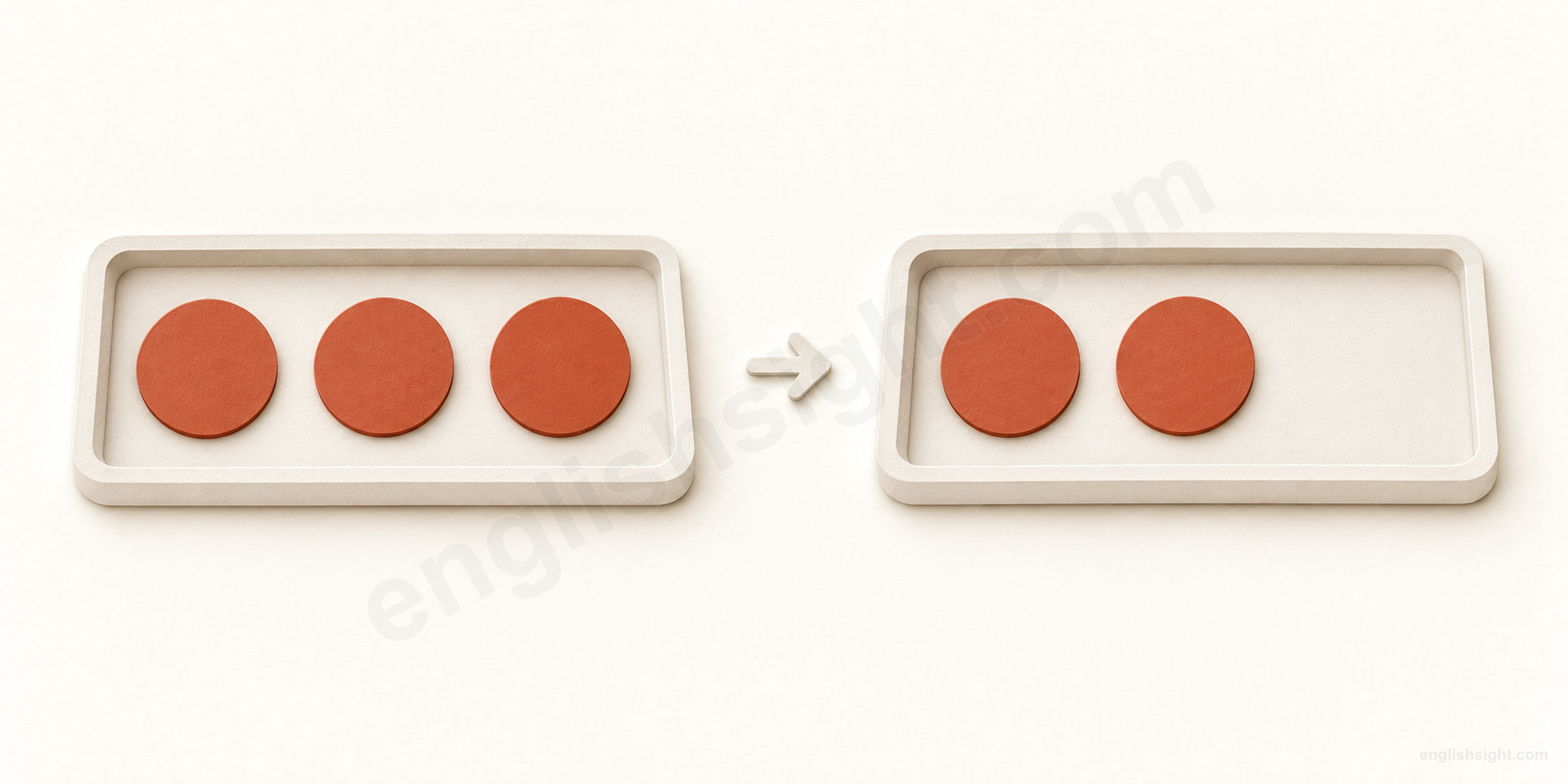
Three items are available in the tray.
loss
Two items remain; there is less than before.
One item is no longer there.
One item is absent in the later view. This models having less without showing why; it does not explain every use of loss.
Loss often names the absence or reduction of something previously available. Context extends the word to the resulting harm, a financial shortfall, or an unsuccessful result.
A loss may be partial, temporary, or even intended. A defeat or missed benefit need not involve something once possessed; established expressions must be learned in context.
Loss is a noun. It often names no longer having something or having less than before. It can also name the harm or sadness that follows, money not recovered, or a failure to win.
Start with the simple change from more to less, then learn the distinct patterns. Loss of hearing, a loss to a team, and a team’s loss to an opponent do different jobs.
The picture is a teaching model for absence and reduction. It is not a claim that every English speaker imagines the same scene or that every idiom can be predicted from it.
01
Things, amounts, and abilities
Name what is no longer available, has become smaller, or cannot be maintained. Of usually introduces what is lost; a noun before loss can name the same thing.
01
the loss of + noun; loss or damage; data loss
the loss of a bag
no longer having a particular thing
Situation / starting point
Your bag was with you when you left home.
What is absent or changed?
You discover that it is missing and report it.
Loss names the event or state; of a bag identifies the thing no longer available.
The loss of my bag is a noun phrase. Compare I lost my bag: lost is the past form of the verb lose. A report of loss need not say whether the item was misplaced, stolen, or destroyed.
Use the loss of a particular item when identifying an event. In general wording such as protection against loss or damage, loss is uncountable. Damage concerns harm to something; it can still be present.
Data loss applies the same absence idea to information. A file may become unavailable even though no physical object has moved away.
In a sentence
Please report the loss of your bag at the service desk.
Watch the difference Use loss as a noun: the loss of my bag. Say I lost my bag, not I loss my bag.
02
noun + loss; loss of + substance / quality; a loss of + amount; without loss of + noun
weight loss / loss of heat
a decrease in an amount or level
Situation / starting point
There is a larger amount or a higher level.
What is absent or changed?
The amount or level becomes smaller.
Loss can mean a reduction, not complete disappearance.
Weight loss means a reduction in body weight; heat loss means heat leaving a body or space. Blood loss and water loss name substances no longer retained; hair loss means losing some or all of one’s hair. The noun before loss tells us what decreases or disappears.
Loss of heat and heat loss express a similar relationship with different word order. A loss of two kilograms states the amount of a decrease. Without loss of quality says that quality is maintained during a change.
The word alone does not say whether the change is welcome: weight loss may be intended. Sleep loss can mean not getting needed sleep; it is not a claim that sleep already obtained is physically removed.
In a sentence
The new windows reduce heat loss from the house.
Watch the difference A loss of five kilograms measures the change, not the final weight.
03
hearing / memory loss; loss of appetite / consciousness; partial / temporary loss of + noun
hearing loss / loss of memory
reduced or absent ability or function
Situation / starting point
A person’s ability or function is being described.
What is absent or changed?
The ability is reduced or absent, either from birth or after a change.
The extent and duration come from the context, not from loss alone.
Hearing loss can involve some or all hearing and may be present from birth; it does not always describe losing an ability previously possessed. Sight loss or loss of sight concerns vision. Memory loss concerns an ability to remember. Loss of appetite means having less or no desire to eat. These are noun phrases, not instructions or diagnoses.
Loss of consciousness means becoming unconscious. Temporary loss of consciousness can end; loss does not itself mean permanent damage. An adjective such as partial, severe, or temporary supplies an important distinction.
Hearing loss is normally uncountable. A sudden loss of hearing identifies a particular change. Do not add an article merely because only one person is involved.
In a sentence
The guide provides written information for visitors with hearing loss.
Watch the difference Hearing loss does not necessarily mean complete deafness, and memory loss does not always mean losing every memory.
04
job losses; the loss of + possessive + job; loss of income / earnings
job losses / loss of income
jobs disappearing or earnings no longer received
Situation / starting point
People have jobs or expect income from their work.
What is absent or changed?
Jobs disappear or the expected earnings are not received.
Loss of income names money not earned; it is not automatically an accounting loss.
Job losses are jobs that disappear, often when an organization closes or reduces its workforce. The loss of her job describes one person’s particular event.
Loss of income or loss of earnings can describe money someone cannot earn while unable to work. The speaker need not have received that money first.
Compare a business loss: that usually concerns costs exceeding income or money lost on a transaction. Reduced income may contribute to a loss, but the two noun phrases answer different questions.
In a sentence
The factory closure caused eighty job losses.
Watch the difference Losses is the plural noun. Do not confuse it with loses, the verb in The factory loses money.
05
loss of control / confidence / interest; cause / suffer a loss of + noun
loss of control / confidence
no longer maintaining control or a personal quality
Situation / starting point
Someone can direct a situation or has confidence in it.
What is absent or changed?
Their control or confidence is reduced or gone.
What follows of determines the kind of capacity or quality affected.
Loss of control may concern a vehicle, a situation, or a person’s behavior. Loss of confidence concerns belief in one’s ability or in someone else. The noun phrase does not by itself explain the cause.
Loss of interest similarly means becoming less interested or no longer interested. The pattern describes an abstract change using the same less-or-none relationship as a decrease in an amount.
Compare lack of confidence: lack describes insufficient confidence, without necessarily suggesting that more existed earlier. Loss normally points to a change or a shortfall against what was maintained or expected.
In a sentence
Repeated mistakes led to a loss of confidence in the team.
Watch the difference Say a loss of control, not a loss to control. Loss to someone names who is disadvantaged in a different construction.
02
People and what their absence means
A death, the feeling that follows an absence, and the disadvantage of someone leaving are connected but distinct uses.
06
the loss of + person; loss of life; suffer a loss; I’m sorry for your loss
the loss of a loved one / loss of life
a death or deaths
Situation / starting point
A person is alive and part of someone’s life.
What is absent or changed?
The person dies; others experience that absence.
In this context, loss of a person refers to death rather than misplacing someone.
The loss of her father can be a gentle way to refer to his death. A loved one means someone dearly loved, not only a romantic partner.
Loss of life is used in reports about deaths, for example after a disaster. Life is normally singular in this expression even when several people die. Heavy losses in reports about war may refer to people killed, wounded, or captured; the exact scope depends on the report.
I’m sorry for your loss is a conventional expression of sympathy after a death. Here your loss refers to the bereavement, not a missing possession or a financial mistake.
In a sentence
After the loss of her brother, Maya took some time away from work.
Watch the difference Do not use I’m sorry for your loss as a routine response to losing a game; its usual condolence context is a death.
07
a sense / feeling of loss; feelings of loss and grief
a sense of loss
sadness because someone or something valued is no longer present
Situation / starting point
Someone values a relationship, home, or part of life.
What is absent or changed?
Its absence brings a feeling that something important is missing.
This use names the emotional response, not just the event that caused it.
A sense of loss or a feeling of loss describes an emotional experience. A death may cause it, but leaving a home or losing a friendship can also do so.
In a sense of loss, a belongs to sense; loss names the feeling generally. The loss of a friendship instead identifies what has ended.
The tray diagram can suggest absence, but it cannot show the depth of grief. Treat the emotional use in its human context rather than reducing it to a missing object.
In a sentence
Leaving the town where she grew up gave her a deep sense of loss.
Watch the difference A feeling of loss is an emotional reaction. A financial loss is a money result; context distinguishes them.
08
a great / sad / big loss to + person / group; be no great loss
a great loss to the team
a disadvantage caused by someone or something valuable leaving
Situation / starting point
A person contributes useful skills or support.
What is absent or changed?
Their departure leaves the group worse off.
Of names what is lost; to names the person or group affected.
Her departure is a loss to the team evaluates its effect on the team. She will be a great loss can describe the valued person whose departure creates that disadvantage. A death is not required: retirement or moving away can have the same effect.
The loss of our coach names the event or absence. A loss to our club names who suffers from it. These phrases can describe the same situation from different viewpoints.
No great loss means that an absence is not very disadvantageous: Missing that dull meeting was no great loss. Applied to a person, this judgment can sound dismissive or unkind.
In a sentence
Our coach’s retirement will be a great loss to the club.
Watch the difference Being a loss to a team means being missed, not being a useless member. That negative judgment belongs to a dead loss.
03
Money and a shortfall
Separate losing income from spending more than you earn. Financial patterns also describe selling below cost and recovering money already lost.
09
make / suffer / incur a loss; a loss of + amount; a loss on + transaction; report losses
make a loss
spend more than is earned or lose money on an activity
Situation / starting point
A business receives income and pays costs.
What is absent or changed?
Its costs exceed its income for the period.
The financial loss is the shortfall, not all the money spent.
A business that earns £900 and spends £1,000 makes a loss of £100. Profit is the opposite result. Make a loss on a deal connects the shortfall to a particular transaction.
Make a loss and suffer a loss are ordinary patterns. Incur losses is more formal; report, post, or record a loss is common in business reporting and describes announcing or registering the result.
Losses can refer to separate periods, transactions, or amounts. A net loss is the overall negative result after the relevant income and costs have been taken into account; this lesson does not teach accounting rules.
In a sentence
The café made a loss of £100 in its first week.
Watch the difference A loss of £100 is the amount lost. A loss on the sale identifies the transaction; of and on do different jobs.
10
sell + object + at a loss; operate / run at a loss
sell / operate at a loss
sell below cost or run a business with costs exceeding income
Situation / starting point
An item costs more to buy or produce than its selling price.
What is absent or changed?
The sale brings back less money than the cost.
At a loss describes a financial result, not the seller’s uncertainty.
Sell something at a loss means receive less than it cost to buy or produce. Operate or run at a loss extends the financial pattern to a business whose costs exceed its income.
The article a is part of the normal phrase at a loss. At a profit gives the opposite result; breaking even means neither making a profit nor a loss.
Compare I’m at a loss to explain the price: that is the separate idiom for not knowing how to explain something. The surrounding words decide which meaning is intended.
In a sentence
We sold the remaining chairs at a loss to clear the storeroom.
Watch the difference For this financial phrase, say at a loss, not in a loss or at loss.
11
cover / absorb a loss; recoup / offset losses
cover / recoup losses
pay for, withstand, or recover what has been lost
Situation / starting point
A business or person has lost money.
What is absent or changed?
Other resources pay for the shortfall, or later earnings recover it.
The verb used with loss explains how the financial loss is being handled.
Cover a loss means provide enough money to pay for it. Absorb a loss emphasizes being able to bear its financial effect. Neither phrase necessarily means the original money has been earned back.
Recoup losses means recover the lost money, often through later earnings. Offset a loss means counterbalance it with something else, such as a gain elsewhere.
Insurance wording uses loss for an insured event or the resulting financial amount. This explains the language of losses and compensation; what a particular policy covers depends on that policy.
In a sentence
Sales of the new product helped the firm recoup last year’s losses.
Watch the difference Recouping losses is recovering money. Cutting your losses is stopping a failing activity to avoid further waste.
04
Defeat and destruction
A loss can be an unsuccessful result or something damaged beyond useful recovery. Neither requires an object to go missing.
12
a loss to + opponent; a loss by + margin; wins and losses
a loss to a rival
a failure to win a contest
Situation / starting point
Two teams play a match.
What is absent or changed?
One team is beaten by the other and records a defeat.
Here a loss counts an unsuccessful result, not the disappearance of a possession.
A loss is a countable result in sport: one loss, three losses, wins and losses. A 3–1 loss gives the score. A loss to another team identifies the winner.
To describes the opposing winner in a loss to Eastfield. By introduces a margin: a loss by two goals. The score and the margin are different ways of describing the result.
The link to other uses is an unfavorable outcome, not literally having a victory taken away. Election losses can likewise describe defeats or seats no longer held, depending on context.
In a sentence
The club finished the season with two wins and one loss.
Watch the difference Use a loss for a defeat. Lost is a verb form or adjective, as in They lost or a lost game.
13
be / declare something a total loss
a total loss
something destroyed or damaged beyond useful recovery
Situation / starting point
A boat or other valuable object is usable.
What is absent or changed?
It is destroyed or can no longer be usefully recovered.
Total describes the extent of destruction or financial damage.
A boat described as a total loss after a fire has been destroyed or damaged so badly that it cannot be usefully recovered. The object need not be physically missing: the wreck may still be there.
In insurance, total loss has technical criteria and can include cases where repair is not economically worthwhile. This everyday lesson does not determine whether a particular claim qualifies.
Do not confuse a total loss with the informal British expression a dead loss, meaning a useless person or thing. Both are strong negative descriptions, but their usual contexts differ.
In a sentence
The fire left the old boat a total loss.
Watch the difference A total loss need not mean that nothing remains physically visible.
05
Established expressions
Learn these complete patterns, including their prepositions, number, and tone. A literal picture of fewer objects cannot supply every idiomatic meaning.
14
be at a loss; be at a loss (as to) what / how to…; be at a loss to + verb
be at a loss what to do
not know how to respond, act, or explain
Situation / starting point
A situation presents a problem or a surprising fact.
What is absent or changed?
You cannot find a suitable next step or explanation.
This established phrase expresses puzzlement or inability to find a response.
I’m at a loss can stand alone if the problem is already clear. Add what to do, as to what to do, or a to-infinitive to identify the difficulty.
At a loss to explain means unable to find an explanation, not that you have lost an explanation you once owned. The uncertainty belongs to the complete phrase.
In We are at a loss to understand why…, to understand supplies the activity that cannot be managed. It is different from the to naming an affected group in a loss to the club.
In a sentence
With both roads closed, we were at a loss as to how to get home.
Watch the difference Keep a in at a loss. This use does not imply that anyone has lost money.
15
be / leave someone at a loss for words
at a loss for words
unable to find suitable words, often because of surprise or emotion
Situation / starting point
Someone receives unexpected or deeply moving news.
What is absent or changed?
They cannot immediately find words to express a response.
For words specifies the response that is unavailable.
Be at a loss for words often describes being speechless from surprise, joy, shock, or strong feeling. It is not limited to sadness or to having a small vocabulary.
Something can leave someone at a loss for words: leave here describes the state it causes. The expression normally concerns a temporary inability to find an adequate response.
This is related to being at a loss what to do, but the conventional for words form focuses specifically on speech. Learn the preposition with the phrase.
In a sentence
The children’s unexpected thank-you speech left me at a loss for words.
Watch the difference Say at a loss for words, not at a loss of words. Loss of speech is a different noun phrase.
16
cut + possessive + losses
cut your losses
stop an unsuccessful activity before it wastes more
Situation / starting point
You have already invested time, effort, or money without success.
What is absent or changed?
You stop investing further and accept what is already lost.
The aim is to prevent further loss, not to erase the past loss.
Cut your losses means stop a failing activity before the situation gets worse. Money is a common context, but the wasted resource may also be time or effort.
Your changes with the person: we cut our losses, she cut her losses. Losses normally stays plural in this idiom, even if the speaker is abandoning one project.
Compare recoup your losses: recoup means get money back. Cutting your losses can leave the original loss unrecovered; the decision concerns what happens next.
In a sentence
After three failed repairs, we cut our losses and replaced the old printer.
Watch the difference It is not a promise that all future losses will disappear, and it does not mean recovering what was already spent.
17
that / it is + possessive + loss
That’s your loss.
someone misses a benefit by choosing not to take an opportunity
Situation / starting point
A person turns down something the speaker considers worthwhile.
What is absent or changed?
The speaker says that person will miss its benefit.
The benefit may never have been possessed; this is an established judgment about a missed opportunity.
That’s your loss means you are the one missing out. It can defend an offer that someone rejected or dismiss their refusal. It often sounds pointed rather than sympathetic.
Change the possessive to match the person: their loss, his loss, or our loss. The judgment about the benefit comes from the speaker; the phrase does not prove the opportunity was valuable.
Compare I’m sorry for your loss, which usually expresses sympathy after a death. The shared noun does not make the two expressions interchangeable.
In a sentence
“I don’t want a ticket to the concert.” “That’s your loss—the band is excellent.”
Watch the difference This reply can sound dismissive. It is not a neutral condolence.
18
loss of face; without loss of face; lose face
loss of face
reduced respect or public embarrassment
Situation / starting point
A person has standing or respect among others.
What is absent or changed?
An event makes them feel or appear less respected.
Face refers figuratively to social standing, not a body part being lost.
Loss of face names a reduction in respect or the embarrassment of appearing foolish. It commonly concerns how others see someone after an error, failure, or public retreat.
The noun phrase loss of face corresponds to the verb phrase lose face. Without loss of face describes doing something without that social cost.
This is a conventional expression. The tray’s absence relationship can suggest losing something valued, but it cannot explain the social meaning of face on its own.
In a sentence
They allowed him to withdraw his proposal without loss of face.
Watch the difference Do not interpret face literally here; loss of face is a social judgment.
19
be a dead loss; be a dead loss at + activity
a dead loss
a person or thing considered useless or unsuccessful
Situation / starting point
A person or thing is expected to help or perform well.
What is absent or changed?
The speaker judges that it provides no useful result.
This is an informal evaluation, not a death or an account of missing possessions.
In British informal English, a dead loss is someone or something judged completely unhelpful or unsuccessful. I’m a dead loss at repairs is a self-critical way to say that repairs are a skill you do very badly.
Applied to someone else, the expression can sound insulting. It is stronger than saying that a task was difficult or that someone made one mistake.
Contrast She will be a great loss to the club: that praises someone’s value and says the club will miss her. Calling someone a dead loss makes the opposite evaluation of their usefulness.
In a sentence
I’m a dead loss at sewing, so I asked Jo to mend the jacket.
Watch the difference Dead intensifies the negative judgment here; it does not mean the person has died.
Keep the noun and the construction clear
Loss, lose, lost, and loose
Loss is a noun; its plural is losses. Lose is a verb, with past and past participle lost: I lose things; I lost my key; I have lost it. Loose is normally an adjective meaning not tight or not firmly attached. A noun such as loss has no tense, passive, progressive, or particle-verb family of its own.
Count the event or describe the condition
Use loss without an article for general conditions such as hearing loss or protection against loss. Use the for an identified event, a loss for one event or amount, and losses for separate events, jobs, defeats, or sums. These choices depend on the intended meaning; loss is not always countable or always uncountable.
Read what the preposition identifies
Loss of a bag identifies what is gone; a loss of £100 states an amount. A loss to the club can name the affected club, while a loss to a rival can name the opposing winner in sport. A loss on a deal identifies a transaction. In at a loss for words, the whole phrase has an established meaning.
Coverage and limits
This lesson covers the modern noun, common compounds and collocations, and familiar idioms. Technical electrical loss calculations, detailed insurance and tax classifications, American football yardage, and literary destruction senses are not developed as separate lessons. The units are organized for learning, not ranked by frequency.
Choose the meaning in context
Use the situation and the whole phrase, including its preposition.
1. Your bag disappeared yesterday. Which sentence uses the verb correctly?
2. A shop bought a chair for £60 and sold it for £45. Which phrase describes that sale?
3. A much-loved coach retires. You want to say the club will miss her contribution. Which sentence fits?
4. You stop spending time on a failing project to avoid wasting more. What are you doing?
5. A visitor has partial hearing loss. What does that tell you?
6. A friend tells you that her grandfather has died. Which reply offers sympathy?
Sources and teaching notes
The sources below support the meanings and usage patterns. Explanations and example sentences are original; the diagram is a teaching interpretation of absence and reduction.
This diagram illustrates one useful connection; English speakers need not share a single mental picture.