Start with volume, then distinguish emphatic opinions, bold designs, and familiar expressions.
The strength of a sound
The strength of a sound
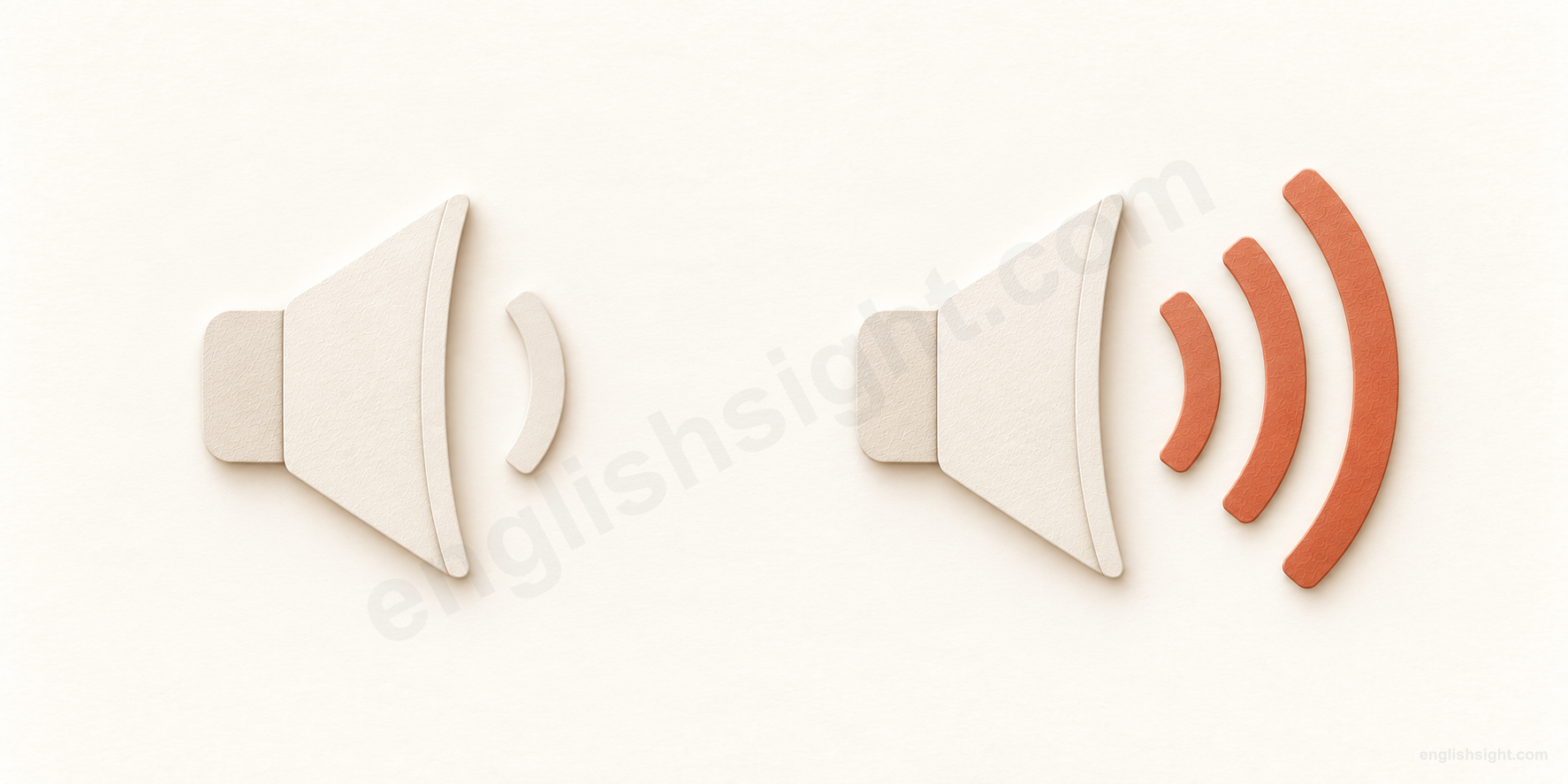
The speaker produces a quieter sound, shown by one pale arc.
loud
The same speaker produces a louder sound, shown by three terracotta arcs.
Compare the same sound source at two volume levels.
The same source, a stronger sound.
A loud sound has high volume. The same source can produce a quieter sound or a louder one; loud identifies the strength of the sound, not its pitch or meaning.
The volume comparison explains the central sound use. Forceful opinions and showy designs are established extensions; out loud and the longer expressions need their own explanations.
Loud usually describes a high sound level: music, a voice, a machine, or a sudden crash. Other uses concern forceful expression or a striking appearance, and fixed phrases add meanings of their own.
Use the sound comparison as a teaching model, not as a rule that predicts every phrase or a claim that all English speakers imagine the same picture.
01
Sound, sources, and volume
Describe the strength of a sound, compare levels, and choose between an adjective and an adverb.
01
loud + sound noun; sound / be + loud; in a loud voice
a loud sound / a loud voice
a sound with high volume
Situation / starting point
A pan falls onto a hard floor.
Meaning / result
The crash is strong to the ear.
Loud describes volume, not the kind of sound or the speaker’s intention.
Loud can come before a sound noun: a loud crash, loud music, loud laughter. It can also follow a linking verb: The music is loud. In both positions it describes the strength of the sound.
A loud voice is a voice produced at high volume. In She answered in a loud voice, loud describes the noun voice; the whole phrase tells us how she answered.
Loud need not mean unpleasant: loud applause may be welcome. Context tells us whether the volume is helpful, exciting, startling, or disturbing. A sound may be loud even if nobody understands what caused it.
In a sentence
The pan hit the floor with a loud crash.
Watch the difference Volume and pitch are different: a low-pitched drum can be loud, and a high-pitched whistle can be quiet.
02
a loud + source / person; source / person + be + loud
a loud machine / a loud person
a source that produces a lot of sound; sometimes an annoying manner
Situation / starting point
A machine runs, or someone talks beside you.
Meaning / result
Its sound, or the person’s manner, attracts attention.
The noun tells us whether loud describes sound production or a judgment about behavior.
We can call a machine loud because the sound it produces is loud: This fan is loud. We are describing its operation, not its size.
With a person, She was loud at dinner can simply concern her voice in that situation, but calling someone a loud person often criticizes a noisy, overbearing way of behaving. It is a stronger social judgment than saying that one sentence was spoken loudly.
Compare She has a loud voice with She is loud and rude. The first focuses on her voice; the second judges her behavior. Neither means that the person is necessarily confident or correct.
In a sentence
The old fan is too loud for the bedroom.
Watch the difference Be careful when describing people: You’re being very loud comments on current behavior, while You’re a loud person can sound like a personal criticism.
03
louder than; the loudest; too / very loud; loud enough (for someone) to + verb; as loud as
louder / loudest / too loud / loud enough
compare volume or relate it to a need
Situation / starting point
The voice is difficult to hear, or the music disturbs someone.
Meaning / result
You compare the volume with another level or a practical limit.
Comparatives compare levels; too and enough judge a level against the situation.
The usual adjective forms are loud, louder, loudest: The engine is louder than before; That was the loudest noise of the evening. Louder does not itself say the sound is now excessive.
Too loud means louder than is suitable or wanted. Very loud only describes a high degree. The music is very loud does not by itself make a request, while The music is too loud often prepares the way for asking someone to turn it down.
Loud enough means sufficient for a purpose: Her voice was loud enough for everyone to hear. Put enough after loud and, when needed, add to + verb or for + person + to + verb. Not loud enough means below the required level.
As loud as compares equal levels or a limit: The alarm was as loud as the bell; I called as loud as I could. In everyday speech, louder can also modify speaking, as the next entry explains.
In a sentence
Her voice was loud enough for everyone at the back to hear.
Watch the difference Say loud enough, not enough loud; use louder than, not more louder than.
04
speak / talk / play + louder, too loud, loud enough; verb + loudly
speak louder / play it too loud
describe how loudly an action is performed
Situation / starting point
A listener cannot hear the speaker, or music is playing strongly.
Meaning / result
You describe or request a different sound level.
Loud can be an adverb, especially in familiar spoken combinations.
In Speak louder, louder modifies speak rather than a noun. Loud is common as an informal adverb in combinations such as so loud, too loud, loud enough, and as loud as. Play the radio too loud is therefore possible English.
Loudly is the usual general adverb: Someone knocked loudly at the door. Do not conclude that every adverb ending is optional. The flat adverb loud is particularly familiar after verbs concerned with making sound and in the combinations above.
Compare a loud reply, She replied loudly, and She replied in a loud voice. The first uses an adjective before a noun, the second an adverb with a verb, and the third a prepositional phrase. More loudly is also possible; speak louder is an ordinary conversational request.
In a sentence
Could you speak a little louder? The train is making it hard to hear you.
Watch the difference After be, use the adjective for volume: The music is loud. The music is loudly is incomplete.
02
Forceful opinions and striking appearances
Loud can describe insistent expression or a design that strongly attracts attention. These uses do not require a high sound level.
05
loud + support / criticism / protests; be loud in one’s support / criticism of something
loud protests / loud in support of
strong, insistent expression of an opinion
Situation / starting point
People oppose a change or support a proposal.
Meaning / result
Their position is expressed emphatically and publicly.
The emphasis can be social or rhetorical rather than a measured sound level.
Loud protests, loud criticism, and loud support can emphasize how forcefully a position is expressed. There may be actual shouting, but the expression can also describe an insistent public response conveyed in writing or through several channels.
In They were loud in their support of the library, loud describes the supporters and in introduces the area of their strong expression. Support of or support for names what they favor. In loud criticism of the plan, of belongs with criticism.
This use connects with the idea of a voice that is hard to overlook. That connection is a teaching aid: loud does not tell us that the opinion is reasonable, widely shared, or successful.
In a sentence
The club was loud in its support of the new library.
Watch the difference Loud support is emphatic support, not necessarily support from a large number of people.
06
a loud + shirt / tie / pattern; loud colours
a loud shirt / loud colours
visually striking, often too bright or showy
Situation / starting point
A shirt has vivid, strongly contrasting patterns.
Meaning / result
Its appearance demands attention.
Loud describes an impression on the eye, not a noise made by the clothing.
A loud shirt, tie, or pattern has a very striking appearance, often through bright colours or bold designs. The speaker commonly implies that it is excessive or in poor taste; this is a judgment, not a neutral colour label.
The teaching connection is that a strong visual impression can demand attention as a loud sound does. The fabric is not literally producing sound. Learn this as an established extension rather than applying loud to anything that happens to be noticeable.
Bright describes colour or light more neutrally. Colourful describes variety of colour. Loud adds a sense of showiness and often disapproval, so choose it carefully when commenting on someone’s clothes.
In a sentence
He chose a loud orange-and-purple tie for the party.
Watch the difference A pale shirt can be beautiful or noticeable without being loud; loud is not a general synonym for attractive.
03
Speaking aloud and established expressions
Read each whole expression: out loud contrasts with silence, loud and clear concerns reception or understanding, and the longer sayings have their own meanings.
07
read / say + something + out loud; laugh out loud
read / say / laugh out loud
make words or laughter audible instead of keeping them silent
Situation / starting point
Words can remain in your mind, or amusement can stay a silent smile.
Meaning / result
The words or laughter are expressed audibly.
Out loud contrasts with silence; it does not require shouting.
Read the name out loud means use your voice so it can be heard, rather than reading silently. Say it out loud contrasts saying words with only thinking them. The volume can be ordinary conversational volume.
Laugh out loud means actually make the sound of laughter, rather than only finding something funny or smiling. The context may suggest strong amusement, but out loud alone is not a precise measure of volume.
Aloud also expresses audible speech, especially with read or say, and can sound more formal than out loud. Loudly focuses on volume. Read it out loud asks for an audible reading; read it loudly asks for a strong voice.
Out loud is a fixed adverbial phrase, not a separable phrasal verb. Place an object before it in Read the name out loud; do not put the name between out and loud.
In a sentence
Please read the address out loud so I can write it down.
Watch the difference Out loud does not mean outside: you can read out loud in a room.
08
think out loud; be just thinking out loud; think aloud
think out loud
say thoughts while working them out
Situation / starting point
You are considering possible solutions.
Meaning / result
Other people hear your unfinished reasoning.
The phrase presents spoken thinking, often without a settled conclusion.
Think out loud means put your thoughts into speech as they occur. You may be comparing possibilities rather than announcing a decision. I’m just thinking out loud often helps a listener understand that a suggestion is tentative.
Think aloud is another form. Out loud contributes audibility, while think identifies the mental activity being verbalized. The expression does not mean think more intensely, and it does not guarantee that the ideas are intended as instructions.
In a sentence
I’m just thinking out loud: could we move the desk nearer the window?
Watch the difference A listener may still take the suggestion seriously; just thinking out loud explains the speaker’s intention but does not undo what was said.
09
hear someone loud and clear; come through loud and clear
hear someone loud and clear
receive a voice or signal without difficulty
Situation / starting point
Two people test an audio connection.
Meaning / result
The listener confirms good reception.
Loud concerns audibility; clear adds the absence of difficulty in recognizing the sound.
In an audio check, I can hear you loud and clear confirms that the voice is strong and distinct enough to receive comfortably. The short reply Loud and clear! can answer a question about reception.
The combination is useful because high volume alone does not ensure clarity. A distorted loudspeaker can be loud while the words remain hard to understand. In this use, the phrase concerns the received sound rather than approval of what is said.
In a sentence
Your voice is coming through loud and clear now.
Watch the difference Clear does not mean quiet, and loud does not automatically mean clear.
10
get / hear / receive + the message + loud and clear; a message comes across loud and clear
get / hear the message loud and clear
understand a message with no doubt about its meaning
Situation / starting point
People make their wishes unmistakable.
Meaning / result
The recipient clearly understands the point.
The established expression can concern meaning without any loud sound.
I got the message loud and clear can mean I fully understood what you wanted me to know. The message might arrive in a quiet conversation, an email, or a repeated pattern of behavior.
The link with good sound reception helps explain the expression, but this is a figurative use. The phrase can reassure someone that their point has been understood, or, with a sharp tone, show impatience at repeated reminders.
Understanding is not the same as agreement. I hear you loud and clear may acknowledge a position without promising to follow it. Read the surrounding conversation before deciding whether it is a friendly assurance or a tense response.
In a sentence
After the survey, the council got the message loud and clear: residents wanted a safer crossing.
Watch the difference The phrase does not prove the council agreed or took action; it reports clear reception of the message.
11
actions speak louder than words
actions speak louder than words
what people do is more convincing than what they say
Situation / starting point
Someone makes a promise.
Meaning / result
You look for behavior that supports it.
Louder means more persuasive or meaningful here, not greater physical volume.
This saying compares conduct with promises or claims. If someone says they will help, actually helping is stronger evidence of their commitment than repeating the promise.
Actions do not literally speak. The full saying uses the image of a stronger voice to express the greater force of practical evidence. Learn its usual wording as a whole; the point comes from the comparison, not from loud alone.
In a sentence
You say you want to help; actions speak louder than words, so please join the cleanup.
Watch the difference The saying is not an instruction to shout or a claim that words never matter.
12
For crying out loud!; For crying out loud, + question / request
for crying out loud!
show annoyance, impatience, or exasperated surprise
Situation / starting point
A small problem happens again.
Meaning / result
The speaker reacts with frustration.
This informal exclamation is a fixed reaction, not a description of crying.
For crying out loud! can stand alone or introduce a question or request. It adds emotional force and often suggests that the speaker thinks the situation should have been avoided.
No one needs to be crying, and the words can be spoken quietly. The meaning belongs to the whole expression. It can sound rude or impatient, especially when directed at another person, so it is unsuitable for a neutral polite request.
In a sentence
For crying out loud, who left the freezer open again?
Watch the difference Do not use this expression as a literal request for someone to cry audibly.
Keep volume, audibility, and meaning apart
Loud, noisy, and high-pitched
Loud focuses on sound level. Noisy often describes a place, activity, or source with much noise, especially disturbing noise. A single bang can be loud; a room full of chatter can be noisy. Pitch is a separate property, so high-pitched and loud are not interchangeable.
Forms and word family
Loud is pronounced /laʊd/. The usual comparison is louder, loudest, for both the adjective and the familiar flat adverb. Loudly is the general adverb, and loudness names the quality. This lesson covers modern adjective and adverb uses; loud has no ordinary verb paradigm, passive, or separable particle-verb family here.
Learn the complete phrase
Out loud concerns audible expression, not necessarily high volume. Loud and clear can concern either sound reception or understanding. The social force of for crying out loud depends on the whole exclamation and its tone.
Choose the meaning that fits
Use the situation and the whole expression. Volume alone will not answer every question.
1. A teacher wants everyone to hear a written name, with no need to shout. Which request fits?
2. The people at the back cannot hear your voice. Which sentence describes the problem?
3. Someone calls a brightly patterned tie loud. What are they probably commenting on?
4. The council got the survey’s message loud and clear. What follows from this sentence?
5. A colleague says, “I’m just thinking out loud.” How should you understand the suggestion?
6. Someone says, “Actions speak louder than words.” What is the point?
Sources and teaching notes
Dictionary entries support the usage distinctions below. Explanations, examples, and the volume comparison were created for this lesson; the visual model is a teaching interpretation.
The comparison illustrates sound level; it is not a picture shared by every native speaker.