From working equipment to coordinated systems, people, and a manufacturing verb.
A working system, a particular task
A working system, a particular task
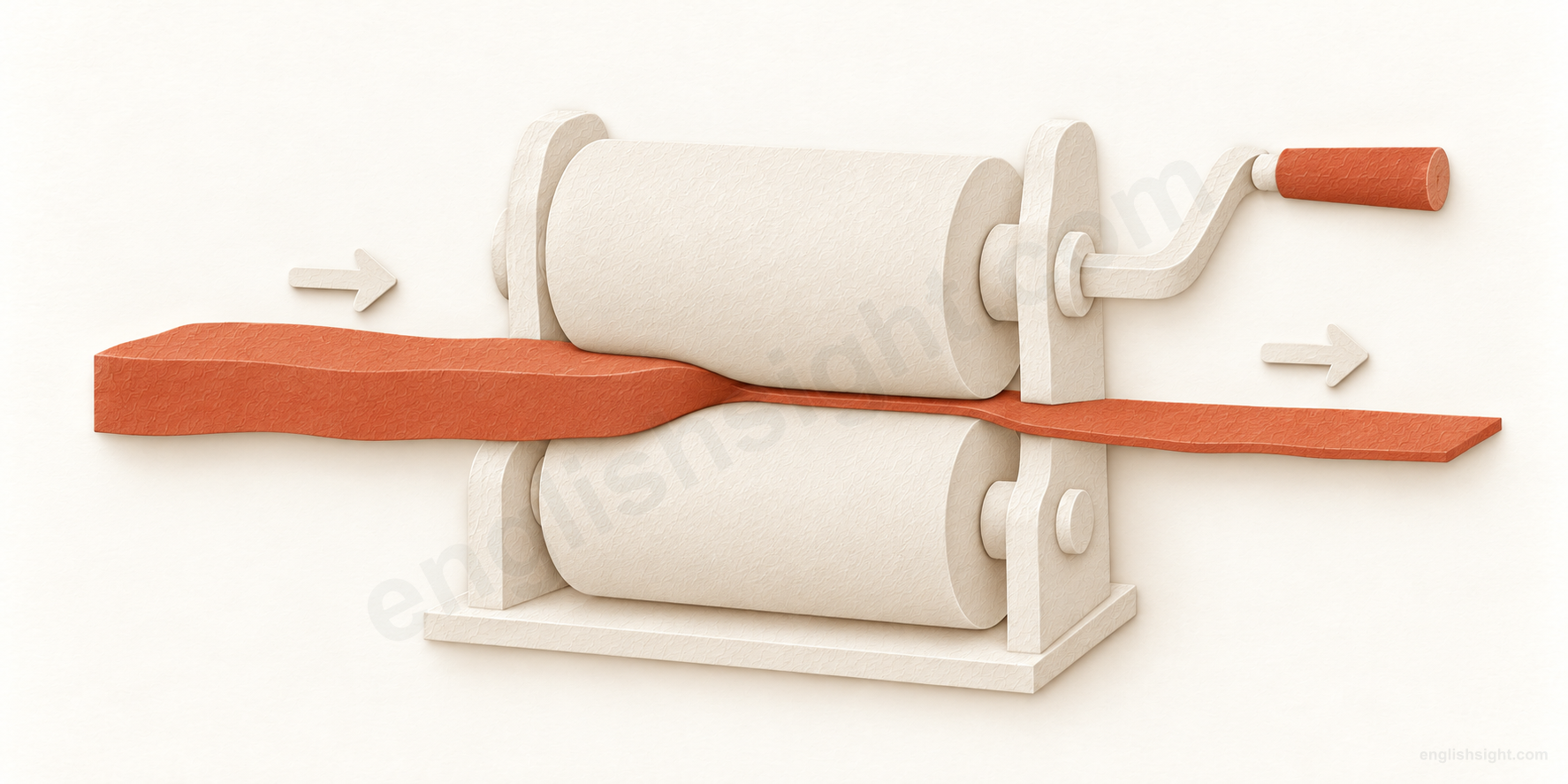
A thick orange strip enters from the left.
machine
A thinner, flatter strip comes out on the right.
The roller press squeezes the strip between its two rollers.
The machine’s parts work together to flatten the strip.
A machine uses a mechanism or an electronic system to carry out a task. In many familiar machines, connected parts act together to produce a useful result.
The roller press is one illustration, not a definition by appearance. Simple machines may have few parts; computers process information. Comparisons about people select only some features of machine operation.
A machine does a particular job through a mechanism or an electronic system. Ask what task it performs and how its components contribute. It can be hand-powered, motor-powered, or electronic.
That useful starting point connects literal equipment with comparisons about people and organizations. The full expression still matters: a cog in the machine and a well-oiled machine make different points.
01
Devices and their names
Identify the job, choose the device name, and notice when context supplies a shorter name.
01
a machine for + -ing; a machine that + verb
a machine for cutting paper
a device that carries out a particular task
Situation
A workshop needs many sheets cut to the same size.
What the expression communicates
One device does the cutting repeatedly.
The noun names the working device; the following phrase names its purpose.
Think of a device organized to do work: a cutter, a washer, or a printer. The roller sketch shows just one possible task. A machine need not have rollers or produce a physical object.
Use a machine for cutting paper or a machine that cuts paper. For introduces the purpose; that begins a clause describing what the device does. Machine is countable: one machine, three machines.
Power can come from a person as well as an engine or electricity. A hand-operated machine is still a machine; automatic is extra information.
In a sentence
We bought a machine for cutting thick paper.
Watch the difference Say a machine or some machines. Machinery is a related uncountable word: new machinery, not three machineries.
The first word specifies the type; machine remains the main noun.
A washing machine washes clothes, a sewing machine joins fabric with stitches, and a coffee machine prepares coffee. These established names are compounds, not phrasal verbs.
Once the situation identifies the appliance, the machine can stand for its full name. In a laundry conversation, Put it in the machine normally means the washing machine, not any available device.
The plural ending goes on the main noun: two washing machines. You can also use machine before another noun: a machine operator controls a machine, and machine parts are its components.
In a sentence
Put the towels in the machine, but wash the wool sweater by hand.
Watch the difference The machine needs shared context. Use the full name when your listener cannot tell which device you mean.
03
vending / snack / cash / slot / fruit + machine
vending machine / cash machine
name a device that supplies a product or a service
Situation
You want a drink or need to withdraw cash.
What the expression communicates
The appropriate machine provides what you need.
The compound identifies the service; it does not mean every machine handles money.
A vending machine sells items such as drinks or snacks. A snack machine is a vending machine named after its contents. A cash machine lets you withdraw money from a bank account; it is not a machine for buying cash.
Cash machine is especially familiar in British English; ATM is used in both American and British English. Follow the local name when asking for directions.
Slot machine often means a gambling device, especially in North American English. British English also uses it for a coin-operated vending device. Fruit machine is a British name for the gambling type, not a device that sells fruit. Context and region help identify the intended machine.
In a sentence
There is a cash machine beside the station entrance.
Watch the difference A vending machine sells a product; a cash machine gives access to your bank funds. They are different devices.
04
my / your / this + machine; on my machine / on this machine
on my machine
a computer, identified by context
Situation
A file opens on one computer but not another.
What the expression communicates
You identify the computer on which it works.
Machine can refer to the whole computer without emphasizing moving parts.
In computing conversation, my machine can mean my computer. This is an established use of machine, not a claim that your laptop looks like industrial equipment.
On my machine concerns the computer where something is stored or runs. Compare in the washing machine, where in refers to a physical container. The preposition depends on the activity and object.
If the context is unclear, my computer is more explicit. A machine does not mean a single application installed on it.
In a sentence
The video plays on my machine, but it will not open on yours.
Watch the difference Do not assume machine means computer outside a computing context.
05
a simple machine; a lever / pulley is a simple machine
a simple machine
a basic device that changes how force is applied
Situation
A person must lift a heavy load.
What the expression communicates
A lever or pulley changes the application of the force.
In school physics, machine includes basic mechanisms without motors.
In physics, a lever or pulley can be called a simple machine. It helps transmit force or change its size or direction. Simple here identifies a basic mechanism, not necessarily an easy task.
This technical sense sets a useful limit on the many-parts picture: a machine does not always need lots of moving components. Nor does using one create energy from nothing.
In a sentence
We used a pulley as a simple machine to lift the model.
Watch the difference Do not define every machine as electric or fully automatic.
02
Using equipment and describing methods
Distinguish the device, its operation, a fault, and the method used to make or process something.
06
operate / run + a machine; a machine runs; turn it on / off
operate / run a machine
control a device or keep it working
Situation
A new worker is learning the controls.
What the expression communicates
The worker can make the device do its job.
People operate machines; machines work or run.
Operate a machine means use its controls. Run a machine can mean operate it or keep it in operation. The same verb can have the machine as subject: The machine is running.
Turn the machine on and switch it off describe changing its powered state. With a pronoun, say turn it on or switch it off. These particle patterns belong to turn and switch, not to machine.
What does this machine run on? asks about its source of power or fuel. This differs from Who runs it?, which asks about the operator.
In a sentence
Only trained staff should operate this machine.
Watch the difference The machine is working means it functions. The operator is working means the person is doing a job.
07
a machine breaks down / does not work; repair / replace a machine
the machine has broken down
a device has stopped functioning
Situation
A ticket device is not working.
What the expression communicates
You report the fault and use a different one.
The problem is in the device, not necessarily in the person using it.
A machine breaks down when it stops working because of a fault. Has broken down reports the failure; is broken describes its present condition. Is out of order is another familiar way to say it is not functioning.
Repair the machine means restore its function. Replace the machine means use another one instead. These actions should not be confused.
Break down is a phrasal verb with machine as its subject. It does not create a new meaning of the noun machine.
In a sentence
The ticket machine has broken down, so we need to buy tickets at the counter.
Watch the difference Break the machine means cause damage; the machine breaks down reports a malfunction without identifying who caused it.
08
verb + by machine; be + past participle + by machine
by machine
using a machine as the method
Situation
A company must sort a large pile of letters.
What the expression communicates
Equipment performs the sorting.
By machine names how the work is done, rather than a particular device.
By machine contrasts a mechanical method with by hand. In this method phrase, machine normally has no article. With a particular device, say with a machine or with this machine.
A passive sentence can place the work first: The letters are sorted by machine. The sentence does not have to name the people responsible for operating the equipment.
Compare The parcels are beside the machine. Here the machine is a physical object, and beside names a location. The meaning of the preposition matters.
In a sentence
Most of these envelopes are sorted by machine.
Watch the difference Use by machine for the method; use a machine when counting or identifying a device.
09
machine-made + noun; be made by machine
machine-made
made using machinery
Situation
A shop sells goods made in different ways.
What the expression communicates
A description identifies the manufacturing method.
The compound adjective describes the product, not the equipment.
Machine-made describes goods produced by machines. Handmade instead highlights work done by hand. Neither word by itself guarantees quality or tells you the price.
Use machine-made before a noun, as in machine-made bowls. These bowls are made by machine gives the same basic manufacturing information in a full clause.
Machine-washable is a different label: it concerns how an item can be cleaned, not how it was made. Keep the whole compound in view.
In a sentence
The shop sells both handmade and machine-made bowls.
Watch the difference A machine-made item is not necessarily safe to wash in a washing machine.
03
People and coordinated organizations
Machine comparisons can highlight coordination, limited individuality, or tireless output. Read the whole expression and its tone.
10
a political / publicity / marketing / military + machine
a political / publicity machine
a coordinated organization and its means of achieving a goal
Situation
Many people arrange messages, events, and publicity.
What the expression communicates
Their coordinated work supports a campaign.
The whole system is compared to equipment with coordinated parts.
A political machine is an organized network that controls or influences political activity. A publicity or marketing machine coordinates efforts to attract attention. The noun refers to people and organization, not a literal engine.
The comparison highlights coordination, power, or impersonal operation. Context determines whether the speaker admires it or distrusts it; machine is not always praise.
In this family, a military or war machine includes the organized resources for warfare. The adjective or first noun tells you the system’s purpose.
In a sentence
The party’s publicity machine worked all weekend to promote the new policy.
Watch the difference A political machine is an established expression, not any device used at an election.
11
run / work like a well-oiled machine; be a well-oiled machine
like a well-oiled machine
with smooth, efficient coordination
Situation
Everyone in a team knows their role.
What the expression communicates
The work proceeds with few delays.
The comparison praises how the parts of the operation fit together.
A team that runs like a well-oiled machine works smoothly and efficiently. Oil reduces friction in a real mechanism; the fixed comparison applies that smoothness to an organization.
You can also say a well-oiled machine directly about the organization. You are evaluating its operation, not saying that staff are literally oiled or that they lack feelings.
In a sentence
By the final rehearsal, the stage crew was working like a well-oiled machine.
Watch the difference This is a conventional positive comparison; do not interpret well-oiled literally in a team description.
12
be / feel like + a cog in the machine / wheel
a cog in the machine
a small part of a much larger organization
Situation
A worker has little influence over a large company.
What the expression communicates
The worker describes feeling like a small replaceable part.
The person is compared to one component, not to the entire machine.
A cog in the machine, also a cog in the wheel, describes a person with a small role in a large organization. It often suggests limited influence or individuality.
Compare She is a machine, which describes how the person works. She is a cog in the machine describes her place in the organization. The complete expression changes the focus.
In a sentence
I left because I felt like just a cog in the machine.
Watch the difference The idiom does not mean that the person is unable to work or is personally inefficient.
13
person + be + a machine; a scoring / writing machine; not a machine
She is a machine.
describe someone as tireless, productive, or mechanical
Situation
Someone keeps completing tasks with almost no pause.
What the expression communicates
You compare their performance to a machine.
Context decides whether the comparison admires output or criticizes a lack of human feeling.
In an admiring informal remark, calling someone a machine can highlight tireless, consistent performance. A scoring machine is someone or a team that scores repeatedly; the modifier names the repeated result.
The comparison can also be critical: I’m not a machine asks others to recognize your limits and feelings. A person who works mechanically may appear to act without thought or emotion.
These are related comparisons, not a rule that productive people have no feelings. Tone and the surrounding situation matter.
In a sentence
Please give me a break—I’m not a machine.
Watch the difference Calling someone a machine is figurative. It may sound admiring, joking, or dehumanizing depending on the context.
04
The specialist verb
In manufacturing, machine describes shaping or processing material with machine tools.
14
machine + part / material; be machined from + material; material + machines + adverb
machine a metal part
make or shape a part using a machine tool
Situation
A rough metal piece has the wrong shape.
What the expression communicates
A controlled cutting process produces the required part.
As a specialist verb, machine names processing the material, not merely using any device.
In manufacturing, to machine a part is to make, shape, or finish it using machinery, especially machine tools that cut away material. The part or material is the object.
The passive is common because the part matters more than the worker: The part was machined from aluminium. From identifies the starting material; it is not a particle in a phrasal verb.
Forms are machine, machines, machined, machining. Drop the final e before -ing. In specialist descriptions, This material machines easily describes how readily it can be processed; it does not mean the material operates a machine.
In a sentence
Each bracket is machined from a solid block of aluminium.
Watch the difference Do not use machine as a general verb meaning operate: say I use a washing machine, not I machine every morning.
Keep the device, method, and comparison distinct
Countability and pronunciation
Say a machine, two machines, or some machinery. Machinery and equipment are normally uncountable: a piece of equipment. Machine is /məˈʃiːn/: stress the second syllable, and pronounce ch like sh.
Machine, engine, and tool
The engine powers a petrol mower; the mower as a whole is a machine. A hand tool such as a screwdriver need not be called a machine in ordinary conversation. In physics, however, a lever is a simple machine. These categories can overlap.
The noun does not contain every surrounding meaning
In turn the machine off and the machine breaks down, the verbs supply switching and failure. There is no everyday family of phrasal verbs formed from the verb machine itself.
Scope of this lesson
The specialist manufacturing verb is included for recognition. Historical stage machinery, literary devices, rare vehicle uses, and detailed technical compounds such as machine code and machine learning are outside this introduction.
Choose the meaning in context
Use the situation and the complete expression to choose an answer.
1. You mean that equipment, rather than hands, performs the sorting. Which phrase gives the method?
2. The kitchen staff coordinate their tasks smoothly. Which comparison praises this?
3. A colleague says, “It works on my machine,” while discussing a file. What does machine probably mean?
4. A factory report says, “The part was machined from brass.” What happened?
5. An exhausted worker says, “I’m not a machine.” What is the worker emphasizing?
Sources and teaching notes
Meanings and usage were checked against the dictionary pages below. Explanations and example sentences are original. The roller press illustrates one working relationship; it is a teaching model rather than the appearance of every machine.
This diagram helps explain a connection; it is not a picture shared by every native speaker.