Follow what is produced, caused, arranged, or achieved.
A cause and its result
Who or what brings about the result?
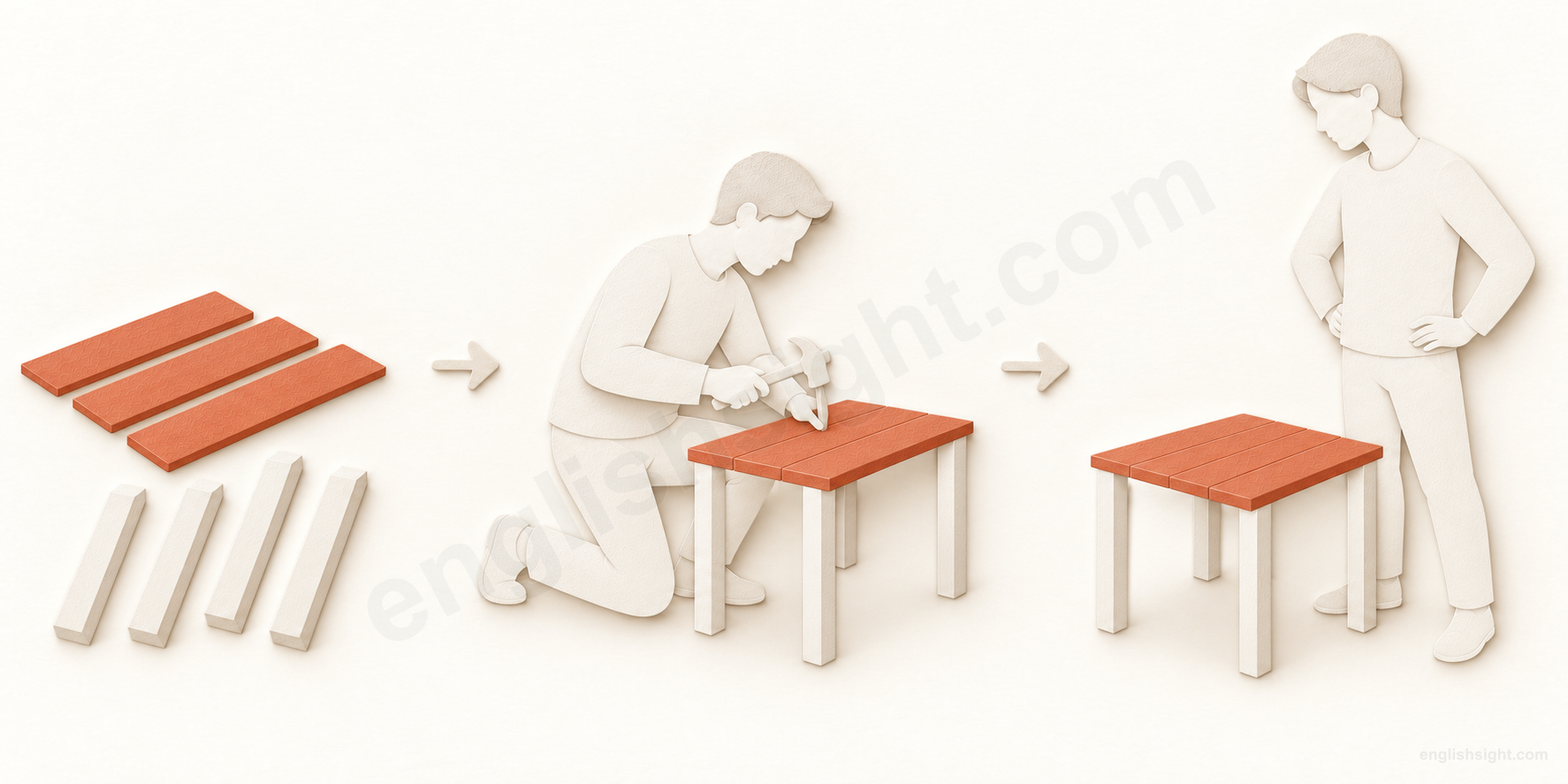
Loose boards and separate legs are available; no table has been assembled.
make
The same maker stands beside a finished table.
A person works on joining the parts, bringing a new result into being.
The sequence connects starting materials, a maker’s action, and a newly produced result. In make someone happy, the result is a state rather than furniture; in make someone laugh, it is a response. This is a teaching analogy, not a literal explanation of every idiom or a shared mental image of all speakers.
A maker, materials, and an action lead to a product. The same question about a cause and its result helps with many nonphysical uses.
The sketch illustrates making a table. The arrow is a teaching analogy for causation; it cannot predict every idiom or prove a historical origin.
Make often directs attention from an action or cause to its result: a table exists, a room becomes brighter, or someone starts laughing. The sentence pattern tells us what kind of result is involved.
This is a teaching connection, not one universal definition or a picture shared by all native speakers. Totals, brands, arrival, and fixed expressions also need their own explanations.
01
Products, preparation, and everyday actions
A noun may name a created product, a prepared item, an action, or a financial result. The noun and situation select the meaning.
01
make + product; make + noun + from / out of + material
make a table
create or produce something
Starting situation
Old boards are available.
Result / interpretation
A table exists.
The object names the product.
Make can describe craft, manufacturing, or creative work: make clothes, make a film, make a list, and make rules. The object identifies the result; the verb does not specify every step. A falling branch can make a hole: the result may be damage rather than a useful product.
In a sentence
We made a small table out of old boards.
Watch the difference Do usually names an activity: do the work, but make a table. Learn collocations rather than replacing every do with make.
02
be made of / from / with / in / by; make + object + into + result
be made of / from; make into
identify materials, makers, or a transformed result
Starting situation
The building is a garage.
Result / interpretation
It becomes a kitchen.
Into names the new form or use.
A chair is made of wood; paper is made from wood. Of often names recognizable material, from often highlights transformation; this is a tendency, not an absolute test. Made with names an ingredient, in a place, and by a maker.
In a sentence
They made the old garage into a kitchen.
Watch the difference Make something into a bowl starts with the material; make a bowl out of something starts with the product.
03
make + person + thing; make + thing + for + person
make someone a drink
prepare food or drink for someone
Starting situation
She is packing and has no tea.
Result / interpretation
Tea is prepared for her.
The first object is the beneficiary.
Make her some tea means make some tea for her. Make breakfast and make dinner concern preparation; make a reservation concerns arranging a booking, not cooking.
In a sentence
I made her some tea while she packed.
Watch the difference Make her tea and make her happy have different structures: tea is a thing prepared, happy describes her.
04
make + a / the bed; make up + a bed / room
make the bed
arrange bedding neatly
Starting situation
The bedding is untidy.
Result / interpretation
The bed is ready to use.
No new piece of furniture is built.
Make the bed normally means arrange the sheets and covers. Make up a bed can also mean prepare a temporary sleeping place: We made up a bed on the sofa. Especially in North American hotel usage, make up the room means clean the room and make its bed: Could you make up our room while we are out?
In a sentence
Please make the bed before breakfast.
Watch the difference Make a wooden bed can mean build the furniture; the object and setting decide.
05
make + action noun; make an effort to + verb
make a decision / call / mistake
perform the action named by a noun
Starting situation
The question is unsettled.
Result / interpretation
Discussion produces a decision.
The noun supplies the specific action.
Common partners include make a plan, an offer, a promise, a comment, an appointment, a mistake, a noise, a mess, an effort, and progress. Make progress is uncountable; make a start means begin. These are conventional combinations, not all phrasal verbs.
Make a face or make faces means deliberately change your expression to show dislike or amuse someone: The child made a face at the bitter medicine. This is an action, not making a new physical face.
In a sentence
We made a decision after making three phone calls.
Watch the difference Say make a mistake and do homework. Make an effort to help uses to; progress normally has no a.
06
make + amount / profit / loss; make a living + -ing / as + role
make money / a living
earn income or obtain a financial result
Starting situation
She repairs bicycles for customers.
Result / interpretation
That work supports her financially.
Money is a result of work or trade.
Make money can mean earn or gain it, not manufacture banknotes. Make a profit and make a loss describe opposite financial outcomes; make a living names how someone supports themselves.
In a sentence
She makes a living repairing bicycles.
Watch the difference Make a living doing something has an -ing activity; it does not mean physically creating a life.
02
Causes, qualities, actions, and roles
Look for an affected object and its resulting quality, action, or role. Some superficially similar patterns instead describe suitability or a representation.
07
make + object + adjective
make someone happy
cause a state or quality
Starting situation
The room is fairly dark.
Result / interpretation
The window increases its brightness.
The adjective describes the affected object.
The subject causes the object to have a quality: news makes someone happy; practice makes a task easier. The result need not be intentional. Make yourself comfortable invites someone to settle comfortably.
Make yourself at home is a welcoming invitation to relax and behave comfortably in someone’s home. It does not mean build a house.
In a sentence
The extra window makes the room brighter.
Watch the difference Use an adjective: make it easy, not make it easily. Get brighter describes the change without naming its cause.
08
make + object + bare infinitive
make someone laugh
cause someone to do something
Starting situation
I watch a funny video.
Result / interpretation
I laugh because of it.
The object performs the following action.
The video causes my laughter; it does not command me. Make me feel welcome and make the room look larger also use a verb without to. The following verb supplies the response or appearance.
In a sentence
That video always makes me laugh.
Watch the difference Say makes me laugh, not makes me to laugh or makes me laughing.
09
make + person + verb; be made + to-infinitive
be made to do something
require or force someone to act
Starting situation
Someone controls entry.
Result / interpretation
We must wait outside.
The passive restores to before the verb.
They made us wait presents the people imposing the requirement. We were made to wait presents those affected. Force is one use of the causative construction; a funny video making you laugh need not involve force.
In a sentence
We were made to wait outside.
Watch the difference Active: made us wait. Passive: were made to wait. For an arranged repair, use had the bike repaired, not made the bike repaired.
10
make + reflexive object + past participle
make yourself heard / understood
succeed in communicating
Starting situation
Words alone are not enough.
Result / interpretation
The listener understands me.
The participle names the achieved communicative result.
Myself refers back to I. In make myself understood, I act so others understand me; make myself heard similarly concerns being audible or getting attention. This result construction differs from make someone do something.
In a sentence
I used a drawing to make myself understood.
Watch the difference Say understood, not understand, in make myself understood. It is not a general recipe for arranging any service.
11
make + it + adjective + that-clause / to-infinitive
make it clear / possible
present a statement clearly or enable an action
Starting situation
The ticket rule is uncertain.
Result / interpretation
The rule is stated clearly.
It points ahead to the clause.
In make it clear that…, the following clause gives the content. In make it possible to travel, the infinitive names the enabled activity. It helps hold the place of that longer information.
In a sentence
The guide made it clear that tickets were required.
Watch the difference Keep it: make it easy to book, not make easy to book. Making something clear does not always make it true.
12
make + object + noun complement
make someone captain
assign a role or produce a new identity
Starting situation
Maya is a team member.
Result / interpretation
She is chosen as captain.
The final noun describes the object.
Captain tells us what Maya becomes. The same construction can describe a result rather than an appointment: The book made her a star.
In a sentence
The team made Maya captain.
Watch the difference Compare make Maya a cake: Maya receives the cake. In make Maya captain, captain is Maya’s role.
13
make + a mess / a success + of + activity; make a habit of + -ing
make a mess / success of
handle an activity badly or make it successful
Starting situation
I attend an interview without preparing.
Result / interpretation
My performance goes badly.
The noun names the outcome; of introduces the affected activity.
Make a mess of an interview means handle it badly; make a success of an event means make it succeed. These are established outcome expressions, not a claim that every noun works here. Make a habit of checking names means turn checking into a regular practice.
In a sentence
I made a mess of the interview by arriving unprepared.
Watch the difference Make a mess can mean create physical disorder. Make a mess of a task judges how it was handled. What do you make of it? instead asks for an opinion.
14
subject + would / will make + noun phrase
would make a good…
be suitable for a role or use
Starting situation
The room is available.
Result / interpretation
You consider it suitable as an office.
There is no separate affected object.
The room itself could serve as the office. She will make a good teacher predicts suitability or development; it does not say she will manufacture a teacher.
In a sentence
This quiet room would make a good office.
Watch the difference Compare make the room quiet: there the room is an object whose condition is changed.
15
make + object + adjective / noun; make + object + look + adjective
make something look different
depict or cause something to appear a certain way
Starting situation
My ears have their usual size.
Result / interpretation
The drawing shows them as huge.
The representation changes, not necessarily reality.
An artist can make a nose too long in a portrait. A camera angle can make a room look larger. Context distinguishes an actual change from a portrayal or comparison.
In a sentence
In your sketch, you made my ears enormous.
Watch the difference Make the room larger suggests a real enlargement; make it look larger may only change its appearance.
03
Totals, judgments, arrival, and success
These uses connect parts with totals or people with achieved targets. They are established branches, not physical manufacturing.
16
number / parts + make + total
two and three make five
amount to a total or form a whole
Starting situation
You count two groups.
Result / interpretation
The total is five.
Make connects the parts with the whole.
Two and three make five states arithmetic. That makes ten in all updates a count. People can also make a circle by arranging themselves in that shape.
In a sentence
Two adults and three children make five guests.
Watch the difference The subject controls agreement: That makes five; two and three make five.
17
make + object / it + amount / time
I make it…
calculate or judge an amount
Starting situation
You add the prices.
Result / interpretation
Your calculation gives €48.
This reports the speaker’s reckoning.
I make it forty-eight euros gives my calculation. What time do you make it? asks what someone’s watch says or what time they judge it to be; this phrasing is especially familiar in British English.
In a sentence
I make the total forty-eight euros.
Watch the difference This is not an offer to create money. Compare Let’s make it eight, which can propose eight as an agreed time. This reckoning sense is not normally used in the passive.
18
make + destination / event / target
make the train / deadline / team
succeed in reaching or qualifying in time
Starting situation
The train has not left yet.
Result / interpretation
We may catch it.
The target is achieved, not manufactured.
Make the train means catch it; make the deadline means finish in time. Make the team means be selected, and make the headlines means become news. These objects select distinct achievement contexts.
In a sentence
If we leave now, we can still make the train.
Watch the difference Make a train at a factory can mean build it. A travel conversation normally selects the catching sense. This reaching sense is not normally used in the passive.
19
make it; make it to + place / event
make it (to the meeting)
manage to come or attend
Starting situation
Attendance is uncertain.
Result / interpretation
I say I can come.
It refers to the relevant arrival or event.
Can you make it? often asks about availability. We made it to the station describes reaching it, sometimes with difficulty. Being able to attend does not by itself promise punctuality.
In a sentence
I can make it to the meeting, but I may be late.
Watch the difference Use to with a destination: made it to the station. Make it is an established expression, not a freely chosen object.
20
make it + as + role; make + event / someone’s day; make or break
make it; make someone’s day
succeed or make an experience successful
Starting situation
She has had only minor roles.
Result / interpretation
Her acting career becomes successful.
The context supplies the successful outcome.
Make it as an actor concerns career success. Your visit made my day means it made me very happy; good music can make a party. Make or break describes something decisive for success or failure.
Make a name for yourself means become known for your work: She made a name for herself as a photographer. The result is a reputation, not a newly invented personal name.
In a sentence
After years of small roles, she finally made it as an actor.
Watch the difference Making it to a party concerns attendance; making a party a success concerns its quality.
21
make it; make it through + difficulty
make it through
survive or endure a difficult experience
Starting situation
The winter is hard to endure.
Result / interpretation
We get through it with support.
Success here means enduring, not becoming famous.
After a serious accident, She made it can mean she survived. Make it through a hard week can describe coping without a life-threatening situation. The context sets the seriousness.
In a sentence
We helped each other make it through a difficult winter.
Watch the difference Do not infer career success from an accident report; make it has several established uses.
04
Learn the complete combinations
Small words help form conventional expressions with different meanings. Check the object, pronoun position, and context; one meaning of up or out cannot explain them all.
22
make for + destination / result
make for
head towards; contribute to a result
Starting situation
We are inside the hall.
Result / interpretation
We move towards the exit.
The object distinguishes direction from contribution.
Make for the exit means head towards it, without guaranteeing arrival. Clear instructions make for fewer mistakes instead means they help produce that result. For stays before its object.
They were made for each other means they are ideally suited as a pair. This established suitability expression does not describe movement towards one another.
In a sentence
We made for the exit when the lights came on.
Watch the difference Made for the door is movement; was made for this job means ideally suited and uses a different passive expression.
23
what + do + subject + make of + person / thing?
What do you make of…?
ask for an interpretation or opinion
Starting situation
You hear a suggestion.
Result / interpretation
You ask how someone interprets it.
Of introduces what is being assessed.
What do you make of it? asks what you think it means or how you judge it. I can’t make anything of this note expresses inability to understand it. This differs from material be made of wood.
In a sentence
What do you make of her suggestion?
Watch the difference Keep the complete question pattern. Make of does not always concern physical composition.
24
make + object + out; make out + question clause
make out the words
manage to perceive or understand
Starting situation
A voice is audible.
Result / interpretation
Its words remain unclear.
Perception can be difficult even when a sound is heard.
Make out concerns distinguishing something by sight or hearing, or understanding confusing information. I can’t make him out concerns understanding his character; I can’t make out why she left concerns her reason.
When make out means understand the reason for something, it is especially used in negatives and questions, as in I can’t make out why she left.
In a sentence
I could hear her, but I couldn’t make out the words.
Watch the difference With an object pronoun, say make it out, not make out it.
25
make + object + out + to be; make out that + clause
make someone out to be…
portray or claim, possibly misleadingly
Starting situation
The problem has a certain seriousness.
Result / interpretation
He presents it as more serious.
This describes a claim, not discovering the truth.
Make out that… can present something as true when it may not be. Make someone out to be dishonest describes a portrayal; the speaker may disagree with it.
In a sentence
He made the problem out to be worse than it was.
Watch the difference Unlike causative make him wait, this expression uses out to be: make him out to be dishonest.
26
make + document + out; make + it + out + to + payee
make out a cheque / form
write or complete a document
Starting situation
The cheque is blank.
Result / interpretation
It is completed for the school.
To names the recipient of payment.
Make out an invoice, prescription, or cheque concerns writing its details. A cheque made out to the school names the school as payee; check is the usual American spelling.
In a sentence
Please make the cheque out to the school.
Watch the difference Make it out to the school keeps it between make and out. It does not mean understand the school.
27
make out; make out with + person
How did you make out?; make out with
manage in a situation; kiss intimately
Starting situation
The interview has finished.
Result / interpretation
You ask how it went.
Different contexts select unrelated established uses.
How did you make out? informally asks how someone managed. In North American informal speech, They were making out in the car refers to intimate kissing or sexual activity. These meanings need their own contexts.
In a sentence
How did you make out at the interview?
Watch the difference With a person after with, do not assume the question is about success. Neutral alternatives are How did it go? and kiss.
28
make + story / excuse + up; make + it + up
make up a story
invent an account
Starting situation
There is no existing story.
Result / interpretation
I invent one.
An invented result need not be a lie.
Make up a story can entertain; make up an excuse can deceive. The object and intention matter. She made it up as she went along means she invented it while continuing.
Make believe means pretend something is true: The children made believe that the sofa was a boat. They act within an imagined situation; make someone believe something instead causes that person to accept it as true.
In a sentence
I made up a story about a talking bicycle.
Watch the difference Say make it up, not make up it. The meaning is not predictable from up alone.
29
parts + make up + whole; whole + be made up of + parts
make up; be made up of
constitute a whole
Starting situation
There are six lessons.
Result / interpretation
Together they form the course.
Active and passive reverse parts and whole.
Six lessons make up the course gives the parts first. The course is made up of six lessons gives the whole first. Make up a package can also mean assemble its components.
In a sentence
The course is made up of six short lessons.
Watch the difference Be made up of lists components; be made of wood identifies material. Do not omit of in the passive composition pattern.
30
make up + shortfall / missed time
make up the difference / time
supply a missing amount or replace lost time
Starting situation
The payment is €10 short.
Result / interpretation
I supply the missing €10.
A gap is filled.
Make up the numbers supplies enough people; make up missed time replaces time not worked. I’ll make up the time tomorrow describes replacement, while make up for the delay describes compensation.
In a sentence
I paid ten euros to make up the difference.
Watch the difference Do not add for when naming the amount directly supplied: make up the difference.
31
make up (with + person)
make up with someone
become friendly again after an argument
Starting situation
We have argued.
Result / interpretation
Our friendly relationship is restored.
There is no invented object.
Make up with a friend describes ending a quarrel. British English also uses make it up with someone in this sense. Reconciliation differs from making up an excuse.
Make peace with someone also means end a quarrel: I made peace with my neighbour. Between opposing groups, make peace can concern ending a conflict rather than becoming personal friends.
In a sentence
We argued yesterday, but we’ve made up now.
Watch the difference Use with for the other person. Make it up to someone instead promises compensation.
32
make + person / oneself + up
make someone up
apply cosmetics
Starting situation
The actors are not ready for filming.
Result / interpretation
Their makeup is applied.
The object is the person receiving cosmetics.
A makeup artist makes someone up for a performance. Wear makeup and put on makeup are familiar everyday alternatives. Make-up or makeup is a noun, not this two-word verb.
In a sentence
The artist made the actors up before filming.
Watch the difference Made-up can also mean invented in a made-up story; context decides the adjective’s sense.
33
make up for + loss; make it up to + person
make up for; make it up to you
compensate for a loss or disappointment
Starting situation
I have disappointed you.
Result / interpretation
I promise something to compensate.
For introduces the loss; to introduces the person.
Extra help can make up for limited experience. I’ll make it up to you promises compensation for letting someone down. It does not mean repair a friendship automatically or invent something for them.
Make amends means act to show you are sorry for a wrong: I offered to pay for the repair to make amends. Use make amends to someone for something; amends keeps its final s.
In a sentence
I missed your birthday; I’ll make it up to you.
Watch the difference Say make up for it and make it up to you. The pronoun positions belong to different patterns.
34
make off; make off with + stolen thing
make off (with something)
leave hurriedly, often with stolen goods
Starting situation
My bag is beside me.
Result / interpretation
Someone takes it and escapes.
With introduces what is taken.
Make off means hurry away, especially to escape. Make off with something includes taking it away, usually by theft. These are familiar in reports of crimes.
In a sentence
Someone made off with my bag while I was buying a ticket.
Watch the difference Keep with before its object: made off with it, not made it off with.
05
Everyday intentions and fixed expressions
Use these expressions to check, decide, understand, affect a situation, build relationships, and manage resources. Keep their complete wording.
35
make sure (that) + clause; make sure of + noun
make sure
check or ensure that something is true
Starting situation
The lock needs checking.
Result / interpretation
You verify or secure it.
The full expression concerns certainty.
Make sure can ask someone to check a fact or take steps to ensure an outcome. Make sure everyone gets a seat may require arranging chairs, not merely looking.
In a sentence
Please make sure the door is locked.
Watch the difference This is not make someone sure. Be sure describes certainty; make sure often describes checking or ensuring.
36
thing + make sense; person + make sense of + thing
make sense; make sense of
be understandable or sensible; understand
Starting situation
The words are legible.
Result / interpretation
The message remains unclear.
The subject and of change who understands what.
The message makes sense means it is understandable. It makes sense to leave early means leaving is sensible. I can make sense of the message means I can understand it.
In a sentence
I can read the words, but I can’t make sense of the message.
Watch the difference Keep of when a person interprets an object. Usually say makes sense, not makes a sense.
37
make up + possessive + mind; make + possessive + mind + up
make up your mind
reach a decision
Starting situation
I am considering the options.
Result / interpretation
I decide on the earlier train.
Mind is part of an established decision expression.
Make up your mind means decide. You can add to do something, about something, or a question clause: Have you made up your mind where to stay? Make a decision is a close alternative.
In a sentence
I’ve made up my mind to take the earlier train.
Watch the difference Match the possessive to the decider: I made up my mind; they made up their minds.
38
make a / no / some difference (to + person / thing)
make a difference
have an effect or matter
Starting situation
The room feels dim.
Result / interpretation
More light improves it noticeably.
Difference measures an effect.
Make a difference can mean help significantly or simply affect an outcome. It makes no difference to me means it does not matter to me; it does not mean I cannot see a contrast.
In a sentence
A little extra light makes a big difference to this room.
Watch the difference Keep the noun phrase: make a difference, but make no difference without a.
39
make friends (with + person)
make friends with
form friendships
Starting situation
She barely knows her neighbours.
Result / interpretation
They become friends.
A new relationship forms.
Make friends names becoming friendly, not manufacturing people. Make an enemy of someone describes the opposite kind of relationship and uses a different noun pattern.
In a sentence
She made friends with two neighbours at the picnic.
Watch the difference Use plural friends in make friends with someone, even when the other person is one individual.
40
make fun of + person / thing
make fun of
mock or laugh at someone
Starting situation
Someone notices his accent.
Result / interpretation
They may turn it into a target for ridicule.
The expression can describe hurtful behavior.
Make fun of someone means mock them, often unkindly. Have fun means enjoy yourself. The two expressions do different social jobs; fun alone does not make the first one friendly.
Make a fool of someone means make them look foolish; make a fool of yourself means behave so that you look foolish. I forgot my lines and made a fool of myself describes embarrassment, not necessarily someone mocking me.
In a sentence
Don’t make fun of his accent.
Watch the difference Keep of: make fun of him. Make him laugh means cause laughter and need not involve mocking him.
41
make the most of + opportunity; make use of + resource
make the most of; make use of
use an opportunity fully
Starting situation
We have a sunny afternoon free.
Result / interpretation
We enjoy it by going for a walk.
The whole expression concerns using available value.
Make the most of something means gain as much benefit or enjoyment as possible. Make use of something means use it; make good use of emphasizes using it well. Neither describes making the resource itself.
In a sentence
We made the most of the sunny afternoon by walking along the river.
Watch the difference Keep the most of, not most from, in this expression. Make the best of a bad situation stresses coping with an unsatisfactory one.
42
make do (with + available substitute)
make do with
manage with something less than ideal
Starting situation
There are no chairs.
Result / interpretation
Cushions serve as a substitute.
The existing resource is enough to manage.
Make do means cope with what is available although it is not what you wanted. It is a fixed expression; it does not use do as an ordinary object naming a product.
In a sentence
We had no chairs, so we made do with cushions.
Watch the difference Write make do, not make due. Compare make someone do something, which is the causative pattern.
43
make one’s way to + place; make way for + person / thing
make your way; make way for
move towards a place; allow passage or replacement
Starting situation
A crowd stands between us and the river.
Result / interpretation
We move through it towards the river.
The possessive changes the expression.
Make your way means move or progress. Make way for an ambulance means clear space for it to pass; old houses can make way for a park when replaced. These are not the same as constructing a road.
In a sentence
We made our way to the river through the crowd.
Watch the difference Our movement: make our way. Clearing space for others: make way for them.
44
make room for + person / thing; make time for + person / activity; make time to + verb
make room / time for
create available space or allocate time
Starting situation
My day is busy.
Result / interpretation
I still reserve time for reading.
The resource is made available, not manufactured.
Make room for a guest means clear or arrange enough space; room here is uncountable space, not a separate bedroom. Make time for a friend or make time to read means deliberately fit that person or activity into a schedule.
In a sentence
I make time to read, even on busy days.
Watch the difference Use for before a person or noun, and to before an action: make time for reading or make time to read.
45
make (both) ends meet
make ends meet
earn enough to cover necessary expenses
Starting situation
Rent has risen.
Result / interpretation
Covering basic costs becomes more difficult.
The whole idiom concerns balancing income and expenses.
Make ends meet means manage financially so essential costs can be paid. It does not imply being wealthy. The ends provide a useful memory image of income reaching expenses, but the meaning belongs to the established expression.
In a sentence
With the higher rent, it’s harder to make ends meet.
Watch the difference Keep ends plural and meet without to; this is not the productive pattern make someone do something.
46
make a point; make a point of + -ing
make a point; make a point of
express an idea; deliberately ensure an action
Starting situation
People have helped me.
Result / interpretation
I deliberately thank each of them.
Of plus -ing distinguishes an intentional practice.
Make a point can mean express an idea in a discussion: You made a useful point about cost. Make a point of doing something means take particular care to do it because it matters; it need not be an argument.
In a sentence
I make a point of thanking everyone who helps.
Watch the difference After of use thanking, not thank. You’ve made your point can mean your argument is understood; tone may also ask you to stop repeating it.
47
make love (to + person)
make love
have sex, expressed as intimacy
Starting situation
A novel describes a couple’s private time.
Result / interpretation
The text states that they had sex.
This is a fixed expression about sexual intimacy.
In modern English, make love refers to sex, often with affectionate or romantic framing. It does not mean become fond of someone or simply say that you love them. Learn it as a complete expression, separate from the physical-making model.
In a sentence
The novel says that the couple made love that night.
Watch the difference Make love to someone is not make someone love you; the latter means cause that person to feel love.
06
The noun and the verb forms
Recognize make as a brand noun and distinguish grammatical forms from additional meanings.
48
a make of + product; different makes
a make of car
a manufacturer’s brand or type
Starting situation
You know someone uses a camera.
Result / interpretation
You ask which company’s product it is.
Here make is a countable noun.
A make of camera or car identifies the brand, while model normally identifies a particular design in that brand’s range. Different makes is a plural noun, not a third-person verb in this context.
In a sentence
What make of camera do you use?
Watch the difference Do not translate this noun as a manufacturing action. Ask What make…?, not Who make…?
49
make / makes; made; making; be made (production passive)
make → made → made
choose the correct verb form
Starting situation
One cake is finished; another is in progress.
Result / interpretation
The forms mark past passive and present activity.
Forms do not create additional meanings.
The past and past participle are made; the -ing form is making, with no e. Was made can be an ordinary production passive, as in the example. Was made to wait is instead a passive causative, with to before the action.
In a sentence
The cake was made yesterday, and we’re making another today.
Watch the difference Do not use maked. Distinguish be made of material, be made to act, and be made up of parts.
Use the result model with care
Make and do have conventional partners
A product-versus-activity distinction helps, but does not predict all combinations. Learn make a mistake, make progress, do homework, and do the shopping as expressions.
The complement matters
Make her tea prepares something for her; make her happy causes a quality; make her laugh causes an action. In the active causative use a bare infinitive; in the passive use to.
Scope of this lesson
This is a broad selection of modern senses, constructions, and expressions, not a frequency ranking or every regional and specialist use. The diagram explains a learning connection, not every speaker’s mental image.
Choose the complete pattern
Read the situation, choose an expression, then check the explanation.
1. A funny voice causes you to laugh. Which sentence fits?
2. A guard required us to wait. Which passive sentence fits?
3. You prepared a drink for Jo. Which sentence says that?
4. You let a friend down and promise compensation. Which expression fits?
5. Six lessons form the course. Which sentence keeps the same relationship?
6. You understand the individual words but not the message. Which sentence fits?
Sources and teaching notes
Usage was checked against Oxford and Collins. The explanations, examples, and diagram are original teaching material; the visual connection is a teaching interpretation.
This is a teaching diagram, not a claim that all speakers imagine the same picture.