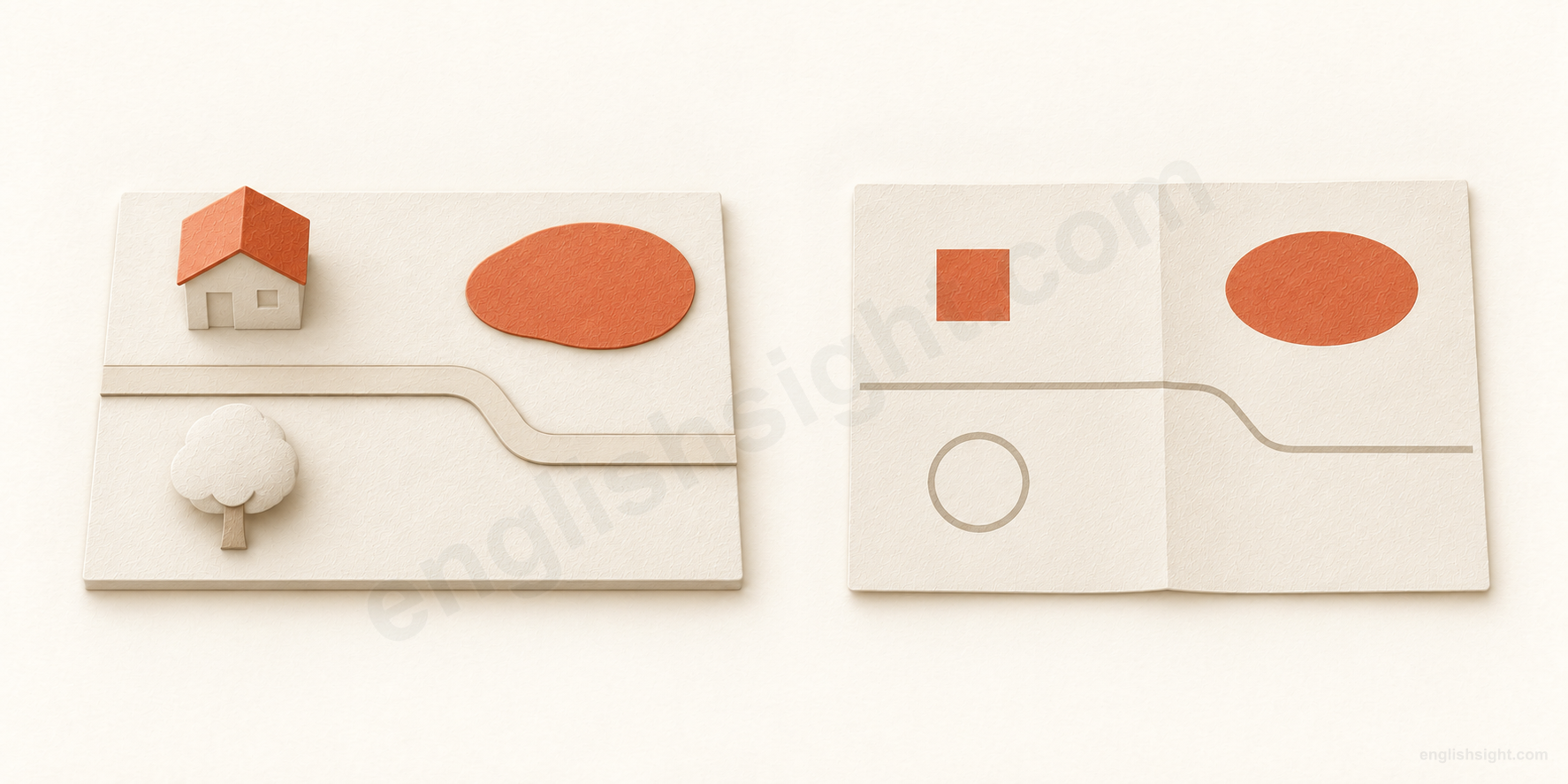
From finding a street to planning steps and matching one system to another.
An arrangement and its representation
An arrangement and its representation
A house, a tree, a pond, and a road form a small landscape.
map
The paper map keeps their relative layout visible.
Selected features become simple symbols with corresponding positions.
Simpler symbols show where the features are relative to one another.
A map represents where things are or how parts relate; to map is to work out or show that arrangement or a correspondence.
This is a teaching connection among modern uses, not a claim that every use has one literal meaning. A plan can concern a future arrangement, while idioms add established meanings.
A map selects features and shows how they are arranged. You can use one on paper or a screen to find a place, compare areas, or understand connections.
As a verb, map can mean making that representation, investigating an arrangement, or establishing a correspondence. Learn map out and the fixed expressions as whole patterns; a picture alone cannot predict their meanings.
01
Find places and read an area
Start with the countable noun: a representation of an area. Of names the area, while on locates a feature in the representation.
01
a / the + map + of + area; street / tourist / world map
a map of the city
a representation of an area
Situation or starting point
You need an overview of unfamiliar streets.
What the expression communicates
You can see where selected places are.
Of identifies the area represented.
Map is a countable noun here: a map, the map, two maps. A map of the city represents the city; a map of the world represents the world. It may be printed or digital.
A street map emphasizes streets, while a tourist map selects places useful to visitors. These are types of map, not new verb meanings. A map shows a layout rather than reproducing every visible detail like a photograph.
A map can also show part of the sky: a star map represents the positions of stars rather than streets.
In a sentence
We downloaded a map of the old town before leaving.
Watch the difference Say a map of the city when naming the area shown; for tourists describes the intended users.
02
read / check / consult / use / follow + a map
read a map
understand the information a map gives
Situation or starting point
You have a map but do not know which path to take.
What the expression communicates
You interpret its symbols and layout.
Reading a map means interpreting it, not only reading place names.
Read a map means understand what its marks and positions tell you. You can check or consult a map to answer a particular question, and use a map to find your way.
Follow the map means navigate using its information. A map does not have to contain a written list of instructions: you can work out the route from the layout.
In a sentence
Can you read this map and tell me which path reaches the lake?
Watch the difference Read a map does not mean create it; draw a map or make a map describes creating one.
03
find / show / mark + something + on + a / the map
on the map
shown in the representation
Situation or starting point
You need to locate the station.
What the expression communicates
Someone identifies its symbol.
On locates a place or mark in the map’s display.
Find a place on the map, or show someone where it is on the map. The place itself is elsewhere; its name or symbol is represented on the paper or screen.
Mark the campsite on the map asks someone to add an indication of its position. This is literal representation. The idiom put a place on the map instead means make it widely known.
In a sentence
She marked our campsite on the map.
Watch the difference For the represented position, use on the map, including on a digital map.
02
Show information and organize ideas
Maps also display distributions and relationships. The word before map tells you what information or purpose matters.
04
weather / geological / heat + map; a map of + distribution
a weather map / a heat map
a display showing how information varies over an area
Situation or starting point
Measurements come from many locations.
What the expression communicates
Their distribution is visible together.
The map organizes information by position.
A weather map shows weather information across an area. A geological map shows information about rock and ground. The first word specifies what the map presents; not every map is mainly a guide to streets.
A heat map uses colors or shades to show levels of activity or values. For example, a shop can use one to compare visitor activity in different areas. Heat in this term need not mean temperature.
In a sentence
The heat map shows which parts of the shop attract the most visitors.
Watch the difference Do not assume every heat map measures how hot places are. Read its key.
05
make / draw / create + a mind map; a mind map of + topic
a mind map
a diagram linking a central idea to related ideas
Situation or starting point
You have several ideas for an essay.
What the expression communicates
You arrange them around a main topic.
Connections between ideas replace physical geography.
A mind map is a diagram with a topic in the middle and related ideas arranged around it. Branches can make the relationships easier to see when studying or preparing to write.
This is a compound noun, not a command to map someone’s mind. The extension keeps the idea of a readable arrangement, but the positions represent conceptual connections rather than actual distances.
In a sentence
I made a mind map of my ideas before writing the essay.
Watch the difference Use a mind map for the diagram; a map in your mind may simply mean your mental sense of an area.
06
a road map for / to + goal; a road map of + area
a road map for the project
a plan showing a way toward a goal
Situation or starting point
A team knows its goal but needs a way forward.
What the expression communicates
A plan identifies stages or actions.
A route becomes a model for reaching a future goal.
A literal road map shows roads for travel. In a project or policy discussion, a road map can instead mean a plan for reaching a goal or guidance on how to proceed.
We need a road map for the project asks for an organized way forward, not a drawing of streets. Map out the project describes the action of planning; a road map names the resulting guide.
In a sentence
The team agreed on a road map for launching the new service.
Watch the difference A road map can give broad stages; it does not automatically guarantee every detail or a successful outcome.
03
Map, plan, and match
The verb can describe representing, investigating, or planning. Map out makes detailed planning explicit, while to and onto can introduce a corresponding item or system.
07
map + area / surface; be mapped; make a map of + area
map an area
make a representation of an area
Situation or starting point
The coastline has not been recorded in detail.
What the expression communicates
Its features are represented on a map.
The object is the area being represented.
As a transitive verb, map takes the area or surface as its object: map the coast, map an island. The work can include surveying or gathering measurements, not only drawing lines by hand.
The coastline was mapped last year focuses on the area rather than who did the work. Make a map of the island expresses the same basic task with a noun phrase. Map the island does not mean travel to it.
In a sentence
The survey team is mapping the coastline with drones.
Watch the difference Double p in mapped and mapping; do not write maped or maping.
08
map + system / network / relationships; map how + clause
map the relationships
work out or show how something is arranged
Situation or starting point
A team has information about several services.
What the expression communicates
Their links become visible.
The object can be a system or its relationships, not just land.
Map can describe investigating and showing an arrangement: map a network, map the relationships between teams. The result may be a diagram or another organized representation.
The emphasis is on where the parts belong and how they connect. Simply listing team names may not map their relationships. This use extends the representational idea without requiring a geographical map.
In a sentence
We mapped the relationships between the local support services.
Watch the difference Map a system does not necessarily mean redesign or improve it.
09
map out + noun; map + noun / pronoun + out; be mapped out
map out a plan
decide or arrange details before acting
Situation or starting point
You have an idea but no clear sequence.
What the expression communicates
You work out steps and arrangements.
Out belongs to the planning expression.
Map out a journey, a strategy, or your future means plan it in some detail. For a journey this may include choosing a route; for a project it may involve deciding stages, timing, and responsibilities. A drawn map is optional. Map without out can also mean plan in detail; the planning sense does not depend on out alone.
This phrasal verb is separable: map out the steps and map the steps out are possible. Put a personal pronoun between the verb and particle: map them out. The steps have been mapped out is a normal passive.
Compare We mapped the valley, which concerns representing an area, with We mapped out our route through the valley, which concerns deciding how to travel.
In a sentence
Before we start, let’s map out the steps and decide who will do each one.
Watch the difference Say map it out, not map out it. Planning does not mean the actions have already happened.
10
map + item + to + corresponding item / action
map A to B
establish a correspondence or assignment
Situation or starting point
An input needs an assigned action or destination.
What the expression communicates
A rule links it to the corresponding item.
To introduces what the item is assigned to.
In computing or other technical work, map A to B can mean assign A a corresponding B. Mapping a key to an action tells the system which action that input should trigger.
The verb describes a relation, not a trip from A to B. In Map this key to the mute function, this key is the direct object and the phrase with to identifies its assignment. This is a useful workplace extension, not a lesson in a specific software tool.
In a sentence
You can map this key to the mute function.
Watch the difference Read to as introducing an assignment here; it does not mean that a key physically moves.
11
A maps onto B; map + A + on / onto + B
map onto another system
correspond to another arrangement
Situation or starting point
Two systems describe related things differently.
What the expression communicates
You check how their parts match.
Onto introduces the system used for comparison.
A maps onto B can say that the parts or categories of A correspond to those of B. It often appears in academic or workplace discussion. The categories do not map neatly onto each other means the match is imperfect.
With an object, map A onto B means relate A’s items to B’s items. Oxford also records map A on B. Unlike map it out, this construction keeps the preposition with its following complement: map these categories onto those groups.
In a sentence
The old job titles do not map neatly onto the new roles.
Watch the difference Do not assume map onto always promises a perfect or one-to-one match; context determines the correspondence.
04
Recognition, remoteness, and variation
These established expressions use the idea of a map in different ways. Read the whole phrase and its context.
12
put + person / thing / place + on the map; be on the map; put + object + back on the map
put someone or something on the map
make someone or something widely known or important
Situation or starting point
A place or person has little recognition.
What the expression communicates
More people know about it or them.
The map is a metaphor for public attention.
A successful event, product, or achievement can put a town, company, or person on the map. The expression concerns recognition or importance, not adding an actual printed label.
Be on the map describes the resulting prominence. Put it back on the map means restore attention after a quieter period. Compare The town is marked on the map, which simply locates it in a representation.
In a sentence
The annual music festival put the small town on the map.
Watch the difference The cause need not be a person: an event or an achievement can be the subject of put.
13
be + off the map; off this / that map
off the map
remote or outside attention, depending on context
Situation or starting point
A village is far from familiar destinations.
What the expression communicates
You describe it as very remote.
Off can suggest distance from the familiar world or loss of prominence.
The village is off the map can describe a very remote place. It need not mean that no map records it. Literally, off this map can also mean outside the area the particular map covers.
Another established use concerns no longer being important or in existence, especially in wipe off the map. Use context to distinguish remoteness, literal omission, and disappearance; do not treat them as identical.
In a sentence
We stayed in a tiny village that felt completely off the map.
Watch the difference Off the map is not the same as offline: a remote place may still have internet access.
14
prices / opinions / an explanation + be + all over the map
all over the map
widely varied or disorganized
Situation or starting point
You compare prices or listen to a rambling argument.
What the expression communicates
There is no consistent level or clear focus.
Scattered positions become a model for variation or lack of order.
Prices are all over the map means they vary widely. His explanation was all over the map means it moved between points without clear organization. The expression is informal, especially associated with North American English.
The first use concerns variation; the second concerns focus or order. Neither necessarily describes geographical travel. In a literal sentence about pins all over the map, however, the words may simply describe where the marks appear.
In a sentence
The repair estimates were all over the map, from fifty to five hundred dollars.
Watch the difference Do not automatically interpret this as everywhere in the world; identify what is varying or unfocused.
15
wipe + object + off the map; be wiped off the map
wipe something off the map
destroy or remove something completely
Situation or starting point
A settlement exists.
What the expression communicates
A disaster destroys it.
The whole expression conveys drastic destruction or removal.
A flood or other disaster can wipe a village off the map. The expression is strong: the village is destroyed, not merely missing a name on a new edition of a map.
The village was wiped off the map is a normal passive. Keep the complete construction wipe + object + off the map. In figurative contexts the target may be an organization or activity that disappears, but the image remains drastic.
In a sentence
The landslide wiped the old settlement off the map.
Watch the difference This is much stronger than damage, inconvenience, or temporarily close.
Keep the representation and the reality distinct
Forms and grammar
Map is pronounced /mæp/. The countable noun has plural maps. Verb forms are map, maps, mapped, mapping: double the final p before -ed and -ing. The verb can be progressive or passive: They are mapping the coast; The coast has been mapped. It has no special everyday causative construction.
A map, a plan, and an atlas
A map normally shows an area or an arrangement. A plan may show a building layout or describe intended actions. An atlas is a collection of maps, usually a book. In navigation, a chart can be a specialized map; elsewhere chart may mean a table or another kind of diagram. These words overlap without being freely interchangeable.
The model has limits
Maps select information and may simplify shapes, distances, or connections. Mapping something does not by itself mean changing it or understanding every detail. On the map and off the map can describe literal representation or idiomatic status; the surrounding words decide.
Scope of this lesson
The lesson covers ordinary navigation, general information displays, planning, workplace correspondence, and familiar idioms. Genetic maps, mathematical functions, and detailed software operations require specialist explanations. The old slang use of map for a face and capitalized names or abbreviations are not taught here.
Choose the relationship
Decide whether the speaker means a representation, a plan, a correspondence, or an idiom.
1. You want a representation showing the town. Which phrase names the area shown?
2. You have a project idea and want to plan its details. Which sentence uses the pronoun naturally?
3. A festival made a quiet town famous. Which sentence expresses that result?
4. Old job titles do not match the new roles straightforwardly. Which sentence captures this?
5. A shop’s heat map shows where customers spend time. Must it display temperature?
6. Repair prices range from fifty to five hundred dollars. What does all over the map mean here?
Sources and teaching notes
Dictionary entries support the senses and constructions below. Explanations, examples, and the visual teaching model were created for this lesson. The coverage file records the source-to-unit mapping and scope.
The diagram is a teaching aid; English speakers do not all share one mental picture.