Use mark for visible traces, identifying signals, assessments, and familiar fixed expressions.
A recognizable trace or sign
A recognizable trace or sign
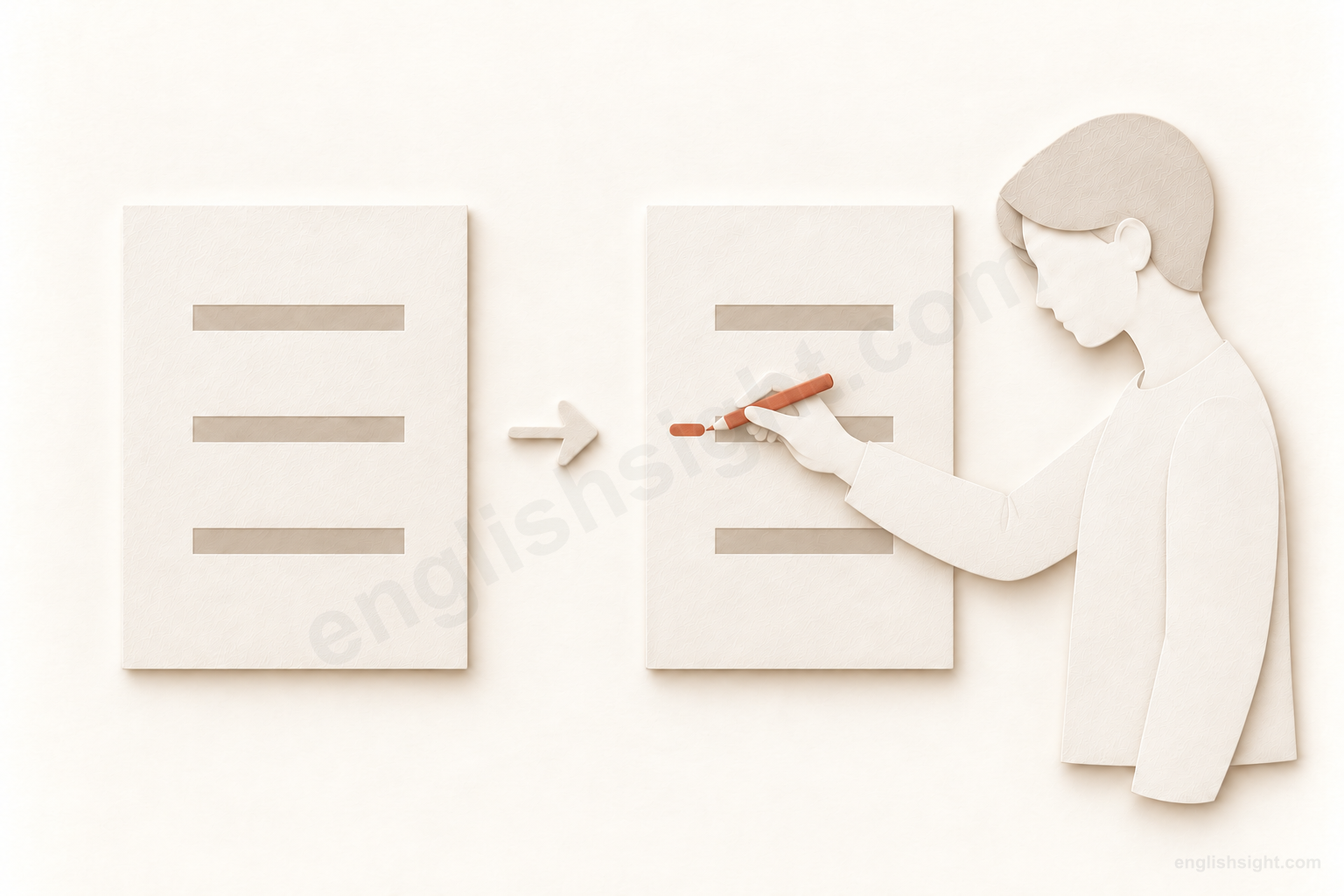
Three list entries have no distinguishing sign.
mark
The dash makes the middle entry easy to identify.
A person adds an orange dash beside the middle entry.
A small sign singles out one item; here it is deliberately added.
A mark is a recognizable trace or sign; to mark is to leave or use one to identify something, or to serve as such a sign.
The sketch shows deliberate information being added. It does not imply that every mark is intentional, physical, permanent, or evidence of damage. The currency name and specialized uses are outside this teaching connection.
A mark can be a trace left on a surface or a sign that lets us identify something. To mark can mean make that trace, add identifying information, or serve as the sign of a place, quality, or important moment.
This is a teaching connection between many uses, not a rule that produces every meaning. Marks can be accidental, natural, or deliberate. Scoring, defending a player, and fixed expressions need their own contexts; the diagram is not a claim about a picture shared by every English speaker.
01
Visible traces and written signs
A mark can be an accidental trace, a natural identifying feature, or a deliberate symbol. The verb can describe making the trace or adding information.
01
a mark on + surface; leave / make + a mark
a mark on something
a visible spot, line, or trace on a surface
Situation / context
A wet bag rests on a wooden table.
What the expression conveys
A darker patch remains after the bag is removed.
A mark is what can be seen; the cause need not be deliberate.
A mark is countable: a mark, two marks. Dirt, pressure, heat, or contact can leave marks. A scratch mark is a line caused by scraping; a burn mark records heat damage. The word itself does not say how the mark was made.
A stain usually suggests discoloration that is difficult to remove; a scar suggests a lasting trace of injury. Mark is broader, and it need not be permanent. Leave a mark describes the resulting trace, while make a mark can describe creating one.
In a sentence
The wet bag left a dark mark on the table.
Watch the difference Say a mark on the table, not a mark in the table for an ordinary surface trace.
02
have + a mark on + body part; distinguishing marks
a distinguishing mark
a visible feature that helps identify someone or something
Situation / context
Several similar dogs are in the park.
What the expression conveys
One dog is recognizable by a patch of colour.
An identifying mark may be natural rather than made by a person.
A mark on an animal or person can be a naturally occurring area of colour or another visible distinguishing feature. Here the important relation is recognition, not damage: the mark helps us pick out the individual.
An animal can have a white mark on its chest. Distinguishing marks can also include scars. Do not assume that every mark is a wound or that somebody deliberately put it there.
In a sentence
Our dog has a white mark on her chest.
Watch the difference A natural mark is not necessarily a stain to be cleaned off.
03
a pencil / punctuation / check mark; put a mark beside something
a pencil mark / a punctuation mark
a written or printed sign
Situation / context
You need to return to one line of a document.
What the expression conveys
A small sign beside it makes it easy to find.
A symbol can carry information because people know how to read it.
A pencil mark may be only a stroke or dot; its purpose comes from the context. Punctuation marks, such as a question mark, exclamation mark, or quotation marks, have conventional functions in writing. A check mark, usually a tick in British English, often records selection or checking.
A maker’s mark identifies the producer of an object. A mark can also be a cross made instead of a written signature. These are uses of a visible sign, but the information carried by a particular shape is learned, not supplied by mark alone.
In a sentence
I put a pencil mark beside the paragraph I wanted to check.
Watch the difference A mark need not be a word or a complete drawing.
04
mark A with B; mark B on A; be marked + label; goods marked at + price
mark something with / mark something on
put identifying information on an object
Situation / context
The boxes look the same.
What the expression conveys
Each box has a label identifying its owner.
With introduces the information; on introduces the surface carrying it.
Mark each box with your name makes the box the object and names the label after with. Mark your name on each box makes the name the object and names the surface after on. Both describe adding identifying information.
The passive is useful when the label matters more than its writer: The boxes are marked with our names. A package marked “Fragile” has that word on it; the quoted word describes the label, not a separate action.
Marked for export designates the intended destination or purpose. A box marked for export is assigned to that use; it has not necessarily been sent yet. This can overlap with an actual written label.
Goods marked at £20 have that displayed price. At introduces the price shown, while marked down to £20 reports a reduction to that price. A price label alone does not tell us whether the price has changed.
In a sentence
Please mark each box with your name.
Watch the difference Mark the box with your name and mark your name on the box have different objects.
05
mark + object + adjective; mark + object + as + category
mark someone absent / mark something as urgent
record a status or category
Situation / context
The register has no attendance status beside a name.
What the expression conveys
The record now shows that the person is absent.
The complement tells us what status is being recorded.
Mark someone absent means record that the person is absent. It does not cause their absence. Similarly, mark an answer wrong records a judgment about it, and mark a message as urgent assigns a category or priority.
An adjective can directly follow the object: mark it urgent, mark her present. As can introduce a category: mark it as important. In the passive, The message was marked as urgent describes the recorded status, which may or may not be correct.
In a sentence
The receptionist marked me absent by mistake.
Watch the difference Mark me absent does not mean make me become absent.
06
mark + surface; material + marks easily
mark a surface / a surface marks easily
leave an unwanted trace, or be easily affected by one
Situation / context
You place a sharp object on a soft surface.
What the expression conveys
A scratch or dent spoils its appearance.
The object may cause a mark, while the surface can also be the subject.
The chair marked the floor presents the chair as the cause of unwanted traces. This is a transitive use: the floor is the object affected. The trace may involve dirt or damage rather than deliberate labeling.
This leather marks easily describes how easily the material develops visible traces. It is an intransitive use with no object. This is not the same event description as The leather is being marked, which is a passive construction.
In a sentence
These chair legs can mark the floor.
Watch the difference The table marks easily is possible; you do not have to add an object after marks.
02
Places, qualities, and important moments
Something can mark a location, reveal a quality, or identify a turning point without anyone drawing a line. Read the subject and its relation to what follows.
07
sign / object + marks + position; mark where + clause
mark the spot / mark the boundary
show where a place, route, or limit is
Situation / context
You need to find a particular position.
What the expression conveys
A visible feature indicates its location.
The subject can already be there; marking need not involve drawing.
A stone marks the boundary means the stone indicates where the boundary is. A cross marks the spot on a map. The indicator is the subject, and the position or limit it identifies is the object.
Compare We marked the route in red, where people add the signs, with Red arrows mark the route, where existing signs show the way. Mark where the holes should go uses a clause to specify the required positions.
In a sentence
A row of stones marks the edge of the path.
Watch the difference Mark the border need not mean create or change the border.
08
as a mark of + feeling; the mark of + person / quality
a mark of respect / the mark of a professional
an action or feature that reveals a feeling or quality
Situation / context
An action or habit is observed.
What the expression conveys
People understand it as evidence of a feeling or quality.
Of links the sign to what it expresses or reveals.
As a mark of respect explains the meaning of a gesture: it is performed to show respect. A mark of gratitude works similarly. No ink mark is required; an action functions as a sign.
The mark of a good teacher identifies a characteristic used to recognize a good teacher. The choice between a and the depends on whether you present one possible sign or a defining characteristic. It does not mean an exam score belonging to a teacher.
In a sentence
We stood in silence as a mark of respect.
Watch the difference A mark of respect shows respect; it does not grade how respectful someone is.
09
be marked by + feature / experience; feature + mark + period
be marked by something
have a prominent quality or lasting influence
Situation / context
You consider what stands out about an experience.
What the expression conveys
One quality or event strongly characterizes it.
By names the feature or influence, not necessarily a person holding a pen.
A period marked by uncertainty is characterized by uncertainty. The passive is common in formal descriptions. The feature may be positive or negative; marked by kindness does not imply damage.
An active version is also possible: Delays marked the early stages of the project. Compare a surface marked with paint, which refers to visible material, with a life marked by hardship, which describes an important influence or character.
The related adjective marked in a marked improvement means clear and noticeable. The stress and form match the verb’s participle, but the phrase need not describe any marking action.
In a sentence
Their first year in business was marked by constant uncertainty.
Watch the difference Marked by does not always describe a visible mark or a harmful experience.
10
feature + marks + person + as + noun phrase
mark someone as something
show that someone belongs to a type or category
Situation / context
Someone’s behaviour provides a clue to their character.
What the expression conveys
Others recognize a particular quality or identity.
The feature identifies the person; no written label is necessary.
Her patience marks her as a good listener means the patience reveals something about her. The feature is the subject, her is the object, and as a good listener names the identity inferred.
Compare They marked her as present, which records a status, with Her accent marked her as an outsider, which reveals an identity. Context distinguishes administrative labeling from an observable sign.
In a sentence
His careful questions marked him as an experienced interviewer.
Watch the difference As introduces the classification; do not use to be after mark in this pattern.
11
event + mark + beginning / end / turning point
mark the beginning / mark a turning point
identify or constitute an important stage or change
Situation / context
A process has been in one phase.
What the expression conveys
An event identifies the start of a different phase.
The event itself serves as the sign of the transition.
The opening marked the start of a new chapter identifies the opening as the significant event at the boundary between stages. Mark can connect an event with a beginning, end, milestone, or turning point.
This does not always say the event caused every later development. It identifies its significance in a sequence. No person has to draw a physical mark on a timeline.
In a sentence
The first public test marked a turning point in the project.
Watch the difference Mark a change identifies a significant development; it need not mean deliberately celebrate it.
12
mark + event + with + activity; do something + to mark + occasion
mark an anniversary / mark the occasion
acknowledge an important event with an action
Situation / context
An anniversary or significant occasion arrives.
What the expression conveys
People do something to acknowledge its importance.
An intentional observance makes the occasion stand out.
People mark an anniversary with a meal, a ceremony, or another deliberate act. Mark the occasion focuses on acknowledging significance. The event may be joyful or sad, so celebrate is not always an appropriate substitute.
In We held a concert to mark the anniversary, to mark expresses the purpose of the concert. With can name the observance: We marked the anniversary with a concert. This is different from an event merely marking a change.
In a sentence
The town marked the anniversary with a small exhibition.
Watch the difference You can mark a tragedy’s anniversary without celebrating the tragedy.
03
Schoolwork, scores, and judgments
Marks can record an assessment. These educational uses are especially familiar in British English; points, scores, grades, and grade are useful alternatives in American English.
13
mark + schoolwork; mark without an object; do some marking
mark homework / do the marking
check and assess students’ work
Situation / context
Students submit their work.
What the expression conveys
A teacher checks it and records an assessment.
Marking is assessment, not simply putting random signs on paper.
In British English, teachers mark essays, tests, and homework. They may correct errors, add comments, and assign marks. Grade is the usual American verb for this assessment, though mark is understood in context.
Mark can occur without an object when the activity is clear: I was marking all evening. Marking is also an uncountable activity noun: I have some marking to do. A paper being marked is undergoing assessment; a marked paper has already been assessed.
In a sentence
I was marking essays when you called.
Watch the difference Mark homework does not mean do the homework as a student.
14
get / award / lose + marks; marks for; marks out of; pass mark
get eight marks out of ten
receive points or an overall assessment
Situation / context
Answers are assessed against a scoring system.
What the expression conveys
A student receives a total or a grade.
A mark can be one point or the recorded assessment of the work.
You can get two marks for an answer, lose marks for mistakes, or get a good mark in a subject. Eight marks out of ten gives both the achieved and maximum totals. The pass mark is the minimum result needed to pass.
In British educational use, marks may be points or a reported number or letter. American English often uses points for individual scoring units, a score for the total, and a grade for the overall assessment. These terms overlap; mark is not simply a British word for every use of grade.
In a sentence
I got eight marks out of ten on the quiz.
Watch the difference Out of ten gives the maximum possible score, not ten additional points.
15
get full marks; give someone high / top marks for + noun / -ing
full marks / high marks for effort
all available points, or praise for a quality
Situation / context
Someone performs a task.
What the expression conveys
The result receives complete credit or strong approval.
A scoring expression can also convey ordinary praise.
Full marks literally means all the possible marks: She got full marks in the test. High or top marks means a very good assessment, but not necessarily the maximum. Low or poor marks gives the opposite evaluation.
Outside school, Full marks for honesty praises someone’s honesty. We give the team high marks for communication evaluates its work positively. Praise can also be ironic in a suitable tone, so full marks does not automatically report an actual exam.
In a sentence
Full marks to Maya for admitting the mistake.
Watch the difference High marks are not necessarily full marks; full marks for effort can be praise without a score.
16
mark + person + down + for + fault; be marked down
mark someone down
reduce someone’s assessment because of a fault
Situation / context
A piece of work has an expected score.
What the expression conveys
Errors result in a lower score.
Down lowers the assessment, not the student’s physical position.
In British educational usage, a teacher may mark someone down for poor spelling. The person is the object, while for introduces the fault that costs marks. A passive is natural: I was marked down for missing the final question.
This separable phrasal verb puts a pronoun between the verb and particle: mark me down. With goods rather than a student, mark something down usually concerns a price reduction. The kind of object helps select the meaning.
In a sentence
The examiner marked me down for not showing my calculations.
Watch the difference Mark me down, not mark down me.
04
Prices, lists, boundaries, and classifications
Down, up, off, and out help form established multiword verbs. Price changes, notes, completed tasks, and judgments need distinct interpretations.
17
mark + goods / price + down / up; to + new price; by + change
mark down / mark up the price
reduce or increase the selling price
Situation / context
A shop has an existing price for an item.
What the expression conveys
The displayed or charged price is lower or higher.
Down and up choose the direction of the price adjustment.
A shop marks a jacket down when it reduces the jacket’s price; it marks it up when it increases it. These are separable phrasal verbs: mark the jacket down, mark down the jacket, and mark it down. The same placement works with up.
To gives the new price; by gives the size of the change. The jacket was marked down to £30 gives the final price. Marked down by £10 gives the reduction. Neither particle says that the item has been physically moved.
In a sentence
The shop marked the coat down from £60 to £45.
Watch the difference Do not confuse marked down to £45 with marked down by £45.
18
mark + information + down; be marked down for + intended action
mark something down
make a written note for later use
Situation / context
You hear information that you will need later.
What the expression conveys
It is recorded so that you can refer to it.
Here down belongs to a note-taking expression, not a price change.
Mark something down can mean record it in writing. I marked down the time means I made a note of it. Write down and note down are useful alternatives; the object and context distinguish this from discounting goods.
The passive can also record an intended action: The building is marked down for demolition. That says demolition is planned or designated, not that it has already happened. With a pronoun, use mark it down.
In a sentence
I marked down the address before closing the message.
Watch the difference Mark down the address records it; it does not make the address lower.
19
mark + person + down as + noun phrase
mark someone down as something
form a judgment about what type of person someone is
Situation / context
You meet someone and interpret their behaviour.
What the expression conveys
You mentally classify that person.
The label can exist in someone’s judgment without being written.
Especially in British English, mark someone down as a beginner means judge them to be a beginner. I had her marked down as a cautious driver reports my earlier impression; it does not guarantee the judgment was right.
Contrast mark her down for poor driving, which lowers an assessment, and mark her down as a poor driver, which classifies her. As introduces the type of person, while for can give the reason for a penalty.
In a sentence
I had him marked down as a beginner, but he won easily.
Watch the difference Keep the person before down: mark him down as a beginner.
20
mark + text + up; mark up + document
mark up a document
add corrections or instructions to a text
Situation / context
A draft needs changes.
What the expression conveys
Notes or editing signs show the required revisions.
Up helps form an annotation expression; it does not necessarily mean more expensive.
An editor marks up a draft by adding corrections, comments, or instructions. This is a publishing or editing use. The document can be paper or electronic; the purpose is to communicate changes.
Mark up the draft and mark the draft up are both possible; with a pronoun, mark it up. Compare mark the price up, which raises a price, and mark an essay, which assesses student work. Editing annotations need not include a grade.
In a sentence
The editor marked up the draft before our meeting.
Watch the difference Mark it up, not mark up it; a marked-up draft is not necessarily an assessed exam.
21
mark + item + off; mark items off + list
mark items off a list
show that listed items have been dealt with
Situation / context
A list contains tasks still to check.
What the expression conveys
Signs show which tasks have been completed or checked.
Off removes an item from the outstanding set, not necessarily from the page.
Mark an item off means put a sign beside it or through it to record that it has been dealt with. Mark off the names can show that those people have been checked, contacted, or otherwise processed; context supplies which action.
This does not require deleting the words. Mark each one off and mark them off are natural pronoun patterns. Cross off more specifically suggests drawing a line through an item; tick off suggests a tick.
In a sentence
I marked each delivery off the list as it arrived.
Watch the difference A mark records that something is dealt with; it does not perform the task itself.
22
mark + area + out / off; mark out / off + area
mark out an area / mark an area off
show an area’s outline or separate it by a marked boundary
Situation / context
An open area has no clear divisions.
What the expression conveys
Lines show the intended edges or a separate section.
Out emphasizes the outline; off emphasizes separation.
Mark out a court means draw lines showing its edges and layout. Mark off an area means separate it from the rest by a line or other visible boundary. These uses overlap, but their focus differs.
Neither expression means remove the area. Both are separable with ordinary noun objects; pronouns go between verb and particle: mark it out, mark it off. With can introduce the material or method used for the lines.
In a sentence
We marked out a small court with chalk.
Watch the difference Mark out defines the area; it does not mean erase it.
23
feature + mark + person / thing + off from + others
mark something off from something
make one person or thing recognizably different
Situation / context
Several places or people seem similar.
What the expression conveys
A feature makes one stand apart from the others.
Off and from express differentiation rather than physical removal.
A distinctive style can mark one artist off from others. The style is the distinguishing feature, the artist is the object, and from introduces the comparison group. There need not be a visible dividing line.
Compare physically marking off a section of a room with a quality marking one town off from another. The spatial separation is a useful teaching connection, but the figurative expression describes a difference in character.
In a sentence
Its steep streets mark the village off from its neighbours.
Watch the difference Use from to name what it differs from; no actual barrier is required.
24
mark + person + out as + type; be marked out for + role / prospect
mark someone out as / for something
make a person stand out as a particular type or prospect
Situation / context
Someone shows an exceptional ability.
What the expression conveys
Others recognize that person as distinctive or suited for a role.
Out highlights distinction; as names a type and for names a prospect.
Her calm judgment marked her out as a leader means it made her stand out and be recognized as a leader. This often suggests someone special, rather than an arbitrary category written on a form.
She was marked out for promotion means she was singled out as a likely or suitable candidate. It does not promise that promotion happened. With pronouns use marked her out, not marked out her.
In a sentence
Her clear explanations marked her out as a gifted teacher.
Watch the difference Marked out as gifted reveals a distinction; marked down as gifted reports someone’s classification.
05
Influence, limits, and reference levels
A trace becomes a useful metaphor for lasting influence, a boundary, a target, or a level. These expressions work as conventional units, with their own grammar.
25
leave + a / your / its mark + on + affected person / thing
leave a mark on someone / something
have a lasting effect
Situation / context
An experience happens and then ends.
What the expression conveys
Its effects remain in someone’s life or in a place.
The trace is a continuing influence, which may be invisible.
A difficult experience can leave its mark on someone long after it ends. This often refers to harm, but lasting influence can also be positive. The subject can be an event, person, or period, and on names what is affected.
Compare a cup leaving a mark on a table with a teacher leaving a mark on a community. The trace connects the uses as a teaching metaphor; only the first necessarily refers to something visible.
In a sentence
Years of neglect have left their mark on the building.
Watch the difference Leave a mark can describe lasting damage or influence; it does not automatically mean achieve fame.
26
make + possessive + mark + in / on + field; as + role
make your mark
become recognized and successful in a field
Situation / context
A newcomer has little reputation in a field.
What the expression conveys
Their achievements gain attention and recognition.
The expression concerns achievement and reputation, not just any lasting effect.
Make your mark means gain recognition through what you achieve. On can name the field influenced, in can name the area of activity, and as can name the role: make her mark in design, make her mark as a designer.
The possessive follows the person: I made my mark; she made her mark. A literal pencil mark and the idiom are different readings. Leave your mark is broader and can include unintended or harmful influence.
In a sentence
Nina made her mark as a designer with her first collection.
Watch the difference Make your mark implies achievement; a bad experience leaving its mark does not.
27
reach / pass / approach + the + quantity + mark; at the halfway mark
reach the hundred mark / the halfway mark
reach a significant level or stage
Situation / context
A total or process is increasing or progressing.
What the expression conveys
It reaches a reference point worth noticing.
The mark is a level or stage, which need not be a drawn line.
The thousand mark refers to the level of one thousand in the current measurement: sales, members, money, or another total. Reach, pass, approach, and fall below specify how the quantity relates to that level.
At the halfway mark can locate a stage in time or progress. In The meeting was still lively at the two-hour mark, mark identifies elapsed time. It does not refer to the meeting’s exam grade.
In a sentence
Membership has passed the five-hundred mark.
Watch the difference State the measured quantity through context; mark alone does not mean five hundred people.
28
Mark + version number; gas mark + setting number
Mark II / gas mark 4
a model designation or a British oven setting
Situation / context
A product version or cooking instruction needs a precise label.
What the expression conveys
A number identifies the version or oven setting.
Numbered labels are established systems, not ordinary exam marks.
Mark followed by a number can identify a version of a machine or vehicle. The Mark II version is a model designation; Roman numerals are common, and the capital letter is common in product names. It does not necessarily describe a visible mark on that product.
In British recipes, gas mark followed by a number specifies an oven setting. Set the oven to gas mark 4 is a cooking instruction, not a score of four. These model and temperature systems must be learned in their own contexts.
In a sentence
This is the Mark II version of the device.
Watch the difference Gas mark 4 is not 4 degrees; check the appliance or recipe for the required setting.
29
hit / miss + the mark
hit / miss the mark
reach a target, or achieve / fail at an intended effect
Situation / context
An action aims at a target or a purpose.
What the expression conveys
It either achieves the aim or fails to do so.
The target may be physical or figurative.
An arrow can hit its mark: the mark is the target. In a figurative use, a joke hits the mark if it produces the intended response, while advice misses the mark if it does not address what is needed.
The metaphor is about success relative to an aim. It does not always concern the truth of a statement. A well-timed speech can hit the mark by moving an audience even if no numerical estimate is involved.
In a sentence
The safety message missed the mark because nobody understood it.
Watch the difference Miss the mark can mean fail in purpose, not simply make a factual mistake.
30
be on / off / wide of / close to + the mark
on / off / wide of the mark
accurate, inaccurate, or very inaccurate
Situation / context
Someone makes a prediction or estimate.
What the expression conveys
Its closeness to the truth is assessed.
The mark is a reference point for accuracy.
An estimate that is on the mark is accurate; one that is off the mark is inaccurate. Wide of the mark emphasizes a substantial error. Close to or near the mark means fairly accurate, not necessarily exact.
Your estimate was on the mark comments on its accuracy. You were quick off the mark instead comments on how fast you reacted. The prepositions and surrounding expression matter; off does not always mean wrong in every phrase containing mark.
In a sentence
My guess of fifty guests was close to the mark; fifty-three came.
Watch the difference Close to the mark is approximate; right on the mark suggests accuracy.
31
be up to the mark; fall short of the mark; not feel up to the mark
up to the mark / fall short of the mark
meet a required standard, or fail to meet it
Situation / context
Work is compared with an expected quality level.
What the expression conveys
It is judged acceptable or below the requirement.
The mark is a standard rather than an individual point awarded.
Up to the mark, especially in British English, means as good as required. The repairs are not up to the mark says their quality is inadequate. Fall short of the mark similarly describes failure to reach a needed standard.
A separate British, old-fashioned expression is not feel up to the mark, meaning not feel as well or energetic as usual: I’m not feeling up to the mark today. This personal health use should not be confused with receiving a poor exam score.
In a sentence
The repairs were tidy, but the final finish was not up to the mark.
Watch the difference Up to the mark describes adequacy, not necessarily outstanding quality.
32
overstep + the mark
overstep the mark
go beyond what people consider acceptable
Situation / context
A conversation or action has an understood limit.
What the expression conveys
Someone behaves in a way that crosses that limit.
The mark acts as a figurative boundary of acceptable behaviour.
If a joke becomes personally insulting, the speaker may have overstepped the mark. This expression evaluates behaviour against a social limit. It need not involve a written rule or a literal line.
Overstep the line is a close alternative. The simple past overstepped and the participle overstepped double the final p in step. Do not substitute miss the mark if you mean unacceptable behaviour rather than failure to achieve an aim.
In a sentence
You overstepped the mark when you mocked her family.
Watch the difference Overstepping the mark can happen even when the speaker achieves an intended effect.
33
a black mark against + person / record
a black mark against someone
a fault or incident that counts against a reputation
Situation / context
Someone’s record or character is evaluated.
What the expression conveys
A bad incident gives others a reason for disapproval.
A figurative mark records something unfavourable.
A black mark against someone is a negative point in their record or reputation. It can be an actual recorded fault, but it can also exist only in people’s opinions.
Against introduces the person whose reputation is affected. A black mark on a wall may simply be a dark stain; the reputational reading depends on the full expression and the situation.
In a sentence
Missing the interview was a black mark against his application.
Watch the difference A black mark is disapproval or a negative record, not a positive exam point.
34
a question mark over / against + noun; a question mark over whether + clause
a question mark over something
uncertainty about a situation or prospect
Situation / context
A plan appears possible but important information is missing.
What the expression conveys
Its future remains doubtful.
The punctuation sign becomes an image of an unresolved question.
A question mark over a plan means something about it is uncertain. There need not be a literal question mark written over a document. Funding problems can leave a question mark over whether an event will happen.
Against is also possible, often when a person’s ability or a claim’s reliability is in doubt. The expression signals an unresolved issue; it does not establish that the plan has failed or that the person is incapable.
In a sentence
There is still a question mark over next year’s funding.
Watch the difference Uncertainty is not the same as a confirmed cancellation.
06
Starting, waiting, warning, and defending
These established expressions extend beyond making a visible sign. Learn their situations and register rather than trying to reconstruct every meaning from the picture.
35
On your marks, get set, go!
On your marks, get set, go!
commands for runners to prepare and start
Situation / context
Runners wait before a race.
What the expression conveys
They take their starting positions, prepare, and begin.
Marks refers to starting positions within an established command sequence.
On your marks tells runners to take their assigned starting positions. Get set tells them to prepare to start. Go is the signal to begin in this familiar spoken sequence.
Learn on your marks as the conventional command addressed to the runners. American English also uses the singular on your mark. The sequence can be used playfully before a task, but it does not instruct runners to collect exam marks.
In a sentence
The coach called, “On your marks, get set, go!”
Watch the difference On your marks is preparation, not the signal to start running immediately.
36
be quick / slow off the mark + in + -ing; be quick / slow off the mark
quick / slow off the mark
quick or slow to react or start
Situation / context
A new opportunity or problem appears.
What the expression conveys
Someone reacts promptly or takes too long.
This uses the image of a start; it does not assess accuracy.
Be quick off the mark describes prompt action when an opportunity appears or a response is needed. Be slow off the mark describes a delayed start or reaction. The phrase can apply to individuals, teams, or organizations.
Compare Her response was off the mark, meaning inaccurate, with She was slow off the mark, meaning slow to respond. A person can react quickly and still give a wrong answer.
In a sentence
We were quick off the mark and booked the last two seats.
Watch the difference Quick off the mark does not mean careless or inaccurate; speed and accuracy are separate.
37
player / team + get off the mark + with + first score
get off the mark
score for the first time in a game or contest
Situation / context
A player or team has not scored yet.
What the expression conveys
Its first point or score is recorded.
The expression concerns beginning to score, not necessarily winning.
In sports reporting, get off the mark means start scoring. A player can get off the mark late in a game even though they have been playing from the beginning.
It differs from quick off the mark, which describes reaction speed. The first score need not be large or decisive, and getting off the mark does not mean leaving the playing area.
In a sentence
The team finally got off the mark with a late goal.
Watch the difference Got off the mark does not by itself say that the team won.
38
mark time; be marking time + until / while + clause
mark time
wait without making progress; march without advancing
Situation / context
Someone is active but cannot move forward.
What the expression conveys
Time passes without progress toward the desired next stage.
The marching use provides a useful connection, but the waiting sense is conventional.
Soldiers mark time when they make marching movements while remaining in one place. Figuratively, someone marking time is waiting for something better or for a decision, without making real progress.
The progressive is natural: I’m just marking time until the course starts. This is not simply recording the time on a clock. Timing a race or noting the time would describe different tasks.
In a sentence
I’m marking time in this job until my training starts.
Watch the difference Mark time does not normally mean write down the time.
39
Mark my words, + statement; mark you, + qualification
mark my words / mark you
pay attention to a warning; consider an added point
Situation / context
A speaker wants a statement to be remembered.
What the expression conveys
The listener is urged to take it seriously.
These fixed expressions preserve an older attention meaning of mark.
Mark my words emphatically tells a listener to remember a prediction or warning: Mark my words, that shortcut will cause trouble. It can sound forceful or theatrical. The older bare verb meaning pay attention is not a neutral substitute for listen in every sentence.
Mark you is a different, old-fashioned expression, especially British, that adds an important qualification: The flat is small; mark you, it is very cheap. It does not normally predict a consequence. Mind you is a useful alternative for this qualifying function.
In a sentence
Mark my words, those cheap hinges won’t last the winter.
Watch the difference Mark my words gives an emphatic warning or prediction; it does not ask someone to grade the words.
40
defender + mark + opponent; be closely marked
mark an opponent
stay close to an opposing player to limit their play
Situation / context
An opponent is trying to receive or use the ball.
What the expression conveys
A defender stays close to make that harder.
Sports marking targets a player, without drawing a mark on their body.
In British sports usage, mark a player means stay close to that opponent to prevent them from receiving the ball or playing freely. The defender is the subject and the opponent is the object.
American English commonly uses guard or cover in relevant sports contexts. Marking names the defensive activity. Closely marked describes tight attention from a defender, not a high or low score awarded to the player.
In a sentence
Ella marked their fastest player throughout the second half.
Watch the difference Marking an opponent does not require touching or physically marking them.
Follow the object, complement, and full expression
Noun and verb forms
The ordinary count noun has plural marks. The verb forms are mark, marks, marked, marking; marked ends in /t/. Action uses allow progressives and passives: I’m marking essays; the boxes were marked with numbers. This wood marks easily is intransitive. There is no general mark + person + to-infinitive causative pattern.
A recorded status is not a caused state
They marked her absent records a status. It does not make her absent. A sign marking a boundary identifies it and need not create it. Mark an event can mean deliberately observe it, while an event marking a change identifies its significance.
Particle verbs and prepositions differ
Mark it down, mark it up, mark it off, and mark it out put the pronoun before the particle. In mark it with a cross, with introduces the symbol; in mark a cross on it, on introduces the surface. In a mark on it, mark is a noun and on it describes the location.
Marked can also be an adjective
A marked improvement means a clearly noticeable improvement; it is not an improvement someone has graded. This related adjective helps with reading, but this lesson does not expand all derived words such as markedly, marker, trademark, or markup.
Scope and regional choices
Educational marking and marks are especially characteristic of British English; American English often uses grade and points. Sports marking is mainly British. Mark you and not feeling up to the mark are recognition items with an old-fashioned flavour. The historical German currency, personal name Mark, and specialist rugby, nautical, and computer-markup uses are not developed here.
Read the relation, not just the word
Choose the expression that fits the situation and check what the object or particle contributes.
1. You want each box to carry its owner’s name. Which instruction fits?
2. The receptionist marked you absent even though you were there. What happened?
3. A £70 coat is marked down to £50. What is the new price?
4. Your estimate was wide of the mark. What does this tell us?
5. An examiner marked you down for spelling errors. Which interpretation fits?
6. The experience left its mark on Jo for years. What is being described?
7. Someone says, “I’m marking time until my course starts.” What do they mean?
Sources and teaching notes
Definitions and usage were checked against the sources below. Explanations, example sentences, and the diagram were written for this lesson; the visual connection is a teaching interpretation.
The picture illustrates a teaching connection; it does not represent an image shared by every English speaker.