Compare features, choose partners, equal a level—and recognize the separate contest and fire-lighting nouns.
A relevant correspondence
A relevant correspondence
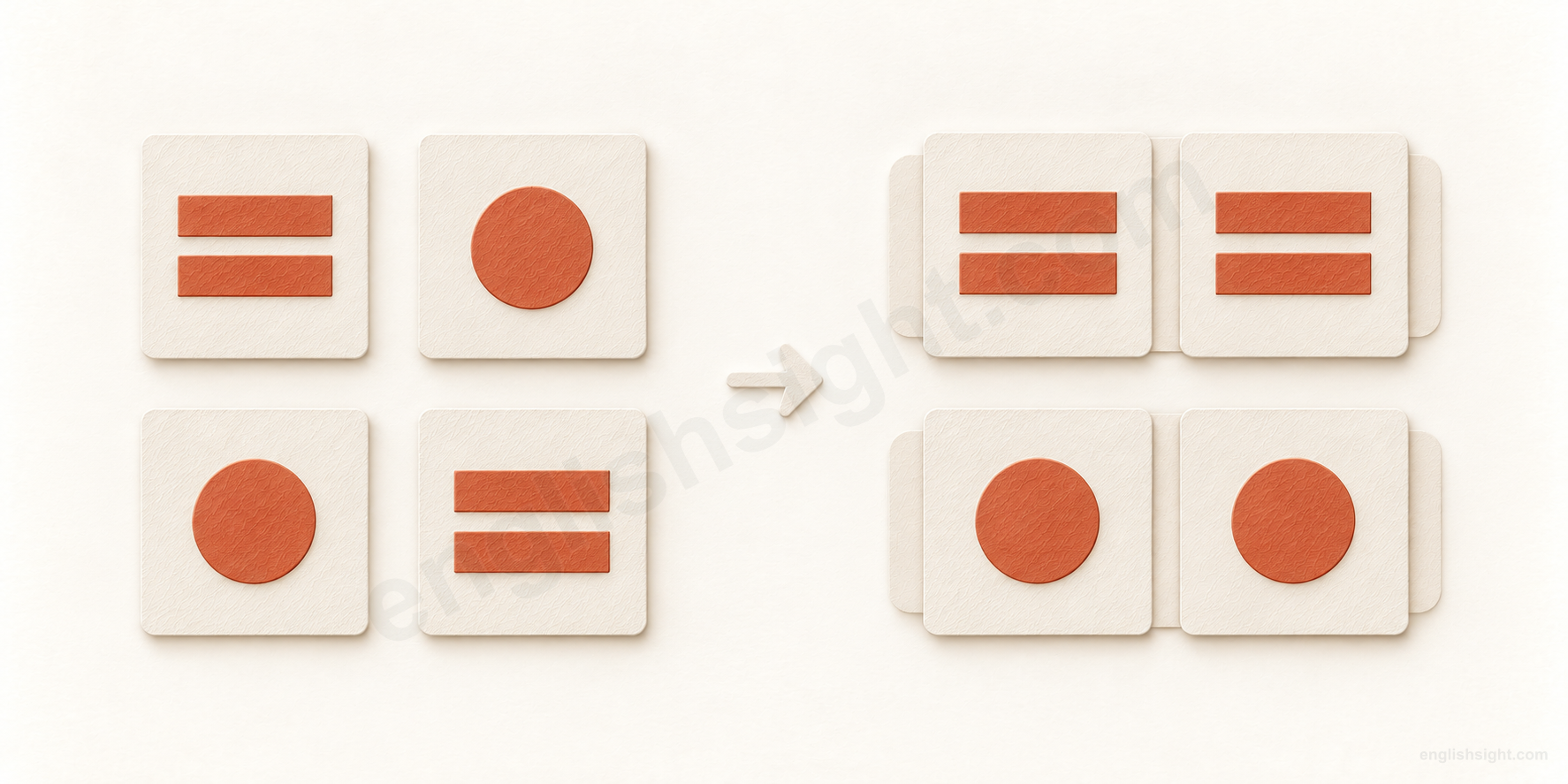
Four separate cards are mixed: two have two stripes, and two have a circle.
match
The striped cards form one pair, and the circle cards form another.
Compare the patterns and put the corresponding cards together.
Here the cards match by pattern. Other uses compare information, suitability, or level.
Two things match when they correspond in the respect that matters; you can also match them by finding or arranging that correspondence.
The sketch shows one simple case: four cards are arranged into pairs by pattern. Other uses compare information, suitability, or a level of performance. The arrow represents arranging the pairs, not movement required by every use of match. The fire-lighting noun is a separate branch.
A colour can match another colour, information can match a record, and a person can be matched with a suitable partner. Ask which feature or relationship matters in the situation: matching does not always mean being identical.
The shared idea of relevant correspondence connects many uses, including equal amounts and comparable ability. A sporting match names a contest, while a match used to light a candle is a separate object meaning. The lesson keeps those branches visible.
01
Compare, connect, and choose
Ask what must correspond: a colour, a number, a description, a suitable partner, or a practical need. Matching can describe a relationship or the work of finding it.
01
A matches B; A and B match
match the curtains
have a corresponding colour, pattern, or style
Situation / comparison
You choose cushions for a room.
Relationship / result
The cushions and curtains look right together.
The subject and the comparison item correspond in appearance.
These cushions match the curtains compares one item with another. These cushions and curtains match describes the same relationship without an object after match. No one has to move or change either item.
The relevant similarity may be a colour, pattern, or style; the objects need not be identical. Match often suggests a coordinated look. Go with is useful for things that look good together even when their colours or patterns differ.
For clothing, compare The jacket fits me, about size and shape; The jacket suits me, about looking right on me; and The jacket matches my trousers, about the relationship between the clothes.
In a sentence
The blue cushions match the curtains.
Watch the difference Say The cushions match the curtains, without adding to after match in this direct comparison.
02
A matches B; plural subject + match; do not match
the details match
agree in the relevant information
Situation / comparison
You compare two records of a payment.
Relationship / result
Both records give the same amount and date.
Matching information agrees; it need not look alike on the page.
Match compares the contents of the records, not their visual design. The amounts match means the amounts are equal. Her account matches mine means the accounts agree about what happened.
The details do not match reports a difference. It does not by itself identify which record is wrong or prove that anyone is lying. Exactly, closely, and roughly can indicate the degree of correspondence where the context allows it.
In a sentence
The amount on the receipt matches the amount in my bank app.
Watch the difference The singular subject amount takes matches even when another plural noun appears elsewhere in the sentence.
03
person / thing + match + a description / profile
match a description
have the features given in a description
Situation / comparison
A lost bag is described as small, green, and zipped.
Relationship / result
You find a bag with those features.
A real item is compared with a description of it.
The bag is the subject; the description is the object and supplies the features being checked. The bag matches your description means that its relevant features agree with what you said.
The same construction works with a photograph or a profile: A candidate matches the profile we need. Matching a description establishes correspondence, not necessarily unique identity; several bags might share the features.
In a sentence
We found a green bag that matches your description.
Watch the difference The description is the comparison, not a person whom the bag is meeting or competing against.
04
match A with / to B; match A and B; be matched with B
match A with / to B
identify or arrange the corresponding partner
Situation / comparison
Photographs and captions are separate.
Relationship / result
Each photograph has the appropriate caption.
An agent finds the connection between two sets of items.
Match each caption to a photograph tells the learner to find the correct relationship. The two items need not look alike: the caption describes the photograph. With and to are both used in this pairing construction; Match the captions and photographs also works.
For people, an agency can match a learner with a tutor whose skills suit the learner’s needs. Passive wording focuses on the person receiving a partner: Each learner is matched with a tutor. This is an ordinary passive, not a new meaning of matched.
The correspondence may be similarity, suitability, or an established association. The picture in this lesson uses shared patterns as one simple example of a wider relationship.
In a sentence
Match each caption to the correct photograph.
Watch the difference The object comes before the prepositional phrase: match it with a photograph, not match with it a photograph.
05
match A to / with B; match needs / demand
match a service to someone’s needs
choose or adjust something so that it suits a requirement
Situation / comparison
Learners have different levels and goals.
Relationship / result
Each learner receives suitable material.
Needs supply the criterion; the chosen material is made appropriate to it.
Match the lessons to the learners’ needs emphasizes deliberate selection or adjustment. It need not mean giving everyone the same lessons. To introduces the requirement being met.
Match supply with demand compares what is available with what is needed and can mean arranging enough supply. In We need more buses to match demand, match takes demand directly. The context supplies whether matching concerns suitability, quantity, or both.
In a sentence
We match the reading material to each learner’s level.
Watch the difference Match in this construction is followed by a noun phrase; do not use match someone to do as a general substitute for ask or make someone do.
06
match A against B; A is matched against B
match information against records
compare information with a reference to find correspondence
Situation / comparison
You have a receipt and the original order.
Relationship / result
You check whether the items correspond.
Against introduces the reference used for checking.
Match a receipt against an order describes comparing the two to find corresponding items or details. The sentence describes the checking operation; it does not guarantee that every detail will agree.
Against does not always introduce an opponent. Match a team against another team arranges a competition, while match a receipt against an order checks information. The objects and setting identify the intended meaning.
In a sentence
I matched the receipt against the order and found an extra item.
Watch the difference Use match it against the order; against belongs before its reference noun phrase, not after it.
02
Things that go together
Use noun phrases, matching, and match up to talk about pairs and agreement. The same pattern can describe objects, information, or people, with different kinds of correspondence.
07
a(n) exact / close match for / of something; find a match; plural matches
an exact / close match
an item or result that corresponds to another
Situation / comparison
You look for replacement fabric.
Relationship / result
You find fabric with nearly the same colour.
The noun names the corresponding item or the degree of similarity.
An exact match agrees in the features being checked; a close match is very similar but may differ slightly. A match for the original identifies the item being compared. An exact match of the original is also used.
A search can return several matches: several results satisfy the search criteria. A medical donor match concerns relevant biological compatibility, not appearance. The criteria come from the situation; the noun alone does not tell us which tests or features matter.
In a sentence
This fabric is a close match for the original curtain.
Watch the difference Match is countable in this item sense: a match, two matches. Close does not promise exact identity.
08
matching + noun; noun + to match; choose A to match B
matching items / items to match
items selected to share a relevant feature
Situation / comparison
You already have a striped notebook.
Relationship / result
You choose a pen with the same stripe design.
Matching before a noun describes a coordinated set; to match can describe a suitable companion item.
A matching pen describes a pen coordinated with the notebook. Matching is an adjective before the noun here, although the same -ing form can be part of the verb: I am matching pens with notebooks.
A notebook with a pen to match means the pen coordinates with the notebook. The comparison can be left understood because the notebook has just been named. In I chose a pen to match the notebook, the infinitive gives the purpose of the choice.
In a sentence
She bought a striped notebook and a pen to match.
Watch the difference Matching pens are separate objects that share the relevant design or other feature; matching does not mean being the same physical object.
09
A is a good / perfect match for B; A and B are a good match
a good match for someone / something
a person or thing that combines well with another
Situation / comparison
Two people consider working together.
Relationship / result
Their skills and ways of working complement each other.
A suitable pairing need not involve identical people or things.
A good match for this role means a suitable person for the role. These two are a good match means they work or fit well together. People can be a good match because their different strengths complement each other.
The expression also describes romantic compatibility: They are a good match. In older writing, a match can mean a marriage or a potential spouse, and make a good match can mean marry advantageously. That older social meaning is narrower than modern everyday compatibility.
In a sentence
Your practical skills are a good match for this role.
Watch the difference A good match for someone can concern compatibility or competitive ability. Read the context rather than assuming romance.
10
A and B are a match made in heaven; a match made in heaven
a match made in heaven
two people or things that seem perfectly suited to each other
Situation / comparison
Two friends have become a couple and get along exceptionally well.
Relationship / result
You describe how well suited they seem to each other.
The whole idiom praises a particularly successful pairing.
A match made in heaven is an established expression for an exceptionally suitable pair, often a romantic couple. Maya and Jo are a match made in heaven praises their compatibility; it does not say that they are identical or equally skilled at everything.
The idiom also applies to things: For me, fresh bread and this cheese are a match made in heaven. Made in heaven is a figurative part of the expression, not a literal claim about where a relationship or object was created.
In a sentence
Maya and Jo are a match made in heaven: they share a love of travel and make each other laugh.
Watch the difference Learn made in heaven as part of the idiom. The phrase expresses an enthusiastic judgment, not proof that a relationship will never have problems.
11
match up + noun; match + noun / pronoun + up; match A up with B
match things up (with other things)
put corresponding items or people into pairs
Situation / comparison
Several invoices need to be connected to payments.
Relationship / result
Each payment is linked to its invoice.
Transitive match up names the activity of making the pairs.
Match up the payments with the invoices and match the payments up with the invoices both describe pairing. Up is a particle, so a noun object can come before or after it.
With an object pronoun, put it before up: match them up with the invoices. The with-phrase identifies the other members of the pairs. People can also be matched up with suitable partners; up does not automatically make the pairing romantic.
In a sentence
We matched the payments up with their invoices.
Watch the difference Say match them up, not match up them. Do not apply this movable-particle rule to to or against.
12
A and B match up; A matches up with B
the accounts match up
agree when compared
Situation / comparison
You hear two accounts of the same journey.
Relationship / result
The times and places in the accounts agree.
Without an object, match up describes correspondence rather than someone sorting pairs.
Their accounts match up means the information in the accounts agrees. Their accounts match up with the records adds a reference. Up belongs to the established verb expression; it does not describe upward movement.
Compare We matched the accounts up with the records, where we did the pairing or checking, with The accounts match up with the records, where the accounts themselves agree. The different subjects help distinguish the activity from the relationship.
In a sentence
The arrival times in the two messages do not match up.
Watch the difference No object follows match up in this agreement pattern. A negative statement identifies a discrepancy, not its cause.
13
mix and match + plural noun; mix and match
mix and match
combine selected items in different ways
Situation / comparison
A shop sells tops and trousers separately.
Relationship / result
You can choose different combinations.
The whole expression emphasizes flexible choice rather than one fixed set.
Mix and match lets you choose items from different sets or options and combine them. The result should work for your purpose; the phrase does not require identical colours or a preselected pair.
It applies beyond clothes: you can mix and match lessons or meal options. In this expression mix and match work together as an established phrase; do not treat and as a particle attached to match.
In a sentence
You can mix and match the tops and trousers.
Watch the difference The phrase permits different combinations; it does not mean that every possible combination will necessarily look good.
03
Reach the same level
Here the comparison concerns ability, performance, money, or a standard. Identify who or what supplies the level being compared.
14
match somebody / something; match somebody for + quality; be matched
match someone’s performance
reach the same level of quality or achievement
Situation / comparison
A runner has set a fast time.
Relationship / result
Another runner achieves the same time.
The comparison is a level, not a visual similarity.
Match a record or a performance means reach its level. Matching a record is different from breaking it: breaking the record goes beyond the previous best under the rules of the event.
Match someone for speed names the respect in which you are equally capable. No one can match her for patience praises her as having more patience than anyone else under discussion. A passive is natural: That performance has never been matched.
In a sentence
Nina matched the club record in her first race of the season.
Watch the difference In this achievement sense, match does not normally mean defeat or outperform. The comparison concerns the stated quality.
15
match a price / salary / offer
match a price / salary
offer an equivalent amount or a competitive offer
Situation / comparison
A customer shows a lower price elsewhere.
Relationship / result
The shop offers the item at that price.
An offer is brought into line with a comparison amount.
When a shop matches a competitor’s price, it offers the corresponding price. When an employer matches a salary, it offers pay at the relevant level. The object names the amount being used as the benchmark.
The ordinary idea is an equivalent offer; in competitive contexts, matching an offer can include meeting or improving its terms. Specific price-match policies may add conditions, so the verb alone is not a promise about every product or fee.
In a sentence
The shop agreed to match the lower price I found online.
Watch the difference Match a price does not mean add that price to your bill or beat it automatically; establish the terms in context.
16
match donations / contributions; matching funds; pound for pound / dollar for dollar
match donations
give an amount corresponding to another contribution
Situation / comparison
Employees raise money for a local project.
Relationship / result
An employer contributes an equal amount under its pledge.
One contribution supplies the amount for another contribution.
An employer that matches donations pound for pound adds one pound for each pound donated. If employees give £300 under that arrangement, the employer adds £300, giving £600 altogether.
Matching funds names the corresponding funding. Real programmes can specify limits or ratios; the example states pound for pound so that its equality is explicit. Matching concerns money here, not pairing the donors with particular recipients.
In a sentence
The company will match our donations pound for pound.
Watch the difference An equal matching contribution is added to the original contribution; it does not replace it.
17
be evenly / closely matched; be well / poorly matched
be evenly / well matched
be comparable in ability or well suited to one another
Situation / comparison
Two teams have similar strengths.
Relationship / result
Neither team has an obvious advantage in ability.
The modifier tells us whether matching concerns balance or suitability.
Evenly matched teams are similar in strength or ability. This predicts a balanced contest, not a certain draw. Closely matched can similarly describe a small difference in the respect being compared.
Well matched can mean suitably paired: The two colleagues are well matched because one plans carefully and the other solves practical problems. In a sporting context it can also suggest a balanced pairing. Ill-matched or not well matched describes a poor pairing.
Be matched can be a passive about someone arranging a pairing, while be evenly matched typically describes the resulting balance. The adjective-like reading does not require naming who arranged it.
In a sentence
The two teams are evenly matched, so the final should be exciting.
Watch the difference Evenly matched does not state that the score is currently equal or that both sides will win.
18
match up to + standard / expectations; fail to match up (to…); match expectations
match up to expectations
reach an expected or required standard
Situation / comparison
An advertisement promises an excellent room.
Relationship / result
The actual room falls below that standard.
To introduces the benchmark after match up.
The room did not match up to expectations means it was less good than expected. The expression is especially familiar in negative statements and with fail to. The standard may be someone’s hopes, a previous achievement, or another person’s ability.
Compare The details match up with the booking, which says the information agrees. Match up to expectations evaluates quality against a standard; match up with information checks agreement. Basic match can also take expectations directly.
In a sentence
The hotel did not match up to the promises in its advertisement.
Watch the difference Keep up to together before the standard: match up to them, not match them up to in this evaluative meaning.
19
be a / no match for somebody / something; be somebody’s match at something
be a match / no match for
be able / unable to compete successfully with
Situation / comparison
A beginner plays a highly skilled opponent.
Relationship / result
The beginner cannot compete at the opponent’s level.
For names the opponent or force whose level must be met.
I am no match for her at chess says she is too strong for me to compete successfully. I am a match for her says I have the ability to compete with her. At can identify the activity being compared.
The expression also applies to things: A thin coat is no match for the cold describes insufficient protection. The lack is in the subject of be no match for. It is not the noun phrase after for that is weaker.
In a sentence
I enjoy playing chess, but I am no match for my sister.
Watch the difference No match for does not mean no suitable romantic partner and does not mean no scheduled game in this context.
20
meet / find + possessive + match; meet one’s match in somebody
meet your match
encounter someone equally capable or better
Situation / comparison
A skilled debater usually wins easily.
Relationship / result
A new opponent can challenge or beat her.
The possessive identifies the person whose equal has been found.
She has met her match in Leo means Leo can equal or surpass her in the relevant ability. In introduces the person who provides that challenge. Find your match is a related expression.
The phrase often suggests that a confident person finally faces a serious challenge. It need not describe a sporting contest, and it does not normally mean simply meeting the person you will marry.
In a sentence
Our best debater has finally met her match in Leo.
Watch the difference Change the possessive with the person: I met my match; she met her match. Match is not plural here.
04
Opponents and competitions
A match can be an event in which opponents compete. Related expressions also describe arranging opponents, contests of cleverness, decisive wins, and arguments.
21
a + sport + match; play / watch / win / lose a match; a match against a team
play / watch / win a match
a sporting contest between opponents
Situation / comparison
Two players have an arranged tennis contest.
Relationship / result
They compete to decide the winner.
The noun names the event, not equal ability or a corresponding object.
A match is an event with opponents: a tennis match, a football match, or a chess match. You play, watch, win, or lose a match. A tournament usually contains several matches; the nouns refer to different levels of the competition.
Match is especially usual in British English for football and many other sports. American English often uses game for team sports, but tennis match is natural in both varieties. In tennis, a match contains sets and games; a game is not the whole match.
A match against another team identifies the opponent. An away match is played at the opponent’s ground; a home match is played at your own team’s ground.
In a sentence
We watched a tennis match after lunch.
Watch the difference A match can be one-sided. The event noun does not promise evenly matched players.
22
match A against / with B; A is matched against B
be matched against someone
be assigned an opponent for a competition
Situation / comparison
Organizers draw the first-round pairings.
Relationship / result
Your team is assigned the defending champions.
Someone arranges the contest; the pairing does not assert equal skill.
The draw matched us against the champions names the draw as arranging the pairing. We were matched against the champions presents the same arrangement from our team’s viewpoint. With is also possible for this competition sense.
Against makes the opposing relationship clear. Matched with can describe a competitor or a suitable partner, depending on the context. Neither wording says that the pairing is fair, evenly balanced, or already won.
In a sentence
We were matched against the defending champions in the first round.
Watch the difference The passive describes the assigned opposition; compare We matched the champions, which can mean we equalled their performance.
23
match wits with somebody; match one’s wits against somebody / something
match wits (with someone)
compete by using intelligence or cleverness
Situation / comparison
Two players try to outthink each other during a strategy game.
Relationship / result
Each tests their cleverness against the other.
Wits names the mental ability being tested in a contest.
When people match wits, they compete through clever thinking. Match wits with someone names the other participant; match your wits against someone or something emphasizes the challenge. The setting might be a game, an argument, or a difficult opponent rather than a formal sporting event.
Compare She matches him for intelligence, which describes comparable ability, with She enjoys matching wits with him, which describes taking part in a mental contest. Matching wits does not say that the participants are equally clever or that either one has won.
In a sentence
The two friends enjoy matching wits over a game of chess.
Watch the difference Use plural wits for mental quickness here. Matching wits means competing, rather than merely discovering that two answers agree.
24
have / face / save a match point; at match point
match point
a point that would win the whole match
Situation / comparison
A tennis player needs one more point to win.
Relationship / result
Winning the next point would end the match.
The possibility concerns the whole match rather than one game alone.
At match point, one player can win the match by winning the next point. If the player loses that point, the match may continue. Match point names the opportunity, not a guarantee that it will be taken.
A player can save a match point by preventing the opponent from winning it. Compare game point or set point: these concern a game or a set, which may be only part of a tennis match.
In a sentence
She saved a match point and went on to win.
Watch the difference A match point is not any point scored during a match; winning it would decide the whole match.
25
be named / chosen (the) man of the match; player of the match
man of the match
a player chosen for the best performance in a match
Situation / comparison
A match has ended.
Relationship / result
One player receives an award for an outstanding performance.
The full expression selects a performer, not the match winner as a team.
Man of the match is a traditional sporting award title, especially in British football and cricket. It identifies the man chosen for the best performance in that match. It is not a general phrase for every man who played.
Player of the match is a gender-neutral wording; woman of the match is also used where appropriate. Use the title chosen by the competition. Being selected for the award does not make someone the winner of an entire tournament.
In a sentence
The goalkeeper was named man of the match after making several difficult saves.
Watch the difference The phrase is an award title, not an ordinary way to say a player took part in the match.
26
game, set and match to + winner
game, set and match
a clear or decisive victory
Situation / comparison
A contest or argument reaches a decisive conclusion.
Relationship / result
One side has secured the win.
A tennis expression can be borrowed to announce a decisive outcome.
In tennis, game, set and match announces that the final game has also completed the final set and the match. All three levels have been won as required to finish the contest.
Outside tennis, It is game, set and match to Maya presents Maya’s victory as decisive. It can describe a debate or negotiation without literal tennis. This borrowed expression depends on established usage, not on the diagram of corresponding pairs.
In a sentence
After the final vote, it was game, set and match to the supporters of the new plan.
Watch the difference Treat the expression as a unit. It does not mean that someone won every earlier point, game, or set.
27
a shouting match; turn into a shouting match; a shouting match with / between people
a shouting match
an argument with people shouting at one another
Situation / comparison
People disagree about a schedule.
Relationship / result
They stop discussing calmly and shout at each other.
The competition image is extended to a noisy argument.
A discussion that turns into a shouting match becomes a loud argument. The speakers are opposing each other verbally; there need not be rules, a referee, or a declared winner.
The -ing word shouting describes the kind of encounter. It does not mean a matchstick makes a sound or that all disagreements are sporting matches.
In a sentence
The discussion about parking turned into a shouting match.
Watch the difference The expression usually conveys disapproval of the noisy argument; it is not a neutral label for a formal debate.
05
A separate object: a match for lighting a flame
The small stick used to start a flame is a separate noun meaning. Learn its ordinary actions and containers without forcing it into the correspondence model.
28
a match / matches; strike / light / blow out a match; put a match to something
strike / light a match
make the small fire-lighting stick burn
Situation / comparison
A match has an unlit coated head.
Relationship / result
Striking it produces a small flame.
This match is a concrete object with a separate meaning.
A match is a short wooden or cardboard stick with a head that can be ignited. Strike a match names the rubbing action that lights it; light a match emphasizes making it burn. A box of matches and a book of matches name ordinary containers.
A lit match can be used to light a candle, and you can blow out the match. Put a match to something means set it alight, rather than compare or pair it with another item.
The spelling and pronunciation are the same as the correspondence noun and verb, but this object sense has a different word history. Treat it as a separate branch, not something predicted by matching patterns.
In a sentence
He struck a match and lit the candle.
Watch the difference A match is the stick; a flame is the burning part. A match can be unlit or already used.
Choose the relationship and the construction
Forms and pronunciation
The noun and verb are pronounced /mætʃ/. The plural noun and third-person verb are matches /ˈmætʃɪz/. The verb forms are match, matches, matched /mætʃt/, and matching /ˈmætʃɪŋ/; there is no extra vowel before the final /t/ of matched.
Match, fit, and suit
A jacket fits a person when its size and shape are right; it suits a person when it is an appropriate or attractive choice; it matches another item when their relevant appearance corresponds. In other contexts these words overlap, so use the objects and intended relationship to choose.
Relationship or activity?
The figures match describes agreement. We are matching orders with payments describes an activity in progress. An agent can match people or things, and an ordinary passive can describe that arrangement. There is no general match someone to do something causative construction.
Read the whole expression
Match up can pair items, describe agreement, or—with to—compare quality with a standard. Match against can check records or arrange opponents. Particle up can move around a noun object in pairing, but prepositions with, to, and against stay before their own noun phrases.
Noun boundaries
Use a match or matches for sporting events, corresponding items, and fire-lighting sticks. A good match often describes a relationship or a suitable person; no match for describes inadequate competitive ability. The word does not require identical objects or equally strong opponents in every use.
A useful model with limits
The picture is a teaching aid for relevant correspondence, not a shared mental image claimed for all English speakers or a rule that predicts every phrase. The course introduces the older marriage sense for recognition. Specialist sporting terms, scientific matching methods, match-fixing, and longer low-priority idioms are not developed here.
Choose the relationship
Look at what is being compared, then check the construction.
1. A jacket is the right size for you. Which sentence says that directly?
2. You want someone to put the receipts into corresponding pairs. Which instruction has the right pronoun position?
3. The new course was less good than its advertisement promised. Which sentence expresses that judgment?
4. I am no match for Hana at chess. Who is stronger at chess?
5. Employees give £80. Their employer matches it pound for pound. What is the total contribution?
6. Our team was matched against the champions. What does this tell us?
7. In She struck a match to light the candle, what is a match?
8. A player saves a match point. What has the player done?
Sources and teaching notes
The dictionary entries and Oxford teaching article below were read to check the meanings and constructions. The explanations, examples, and correspondence model were written for this lesson. The model is a teaching interpretation, not a dictionary claim about a universal mental picture.
The diagram illustrates a relevant correspondence; it does not predict every meaning of match.