Connect substances, useful content, and potential; keep the adjective’s different meanings in view.
Substance and usable input
Substance and usable input
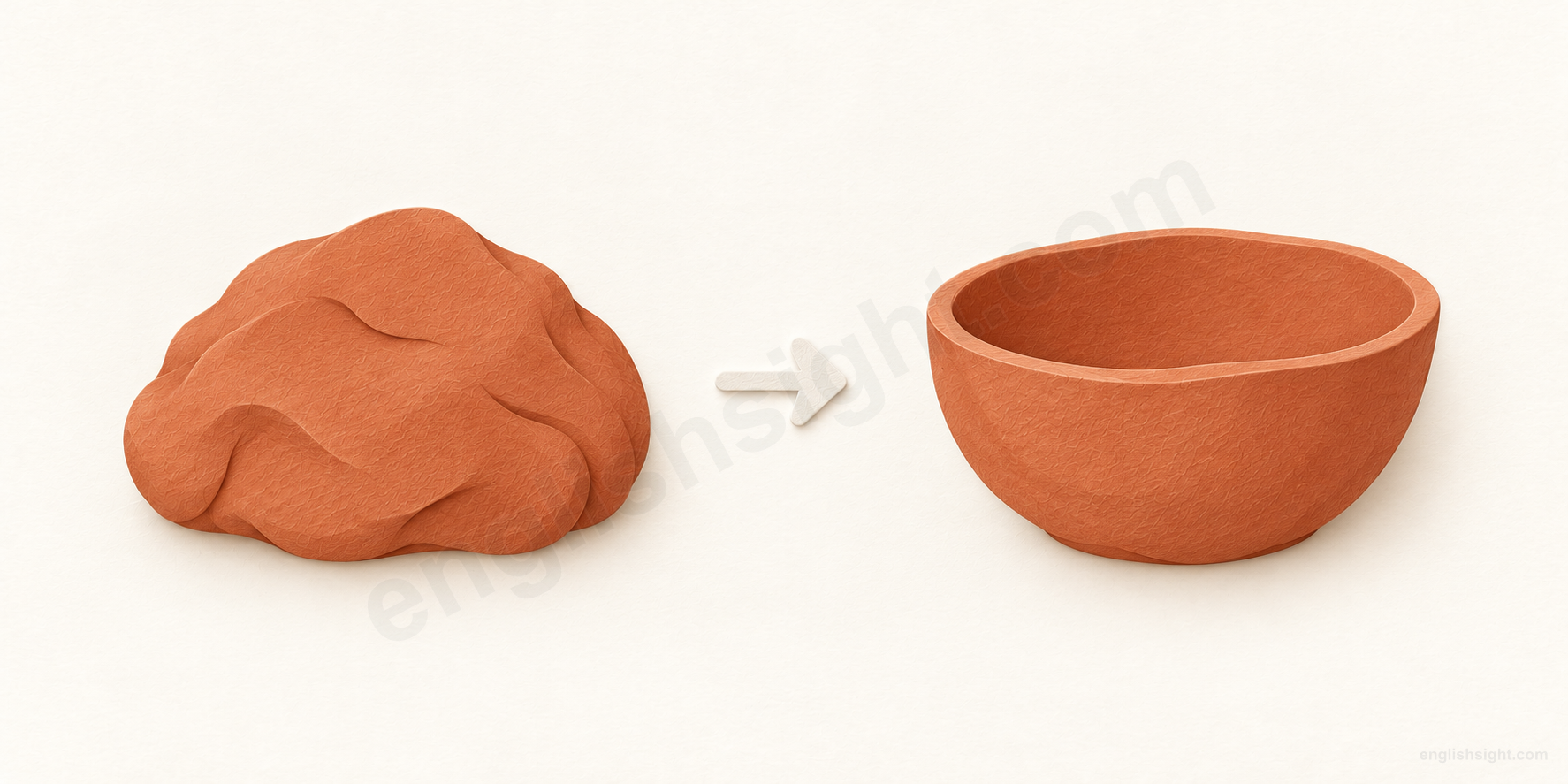
A terracotta-colored lump of clay is ready to be shaped.
material
The open bowl has a new shape but is made of the same clay.
The arrow marks the clay being shaped into a bowl.
The shape changes; clay remains the bowl’s material.
As a noun, material can name the substance something consists of, or the supplies and content available for an activity or a piece of work.
The clay example shows substance taking a useful form. Clay is still the bowl’s material after shaping; material does not always mean unfinished. Content and human potential offer related teaching comparisons, while the formal important-or-relevant adjective is a separate branch.
A bowl has a shape, but clay supplies its substance. A report has a structure, but interviews and records can supply its content. Material helps you talk about what is available to make something, do an activity, or develop a piece of work.
The noun can also describe someone’s suitability for a role. The adjective has physical, economic, and formal important-or-relevant uses. These uses need their own contexts; one picture does not predict them all.
01
Substances, cloth, and raw inputs
Choose material to identify a substance, discuss cloth, or name the starting inputs for production. Count a kind of material differently from an amount of it.
01
a / an + adjective + material; some / more + material; different + materials
a strong material / recycled materials
the substance something consists of or can be made from
Situation / available input
You compare wood, steel, and plastic for a frame.
Meaning in context
You identify a suitable substance and its properties.
The noun directs attention to substance, rather than shape or the finished object’s function.
In Bamboo is a light material, a material means a kind of substance. Several materials can mean several kinds, such as wood and metal. In We need more material, the uncountable noun treats it as an amount instead.
The material can already be inside a finished object: What material is the frame made of? asks about its substance. Recycled material and natural materials describe origin or type, not a particular stage of manufacture.
Plant material and genetic material also name physical matter in scientific contexts. The noun does not require something to have been deliberately manufactured.
In a sentence
The frame uses two materials: bamboo and steel.
Watch the difference The expression two materials normally identifies types or supplies in context. For two individual pieces of one substance, say two pieces of material.
02
a piece / strip / scrap of material; material for + item; adjective + material
a piece of material
cloth used for clothing, curtains, or similar objects
Situation / available input
You choose cloth for a cushion cover.
Meaning in context
You describe the cloth’s amount and qualities.
In a sewing context, material commonly means fabric.
The situation can narrow material to cloth without adding the word cloth. We bought some material for the curtains describes a quantity of fabric. A piece, strip, scrap, or metre of material gives a unit or amount.
For kinds, you can compare different materials or say This material is washable. Fabric is often an equally natural choice when you want to make the cloth meaning explicit.
A finished shirt is made of material, but it is normally a shirt or an item of clothing, not a material. The material is its substance.
In a sentence
I saved a piece of striped material for the cushion cover.
Watch the difference Material is broader than fabric outside a cloth context: steel is a material, but it is not fabric.
03
raw material(s) for + product / work; provide / use + raw material
raw material for something
basic input to be processed or developed
Situation / available input
A workshop receives clay before making pots.
Meaning in context
The clay is treated as an input to production.
Raw marks an input in relation to a later product or developed work.
The expression raw material can be countable or uncountable. A raw material names one kind of basic input; raw materials can name several kinds. Raw emphasizes the starting resource, not the finished product. It need not mean that no earlier processing has ever occurred.
The expression also works figuratively: Her travel notes became raw material for a radio play. The notes supply ideas to develop; they do not physically turn into sound.
For introduces what the input is intended to help produce. The picture’s shaping sequence fits this use, but ordinary material does not always include the raw-stage meaning.
In a sentence
The studio buys clay as raw material for its bowls.
Watch the difference Raw material is a noun expression, not a phrasal verb. Raw does not mean poor quality here.
02
Supplies, learning, and creative content
What you work with need not be a physical substance. Material can be practical supplies, study content, source information, or a performer’s work.
04
activity + materials; buy / prepare / run out of + materials
art / cleaning / building materials
things needed for a practical activity
Situation / available input
You prepare paper, paint, and glue for a workshop.
Meaning in context
You group these items as the workshop’s supplies.
The noun groups useful items by the activity they support.
Art materials, writing materials, and cleaning materials name resources for doing something. Materials can include small objects, liquids, or powders; they are not necessarily substances that all become part of a final product.
The plural is common when discussing a set or range of supplies. The builders ran out of materials says that supplies became insufficient; ran out of contributes that meaning, not material itself.
Equipment usually brings tools and apparatus into focus. For an art class, brushes may be equipment while paper and paint are materials, although the categories can overlap in actual usage.
In a sentence
Please put the art materials in the cupboard after the workshop.
Watch the difference Materials can be plural. Equipment is normally uncountable: some equipment or two pieces of equipment, not two equipments.
05
teaching / training / study / promotional + material(s); reading material
teaching materials / reading material
resources and content used to teach, study, read, or communicate
Situation / available input
A tutor selects worksheets, recordings, and web pages.
Meaning in context
These become resources learners can use.
Material may be digital or spoken content, not just paper.
Teaching materials and training materials commonly refer to a collection of learning resources. Teaching material or course material can instead treat the content as a whole. Both countable and uncountable choices occur in this resource sense.
Reading material means things or content available to read: I downloaded some reading material for the flight. Study material may include content to learn, not only tools for studying.
The phrase promotional materials follows the same resource pattern in a different setting: brochures, files, or other content used to publicize something. The modifier supplies the purpose; material does not itself mean educational.
In a sentence
The course materials include short videos and printable exercises.
Watch the difference For one file or handout, name it directly or say a piece of material. Do not automatically call every separate page a material.
06
collect / gather + material; material on + subject; (source) material for + work
material on a topic / material for a book
information, ideas, or records available for a piece of work
Situation / available input
A writer gathers interviews and old letters.
Meaning in context
The writer has content to draw on for a biography.
On gives the subject; for gives the purpose or intended work.
Material on local history concerns local history. Material for a documentary is intended for use in that documentary. You can combine them: material on local history for a documentary. The two prepositions answer different questions.
Source material names the records or existing work that a new work draws on. Original material and previously unpublished material describe the content’s origin or publication history; context determines precisely what original contrasts with.
This information sense is normally uncountable: enough material for a chapter, some useful material, or a great deal of material. In professional settings, research materials can also group particular resources, rather than simply quantify information.
In a sentence
These interviews provide useful material on village life for my documentary.
Watch the difference Material on the village states a topic; material for the village suggests an intended use or recipient. Changing the preposition changes the relationship.
07
new / old / original material; perform / play / try out + material
new material / a comedian’s material
songs, jokes, or other content used in a performance
Situation / available input
A performer prepares songs or jokes for a show.
Meaning in context
Those pieces form the content the performer presents.
The noun groups performance content without counting individual items.
A band can play new material and a comedian can try out material. The noun refers to the songs, routines, or jokes being performed, not to instruments, costumes, or stage equipment.
New material may already be fully written. This is an important limit to the raw-input picture: here material is the performer’s content, whether being tested or presented in its finished form.
Keep the uncountable pattern when treating the repertoire as content: some new material or twenty minutes of material. Count a song, joke, or routine when the individual item matters.
In a sentence
The singer tried out some new material at a small café.
Watch the difference In this context, new materials would suggest resources or substances rather than the ordinary uncountable performance-content meaning.
03
Suitability for a role
An established noun pattern evaluates a person’s potential. It does not say that the person literally becomes an object.
08
person + be / seem + (good / not) + role / opportunity + material
leadership material / not manager material
a person judged to have suitable qualities for a role or opportunity
Situation / available input
A colleague handles a difficult discussion calmly.
Meaning in context
Others see potential for a leadership role.
A role or opportunity names the standard used to judge the person’s suitability.
She is leadership material means she has qualities that could make her a leader. He is not manager material judges his suitability for management. The noun is uncountable in this pattern; you do not normally add a or make material plural.
The relation to useful input is a teaching comparison: the person has potential for a role. It does not imply that the person already holds the role or has no value outside it.
Expressions such as university material and Olympic material use the same established pattern. Judging someone this way can sound blunt or dismissive, especially in the negative, so consider the situation and the person you are addressing.
In a sentence
After seeing her lead the discussion, I think she is leadership material.
Watch the difference Say She is leadership material, not She is a leadership material. The expression assesses potential; it does not appoint her to a position.
04
Physical, economic, important, or relevant
Read the surrounding noun and situation. Material possessions, a material difference, and information material to a decision use different adjective meanings.
09
material + world / object / existence
the material world
relating to physical substance rather than mind or spirit
Situation / available input
A discussion distinguishes objects from beliefs and thoughts.
Meaning in context
Material identifies the physical side of that distinction.
Here material is an adjective describing a kind of existence.
The material world means the physical world. Material objects are physical things, contrasted here with thoughts, ideas, or spiritual entities.
This adjective connects directly with the substance meaning of the noun. The context does not require anyone to manufacture, own, or use the objects.
The physical-world meaning is normally used before a noun. A sentence such as Is that material to the question? instead uses the formal relevant meaning, not a test of whether something has a body.
In a sentence
The essay asks how thoughts relate to the material world.
Watch the difference Material does not always mean visible: physical substance need not be visible to the unaided eye.
relating to money, belongings, or physical living conditions
Situation / available input
You discuss housing, food, income, and belongings.
Meaning in context
You focus on practical or economic conditions of life.
Material identifies the physical or economic side of well-being.
Material possessions are the things someone owns. The expressions material wealth and material comforts focus on resources and practical comfort, rather than emotional, intellectual, or spiritual life.
Material needs can include food and shelter; material conditions or circumstances can concern income and housing. The adjective does not itself mean luxury, selfishness, or unnecessary spending.
Material assistance can mean practical resources such as money or supplies. Contrast emotional support, which concerns feelings. The surrounding words make the intended kind of support clearer.
In a sentence
The project addresses material needs such as warm clothing and safe housing.
Watch the difference Material describes a sphere of life here. Materialistic is a different adjective that criticizes giving possessions too much importance.
11
a / no + material + difference / change; material + improvement / benefit
a material difference / no material change
a difference or change important enough to matter
Situation / available input
You compare two plans and their likely effects.
Meaning in context
You judge whether any difference has practical significance.
The adjective assesses importance or consequence, not physical composition.
A material difference is a significant difference. No material change says that nothing changed in a way that matters for the issue being discussed; it need not mean that every detail stayed identical.
This use is more formal than important or significant and appears in business, reporting, and official discussion. A material improvement or benefit similarly concerns a meaningful effect.
Do not derive this meaning by imagining a new physical substance. It is an established adjective branch. A change in the material would instead concern the substance or content itself.
In a sentence
The revised timetable makes no material difference to our arrival time.
Watch the difference No material difference allows minor differences that do not matter in context. It does not always mean exactly identical.
12
material + facts / evidence / information / witness; be material to + issue / decision
material to a decision / material facts
relevant and important to the issue being considered
Situation / available input
A decision-maker separates useful facts from background detail.
Meaning in context
The facts that bear importantly on the decision are identified.
To introduces the issue for which the information matters.
Information material to a decision has a significant bearing on that decision. Material can stand before a noun, as in material facts or material evidence, or follow be with to: These facts are material to the inquiry.
This is formal language, especially in legal or official contexts. In ordinary conversation, relevant to or important to is often clearer. A material witness is a witness with important relevant evidence; it is not a witness made from a particular substance.
The relevant and significant meanings overlap. Material facts emphasizes which facts matter to the issue; a material difference emphasizes the significance of a difference. Context supplies the standard, so the word alone does not establish a legal threshold.
In a sentence
The delivery date is material to our decision about which supplier to use.
Watch the difference Use material to the decision, not material for the decision, for this adjective pattern. Material for a report normally uses the noun meaning source content.
Check the noun pattern and the adjective branch
An amount, a type, or a collection?
Some material measures substance or content as a whole. A material can identify a substance or type. Materials can identify types or a collection of resources. For a single handout, sheet, or cloth piece, name the item or use an appropriate unit; the word’s countability depends on its meaning.
Before a noun does not always mean adjective
In material costs, the noun material can modify costs: these are costs of materials. In material possessions, material is the adjective about belongings and wealth. In a material difference, it is the significant adjective. The phrase’s meaning determines the analysis.
Material, matter, and materialistic
Matter is common for physical substance in general, as in states of matter; material often identifies a particular substance or usable content. For an issue to discuss, say a matter or a problem, not a material. Materialistic describes excessive concern with possessions; material needs does not make that criticism.
Forms, sound, and scope
The noun has the plural materials. The adjective does not take a plural ending. UK /məˈtɪəriəl/ and US /məˈtɪriəl/ have the main stress on the second syllable. This lesson covers the modern noun and adjective, not a productive verb: verb tense, passive, causative, and separable particle-verb patterns do not apply. Highly specialized legal, philosophical, and military terminology is not developed here.
Choose the meaning in context
Look at the noun’s countability, the neighboring words, and the situation.
1. You need one small piece of cloth, not a new kind of substance. Which request is clearest?
2. You collect information about birds to use in a school talk. Which sentence states both topic and purpose?
3. A comedian says, “I’m trying out new material tonight.” What is being tried?
4. A colleague calls Mina “leadership material.” What does this expression say?
5. A report says, “There was no material change.” Which reading fits the formal adjective?
6. Which sentence says that a fact has an important bearing on the choice, using the formal adjective?
Sources and teaching notes
The linked dictionaries support the meanings and patterns. The explanations and examples are original, and the connection between substance and usable input is a teaching model rather than a rule that generates every use.
The diagram illustrates one useful connection; it does not describe a mental picture shared by every English speaker.