Use meal for a breakfast, lunch, dinner, or another eating occasion—then learn what the surrounding words add.
Food and an eating occasion belong together
Food and an eating occasion belong together
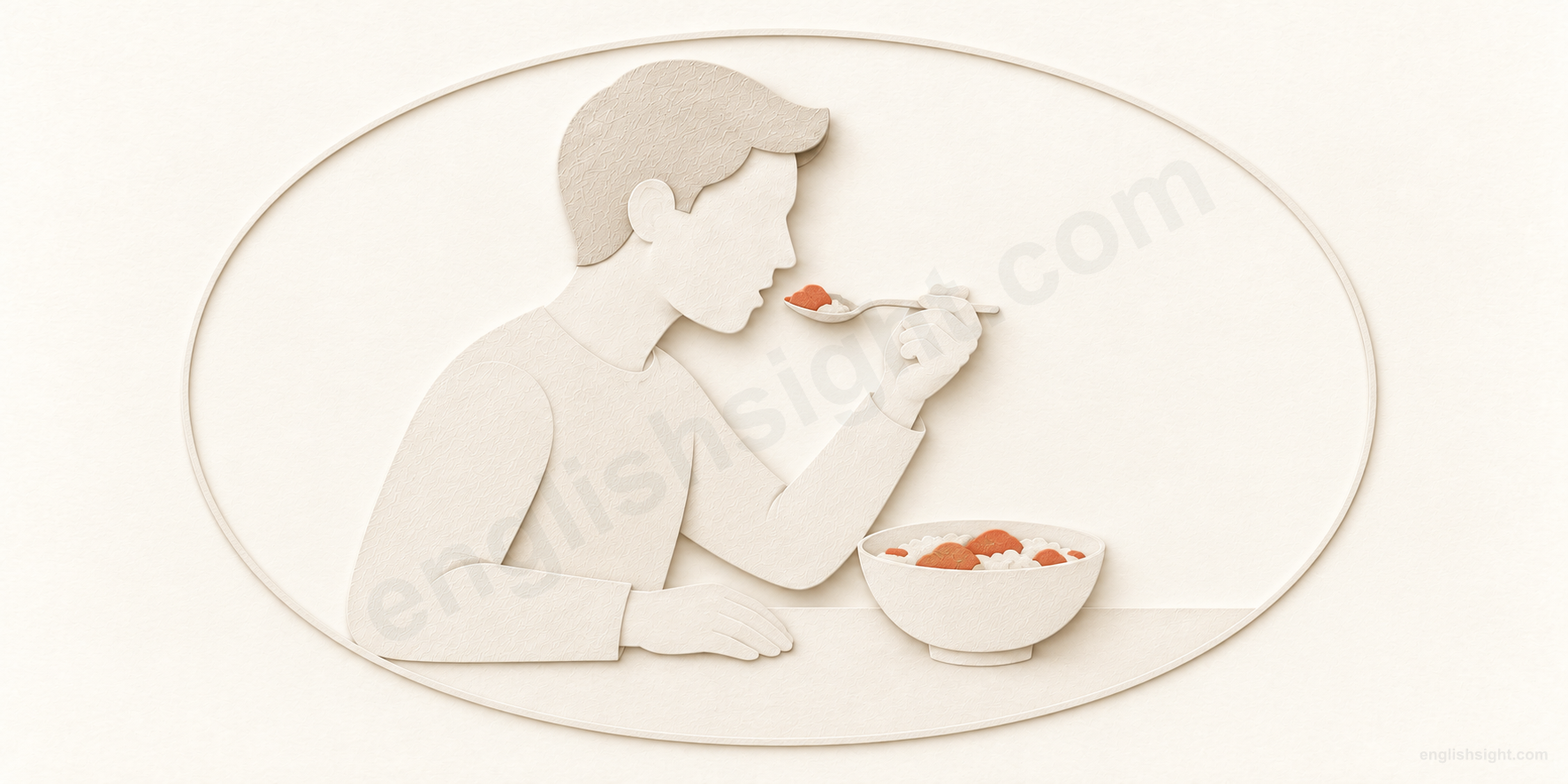
A bowl holds food for one eating occasion.
meal
The eater and food are grouped as one meal.
The person lifts a spoonful toward their mouth.
A meal can mean the eating occasion or the food eaten during it.
A meal is an occasion of eating, or the food eaten on that occasion.
The same situation lets us focus on the event or the food. A table and a fixed clock time are not required. The powdered-material meaning is separate.
Meal /miːl/ is a noun. In everyday use it can focus on an eating occasion or on the food provided for that occasion. The plural is meals /miːlz/.
Start with the relationship between someone eating, a portion of food, and one occasion. Fixed expressions add meanings that need to be learned as combinations; the ground-grain noun is a separate branch.
01
One occasion for eating
Count occasions, arrange time together, or say that an expected meal did not happen. Meal is a general word; breakfast and lunch name particular meals.
01
have / eat + a meal; meals + a day
have / eat a meal
take part in one occasion of eating
Situation
Two friends have time together at midday.
What is meant
They eat lunch together.
Meal packages eating as one occasion.
A meal can be breakfast, lunch, dinner, or another occasion treated as a meal. Have a meal and eat a meal both describe eating; have does not simply mean possessing food here.
Use a meal for one unspecified occasion, the meal for an identified one, and meals for more than one. We have three meals a day counts occasions. We have lunch names one, usually without an article.
A meal does not have to be formal, shared, or eaten at a table. The drawing shows one possible setting, not a requirement.
In a sentence
We usually have a meal together at noon.
Watch the difference Say have a meal, not have meal, when referring to a single ordinary eating occasion.
02
a meal of + food; food for + a meal
a meal of rice and beans
the food eaten on one occasion
Situation
There is cooked rice and a pot of beans.
What is meant
Someone serves them as dinner.
Meal can name the food as well as the occasion.
In The meal is cold, meal refers to the food. In The meal lasted an hour, it refers to the eating occasion. Context selects the focus without changing the spelling or the plural meals.
Of introduces what the meal consists of: a meal of rice and beans. For introduces the purpose or intended occasion in food for a meal. A dish is a particular prepared food; a meal may contain several dishes, or just one.
In a sentence
I made a simple meal of rice and beans.
Watch the difference Do not use meals as a general substitute for food: a food shop sells food, which people may later use to make meals.
03
before / during / after + a/the meal; between meals; with / over + a meal
before / after / between meals
locate something in relation to eating occasions
Situation
You eat lunch and plan to eat dinner later.
What is meant
You have an apple in the interval.
The preposition locates an action relative to a meal.
Before a meal, during the meal, and after the meal place an action before, within, or after one eating occasion. Between meals refers to the gaps separating meals.
With a meal can mean accompanying the food: I like water with my meal. Over a meal can frame a conversation during eating: We discussed the trip over a meal. These are ordinary prepositional combinations, not phrasal verbs.
An evening meal avoids choosing between regional names such as dinner, supper, or tea. Main meal identifies the principal meal, which need not be in the evening. Mealtime means the time when a meal is eaten.
In a sentence
I had an apple between meals.
Watch the difference Between meals uses plural meals; during the meal places you inside one identified occasion.
04
skip / miss + a meal
skip / miss a meal
not eat at an expected eating time
Situation
Work continues through lunchtime.
What is meant
You do not eat lunch.
An expected occasion is left out.
Skip a meal often presents not eating as a choice; miss a meal can also describe failing to eat because circumstances prevent it. Neither expression means dropping a plate.
You can skip breakfast or miss lunch when naming the meal. This is ordinary verb-plus-object grammar: meal is the thing skipped or missed, not part of a separable particle verb.
In a sentence
I missed a meal because the train was delayed.
Watch the difference The expression describes an omitted eating occasion; it does not itself tell you why.
02
What is prepared and eaten
Describe the food, its preparation, its size, or the way it is provided. These combinations keep the everyday food meaning of meal.
05
make / cook / prepare / serve + a meal; make + someone + a meal
make / cook / prepare / serve a meal
get food ready or provide it for eating
Situation
The vegetables and rice are uncooked.
What is meant
Dinner is ready and is brought to the table.
The verb tells you which stage of providing food is meant.
Make a meal is the broad everyday expression for putting a meal together. Cook a meal emphasizes cooking; prepare a meal can include work such as washing and arranging food. Serve a meal means providing it to be eaten.
Make someone a meal and make a meal for someone both identify the person receiving the food. That person need not cook it. The passive is possible because these verbs have an object: The meal was prepared by volunteers.
Enjoy your meal is a friendly wish when someone is about to eat or is eating. Thanks for the meal thanks the person who provided it.
In a sentence
I’ll make you a meal when you get home.
Watch the difference Make a meal for someone concerns preparing food; make a meal of a small task can be an idiom with a different meaning.
06
go out for + a meal; take + someone + out for a meal; meals included
go out for a meal
go somewhere to eat, often at a restaurant
Situation
Friends want to meet after work.
What is meant
They arrange to eat at a restaurant.
For gives the purpose of going out.
Go out for a meal is especially familiar in British English. Have a meal out also describes eating away from home, often in a restaurant. It does not require sitting outdoors.
Take someone out for a meal means taking them somewhere to eat. Treat someone to a meal explicitly offers to pay. In The hotel price includes meals, the plural says that food is provided as part of the price.
In a sentence
Shall we go out for a meal on Friday?
Watch the difference For a meal expresses purpose; a meal of vegetables describes the food.
07
a light / filling / balanced + meal
a light / filling / balanced meal
describe how much a meal provides or what it contains
Situation
You choose what to eat before a journey.
What is meant
You choose a small meal rather than a heavy one.
The adjective describes the meal; it does not create a new noun sense.
A light meal is relatively small or not heavy. A filling meal makes you feel that you have eaten enough. A balanced meal suggests a suitable mix of foods or nutrients; filling and balanced do not mean the same thing.
A snack usually suggests a small amount of food or a small, quick meal. The boundary is flexible: something can be a snack for one person and a light meal for another. Meal does not guarantee a large portion.
In a sentence
We had a light meal before the concert.
Watch the difference Do not interpret light as a statement about the food’s color or a precise calorie limit.
08
a + number-course + meal
a three-course meal
a meal served in three successive parts
Situation
A menu offers soup, fish, and dessert.
What is meant
The dishes arrive in three stages.
Courses are parts of one meal, not separate meals.
A course is one stage in a meal. A three-course meal might have a starter, a main course, and a dessert. Three describes the number of courses, while meal remains singular.
The compound adjective uses course, not courses: a two-course meal, a three-course meal. A dish is a particular prepared food, and several dishes can be served within one course.
In a sentence
The restaurant offers a three-course meal for twenty pounds.
Watch the difference Write a three-course meal, not a three-courses meal or three meals, for this menu.
09
buy / heat + a ready meal; the meal + is ready
a ready meal
a purchased prepared meal that needs heating
Situation
You buy a chilled prepared dinner.
What is meant
You heat it at home before eating.
Ready meal is an established food product name.
In British English, a ready meal is bought already prepared and normally needs only heating. It is one kind of meal, rather than a separate action meaning of meal.
Compare The meal is ready, which simply says that any meal can now be eaten. A freshly cooked dinner can be ready without being a ready meal. Frozen meal describes storage and does not itself explain every preparation step.
In a sentence
I bought a ready meal to heat after work.
Watch the difference The noun phrase a ready meal and the sentence The meal is ready have different jobs.
10
a meals on wheels service; deliver meals through meals on wheels
meals on wheels
a service delivering meals to people at home
Situation
An older person cannot easily prepare food.
What is meant
A local service brings a meal to their home.
The whole phrase names a home meal delivery service.
Meals on wheels conventionally refers to delivering prepared meals to people such as older or ill people who need help at home. It does not mean that the diners must eat in a moving vehicle.
The phrase is used for the service, and some organizations use it in their names. The words meals and wheels rhyme: both end in the sound /iːlz/.
In a sentence
She volunteers for the local meals on wheels service.
Watch the difference Do not assume that every ordinary takeaway delivery is called meals on wheels.
03
Fixed expressions and a separate meaning
Learn the whole expression when the meaning is conventional. Powdered meal belongs to a separate noun meaning and is not explained by the dining picture.
11
have / need + a square meal
a square meal
a substantial, satisfying meal
Situation
You have eaten only a few small snacks.
What is meant
You want a proper meal that will satisfy your hunger.
Square has a conventional meaning in this expression.
A square meal is a good, substantial meal that fills you up. The expression often occurs when someone has not eaten properly for a while.
It says nothing about the shape of the plate or food. The meaning belongs to square meal as an established combination; it cannot be worked out by drawing four corners.
In a sentence
After a day of snacks, I wanted a square meal.
Watch the difference A square meal need not have exactly three courses or any particular ingredients.
12
make + a meal + of something
make a meal of something
spend more time or effort on something than seems necessary
Situation
A form needs only a name and a date.
What is meant
Someone turns completing it into a lengthy task.
The idiom presents a small job as unnecessarily elaborate.
Make a meal of something is informal and especially British. It commonly criticizes someone for making an activity more complicated or drawn-out than the speaker thinks necessary. Something can be a task, incident, or issue; it need not be food.
Contrast I made a meal of the leftover rice, where actual food supports a literal reading. In Don’t make a meal of it, it refers to the task or issue. Learn the whole idiom instead of giving make or of this meaning on its own.
In a sentence
It’s only a short form; don’t make a meal of it.
Watch the difference This expression can sound impatient or critical; it is not neutral praise for careful work.
13
a meal ticket; someone’s meal ticket; see / use + someone + as a meal ticket
a meal ticket
a ticket for food, or figuratively a source of support
Situation
A person depends on a job for income.
What is meant
They view that job mainly as a way to support themselves.
Context separates permission to eat from financial dependence.
Literally, a meal ticket entitles its holder to a meal, sometimes free or at a reduced price; Oxford marks this use North American. A student might show a meal ticket in a school dining hall.
Informally, a person or thing can be someone’s meal ticket: a source of income or support. Treating another person as a meal ticket suggests using them for financial benefit. With a job or qualification, the phrase can simply emphasize earning a living.
In a sentence
He sees the job as a meal ticket, not a career.
Watch the difference A meal ticket in this sentence is not a restaurant booking or a ticket printed by the employer.
14
some + meal; a bag of + meal; cornmeal
cornmeal / ground meal
grain or similar material ground into small particles
Situation
Corn kernels are ground.
What is meant
The resulting meal is used as an ingredient.
This mass noun is separate from the eating-occasion noun.
Meal can name ground grain, often a relatively coarse powder. Cornmeal is a familiar example. Merriam-Webster also records similar ground products. This is a separate meaning with a different historical origin; it is not a meal being served.
Treat the substance as uncountable in this use: some cornmeal, a bag of meal. Compare three meals, which normally counts eating occasions or prepared portions. Oatmeal and wholemeal are related established words whose full uses need their own entries.
In a sentence
The recipe calls for a cup of cornmeal.
Watch the difference A cup of cornmeal measures a substance; it does not mean one eating occasion made of corn.
Choose the noun meaning and the whole expression
Meal, food, dish, and course
Food names what people eat in general and is normally uncountable in that use. A meal groups food and eating as one occasion. A dish is a particular prepared food; a course is a stage of a meal. One dish can be enough for a meal.
Count occasions; measure powder
Say a meal, two meals, or our meal for ordinary dining uses. Meal meaning ground material is normally uncountable. The noun itself has no tense, passive, causative, or particle-verb family; those questions belong to the verbs used with it.
Names vary by community
Breakfast, lunch, dinner, supper, and British tea are not interchangeable labels with identical schedules everywhere. Evening meal and main meal can make your intended time or role clearer.
A model with limits
The dining relationship explains the everyday event and food meanings. It does not predict the meaning of square meal or every compound, and it does not explain ground grain. The diagram is a teaching aid rather than a claim about every speaker’s mental picture.
Read the whole situation
Choose the expression or interpretation that fits the context.
1. You are describing one ordinary eating occasion. Which sentence is complete?
2. In The meal lasted two hours, what is meal referring to?
3. Soup, a main course, and dessert are served one after another. What have you had?
4. Someone says Don’t make a meal of it about a tiny correction. What are they asking?
5. A recipe needs ground corn as an ingredient. Which phrase fits?
Sources and teaching notes
The sources below were read to check meanings, grammar, and expressions. The explanations and examples are original; the diagram is a teaching model.
The diagram connects food with an eating occasion; it does not represent a picture shared by every speaker.