Find sizes, evaluate results, and recognize amounts, actions, and fixed expressions.
Relate an extent to a reference
Relate an extent to a reference
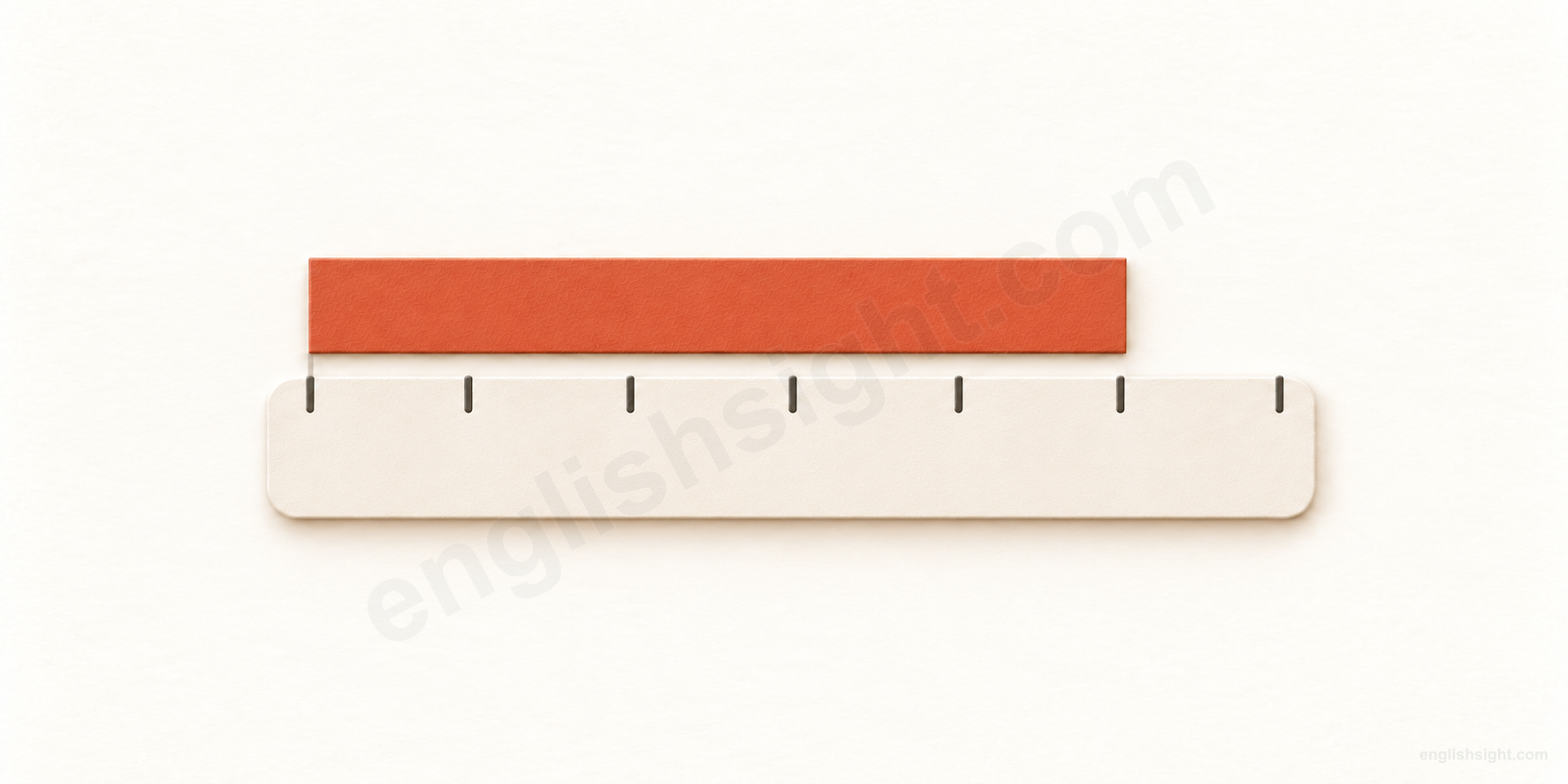
The strip has a length to establish.
measure
It spans five equal unit intervals.
Compare its ends with the ruler’s scale.
The ruler provides the reference: the strip spans five equal unit intervals.
To measure is to establish an amount or degree by relating something to a unit, scale, or criterion.
The sketch models physical measurement and offers a bridge to evaluation. The object does not grow or shrink. Measures meaning planned actions and the fixed expressions are separate branches to learn in context.
To measure something is to find how much or how great it is, using a unit, scale, or criterion. A ruler supplies a physical reference; a goal can supply a reference for judging progress.
The noun also names units, tools, portions, degrees, and actions taken for a purpose. These are established uses, not meanings you can always calculate from a ruler picture. The picture is a learning model, not a claim that all English speakers share one mental image.
01
Find a size, choose units, and make things fit
An object, an instrument, and a unit have different jobs. Learn the action of measuring, the size reported, and the combinations used in making or preparing things.
01
measure + object; measure + how-clause
measure the width
find a physical quantity
Situation / reference needed
You need to know whether a desk will fit.
What is established or intended?
You find its width using a ruler or tape.
The person or instrument finds the quantity; the object need not change.
Measure takes the thing or quantity being checked: measure the desk, its width, the temperature, or the time needed. An instrument can be the subject too: This sensor measures temperature.
A how-clause can specify the question: Measure how wide the opening is. During the activity, I’m measuring the desk is natural. The desk was measured yesterday is a normal passive.
In a sentence
Please measure the width of the desk before we move it.
Watch the difference Measure is broader than weigh: use weigh for finding weight, not for finding length.
02
measure something in + units; measure something with + instrument
measure in centimetres / with a ruler
separate the unit from the instrument
Situation / reference needed
You choose how to check a sheet of card.
What is established or intended?
The result has a unit; the tool supplies the reading.
In names the units; with names the tool.
In centimetres tells the reader how the result is expressed. With a ruler tells them what you use. They can occur together because they answer different questions.
A unit of measure is a standard quantity such as a centimetre or litre. Weights and measures is an established phrase for standards and systems used in measuring. A measurement is a result or act of measuring; a unit of measure is the reference used.
In a sentence
We measured the card in centimetres with a ruler.
Watch the difference Do not use with centimetres when you mean the units, or in a ruler when you mean the tool.
03
object + measures + amount; measures X by Y / X across / X long
measure two metres by one metre
have a stated size
Situation / reference needed
The desk’s dimensions have been established.
What is established or intended?
You report its length and width.
The object is the subject; nobody is doing a measuring action in this sentence.
The desk measures two metres by one metre reports dimensions. By joins the dimensions; across, wide, long, and in length help identify a dimension in other sentences.
Compare I am measuring the desk, an activity, with The desk measures two metres, a size description. The size use is normally simple, not progressive. The desk is measured every year would instead describe a repeated action done to it.
In a sentence
The desk measures two metres by one metre.
Watch the difference Say The desk measures two metres, not The desk is measuring two metres for its fixed size.
04
measure somebody/something for + item; measure up; measure somebody/something up
measure someone for a suit / measure up
take dimensions for something that must fit
Situation / reference needed
A new item must fit a person or a space.
What is established or intended?
The required dimensions are recorded before it is made or bought.
For gives the purpose; up can belong to a physical measuring expression.
Measure someone for a suit means find the body measurements needed for the suit. Someone can be measured for it: I’m being measured for a jacket. This passive describes the activity, not the finished jacket.
Measure up can mean take dimensions, with or without an object: We’re measuring up for new shelves. Measure the room up and measure up the room are possible; with a pronoun, use measure it up. This physical use is distinct from meeting a standard.
In a sentence
We measured the window up for a new blind.
Watch the difference Measure it up is physical measuring; It measures up to our needs means it meets our requirements.
05
measure out + quantity / material; measure + object + out
measure out the rice
set aside a needed quantity
Situation / reference needed
There is more rice in the bag than the recipe needs.
What is established or intended?
You separate the required amount.
Out adds selecting a portion from a larger supply.
Measuring the rice can simply establish how much there is. Measuring out the rice prepares a chosen quantity for use. The object can name the material or the quantity: measure out 200 grams of rice.
This is a separable phrasal verb: measure out the rice or measure the rice out; measure it out with a pronoun. The quantity may be weighed or measured by volume, depending on the task.
In a sentence
I measured out 200 grams of rice for dinner.
Watch the difference Use measure it out, not measure out it. Out does not mean the rice must go outdoors.
06
measure off + length / area; measure + object + off
measure off a length
mark the limits of a required amount or area
Situation / reference needed
A long roll of fabric has no marked cutting point.
What is established or intended?
You mark a two-metre section.
Off focuses on marking out a bounded portion.
Measure off is useful when you establish the boundaries of a length or area. The measuring does not itself say you have cut the fabric or built a fence.
Measure out can also be used for marking a space; the expressions overlap. In a sewing task, Measure off two metres, then cut it makes the sequence clear. With a pronoun use measure it off.
In a sentence
Measure off two metres of fabric before you cut it.
Watch the difference Off identifies the portion or limits; cutting is a separate action unless the context adds it.
07
a tape measure; a measuring tape; a measure
a tape measure
an instrument marked for measuring
Situation / reference needed
You need a tool to check a table’s length.
What is established or intended?
You use marked tape to read the distance.
The countable noun can name the tool rather than the result.
A tape measure is flexible marked tape, often wound into a case. A measure can also be a marked stick or container. The compound tells you which type of instrument is meant.
Compare a tape measure, the instrument, with the table’s measurements, the recorded dimensions. Measuring tape is another name for tape measure. You can also use a measuring cup or jug for quantities of liquid.
In a sentence
Could you pass me the tape measure?
Watch the difference A measurement is not the usual name for the tool: ask for a tape measure.
08
be made to measure; made-to-measure + noun
made to measure
made to fit particular dimensions
Situation / reference needed
A window needs curtains of a particular size.
What is established or intended?
The curtains are made for that window.
The finished item follows individual measurements.
This expression is especially associated with British English and with clothing or home fittings. Curtains made to measure are produced to the required dimensions rather than chosen solely from standard ready-made sizes.
Before a noun, write a made-to-measure suit or made-to-measure curtains. After made, the phrase is commonly open: The curtains were made to measure. The whole expression describes the fit, not the act of measuring.
In a sentence
Our curtains were made to measure for the narrow window.
Watch the difference Made to measure does not mean made in order to measure other objects.
02
Evaluate by a standard or understand a person
A reference can be a goal, a test, or another person’s performance. These uses involve judgment; they need not produce an exact number.
09
measure + progress / success / effect; measure something by / in terms of something
measure progress / success
assess an effect, quality, or achievement
Situation / reference needed
You want to know whether your reading is improving.
What is established or intended?
You choose evidence of progress.
The reference can be a criterion rather than a physical scale.
Measure can concern learning, effectiveness, value, or impact. You need an appropriate way to judge the thing in question; the result need not be a number.
By introduces a basis for judgment: measure progress by what you can now understand. In terms of specifies the dimension used, as in measure success in terms of customer satisfaction. Neither wording guarantees that the chosen criterion is fair or complete.
In a sentence
We measure reading progress by what learners can understand without help.
Watch the difference Measuring progress evaluates improvement; making progress means improving. Measuring alone does not cause it.
10
measure somebody/something against somebody/something
measure something against a standard
compare with an explicit reference
Situation / reference needed
You have a current result and a target.
What is established or intended?
You compare the result with that target.
Against introduces the benchmark, not necessarily an enemy.
The object before against is what you evaluate; the phrase after it gives the reference. You can measure performance against a target or one team against another.
The passive is common when the evaluator is unimportant: Results are measured against the same criteria. Comparing with a standard does not itself say the result meets that standard; use measure up to for that question.
A reflexive object is possible too: I measure myself against my earlier work. Myself identifies the person being assessed; the earlier work supplies the reference.
In a sentence
We measured this month’s sales against our target.
Watch the difference Keep the reference after against: measure the results against it, not measure the results it against.
11
somebody/something + measure up (to + standard / person)
measure up to expectations
be good enough for a standard
Situation / reference needed
A hotel is advertised as quiet and comfortable.
What is established or intended?
You decide whether the actual stay meets that expectation.
The subject is being evaluated; it is not doing the evaluation.
Measure up asks whether someone or something reaches the required level. It often occurs in questions and negatives: Does it measure up? It didn’t measure up to our expectations.
To is a preposition here: measure up to the standard, or measure up to it. The reference can be omitted when it is already understood. Unlike physical measuring up, this use does not take a direct object naming what you inspect.
In a sentence
The hotel didn’t measure up to its online description.
Watch the difference It doesn’t measure up to them evaluates it against them; I’m measuring them up means I am inspecting them.
12
measure somebody up; measure + personal pronoun + up
measure someone up
look at a person to assess them
Situation / reference needed
An opponent arrives before a match.
What is established or intended?
You look carefully at them and form an assessment.
The person assessed is the direct object.
In this use you assess someone’s apparent character, ability, or likely behavior. No ruler is required. A sentence about a tailor can instead have the physical meaning; the situation decides.
The expression is separable: measure the opponent up or measure up the opponent, but measure them up. Contrast The opponent didn’t measure up, which evaluates whether the opponent was good enough.
In a sentence
The two players quietly measured each other up before the match.
Watch the difference Measure someone up does not promise an accurate judgment or mean that you already understand them completely.
13
get / take / have the measure of + person / situation; take somebody’s measure
get / take / have the measure of someone
understand what someone or something is like well enough to deal with them
Situation / reference needed
An opponent’s tactics are hard to predict.
What is established or intended?
You learn their pattern and can respond effectively.
The fixed noun expression implies an understanding useful for dealing with the target.
Get or take the measure of describes arriving at an assessment. Have the measure of describes possessing that understanding. The target can be a person or a difficult situation.
The expression is relatively formal. It can sound strategic, as if you know how to handle an opponent or a problem. Take someone’s measure is an alternative form. This is more than merely recording their height.
In a sentence
By the second game, Jo had the measure of her opponent.
Watch the difference Keep the article in have the measure of her; have a measure of her does not express this idiom.
14
a measure of + quality; a measure of how + clause; it is a measure of X that + clause
a measure of ability / of how much it matters
a basis for judgment or a sign of degree
Situation / reference needed
You need evidence about a quality you cannot observe directly.
What is established or intended?
A test, result, or action supplies an indicator.
Of can connect an indicator to the quality it represents.
A test can be a measure of reading ability: it is used to assess that ability. An accurate or reliable measure is one that serves the purpose well. That does not make it the only possible measure.
In It is a measure of her commitment that she comes every week, attendance is evidence of how strong the commitment is. Compare a measure of success meaning some success: that is an amount, not a test or sign. Read the whole sentence to identify the relation.
In a sentence
The time he gives us is a measure of how much he cares.
Watch the difference A measure of ability can be an assessment tool; a measure of confidence usually means an amount of confidence.
03
Quantities, degrees, and something extra
Measure can name a portion or an amount of an abstract quality. Fixed expressions add meanings such as equally, greatly, fully, or as an extra.
15
a measure of + substance; two measures of + substance
a measure of juice
a measured serving or portion
Situation / reference needed
A recipe specifies one portion of juice and two of water.
What is established or intended?
You keep the same portion size for the ratio.
The countable noun can name an amount that has been measured out.
A measure may be a standard serving, especially of spirits in a bar, or a portion used in mixing. In a recipe, one measure of juice to two of water gives a ratio if each measure uses the same volume.
The word alone does not tell you a universal volume. A bar’s single measure depends on the setting; in a recipe you need to know the chosen container or stated amount. Two measures means two portions, not two measuring actions.
In a sentence
Mix one measure of juice with two measures of water.
Watch the difference Do not assume a measure always equals a cup or a fixed number of millilitres.
16
a / some / a greater measure of + abstract noun
a measure of confidence
some amount of an abstract quality
Situation / reference needed
A first success makes you feel more confident.
What is established or intended?
You now have some confidence, though not necessarily complete confidence.
Here measure names a degree, not a ruler, a test, or a planned action.
A measure of confidence, freedom, or success presents the quality as something present to a degree. This wording is somewhat formal and can suggest an appreciable amount. The exact extent still depends on context.
Some measure of success emphasizes that success exists without necessarily claiming a total success. A greater measure of freedom compares degrees. These phrases do not assign a percentage, and a measure of does not always mean only a tiny amount.
In a sentence
Finishing the first task gave me a measure of confidence.
Watch the difference Compare a measure of confidence, an amount, with a measure of ability, which can be a way of assessing ability.
17
in large / some / no small / equal measure; equal measures of X and Y
in large / some / equal measure
to a stated extent or in equal degrees
Situation / reference needed
Several things contribute to an outcome or feeling.
What is established or intended?
You describe their relative extent.
The modifier tells you how much; the expression often sounds formal.
In large measure means to a large extent; in some measure means to some extent. In no small measure also means to a substantial extent: the negative wording emphasizes a large contribution.
In equal measure puts qualities or contributions at equal degrees: The story amused and frightened us in equal measure. It need not imply a precise numerical calculation. Without in, equal measures of hope and fear presents the emotions as matching amounts.
In a sentence
The project succeeded in large measure because volunteers kept it running.
Watch the difference In no small measure means considerably, not hardly at all. In equal measure means equally, not fully.
18
adjective + beyond measure; verb + beyond measure
beyond measure
to an extremely great degree
Situation / reference needed
You want to emphasize how strong a feeling is.
What is established or intended?
You describe it as too great to measure.
The expression intensifies; it is often formal or emotional.
Pleased beyond measure expresses very great pleasure. The phrase uses the idea of exceeding a measurable limit, but it normally functions as emphasis rather than a scientific statement.
It can follow an adjective or verb: grateful beyond measure; The news delighted us beyond measure. Ordinary alternatives are extremely grateful or delighted us very much.
In a sentence
We were grateful beyond measure for their kindness.
Watch the difference Use the fixed phrase without an article: beyond measure, not beyond a measure.
19
give / get short measure; the full measure of something; in full measure
full measure / short measure
the full expected amount or less than is due
Situation / reference needed
You expect a certain quantity or degree.
What is established or intended?
You receive it fully, or receive less than expected.
Full and short compare what is received with what is due.
Short measure can concern goods sold in too small a quantity, or figuratively an experience that gives you less than promised. Full measure refers to the whole amount or degree.
In full measure is a formal expression meaning fully or to the greatest degree: Their efforts were rewarded in full measure. Short here means deficient, not short in physical length or lasting a short time by definition.
In a sentence
The show ended after twenty minutes, and we felt we had been given short measure.
Watch the difference Do not confuse short measure, an inadequate amount, with a short measurement recorded with a ruler.
20
do / add something for good measure; for good measure, + clause
for good measure
as an extra addition
Situation / reference needed
The necessary items have already been supplied.
What is established or intended?
Someone adds one more thing.
The whole expression marks something extra, not accurate measuring.
You can add an extra biscuit for good measure, or repeat a warning for good measure. The addition can be a bonus, an extra precaution, or simply one more point.
No physical quantity has to be measured. The phrase often comes after the extra action, although it can introduce it: For good measure, she checked the lock again. Good does not independently mean extra in arbitrary combinations.
In a sentence
She packed two spare batteries and added a third for good measure.
Watch the difference For good measure does not mean for a good measurement. Learn the whole expression.
04
Actions intended to achieve a result
A measure can be a planned response to a problem. This is an established noun branch: taking measures does not mean taking measurements.
21
take / introduce / implement measures to + verb; measures against + problem; as a precautionary measure
take measures to protect something
carry out actions for a particular purpose
Situation / reference needed
A building has repeated security problems.
What is established or intended?
The managers introduce steps to reduce the risk.
Measure is a countable noun naming a planned action.
Take measures to do something introduces actions and their aim. To protect explains the purpose; it does not guarantee success. Take measures against theft names the problem being opposed. Introduce, adopt, and implement measures are also natural.
Safety measures, security measures, emergency measures, and cost-cutting measures identify different purposes. As a precautionary measure frames one step as prevention: They copied the files as a precautionary measure. This branch is common in organizational and official language; action or steps is often simpler in conversation.
In a sentence
The library took measures to protect its rare books from damp.
Watch the difference Say take measures, not make measures. Taking measurements means recording quantities and is a different activity.
22
propose / approve / pass / reject a measure; a ballot measure
pass a measure / a ballot measure
a proposed or adopted legislative item
Situation / reference needed
A change in the law is formally proposed.
What is established or intended?
A council, legislature, or voters decide on it.
The noun can refer to the proposal or legislative act itself.
In North American political news, a measure can be a proposed law or a legislative action under discussion. The verb tells you its stage: propose a measure, reject it, or pass it.
A ballot measure is a proposal that voters decide on directly. This is related to the action branch, but a proposed measure is not automatically an existing law. Here the lesson explains vocabulary, not any particular legal procedure.
In a sentence
Voters approved a ballot measure to fund the new park.
Watch the difference A measure can still be only a proposal. Look for passed, rejected, or proposed before deciding its status.
23
half measures; no half measures; not settle for half measures
no half measures
no weak or incomplete attempt at solving a problem
Situation / reference needed
A problem needs a thorough response.
What is established or intended?
The speaker rejects an inadequate partial response.
This established expression evaluates how fully an action addresses the problem.
Half measures are actions that do not go far enough. No half measures signals a determination to deal with something thoroughly. The expression often carries criticism of an ineffective compromise.
Half is figurative here; no calculation of exactly fifty percent is intended. Compare a half measure of juice, which can literally be half a serving. The plural expression half measures belongs to the action branch.
In a sentence
The roof needs replacing; we can’t settle for half measures.
Watch the difference Half measures are insufficient actions; they are not necessarily inaccurate measurements.
05
A section of music
In music, especially in American English, measure names a rhythmic section. Learn it within that subject rather than treating it as a ruler or a government action.
24
a measure of music; play + number + measures; beats per measure
play the first four measures
play counted sections of music
Situation / reference needed
A piece of written music is divided into rhythmic sections.
What is established or intended?
You select a particular set of those sections to play.
A measure groups beats; it is not automatically one note or one second.
Measure is especially the American English word for what British English usually calls a bar. In written notation, bar lines mark these sections. The time signature helps specify the grouping of beats.
For example, in ordinary 4/4 each measure contains four quarter-note beats. The duration in seconds depends on the tempo. A piece can change its time signature, so do not treat every measure in all music as the same fixed number of seconds or beats.
In a sentence
Let’s practise the first four measures slowly.
Watch the difference In music, four measures means four bars, not four measuring instruments or four notes.
Keep the noun, the action, and the construction distinct
Forms and sound
The verb forms are measure, measures, measured, measured, and measuring. Drop the final e before -ing. The noun and verb have the same pronunciation, /ˈmeʒə(r)/; the middle consonant is like the sound in vision, not the sh in ship.
Activity, size, and passive
I’m measuring the table is an ongoing action. The table measures two metres reports its size and is normally not progressive. The table is being measured is a passive action. Having the table measured means arranging for someone to do the measuring; it is the have + object + past participle construction, not a special new meaning of measure.
Which sort of combination?
Measure out and measure off allow an object before the particle. Measure up has physical, inspecting, and standard-reaching uses. In measure against a target and measure up to it, the reference follows the preposition. Measure in centimetres and measure with a ruler are ordinary prepositional patterns; take measures and for good measure are established noun expressions.
Measure, measurement, and measured
Take measurements when recording dimensions; take measures when acting to achieve a result. A measured response can mean a careful, controlled response, not one assigned a numerical size. That adjective is a related use; full adjective and adverb families are outside this lesson.
Boundaries of the model
Comparison with a reference connects measurement and assessment, but does not predict every idiom. Historical dance or tune senses, poetic metre, printing widths, coal-measures geology, and advanced mathematical uses are outside this everyday course. No frequency ranking or claim of every possible English use is intended.
Choose the meaning from the whole pattern
Identify the subject, object, and reference. Then decide whether the sentence is about a quantity, an assessment, or an action.
1. You are stating the fixed size of a shelf. Which sentence fits?
2. You used a tape measure and recorded lengths as centimetres. Which sentence assigns those roles correctly?
3. You need to take a particular amount of rice from a large bag. Which instruction fits?
4. The new laptop is less capable than you expected. Which sentence describes that assessment?
5. The school added new locks to improve security. Which description expresses the planned response?
6. After packing two spare pens, Sam adds one more for good measure. What does the final phrase mean?
7. A report says the outcome depended in no small measure on teamwork. What does this mean?
Sources and teaching notes
Noun and verb uses, constructions, and expressions were checked against the dictionary pages below. The explanations and examples are original teaching material. The visual connection is a learning model rather than a dictionary definition or a universal mental image.
The sketch connects an extent with a reference; it does not explain every fixed expression.