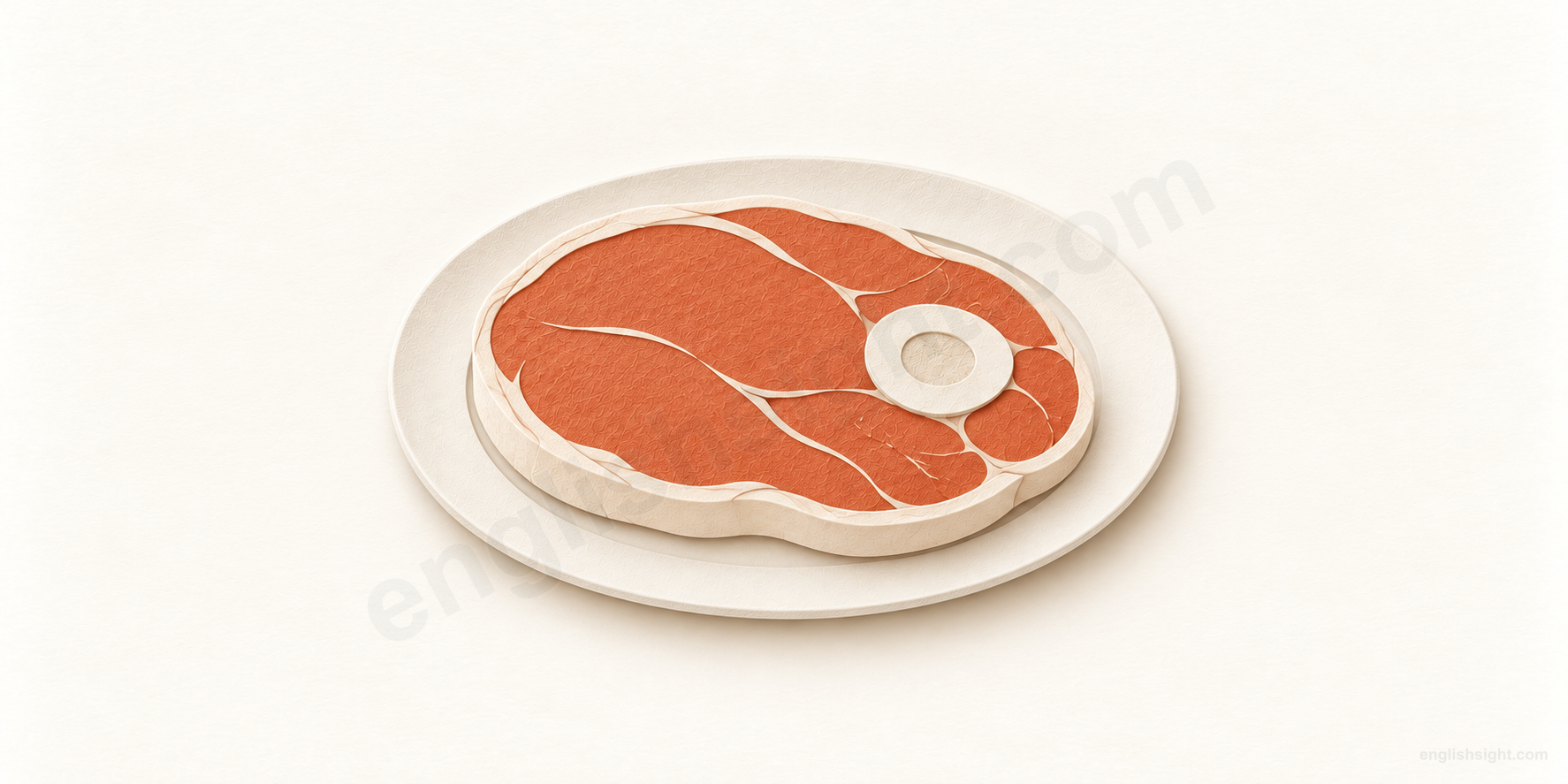
Use meat for food, distinguish its kinds and amounts, and recognize the whole expressions.
Flesh considered as food
Flesh considered as food
A cut on a plate contains flesh and a small bone.
meat
The flesh is meat; the bone provides a contrast.
Notice the orange flesh surrounding the ivory bone.
The orange flesh is the focus. Boneless meat is still meat.
Meat names the flesh of an animal considered as food; in a figurative use, it names substantial content.
The cut shows the food meaning. Meat need not be attached to a bone, and the word does not itself describe cutting, cooking, or movement.
Meat /miːt/ usually names animal flesh as food. It can be raw or cooked; the word itself does not say how it has been prepared.
A useful connection is substance: edible flesh rather than bone, then the substantial content of a discussion. Fixed expressions need separate learning; this connection does not predict every phrase.
01
Buying, cooking, and choosing food
Start with meat as a substance. Amounts, kinds, preparation words, and familiar food names answer different questions.
01
eat / buy / cook + meat; some / a piece of / a kilo of + meat
eat meat / some meat
animal flesh considered as food
Situation
You ask what a guest eats.
What is meant
You learn whether animal flesh is part of their diet.
Meat names the food substance, not a whole animal.
In ordinary food talk, meat is usually uncountable: some meat, much meat, or no meat. To count portions, use two pieces of meat; to measure an amount, use half a kilo of meat. The meat in this pie refers to a specific quantity, so the is possible.
Chicken can be called meat, but a menu or shop may list meat, poultry, and fish separately. Meat and fish is a familiar contrast. Do not assume that every speaker uses the category with exactly the same boundary.
When ordering, Does this soup contain meat? asks about an ingredient. I don’t eat meat states a dietary practice; it does not mean I am refusing all food.
In a sentence
Does this sauce contain any meat?
Watch the difference For two portions, say two pieces of meat, not two meats. Ask specifically about chicken or fish if the distinction matters.
02
different / various + meats; a selection of + cold meats
different meats / cold meats
refer to kinds of meat or an assortment of prepared meats
Situation
A shop offers beef, pork, and other choices.
What is meant
You compare the kinds rather than count individual pieces.
The plural points to varieties or a selection.
Meats is useful when discussing kinds: The shop sells several different meats. It is not the default plural for a quantity on your plate.
Cold meats often refers to a selection of cooked or prepared meats served cold, such as sliced ham. In The meat is cold, cold simply describes its temperature; the sentence does not name an assortment.
In a sentence
They set out bread, cheese, and a selection of cold meats.
Watch the difference Meats does not automatically mean pieces. Use three slices of meat when you mean three slices.
03
adjective + meat; meat + food / product noun
raw / cooked / lean / processed meat
describe the state or preparation of the food
Situation
You compare ingredients for a meal.
What is meant
A describing word tells you what kind of preparation or composition is involved.
The modifier adds information; meat still names the substance.
Raw and cooked describe preparation; lean describes meat with little fat. Cured meat has been treated for preservation, for example with salt or smoke. Processed meat is a broader product description, not a synonym for raw meat.
In meat pie, meat dish, and meat products, meat is a noun modifying another noun. The second noun names the thing: a meat pie is a pie, while pie meat is meat intended for a pie. These combinations are not phrasal verbs.
In a sentence
Use lean meat for the filling.
Watch the difference Lean describes fat content. It does not mean uncooked; raw meat and lean meat answer different questions.
04
minced / ground + meat; minced / ground + beef
minced meat / ground meat
meat broken into very small pieces
Situation
A recipe needs meat that will mix into a filling.
What is meant
You choose the finely divided form.
Minced and ground describe preparation rather than the animal source.
Minced meat is a usual British expression; ground meat is usual in American English. British English also uses mince as a noun. Ground beef and minced beef specify the animal product more precisely.
Keep minced meat separate from the single word mincemeat. In modern British food talk, mincemeat commonly means the sweet dried-fruit mixture used in mince pies. Its spelling preserves a history that does not reliably tell you the present ingredients.
In a sentence
We need ground meat for the dumpling filling.
Watch the difference Do not replace minced meat with mincemeat in a shopping list without checking which ingredient is intended.
05
red / white / dark + meat
red meat / white meat / dark meat
distinguish food categories and parts of poultry
Situation
You choose a kind of meat or a portion of chicken.
What is meant
The colour term identifies the relevant food category.
White contrasts with red in one context and dark in another.
Red meat includes familiar examples such as beef and lamb. White meat can name paler meat such as chicken. These are conventional food categories, not a request to judge how red a cooked slice looks.
When choosing parts of a chicken or turkey, white meat usually means breast meat, while dark meat means the darker leg meat. Dark meat here is not another name for beef. The surrounding conversation tells you which contrast is intended.
In a sentence
Would you prefer white meat or dark meat from the turkey?
Watch the difference The white/dark distinction within poultry is different from the broader red/white food-category distinction.
06
some / slices of + lunch meat
lunch meat
cooked meat sold in slices
Situation
You are shopping for sandwich ingredients.
What is meant
You choose prepared sliced meat.
Lunch meat is a product name, not any meat eaten at midday.
Lunch meat is a North American food term for cooked meat sold in slices. A shopper might buy it to fill sandwiches.
The compound has a conventional meaning. A freshly cooked steak eaten at noon is meat for lunch, but that timing alone does not make it lunch meat.
In a sentence
There’s some lunch meat in the fridge for sandwiches.
Watch the difference Read the full compound; lunch does not merely give the time when the meat is eaten.
07
meat and two veg
meat and two veg
a traditional British style of meal
Situation
Someone asks what sort of dinner is planned.
What is meant
You describe a plain meal of meat, potatoes, and another vegetable.
The whole phrase names a familiar meal pattern.
In informal British food talk, meat and two veg means a meat dish with potatoes and another vegetable. Veg is a shortened form of vegetables.
It can evoke a traditional, straightforward dinner rather than a particular recipe. It is separate from the figurative American expression the meat and potatoes of something.
In a sentence
We’re having meat and two veg tonight.
Watch the difference The two includes potatoes in this meal expression; it does not necessarily mean two additional green vegetables.
02
Edible parts and substantial content
Meat can name the part you eat inside a covering, or the part of a discussion that supplies its substance. These uses need their own context.
08
crab / coconut + meat; the meat of + a nut
crab meat / coconut meat
the edible substance apart from its shell or covering
Situation
You open a shell or a coconut.
What is meant
You identify the part that can be eaten.
A source noun tells you which edible material is meant.
Crab meat names the edible flesh of a crab, as distinct from its shell. Here meat combines naturally with a seafood source even though people often contrast meat and fish in general food categories.
Coconut meat and the meat of a nut use meat for the edible inner part. This use is especially familiar in American English. It does not classify the coconut as an animal.
In a sentence
Scoop out the coconut meat and put it in a bowl.
Watch the difference Coconut meat is not coconut milk or the hard shell. This particular use cannot be predicted for every edible plant.
09
the meat of + topic; put meat on the bones of + outline / plan
the meat of the matter / put more meat on the bones
the substantial content rather than surrounding material
Situation
A presentation contains a long introduction but few details.
What is meant
The speaker reaches the important points or adds useful detail.
Food substance becomes a teaching link to intellectual substance.
The meat of an argument, report, or discussion is its substantial content. Get to the meat of the matter asks someone to reach what matters. Get to contributes reaching a point; of connects meat with the topic.
A plan with no meat lacks substance. Put more meat on the bones of a proposal uses a skeleton as a comparison for a bare outline: add the details that will make it useful. The bones do not mean literal bones in this context.
In a sentence
The opening is clear, but we need more meat on the bones of the proposal.
Watch the difference This metaphor concerns useful content, not the physical length of a document. A long report can still lack substance.
10
not much meat on + bone / person / possessive + bones
not much meat on the bone / on someone
little edible flesh; informally, a thin body
Situation
A chop contains a large bone but little flesh.
What is meant
You notice how little substance surrounds the bone.
The physical comparison can be extended to a person’s build.
There isn’t much meat on this chop can be a literal comment about how much edible flesh you get. Not much meat on the bones of a plan instead concerns detail.
Informally, not much meat on someone or on their bones can describe a thin person. That is a comment about their body, not a statement that they are food; it can sound intrusive, so use care when speaking to someone.
In a sentence
There isn’t much meat on this chop.
Watch the difference A body comment and a comment about a plan have different targets. Read the noun phrase after on.
03
Expressions to learn as whole phrases
Some phrases describe essentials or preferences; others describe trouble or exploitation. Their full wording and tone matter.
11
the meat and potatoes of + activity; meat-and-potatoes + issue / work
the meat and potatoes of…
the basic practical elements of something
Situation
A training course covers many extras.
What is meant
You identify the practical essentials.
The whole food phrase can name what a task mainly depends on.
Especially in American English, the meat and potatoes of something means its basic, essential parts. A familiar substantial meal supplies a useful comparison, but the figurative meaning belongs to the established phrase.
Before a noun, the hyphenated adjective can describe basic practical concerns: meat-and-potatoes issues. Without that figurative context, meat and potatoes can simply name food.
In a sentence
Daily practice is the meat and potatoes of this course.
Watch the difference Meat and potatoes stays a fixed expression in the figurative use; changing potatoes to another food does not preserve it.
12
a meat-and-potatoes + person / guy
a meat-and-potatoes person
someone with plain, straightforward tastes
Situation
You discuss someone’s preferences.
What is meant
You describe their liking for simple things.
The adjective can characterize a person’s tastes, not just a task’s essentials.
A meat-and-potatoes person likes plain, uncomplicated things. The description can concern food or a more general preference for simplicity.
This is a North American adjective used before a noun. It is related to the practical-essentials expression but answers a different question: What sort of person? rather than What are the basic elements?
In a sentence
He’s a meat-and-potatoes guy who prefers simple meals.
Watch the difference This is an informal characterization, not a precise dietary category or a claim that the person eats nothing else.
13
be + dead meat
be dead meat
be in serious trouble or face unpleasant consequences
Situation
You realize you have made a serious mistake.
What is meant
You expect a very bad reaction.
The phrase expresses danger or trouble, often with exaggeration.
I’m dead meat is informal and can dramatize an expected punishment or other serious consequence. It need not predict a literal death.
You’re dead meat can be a hostile threat, though friends may also use it jokingly. The relationship and tone matter. This is a fixed noun phrase after be, not a passive form of a verb called meat.
In a sentence
If I lose the only set of keys, I’m dead meat.
Watch the difference Do not assume this is harmless language when it is directed at another person; it can sound threatening.
14
be / see someone as + easy meat + for + opponent / exploiter
be easy meat for…
be an easy target to defeat, deceive, or exploit
Situation
Someone looks for people who may not resist.
What is meant
They regard those people as easy targets.
For names the person who may take advantage.
Especially in British English, easy meat can describe someone easily defeated or tricked. The comparison treats the target as easy prey; it does not concern cooking difficulty.
Collins also records something easy to obtain or do. That broader use needs a clear context, while easy meat for scammers makes the target-and-exploiter relation explicit.
In a sentence
The scammers saw inexperienced buyers as easy meat.
Watch the difference Easy meat is a dismissive description of a target. For simply identifies who can exploit the opportunity.
15
activity / task + be + meat and drink to + person
be meat and drink to someone
be enjoyable or a familiar task someone handles readily
Situation
A difficult repair worries a beginner.
What is meant
An experienced mechanic treats it as welcome routine work.
To names the person for whom the activity is familiar or enjoyable.
This mainly British expression can stress enjoyment, ease through familiarity, or both. The task itself is the subject; to is followed by the person: This is meat and drink to her.
It is a conventional expression. You cannot derive the whole meaning by translating meat and drink separately, and the phrase does not promise that anyone could do the task.
In a sentence
Finding faults like this is meat and drink to an experienced mechanic.
Watch the difference Keep to before the person; compare easy meat for an opponent, which describes vulnerability instead.
16
one man’s meat is another man’s poison
One man’s meat is another man’s poison.
different people can strongly prefer different things
Situation
You love a busy city, but a friend dislikes it.
What is meant
You acknowledge the difference in taste.
The proverb contrasts what pleases one person with what displeases another.
This traditional saying can refer to jobs, music, places, or other preferences as well as food. Meat represents something welcome, while poison represents something unwelcome in the comparison.
Man is part of the inherited wording and is not a restriction to men. In everyday conversation, People like different things is a plain alternative. The proverb is a comment on taste, not evidence that a food is actually poisonous.
In a sentence
I enjoy the busy city, but you hate the noise—one man’s meat is another man’s poison.
Watch the difference Learn the whole saying. It does not mean every disagreement is merely a matter of personal taste.
17
treat + person + like a piece of meat; regard + person + as a piece of meat
treat someone like a piece of meat
treat a person as only a body or useful physical object
Situation
Someone ignores a worker’s feelings and individuality.
What is meant
The worker objects to being valued only for physical use.
The phrase criticizes reducing a person to their body.
A piece of meat can be a literal portion of food. Applied to a person, it is a dehumanizing comparison: the person is treated as a sexual object or as nothing more than a useful body.
In Don’t treat me like a piece of meat, the speaker rejects that treatment. Like introduces the comparison; the whole expression carries the critical meaning. This use is informal and can be offensive when used to label someone.
In a sentence
The workers said they were treated like pieces of meat, with no concern for their feelings.
Watch the difference Do not use this as a neutral description of a person. The literal food meaning and the critical human comparison differ sharply.
Keep the substance, grammar, and phrase apart
Meat, flesh, and meet
Meat usually presents animal flesh as food. Flesh can describe the soft tissue of a living body, and the flesh of fruit. Meet is a different word with the same pronunciation /miːt/: We meet at six.
Amounts are different from kinds
Use some meat, a piece of meat, or two slices of meat for quantities. Meats is possible for varieties or an assortment. Ordinary meat is a noun, so verb tense, passive, causative, and phrasal-verb patterns do not apply.
The picture has limits
The bone is only a contrast in this sketch: boneless meat is still meat. Coconut meat and figurative substance are extensions to learn in context. Threats, preferences, and objectifying expressions belong to their whole phrases.
Scope of this lesson
This selection covers modern food usage, important figurative uses, and established expressions. Historical meat meaning food in general or a meal, specialized trade vocabulary, and vulgar anatomical slang are outside the lesson. Compounds such as meatball and meatloaf name their own dishes; they are not new senses of meat.
Choose the meaning in context
Use the whole phrase and the situation to decide.
1. You need two individual portions for dinner. Which shopping-list phrase clearly counts the portions?
2. “Let’s get to the meat of the discussion.” What does the speaker want?
3. You are choosing white meat or dark meat from a cooked chicken. Which contrast fits?
4. “These repairs are meat and drink to Jo.” Jo is an experienced technician. What does this mean?
5. A British recipe needs finely divided beef for a savoury filling. Which label avoids confusion with a sweet fruit mixture?
Sources and teaching notes
Dictionary sources support the usage inventory. The explanations, examples, and teaching sketch were created for this lesson; the visual connection is a teaching aid.
The diagram illustrates a useful distinction; it is not a mental picture shared by every English speaker.