Talk about materials, metal objects, and the combinations whose meanings go further.
Material stays metal as its form changes
Material stays metal as its form changes
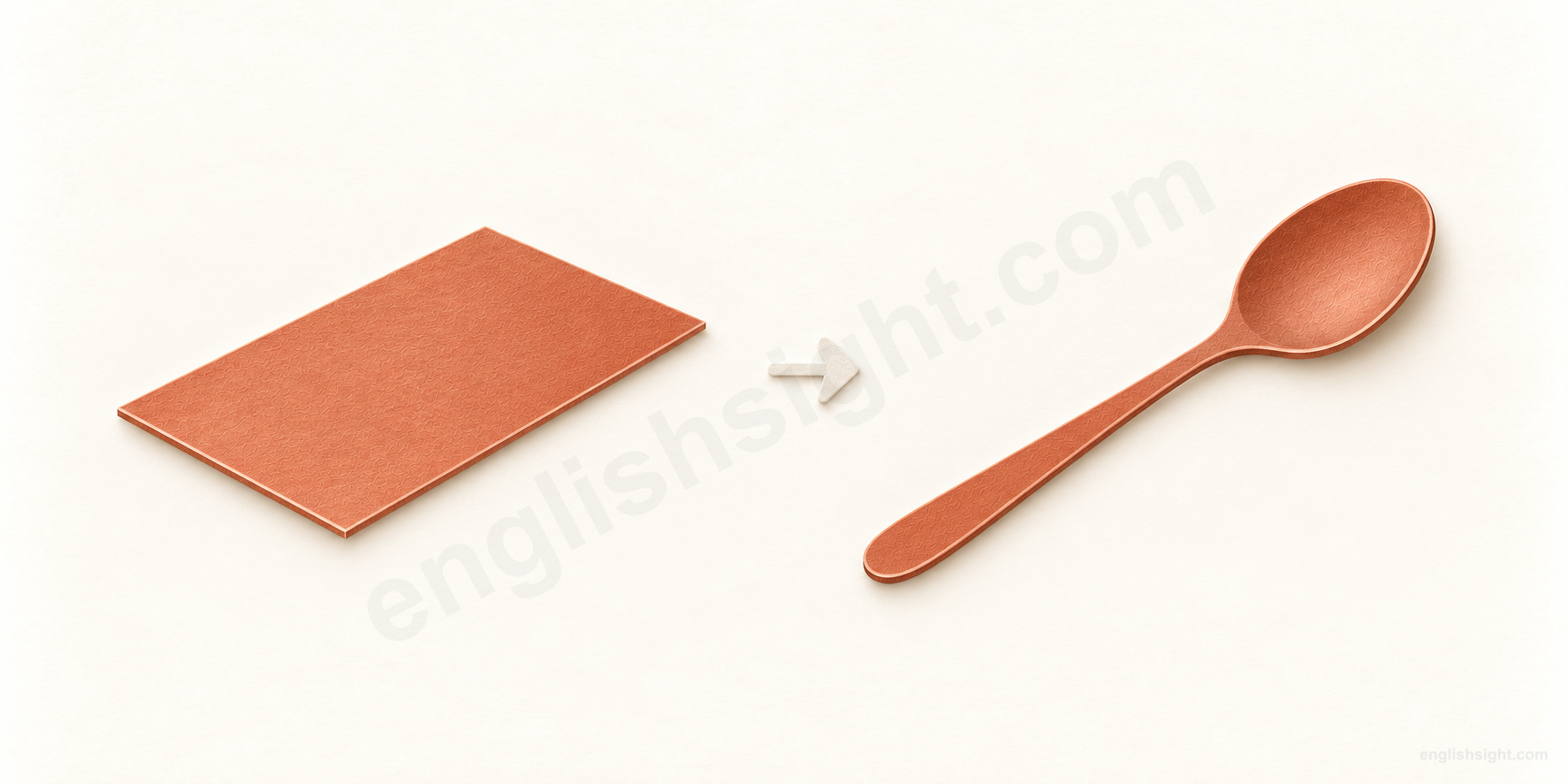
A flat copper-colored metal blank.
metal
A spoon, still made of metal.
The material is shaped into an object.
The shape changes from blank to spoon; the material remains metal.
Metal names a class of materials, such as iron and copper, that can be shaped into objects while remaining metal.
This is a material relationship, not a definition of a manufacturing process. The sketch follows a metal blank into a spoon; the lesson also separates kinds of metal, fixed combinations, and the music sense.
A key, a spoon, and a sheet can have very different shapes while all being metal. Start with the material, then ask whether the sentence counts kinds, pieces, or finished objects.
The material model helps with everyday descriptions. It does not explain the music meaning or every fixed phrase by itself. It is a teaching connection, not a claim about a picture shared by all English speakers.
01
The material, its kinds, and its objects
Start with what something is made of. Grammar separates an amount of material, a kind of metal, and an object made from it.
01
metal as an uncountable material noun
metal
a broad class of materials such as iron and copper
Situation / material
You compare materials for a handle.
What the expression identifies
You identify metal rather than wood or plastic.
Metal tells us the material category, not the object’s shape.
Metal commonly names a material without counting it: some metal, more metal, or The metal is cold. Iron and copper are examples. Metal does not mean only iron.
Metals typically conduct heat and electricity and can often be shaped. Hardness and shine are useful clues, not a rule that every metal object must be hard, bright, or silver in colour.
The sketch follows material through a change of shape. It explains why a sheet and a spoon can both be metal; it does not define the word as an action.
In a sentence
We need metal for the handle, not plastic.
Watch the difference For material in general, say metal, not a metal. Use a metal when you mean one kind.
02
a metal; metals; a kind / type of metal
a metal / different metals
one type of material, or several types
Situation / material
You have samples of copper and iron.
What the expression identifies
You describe them as two different metals.
Countable metal usually counts kinds, not individual spoons or keys.
Copper is a metal classifies copper as one kind. Copper and iron are metals uses the plural for different kinds. This is the countable use of the same material word.
In everyday English, metal also includes alloys such as steel and brass. An alloy combines elements and includes metal. More narrowly, a scientific definition may distinguish a metallic element from an alloy.
Two metal keys counts keys. Two metals normally suggests two kinds of material, not two keys. Choose the noun according to what you want to count.
In a sentence
The display contains two metals: copper and iron.
Watch the difference Steel is a kind of metal, but it is not the name for every metal.
03
a piece / lump / strip / bar of metal; pieces of metal
a piece of metal
one separate amount or fragment of material
Situation / material
You find one sharp fragment on the floor.
What the expression identifies
You identify it without knowing its original object.
Piece supplies the countable unit; metal supplies the substance.
A piece of metal can be a fragment, an offcut, or another separate portion. Two pieces of metal counts portions even if both are steel.
Lump, strip, and bar add information about shape. A lump of metal is a compact, irregular amount; a strip is long and narrow. These words do not create new senses of metal.
Use some metal for an unspecified amount, or a piece of metal for one portion. In The metal on this table is cold, the identifies particular material without making it countable.
In a sentence
There is a sharp piece of metal under the chair.
Watch the difference Say three pieces of metal for three fragments; three metals normally counts kinds.
04
be made of / from / out of metal; work / cast in metal
made of metal / work in metal
identify the material used in an object or craft
Situation / material
Someone asks about a bowl’s material.
What the expression identifies
You explain what the bowl consists of.
Of names the material; in can name an artist’s working medium.
The bowl is made of metal answers What is it made of? Made from metal and made out of metal are also possible. These expressions describe the object’s material or source; they are not different senses of metal.
She works in metal says that metal is her artistic medium. A design cast in metal has been given a metal form using a mould. In these uses, in identifies the medium or material.
A metal bowl is a shorter description of the same material relationship. A bowl for metal instead says what the bowl is intended to hold, so the preposition changes the relationship.
In a sentence
This bowl is made of metal, but its lid is wooden.
Watch the difference Use made of metal to name the substance, rather than made by metal; by normally introduces a maker.
You compare a steel door and a painted plastic panel.
What the expression identifies
You distinguish material from appearance.
Metal before a noun usually names material; metallic can describe resemblance.
In a metal door or metal spoons, metal comes before the object noun and identifies its material. Dictionaries may describe this as attributive noun use or as an adjective meaning made of metal.
Keep metal singular in ordinary material descriptions: metal doors, not metals doors. You can also say The door is metal or The door is made of metal.
Metallic is useful for a metal-like shine, taste, or sound: a metallic finish can appear on a plastic object. Metallic can also mean containing or made of metal, especially in technical descriptions; it does not always mean imitation.
In a sentence
The plastic panel has a metallic finish; the door itself is metal.
Watch the difference A metallic taste describes a sensation; it does not itself prove that metal is present.
02
Forms, reuse, and value
The added word tells you how the material is supplied, what it is used for next, or which class it belongs to.
06
sheet metal; a sheet / two sheets of metal
sheet metal / a sheet of metal
material supplied in thin flat form, or one flat piece
Situation / material
A workshop needs flat material for a cover.
What the expression identifies
You specify the form and then the number of pieces.
Sheet metal names a material form; a sheet of metal counts one piece.
Sheet metal is metal made into thin flat sheets. The combination describes the form in which the material is supplied, not a different chemical substance.
We need sheet metal asks for that kind of material. We need two sheets of metal specifies two flat pieces. The plural belongs to sheets when you count the pieces.
A sheet-metal cover is a cover made from this material. Thin foil and thick plate are related forms, but this lesson does not set engineering thickness limits.
In a sentence
We ordered two sheets of metal to make a new cover.
Watch the difference Use some sheet metal or two sheets of metal, rather than two sheet metals for two sheets.
07
scrap metal; sell something for scrap; a pile of scrap metal
scrap metal
unwanted metal or old metal articles collected as material
Situation / material
An old metal gate is no longer usable as a gate.
What the expression identifies
Its material can be collected for reuse or recycling.
Scrap changes the status or use of the material, not its material category.
Scrap metal includes unwanted metal pieces and used metal objects, often collected for reprocessing. Something can have little value as an object but still be sold for its material.
Sell it for scrap means sell it for the material that can be recovered. It does not mean repair it and sell it as a working object.
Scrap metal is normally uncountable. Say a pile of scrap metal or pieces of scrap metal when you need a unit. Recycled metal describes material after recycling; scrap metal describes unwanted or discarded metal, often collected for that purpose.
In a sentence
They sold the damaged gate as scrap metal.
Watch the difference Scrap metal need not be rusty, and scrap does not mean that the material has stopped being metal.
08
a precious metal; precious metals; base metal beneath a coating
precious metal / base metal
name a valuable metal class or a contrasting ordinary material
Situation / material
You read a description of gold-plated jewellery.
What the expression identifies
You distinguish the valuable coating from the material underneath.
The extra word classifies the metal; base can also identify the underlying material.
Precious metals include gold, silver, and platinum: metals valued for their relative rarity and high value. A precious metal is one member of that class; precious metals names the class in the plural.
Base metal can mean a comparatively less valuable metal or alloy, rather than a precious one. In a plated object, the base metal can also mean the metal beneath the coating.
In The gold coating has worn away, exposing the base metal, base identifies what lies underneath. The phrase is not a judgment about the owner’s taste, and it is not base meaning the foot of an object.
In a sentence
The ring has a thin gold coating over a base metal.
Watch the difference Gold-plated does not mean solid gold. Learn which material description the whole phrase actually gives.
03
Special combinations and established meanings
Some combinations still concern the material. Music and an informal idiom need meanings learned with the whole expression.
09
a heavy metal; heavy metals in soil / water
a heavy metal / heavy metals
a material category used in science and environmental discussion
Situation / material
A report describes lead in an environmental sample.
What the expression identifies
It places lead among heavy metals.
Here heavy metal concerns a kind of material, not music or the size of one object.
In its material sense, heavy metal is a term for metals of high density, such as lead. It is countable in this sense: a heavy metal, several heavy metals.
The phrase often occurs in reports about contamination. In that context, read which substances the report names; the phrase alone does not give an exact risk or safety threshold.
A heavy metal box is different: heavy may describe the weight of the whole metal box. Word grouping and context distinguish a heavy [metal box] from [heavy metals] in a water report.
In a sentence
The report lists lead as a heavy metal found in the soil.
Watch the difference Do not read a pollution report about heavy metals as referring to bands or music.
10
listen to / play metal; heavy metal; a metal band
metal / heavy metal
a style of rock music
Situation / material
A friend tells you which music a band plays.
What the expression identifies
You understand metal as a genre name.
Music is an established separate meaning; the material sketch does not predict it.
Metal can be short for heavy metal, a style of rock music associated with powerful amplified guitars and a strong beat. Listen to metal names music, not a physical substance.
Use the music name without an article for the genre in general: She likes metal. A metal band is a band playing this music; metal describes its style rather than what the musicians are made of.
Compare The band plays metal with The sculpture is made of metal. The verbs and the subject matter identify the intended sense.
In a sentence
My brother plays guitar in a metal band.
Watch the difference In ordinary genre use, say I like metal, not I like a metal or I like metals.
11
a metal detector; go through / use a metal detector
metal detector
a device that finds metal objects
Situation / material
An object is hidden in sand or carried out of sight.
What the expression identifies
A detector is used to locate the metal.
In this compound, metal names what the device detects.
A metal detector can be used to search for buried metal objects. The same term also covers security equipment used to check for concealed metal objects, for example at an airport.
The compound does not just mean a detector made of metal. Compare a metal box, where metal usually names the box’s material, with a metal detector, where it names the detection target.
The complete noun is countable: one metal detector, two metal detectors. Metal normally stays singular inside the compound.
In a sentence
We went through a metal detector before entering the building.
Watch the difference A metal detector detects metal objects; the phrase does not promise that every signal identifies a weapon or treasure.
12
metal fatigue; signs of metal fatigue
metal fatigue
weakening of metal under repeated stress
Situation / material
A component experiences force repeatedly.
What the expression identifies
It can develop weakness and become liable to break.
Fatigue applies to a material’s weakening, not to a person feeling sleepy.
Metal fatigue names weakness that develops when metal is repeatedly put under stress. You may meet the expression in reports about machines, vehicles, or structural parts.
In signs of metal fatigue, the phrase is uncountable and names a process or condition. It does not say that metal has human feelings or needs sleep.
Metal fatigue and rust are different descriptions. Fatigue concerns repeated stress; do not use it as a general synonym for every kind of damage to metal.
In a sentence
The inspection found signs of metal fatigue in the bracket.
Watch the difference Use metal fatigue for this material condition, not to describe how tired a metalworker feels.
13
put the pedal to the metal; with the pedal to the metal
put the pedal to the metal: speed
drive at full speed or press the accelerator fully down
Situation / material
Someone describes driving as fast as possible.
What the expression identifies
The idiom emphasizes maximum speed.
The whole informal expression carries the driving meaning.
Put the pedal to the metal is an informal expression, especially associated with North American English. In a driving context it means press the accelerator to the floor or drive at full speed.
With the pedal to the metal describes the same full-speed manner. Metal by itself does not mean speed; learn pedal to the metal as a fixed combination.
In a story, the expression emphasizes the driver’s full-speed movement. It does not specify a numerical speed.
In a sentence
In the film, the driver puts the pedal to the metal to escape.
Watch the difference Keep the fixed wording: the pedal to the metal, rather than a pedal to a metal.
14
put the pedal to the metal + work / project context
put the pedal to the metal: effort
work with maximum effort or urgency
Situation / material
A team has little time left to finish a project.
What the expression identifies
Someone asks everyone to increase their effort.
The driving idiom extends to effort even when no vehicle is involved.
Away from driving, put the pedal to the metal means make as much effort as possible. A deadline or competition often makes the intended sense clear.
We need to put the pedal to the metal does not mean anyone should operate an actual pedal. The full-speed driving image provides a comparison for intense work.
This is energetic informal wording. In a formal update, We need to increase our effort or We need to work faster may fit better. The phrase expresses effort, not a guarantee of success.
In a sentence
With two days left, our team needs to put the pedal to the metal.
Watch the difference Context chooses the figurative meaning; an office sentence need not involve driving.
Read the material and the whole expression
Material, kind, and object are different counts
Use some metal for material, a metal or several metals for kinds, and metal objects or pieces of metal for separate things. The plural in metal spoons belongs to spoons.
Names are more precise than surface clues
Metal is a broad category. Iron and copper name particular metals; steel and brass name alloys included in everyday metal. A shiny finish does not alone tell you an object’s material.
Metal, mettle, and medal
Metal and mettle have the same pronunciation, /ˈmetl/. In everyday writing, prove your mettle means show courage or ability under pressure; metal normally names the material or music. Medal names an award, often a metal disc. Metal and medal can sound alike in some accents, so use context and spelling.
Scope and less usual forms
The main lesson covers noun uses and metal before another noun. Dictionaries also record a verb metal, meaning cover or supply with metal, with metalled/metalling and metaled/metaling spellings. In British road-surfacing use, metal can refer to broken stone rather than the metallic material taught here. Road surfacing, printing, molten glass, astronomy, heraldry, and naval senses need their own specialist contexts and are not everyday senses taught here.
Choose the meaning and the form
Decide whether the sentence concerns material, kinds, objects, music, or a whole idiom.
1. Three fragments are on the floor. All three are steel. Which description counts the fragments?
2. A lesson introduces copper and iron as different kinds of material. Which sentence fits?
3. A plastic panel has a shiny, metal-like surface. Which description avoids claiming that the whole panel is made of metal?
4. “She listens to metal while she draws.” What does metal name?
5. “Our deadline is tomorrow. Let’s put the pedal to the metal.” What is the speaker asking the team to do?
Sources and teaching notes
The dictionary pages below support the meanings and usage distinctions. Explanations, examples, exercises, and the material-continuity sketch were written for this lesson; the sketch is a teaching model.
The diagram connects a material with an object made from it. It is not a shared mental picture of every English speaker.