Find a central part, locate an ongoing activity, and recognize the expressions that go beyond physical position.
A central position within a whole
A central position within a whole
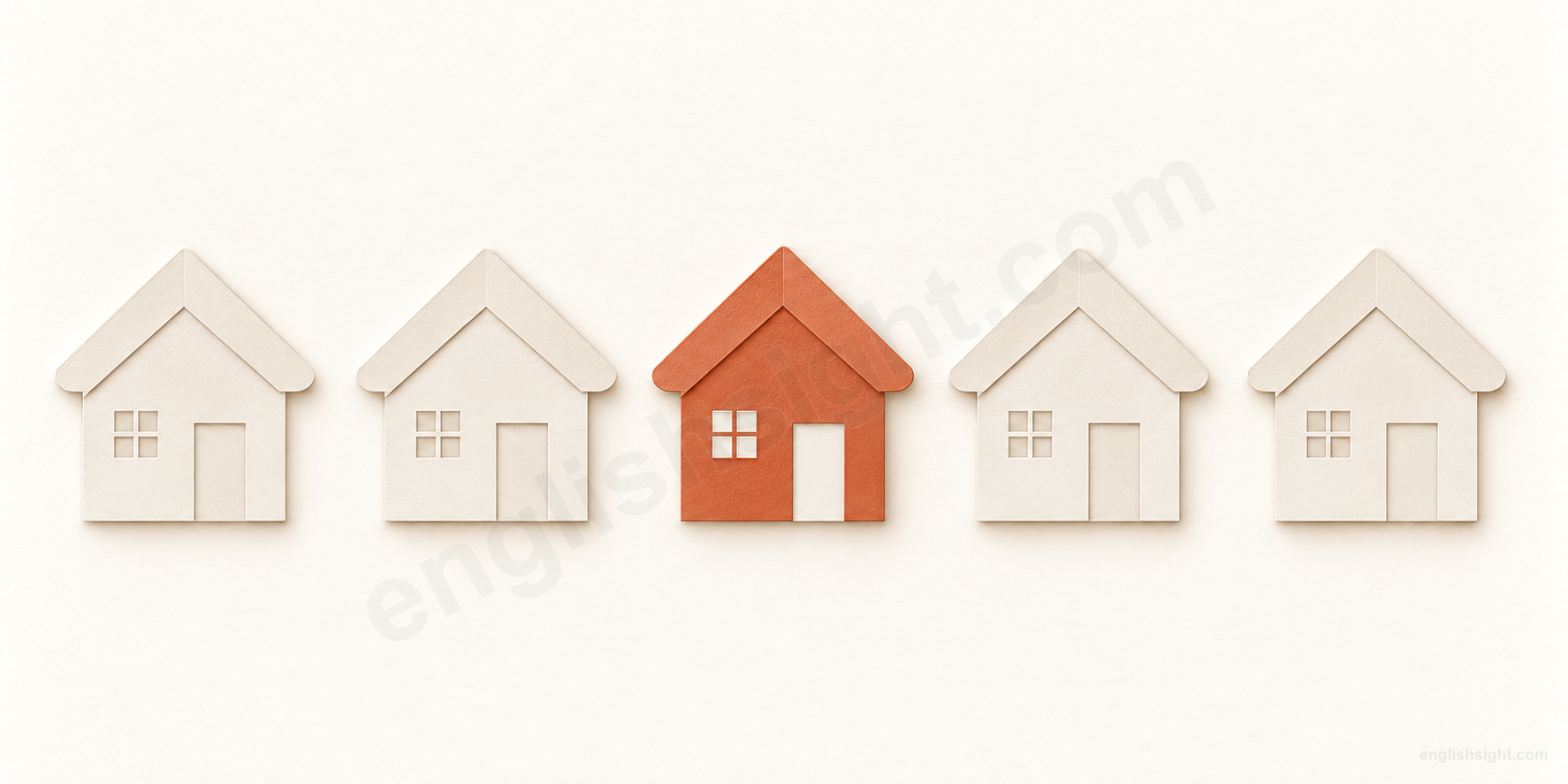
Two ivory houses stand to the left of the highlighted house.
middle
Two ivory houses stand to its right.
The terracotta house is the third in the row.
The terracotta house is in the middle, with two houses on each side.
Middle identifies a central part or an intermediate position, understood in relation to the sides, ends, or extremes around it.
The row shows a static relation, not a movement or change. It is a teaching model for central position; fixed expressions add meanings that the row alone cannot predict.
Middle commonly locates a part or item relative to a whole, its ends, or the things on either side. The whole may be a room, a row, a stretch of time, or an ordered group.
That relation helps connect many uses, but it does not turn every idiom into a measurement. Being in the middle of a task means it is under way; being caught in the middle means facing pressure between other people.
01
Places, positions, and parts
First identify the whole or ordered group. Its middle is understood relative to its sides or ends; everyday descriptions need not give an exact measurement.
01
in the middle (of + noun); right / bang in the middle
in the middle of the room
in the central part of a space or thing
Reference situation
You consider the room as a whole.
Meaning in context
The table is away from the surrounding walls.
Middle locates a part relative to the whole around it.
The middle is a noun phrase. In the middle of the room tells us where something is; of the room identifies the whole. If the whole is already clear, say in the middle: The cake is still soft in the middle.
Use right in the middle or the informal bang in the middle to emphasize an exact central position. Middle and centre (US center) overlap in space; the middle can also be a region rather than one measured point.
Example
We put a small table in the middle of the room.
Watch the difference Keep the article in this pattern: in the middle of the room, not in middle of the room.
02
the middle + noun; the middle one / two
the middle drawer
the item or section between others in an ordered group
Reference situation
A cabinet has three drawers, one above another.
Meaning in context
You select the second drawer.
Middle modifies a noun and selects by position, not by size.
In the middle drawer, middle is an adjective before drawer. It can describe a row, shelf, seat, or section too. The middle one replaces a noun that is already understood.
With five equally spaced items, the third is the middle one. An even number can have two middle items. Do not confuse a middle-sized box, which concerns size, with the middle box in a row. Medium-sized is a familiar alternative when talking about size.
Example
Your keys are in the middle drawer, between the top and bottom drawers.
Watch the difference Say This drawer is in the middle; bare This drawer is middle is not the normal positional description.
03
the / a middle child; someone’s middle son / daughter
the middle child
a child between older and younger siblings in birth order
Reference situation
There are three children in the family.
Meaning in context
The second-born child has an older and a younger sibling.
The ordering is by birth, not by where the children stand.
A middle child is neither the oldest nor the youngest. With three children, there is one middle child; larger families can have middle children.
My middle son selects from the sons, while my middle child selects from all the children. The phrase identifies birth order and does not by itself describe personality.
Example
I’m the middle child: my sister is older and my brother is younger.
Watch the difference A child standing between two friends is not therefore the family’s middle child.
04
cut / split / divide + object + down the middle; a line down the middle
cut it down the middle
divide something along its central line into two parts
Reference situation
One rectangular sandwich is still whole.
Meaning in context
A central cut produces two equal halves.
Down the middle identifies the dividing line.
Cut, split, and divide something down the middle describe a division through the central part. Down does not have to mean vertically downward: the object may be lying flat.
We can also describe a line down the middle of a page without cutting it. The verb supplies the action; down the middle supplies the location or course of the line. This is not a phrasal verb called middle down.
Example
Cut the sandwich down the middle so we can share it.
Watch the difference In the middle gives a location; down the middle can trace a central line or division.
05
around + possessive + middle; around the middle
around your middle
around the waist or stomach area
Reference situation
You want to describe where a belt goes.
Meaning in context
You identify the central part of the body.
Someone’s middle is an informal body-part noun.
My middle, your middle, and around the middle refer informally to the waist or belly area. A possessive makes it clear whose body is meant.
This is an established bodily use, not a claim that the waist is the exact halfway point of someone’s height. Waist or stomach may be more precise in a particular description.
Example
I tied the costume’s belt around my middle.
Watch the difference Use a possessive or the: around my middle, not around my middle of body.
06
in the middle of nowhere
in the middle of nowhere
in a remote place far from towns or buildings
Reference situation
The road leaves the last village behind.
Meaning in context
The cabin is far from other buildings.
Nowhere makes the whole expression an informal description of remoteness.
The middle of nowhere is an idiom, not the central point of a place officially called nowhere. People use it when somewhere feels isolated or inconveniently far away.
It can sound humorous or critical. A remote home is still a real place, and calling it the middle of nowhere does not mean nobody lives there.
Example
Their cabin is in the middle of nowhere, an hour from the nearest town.
Watch the difference Do not interpret nowhere literally as nonexistence.
02
Time and life stages
A period has an earlier part and a later part. Middle can locate a time within it, while in the middle of doing something describes an activity already under way.
07
in / by / until the middle of + period; the middle section
the middle of May / the night
the central part of a period or sequence
Reference situation
The month has a beginning and an end.
Meaning in context
You plan for a time between those parts.
The reference whole is time rather than physical space.
The middle of May means roughly the central part of the month. In the middle of the night places an event during the night, often with a sense of interruption; it need not mean exactly midnight.
Prepositions add different relations: in the middle of May locates an event; by the middle of May gives a deadline; until the middle of May marks how long something continues. A story can have a beginning, a middle, and an end; the middle section is the part between its opening and ending.
Example
We should have the new timetable by the middle of May.
Watch the difference By gives a latest expected time; it does not say the timetable will arrive exactly then.
08
be in the middle of + noun / -ing
be in the middle of doing something
be busy with an activity that has already started
Reference situation
The report is not finished.
Meaning in context
A phone call interrupts your work on it.
The activity is under way; its exact halfway point is irrelevant.
I’m in the middle of writing a report explains that the work is already in progress. It often gives a reason to postpone another request. In the middle of dinner similarly treats dinner as an ongoing activity.
Of is a preposition. Follow it with a noun or an -ing form, not an infinitive: in the middle of a call or of making a call. The expression is useful even if you have only just started or are nearly finished.
Example
Can I call you back? I’m in the middle of writing a report.
Watch the difference Being in the middle of a task does not state that exactly half the task is complete.
09
in + possessive + middle thirties / forties; in + possessive + mid-thirties
in her middle thirties
at an age near the central part of a ten-year age band
Reference situation
You do not need an exact age.
Meaning in context
You place the person at about thirty-five.
Middle narrows an age band; the possessive identifies the person.
In her middle thirties gives an approximate age around thirty-five. In her mid-thirties is another familiar form. Compare early thirties and late thirties.
The plural thirties names ages thirty to thirty-nine, not thirty separate years of someone’s life. This pattern can also be used for the forties, fifties, and other decade bands.
Example
She started learning the violin in her middle thirties.
Watch the difference Say in her middle thirties, not at her middle thirty. These are approximate bands, not exact birthdays.
10
in / during middle age; a middle-aged + person noun
middle age / middle-aged
the adult stage between youth and old age
Reference situation
You describe a broad stage of adult life.
Meaning in context
You contrast it with youth and old age.
This is a conventional life-stage name, not a calculation of half a lifespan.
In middle age uses the noun phrase for a period of life. A middle-aged person uses the adjective. The boundaries are approximate and depend on context; do not use this as an exact age label.
This differs from in her middle thirties, which locates someone within one decade. It also differs from the Middle Ages, a capitalized plural name for a historical period.
Example
He took up painting in middle age.
Watch the difference Middle age is normally uncountable here. The Middle Ages is a different expression.
03
Opposing sides and moderate choices
Two sides can be positions in an argument rather than places. Learn the whole expression: being caught between people differs from reaching agreement or manipulating them.
11
be / get caught in the middle (between A and B)
be caught in the middle
be drawn into a disagreement between other people
Reference situation
Two colleagues each want you to support their side.
Meaning in context
You face pressure from both.
The middle is an uncomfortable social position, not necessarily a physical location.
Be caught in the middle describes unwanted involvement between opposing people or groups. Get caught in the middle emphasizes entering that situation. You need not be standing between them or holding a neutral opinion.
British English also uses piggy in the middle or pig in the middle for this role. That image comes from a ball game, but the idiom can describe a dispute with no ball or game involved.
Example
When the two team leaders disagree, I get caught in the middle.
Watch the difference Being caught in the middle does not mean you have successfully negotiated a compromise.
12
find middle ground between A and B; take / steer a middle course; find a middle way
find middle ground / take a middle course
find an acceptable position between opposing extremes
Reference situation
One person wants to cancel the project; another wants to expand it.
Meaning in context
They consider keeping a smaller version.
A moderate position can connect opposing demands without being an exact numerical halfway point.
Find middle ground means find a position the different sides can accept. Middle ground between A and B specifies those sides. The noun ground is normally uncountable in this use.
Take or steer a middle course and find a middle way focus on choosing an approach that avoids extremes. Compare meet someone halfway, which emphasizes making some concessions to reach agreement. None of these expressions guarantees that the choice is the best one.
Example
We found middle ground: keep the project, but reduce its budget.
Watch the difference Use middle ground for a shared or moderate position; use caught in the middle for unwanted pressure.
13
meet in the middle (on + issue); meet someone halfway
meet in the middle
reach agreement by moving from opposing demands toward a compromise
Reference situation
A buyer offers forty; a seller asks sixty.
Meaning in context
They consider agreeing on fifty.
Meeting is figurative when the sides adjust their demands rather than travel.
In a negotiation, let’s meet in the middle invites both sides to adjust what they want so they can agree. In a simple price discussion the compromise can be an exact halfway amount; in a broader disagreement it need not be a numerical calculation.
Compare meet someone halfway, which also describes making concessions. In a literal sentence such as Let’s meet in the middle of the park, the phrase instead names the meeting place. The situation determines whether a physical or figurative meeting is intended.
Example
You want sixty and I offered forty. Could we meet in the middle at fifty?
Watch the difference This proposes mutual compromise; it does not mean that only one side must accept all the other side’s demands.
14
be split / divided down the middle over / on + issue
be split down the middle
be divided into two opposing groups of roughly equal size
Reference situation
People vote for two different options.
Meaning in context
Support is nearly evenly divided.
A physical division becomes a metaphor for opposing opinions.
A committee split down the middle has two sides with similar support. Over the proposal or on the issue can identify the topic. It describes division rather than agreement.
We split the cake down the middle describes a physical action. The committee is split down the middle describes the resulting distribution of opinion; no one is physically cut.
Example
The committee is split down the middle over the new timetable.
Watch the difference An even split in opinion is different from finding middle ground between the opinions.
15
a middle-of-the-road + noun; be middle-of-the-road
a middle-of-the-road policy
a moderate policy that avoids extreme positions
Reference situation
Several proposals range from very cautious to very radical.
Meaning in context
One proposal takes a moderate position.
The road is figurative; the whole hyphenated expression is an adjective.
Middle-of-the-road can describe a person, opinion, newspaper, or policy as moderate. It describes political or other positions rather than someone’s physical position on a road.
Compare a car in the middle of the road, where the separate words describe a literal location. The adjective middle-of-the-road is written with hyphens, including when it follows be.
Example
The candidate proposed a middle-of-the-road tax policy.
Watch the difference Moderate does not necessarily mean neutral, universally popular, or free of disagreement.
16
middle-of-the-road music / pop; the music is middle-of-the-road
middle-of-the-road music
conventional, easy-listening music rather than an adventurous style
Reference situation
You compare experimental music with familiar gentle pop.
Meaning in context
You describe the latter as conventional and easy to listen to.
The musical use evaluates style, not political beliefs.
Middle-of-the-road music is accessible and conventional. The description can suggest that the music is pleasant but unexciting, so context and tone matter.
The same adjective has a moderate-opinion use, but a middle-of-the-road singer is not automatically a political moderate. The noun being described helps determine which meaning is intended.
Example
The café plays middle-of-the-road pop while people eat lunch.
Watch the difference Do not infer a musician’s politics from this description of their music.
04
Names and familiar compound words
Middle contributes a position within a sequence or hierarchy, but the complete compound names a particular thing. Its meaning and social context must also be learned.
17
someone’s middle name; first name / middle name / family name
a middle name
an additional personal name between a first name and a family name
Reference situation
A form shows the name Maya Rose Evans.
Meaning in context
Rose is identified as the middle name.
The position is within a particular naming pattern.
In a name such as Maya Rose Evans, Rose is a middle name. A person can have more than one middle name or none. Follow the person’s actual name and the form’s instructions rather than inventing one.
The expression concerns a naming convention, not the central word in every person’s name worldwide. A middle initial is the initial letter used in place of a middle name, such as R. in Maya R. Evans.
Example
Rose is Maya’s middle name.
Watch the difference A two-part given name or an unfamiliar naming order cannot safely be classified just by counting words.
18
quality noun + be + possessive + middle name
Patience is her middle name.
humorously say that someone has a quality to a high degree
Reference situation
She stays calm through a very long wait.
Meaning in context
You jokingly characterize her as very patient.
The supposed name stands for a strong characteristic.
Be someone’s middle name is an informal, often playful way to emphasize a quality. It does not normally report the person’s legal name.
A speaker can also use it ironically when the person obviously lacks the quality. The situation and tone tell you whether the praise is sincere or teasing; the expression alone does not settle that.
Example
Patience is her middle name; she never complains about waiting.
Watch the difference Check the context before taking the sentence as a literal statement about a name.
19
the middle class; a middle-class family; middle-income groups
the middle class / middle-class
a social group associated with an intermediate social and economic position
Reference situation
A discussion concerns social groups rather than school lessons.
Meaning in context
Middle class identifies one broad group in that discussion.
Class here is a social category, not a classroom group.
The middle class is commonly associated with professional and business occupations and a position between very wealthy and poorer groups. The boundaries vary with place and context; the phrase is not a universal income formula.
The noun is written middle class. Before another noun, the adjective is normally hyphenated: a middle-class family. Upper-middle-class and lower-middle-class make finer distinctions. Middle-income describes income more specifically and is not automatically identical to middle-class.
Example
The survey asked middle-class families about housing costs.
Watch the difference Do not read middle class as the second lesson in a school day or as a judgment of someone’s personal worth.
20
work in middle management; a middle manager
middle management
managers between senior leadership and the staff they supervise
Reference situation
An organization has several levels of responsibility.
Meaning in context
Department managers form an intermediate level.
Middle describes a position in a hierarchy rather than physical space.
Middle management names the management layer below senior leadership. These managers may run departments or teams while reporting to higher managers. They are not simply managers of average skill.
Use middle management for the layer or group and a middle manager for an individual. Related descriptions such as middle-ranking officials also concern relative rank, not the central seat in an office.
Example
After leading a small team, she moved into middle management.
Watch the difference Management is normally uncountable here: a job in middle management, not a middle managements.
21
go to / attend middle school; a middle school student
middle school
a school stage between earlier schooling and later secondary schooling
Reference situation
A school system has different stages.
Meaning in context
A child moves into the stage called middle school.
The full expression names an institution within a school system.
Middle school often covers the early teenage years in North America. Some British school systems also have middle schools, with different age ranges.
The term is not a universal translation of every country’s secondary school. Its exact grades and ages depend on the local system. It does not mean the building in the centre of a town.
Example
My nephew starts middle school next year.
Watch the difference Check the local school system before converting the term to a particular grade or age.
22
the / possessive + middle finger; give + person + the finger
the middle finger
the finger between the index finger and the ring finger
Reference situation
You identify fingers on a hand.
Meaning in context
You select the central, usually longest finger.
Middle selects a particular finger by its place on the hand.
The middle finger is the finger between the index and ring fingers, usually the longest. In this anatomical use, the phrase simply names a body part.
My middle finger identifies the finger on my hand. This differs from my middle on its own, which informally refers to the waist or belly area.
The gesture has a separate social meaning. Give someone the finger, especially in North American English, means raise the middle finger toward them as an insult or sign of anger. For example, He gave the other driver the finger describes a rude gesture, not handing over an object. Simply mentioning or pointing to the body part is not the same as making this gesture.
Example
The glove has a small hole at the tip of the middle finger.
Watch the difference The body-part name is neutral; giving someone the finger describes an insulting gesture. Someone’s middle without finger refers to the waist or belly area.
23
play piggy in the middle; play monkey in the middle
piggy in the middle / monkey in the middle
a ball game with a player trying to intercept passes
Reference situation
Two players throw a ball to one another.
Meaning in context
The player between them tries to catch it.
The central player’s position creates the role in the game.
Piggy in the middle or pig in the middle is the British game name. Monkey in the middle is the North American name. One player tries to catch the ball that the others pass over or past them.
The British expression can also name a person unwillingly involved between arguing sides, as in the earlier caught-in-the-middle unit. Learn the name as a whole: no animal is required in the game.
Example
The children played monkey in the middle with a soft ball.
Watch the difference Game terminology varies by region. The figurative dispute use depends on context, not on an actual game.
Keep the whole and the construction in view
Noun or adjective?
The middle of the room uses the noun, usually with the. The middle room uses the adjective before a noun. For a position after be, say The room is in the middle. The adjective does not normally take more or most: use more central or closer to the middle.
Middle, medium, and between
A middle seat concerns position; a medium-sized seat concerns size. Between names a relation to specified things and need not be central: a house can be between two stations but much closer to one. Middle usually selects the central part or an intermediate band.
An activity need not be half finished
In the middle of doing something emphasizes being occupied with it. The surrounding context can suggest an interruption, but the expression itself does not give a completion percentage.
Forms and scope
Middle is pronounced /ˈmɪdəl/. The noun can have the plural middles, though the central-part use is usually singular. This lesson covers the everyday noun, adjective, and selected compounds. Rare verbs, specialized grammar, sports terminology, and historical or geographical proper names are outside its main scope. Passive and causative patterns are not productive patterns of this noun/adjective lesson.
Choose the relation
Identify the whole, the position, and what the full expression contributes.
1. Three drawers are stacked vertically. Your keys are in the second. Which description identifies its position?
2. Someone says, “I’m in the middle of cooking dinner.” What can you safely conclude?
3. Two friends are arguing, and each demands your support. Which expression describes your uncomfortable position?
4. “Send the forms by the middle of June.” Which interpretation fits?
5. A friend says, “Caution is my middle name,” while checking every detail. What does the expression communicate?
6. A council is “split down the middle” over a plan. What is the likely situation?
Sources and teaching notes
Dictionary entries were checked for the meanings and patterns below. The explanations and example sentences are original; the central-position diagram is a teaching model.
The diagram explains a relation; it does not claim that all native speakers imagine the same picture.