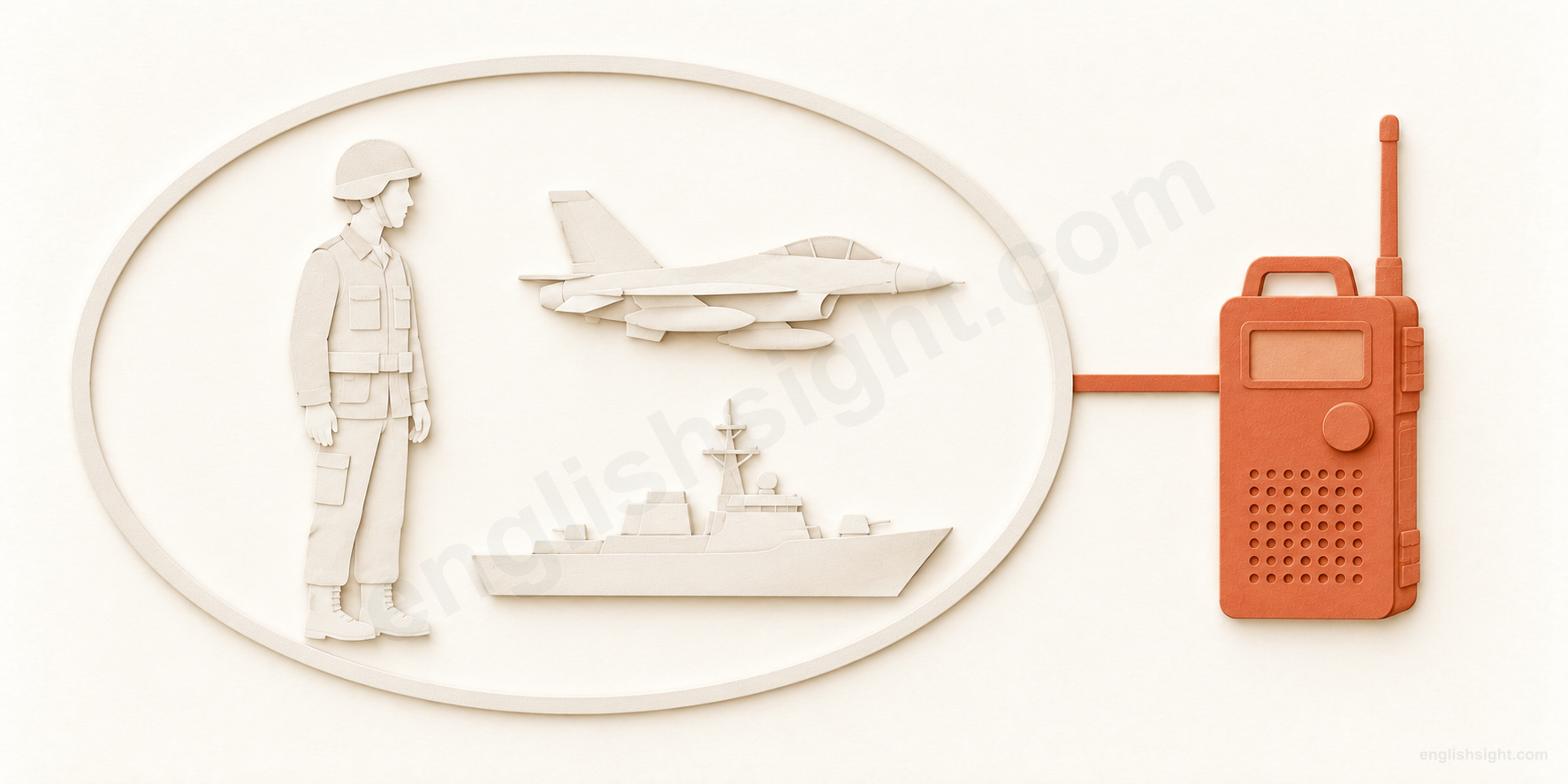
Describe military people and activities, name the military as an institution, and recognize comparisons with soldierly order.
An institutional connection
An institutional connection
A service member, an aircraft and a ship are grouped together.
military
The radio is shown as equipment connected with the armed forces.
A line links the group to a radio.
Military identifies a connection with the armed forces; here the link identifies military equipment.
Military connects people, equipment, actions, or authority with organized armed forces. The military names those forces together.
This is a relationship, not a required change over time. The broad meaning includes different service branches; some contexts narrow it to the army. Comparisons with military order are explained separately.
A military radio and a military operation are different things. Military connects each one with the armed forces; the noun tells you whether you mean equipment, people, or an activity.
The military names the forces together. Expressions such as with military precision extend the connection through a comparison with disciplined organization. The diagram is a teaching aid, not a claim that all English speakers picture the same scene.
01
People, service, and equipment
Before a noun, military tells us what that person, activity, or thing is connected with. The following noun supplies the specific job or object.
01
military + noun
military personnel / a military uniform
connected with soldiers or the armed forces
Situation / connection
Rescue workers include people serving in the armed forces.
What the expression identifies
You identify those workers by their institutional connection.
Military classifies a person or thing; it does not say that fighting is happening.
Military personnel are people serving in the armed forces. A military officer has an officer’s role there; a military uniform is clothing worn as that organization’s uniform.
Compare military and civilian staff: the contrast concerns their status, not whether one group is brave or trained. The whole phrase gets its specific meaning from the noun: personnel are people, while a uniform is clothing.
The broad meaning can include land, sea, and air services. In a contrast such as naval and military forces, military may instead mean army forces. Let the surrounding words establish the scope.
In a sentence
Military personnel helped residents leave the flooded village.
Watch the difference For one person, say a soldier, an officer, or a member of the military; a military is not the ordinary expression for one service member.
02
do / complete + (possessive) + military service; military training / career
military service / military training
time spent serving, or preparation for service
Situation / connection
Someone spends a period in the armed forces.
What the expression identifies
You describe their service and the training connected with it.
Service names the period or work; training names preparation.
Military service can mean time in the armed forces generally, or a required period of service. The phrase alone does not tell you that service was compulsory: compare voluntary military service and compulsory military service.
Do your military service and complete your military service often refer to a defined period. Be called up for military service refers to being officially required to serve. A military career describes a working life in the forces.
Military training prepares people for military duties; it does not by itself say that they have fought in a war. Service and training in these uses are normally uncountable.
In a sentence
After completing her military service, Lena trained as a teacher.
Watch the difference Do not assume that military service always means compulsory service, or add a before service when you mean the period in general.
03
a military + countable noun; military equipment
a military base / military equipment
facilities and things used for military purposes
Situation / connection
A site houses service members and their equipment.
What the expression identifies
You classify the site as a military facility.
Base names the site; military identifies its purpose and institutional connection.
A military base is a facility used by the armed forces, including for housing personnel, keeping equipment, or training. A military vehicle, aircraft, or radio is connected with their work or use.
Military equipment is broader than weapons: equipment can include communications or transport equipment. A thing does not become military merely because it is strong, green, or expensive.
Base is countable: a military base, two military bases. Equipment is normally uncountable: military equipment, or two pieces of military equipment.
In a sentence
The museum’s radio was once used at a military base.
Watch the difference Use equipment without a plural -s in this meaning; military does not change its ending before plural nouns.
04
the military police + plural verb; a military police officer
the military police
the police organization responsible for the armed forces
Situation / connection
An incident needs police attention within the armed forces.
What the expression identifies
You refer to the military police.
This established compound identifies a particular policing role.
The military police deal with policing in the armed forces. The expression is not simply another name for any police officers who carry weapons.
The military police are investigating uses plural agreement, like the police. For one person, use a military police officer. MP is a common abbreviation; its meaning depends on context.
The connection is institutional: military specifies the community for which this police organization is responsible. It does not mean that all civilian policing is a military activity.
In a sentence
The military police are investigating the theft at the base.
Watch the difference Say a military police officer for one individual, rather than a military police.
02
The forces as a group
The military names an institution. Grammar distinguishes joining it, serving in it, and talking about its people or strength.
05
the military + singular or plural verb; a country’s military; different militaries
the military
a country’s armed forces considered together
Situation / connection
You want to talk about the armed forces as one institution.
What the expression identifies
You name the institution rather than list its members.
The military is a collective noun phrase, not an adjective waiting for another noun.
In The military needs new equipment, the military is the subject. It refers collectively to the forces; in statements or decisions, the context may especially point to their leadership.
The military is ready treats the organization as a unit. The military are ready is also possible, especially in British English, with the members in view. Follow the agreement appropriate to your context.
A country’s military and a strong military are also possible. The plural militaries can compare different countries’ forces. It does not count individual soldiers.
In a sentence
The military has opened its medical centre to local residents.
Watch the difference Do not replace the military with the militaries merely because it contains many people; militaries refers to separate forces or establishments.
06
join / leave + the military; be / serve + in the military
join / be in / serve in / leave the military
enter, belong to, work in, or depart from the armed forces
Situation / connection
A person considers or has a role in the armed forces.
What the expression identifies
The verb shows entry, membership, service, or departure.
The different relationship comes from the verb and any following preposition.
Join the military describes entry, while be in the military describes membership. Serve in the military emphasizes doing military service. Leave the military marks the end of membership.
Compare She joined the military last year with She has been in the military for a year. Joining is the entry event; being in describes the continuing situation.
Join takes its object directly. In belongs after be or serve in these patterns. These are ordinary verb constructions with a noun phrase, not phrasal verbs made from military.
In a sentence
My aunt served in the military for six years before becoming an engineer.
Watch the difference Say joined the military, not joined in the military, when you mean became a member.
07
use military force; military forces + plural verb; a military force
military force / military forces / a military force
armed power, the troops collectively, or a particular organized body
Situation / connection
A report mentions either armed power or a body of service members.
What the expression identifies
Countability helps identify what the writer means.
Force can name power or a group; military specifies the armed-forces connection.
Use military force commonly means use armed power to make something happen. Here force is uncountable. Military forces refers to troops or armed units, often collectively.
A military force can be one organized body assigned to a task: A small military force guarded the port. The article a selects the group meaning, so it is not correct to say force must always be uncountable.
Compare The leaders rejected the use of military force with Military forces left the area. The first concerns using armed power; the second concerns people or units moving away.
In a sentence
The negotiators hoped to settle the dispute without using military force.
Watch the difference Force and forces are not freely interchangeable: using force concerns power, while withdrawing forces concerns troops.
03
Operations, resources, and government
These combinations occur in news and history. Read the noun carefully: training, fighting, funding, and governing are different activities.
08
take military action; carry out a military operation; conduct military exercises
military action / operations / exercises
armed intervention, organized tasks, or training activities
Situation / connection
The armed forces carry out an activity.
What the expression identifies
The following noun shows what kind of activity it is.
An operation may be an actual mission; an exercise is practice.
Military action often refers to using armed force in a conflict, especially when contrasted with talks or diplomacy. A military operation is an organized mission or series of activities; it can include evacuation or rescue as well as combat.
A military exercise is organized practice or training. It may imitate a difficult situation without being a real attack. Military alone does not turn every operation into a battle.
Carry out a military operation and conduct military exercises are useful combinations. In a rescue operation, rescue supplies the mission’s purpose; the adjective military identifies its connection with the forces.
In a sentence
The ships are taking part in a military exercise, not an actual attack.
Watch the difference An exercise can be a training event; do not automatically interpret military activity as warfare.
09
military power / spending / aid; a military budget
military power / spending / aid
capacity, money spent, or support for military purposes
Situation / connection
A discussion concerns the resources available to the armed forces.
What the expression identifies
The noun distinguishes capability, expenditure, or assistance.
Military connects the topic with armed forces; power, spending, and aid contribute separate meanings.
Military power is the ability to act effectively through armed strength. Military spending is money spent on armed-forces needs; the military budget is a plan for such expenditure.
Military aid commonly means assistance for another country’s forces, such as equipment, funding, or training. It need not mean that the donor’s troops are fighting. Aid to civilians delivered by soldiers can instead be humanitarian aid.
Compare The report examines military spending with The report examines military power. The first asks about expenditure; the second asks about capability. One is not a precise measure of the other.
In a sentence
The agreement provides military aid in the form of training and equipment.
Watch the difference Military aid and humanitarian aid identify different purposes; who delivers the aid alone does not determine its label.
10
under military rule; a military government; a military coup
military rule / a military government / a military coup
armed forces governing, or seizing political power
Situation / connection
A history describes who holds political authority and how it was obtained.
What the expression identifies
You distinguish a form of rule from an event that changes the leadership.
Rule is a continuing condition; a coup is a takeover event.
Under military rule means that the armed forces hold governing power. A military government is a government controlled or backed by military power.
A military coup is a sudden seizure of political power organized and carried out by members of the armed forces. Coup names the takeover, not the whole period of government that may follow.
Compare The country experienced a military coup with The country remained under military rule. These phrases describe different parts of a political history. Military identifies the forces’ role; rule and coup supply the political meanings.
In a sentence
The history book describes a military coup followed by several years of military rule.
Watch the difference A military presence in an area does not by itself mean military rule; presence and governing authority are different claims.
04
A soldier-like manner
Military can compare civilian organization, posture, or appearance with features associated with soldiers. These are conventional comparisons, not proof of military membership.
11
plan / organize / carry out something + with military precision
with military precision
with very exact organization and timing
Situation / connection
A civilian team coordinates tasks and timings carefully.
What the expression identifies
You compare its organization to disciplined military activity.
The phrase describes how something is done; it does not identify who employs the people.
With military precision presents an activity as exceptionally well coordinated or exact. It can describe a concert, a wedding, or a family timetable; no soldiers need be involved.
With introduces a manner phrase, and precision contributes exactness. Military supplies a conventional comparison with disciplined organization. Depending on tone, the phrase can express admiration or suggest excessive rigidity.
The comparison helps connect this use with the armed-forces meaning, but it is not a factual claim that every military activity is perfectly organized.
In a sentence
The stage crew changed the scenery with military precision.
Watch the difference This phrase describes manner. It does not mean that the theatre crew belongs to the military.
12
have a military bearing; a military-style + noun
a military bearing / a military-style jacket
a soldier-like posture or appearance
Situation / connection
Someone’s posture or clothes resemble a familiar soldierly style.
What the expression identifies
You describe the resemblance without establishing membership.
Bearing concerns how a person carries themselves; style concerns appearance.
A military bearing suggests an upright, disciplined way of standing or carrying oneself. It can describe someone who is not a serving soldier.
Military-style clothing resembles a style associated with uniforms. A military-style jacket in a fashion shop need not be an actual military uniform. The word style makes the comparison explicit.
Compare He has a military bearing with He is in the military. The first describes a manner; the second states membership. Appearance alone does not establish a person’s job or history.
In a sentence
The actor adopted a military bearing for the role, standing straight with his shoulders back.
Watch the difference Do not infer that someone is a soldier just from a military bearing or military-style clothes.
Keep the institution, the person, and the comparison distinct
Adjective or collective noun
Military is usually an adjective before a noun: military training, military officers. It has the same form before singular and plural nouns. The military is a noun phrase for an institution; a member of the military names one person. This lesson has no military verb or particle-verb family.
Military, army, armed, and civilian
The army normally identifies land forces. Military often covers the armed forces broadly, though a naval/military contrast can narrow it to the army. Armed means carrying or supplied with weapons; armed police are not automatically military police. Civilian distinguishes people or things outside military status, rather than meaning untrained or harmless.
Collective agreement is different from a plural of people
The military is and the military are can both be grammatical, depending on variety and whether the institution or its members are in view. Militaries compares separate countries’ forces. Military police takes plural agreement; one individual is a military police officer.
Neither a battle nor a personality trait is required
Military work can include training, transport, medicine, and rescue. Military precision and military bearing are comparisons with familiar soldierly discipline; they do not prove membership or describe every service member.
Pronunciation and related forms
Stress the first syllable. Common pronunciations are British /ˈmɪlətri/ and American /ˈmɪləteri/. Military is an adjective or noun; militarily is the related adverb, as in militarily effective.
Choose the connection
Use the whole expression and the situation. Select the interpretation that fits.
1. Which sentence naturally says that one person belongs to the armed forces?
2. Your cousin became a member of the armed forces last month. Which construction fits?
3. A wedding planner coordinates every arrival and departure with military precision. What does this tell you?
4. A report says that ships are conducting military exercises. Which reading is justified?
5. Which sentence uses force to mean armed power, rather than a body of troops?
6. Which expression names a takeover event rather than a continuing form of government?
Sources and teaching notes
Dictionary headwords, compounds, and collocation pages support the usage inventory below. Explanations and examples are original; the diagram offers a teaching interpretation of the institutional connection.
The diagram illustrates an institutional connection. It does not represent a mental picture shared by every English speaker.