Learn milk as food, a farming action, and a figurative way to extract benefit.
The liquid and its source
The liquid and its source
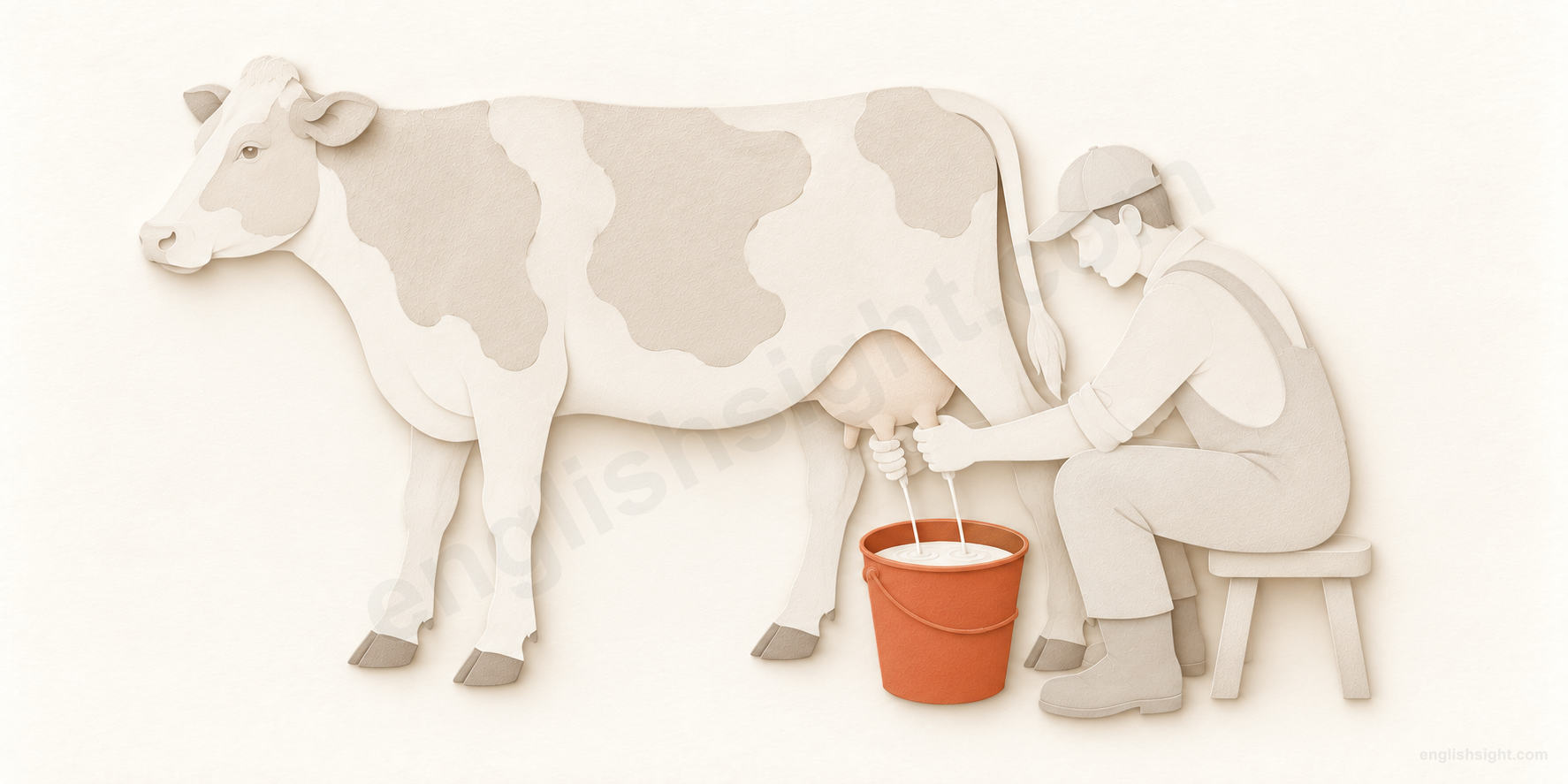
The cow produces milk.
milk
Milk collects in the pail.
The worker draws milk from the udder.
The cow is the source; the worker draws milk into the pail.
Milk names the liquid mammals produce to feed their young. To milk an animal is to draw that liquid from it; figurative milking draws benefit from a person or situation.
The sketch focuses on the animal source and collected milk. Plant drinks, cosmetic products, and fixed expressions are separate extensions explained below; they do not all describe an animal being milked.
Milk usually names a familiar food, but the word also connects production, collection, and figurative extraction. A café order, a farm routine, and an accusation of exploitation use different grammatical patterns.
Start with the liquid mammals produce for their young. Plant-based foods and some other liquids extend the noun by resemblance; figurative verbs and fixed expressions need their own context. These connections help organize usage without predicting every combination.
01
Buying, serving, and describing milk
Treat the liquid as a substance, then name its quantity, source, or type. These choices help with shopping, recipes, and café orders.
01
some milk; a glass / carton / litre of milk
some milk / a glass of milk
name the liquid and measure an amount
Situation / source
You are buying enough for breakfast.
Meaning / result
You ask for a measured quantity.
Milk names the substance; the container or unit supplies the count.
Milk is normally uncountable: some milk, a little milk, or much milk. Say The milk is cold, with a singular verb. For a general statement, use no article: Milk is used in cooking. The milk in our fridge refers to a particular supply.
Count litres or liters, cartons, bottles, and glasses: two cartons of milk. A milk can mean one serving in an ordering context, and milks can mean different kinds. These contextual uses do not make two milks the usual way to describe two unspecified quantities at home.
In a sentence
Could you buy two cartons of milk on your way home?
Watch the difference Use How much milk? for the amount; How many cartons of milk? for containers.
02
milk in + drink; drink + with / without milk; take milk
milk in tea / coffee with milk
add milk to a drink or use it in food
Situation / source
Someone is making your tea.
Meaning / result
You explain how you want it served.
In names the drink receiving the milk; with describes the finished drink.
Would you like milk in your tea? offers an addition. Coffee with milk describes coffee containing milk; without milk declines it. Do you take milk? asks about your preference when the drink is understood. Take here concerns how you have the drink, not carrying milk away.
Milk can also be an ingredient: Add the milk slowly while stirring. In milk bottle and milk products, milk modifies a following noun. A milk bottle is a bottle intended for milk, even when empty; milk products include foods made from milk. These are noun combinations, not new actions meaning milk.
In a sentence
Would you like milk in your coffee, or do you prefer it black?
Watch the difference Say add milk to the coffee or put milk in the coffee; milk is the addition, not the container.
The modifier selects a type; milk remains the substance.
Whole milk retains its milk fat; full-fat milk is a familiar British label. Skimmed milk in British English and skim milk in American English name milk with most of the fat removed. British semi-skimmed milk has some of the fat removed.
Low-fat milk is a broader description, and American labels may give a percentage, as in 2% milk. Learn the local label rather than translating skim as a separate action in your order. These names describe composition, not how large or full the carton is.
In a sentence
We need whole milk for this recipe, but I usually buy skim milk.
Watch the difference Whole milk does not mean a whole carton; skim milk does not mean milk with a layer added on top.
recognize milk products used in storage and cooking
Situation / source
A recipe specifies a particular milk product.
Meaning / result
You select the named form instead of any carton of milk.
Changing the modifier can change the ingredient substantially.
Powdered milk, also called dried milk, is sold as a powder rather than a ready-to-pour liquid. Milk powder is another noun combination for that product. The word milk can therefore name the food even when its water has been removed.
Condensed milk in ordinary recipe and shopping language commonly means a thick, sweet canned product. Evaporated milk is also concentrated by removing water. Do not assume the two names are interchangeable: follow the recipe and the actual product label, including whether sugar is added.
In a sentence
The shopping list says condensed milk, not powdered milk.
Watch the difference The modifier is part of the ingredient name; leaving it out can change the recipe.
05
oat / almond / soy / soya / coconut + milk
oat / soy / coconut milk
name a milk-like food made from plants
Situation / source
A customer wants a different ingredient in a drink.
Meaning / result
The customer specifies its plant source.
Milk in these names describes a similar food use, not an animal origin.
Oat milk, almond milk, and soy milk are established names for plant-based liquids used as alternatives to dairy milk. Soya milk is another name for soy milk, especially in British English. The first noun tells you the source material.
Coconut milk is an established cooking ingredient too. These names do not mean that plants produce mammalian milk, and they do not promise identical ingredients or cooking behavior. The source-and-use connection is enough for the name; it is not a claim that every white drink can be called milk.
In a sentence
Could you make mine with oat milk, please?
Watch the difference Specify the type when it matters; the word milk alone may be understood as dairy milk in an ordinary café exchange.
06
milk + go off / go bad / turn sour; run out of milk
the milk has gone off / gone bad
describe a change in the condition of milk
Situation / source
You notice an unpleasant change in the milk.
Meaning / result
You describe the milk as no longer fresh.
The change is expressed by go or turn, not by milk itself.
The milk has gone off is a familiar British way to describe spoilage. The milk has gone bad is also used, especially in American English. Turn sour describes becoming sour; sour milk names the resulting condition.
Compare We have run out of milk: there is none left, which says nothing about spoilage. These are useful everyday combinations, but go off and run out of supply their own meanings. They are not phrasal verbs formed from the verb milk.
In a sentence
We have milk, but it has gone off, so I need to buy more.
Watch the difference Gone off means a condition change here; run out means the supply is exhausted.
02
Feeding babies and naming similar liquids
Milk is broader than cow’s milk. The biological use includes human milk; some other uses name liquids that resemble it.
07
breast milk; mother’s milk; produce / express milk
breast milk / mother’s milk
name milk produced for a baby
Situation / source
People are discussing feeding a baby.
Meaning / result
They specify the milk’s human source.
Milk includes human milk, not just the dairy drink sold in cartons.
Breast milk is milk from a human breast; mother’s milk can identify milk from a baby’s mother. The noun is still normally uncountable. In animal contexts, a mother’s milk can also refer to the milk a mammal produces for her young.
Produce milk describes making it in the body. Express milk describes removing breast milk, by hand or with a pump. Feed a baby milk describes giving the baby the food. These verbs distinguish production, collection, and feeding; milk alone does not specify all three actions.
In a sentence
She expressed some breast milk before leaving for work.
Watch the difference In ordinary discussion of human feeding, say express milk rather than treating milk the mother as the neutral everyday wording.
08
cleansing milk; a cleansing milk; cleansing milks
cleansing milk
recognize a milk-like skin-care liquid
Situation / source
You read a label in the skin-care section.
Meaning / result
You understand that the product is for skin, not drinking.
Resemblance in appearance or texture supports a separate product sense.
A cleansing milk is a liquid skin-care product. Here milk is not food from a mammal: the product name draws on a milk-like appearance or consistency. Collins lists this as a separate use, while Oxford’s learner headword concentrates on animal and plant milk.
The product can be counted as a type: several cleansing milks. This is useful recognition vocabulary for shopping, rather than a rule for naming any pale liquid. The label and context establish the intended product.
In a sentence
This cleansing milk comes in a small pump bottle.
Watch the difference Do not interpret every product with milk in its name as something to drink.
03
Drawing milk or drawing advantage
The literal verb usually takes an animal as its object. In figurative uses, the object can name the source being exploited or the money, information, or response drawn from that source.
09
milk + animal; be milked; milk without an expressed object
milk a cow
draw milk from an animal
Situation / source
A cow is ready for milking.
Meaning / result
Milk is collected from its udder.
The animal is the source and the direct object of milk.
In The farmer milks the cows, the farmer carries out the action and the cows supply the milk. Milking can be done by hand or with a machine. The same verb works with goats and other milk-producing animals.
Forms are milk, milks, milked, and milking. The action can be progressive or passive: They are milking the cows; The cows are milked twice a day. We start milking at six leaves the animal understood. Dictionaries also record an animal yielding milk, but a beginner can say The cow produces milk to keep the roles explicit.
In a sentence
The cows are milked before the farm shop opens.
Watch the difference Milk a cow means take milk from it; feed a calf milk means give milk to the calf.
10
milk + source + for + benefit; milk + benefit + from + source; milk + source + of + resources
milk someone for money
extract money or another benefit from a source
Situation / source
Someone sees an organization as a source of money.
Meaning / result
They keep extracting benefit, often unfairly.
The figurative source may be a person, an organization, or a system.
Milk a person or organization for money or information presents them as a source to draw on. The word commonly suggests excessive, selfish, or dishonest exploitation. It is stronger and more critical than simply receive money or ask for information.
Notice the roles in three constructions: milk the company for money; milk money from the company; milk the company of its money. The company is the source in all three. For introduces what is sought, from introduces the source after the thing obtained, and of introduces what the source is deprived of.
This figurative connection with extracting milk is a teaching aid. No actual dairy action is implied, and using milk does not by itself establish that a legal offence occurred.
In a sentence
The consultant was accused of milking the company for fees it did not need to pay.
Watch the difference Milk the company of money and milk money from the company put different nouns immediately after milk; keep the source and the resource distinct.
11
milk + situation / it; milk it for all it’s worth
milk it / milk it for all it’s worth
get as much attention, sympathy, or advantage as possible
Situation / source
A small success attracts attention.
Meaning / result
Someone keeps using it to gain more attention.
It refers back to the situation being used for benefit.
Milk it can mean keep taking advantage of a situation: a minor problem might become an excuse for extra help, or one success might be repeatedly used to attract praise. The speaker often sounds critical or teasing. You need context to know what it refers to.
For all it’s worth intensifies the idea of getting the maximum possible advantage. In this expression, it’s means it is. The whole phrase is established; worth is not a price that the speaker has calculated. This use is not a separable phrasal verb: milk is the verb and it is its object.
In a sentence
He won one office quiz and has been milking it for all it’s worth ever since.
Watch the difference Without a figurative context, milk it could refer literally to an animal; identify the referent before choosing a meaning.
prolong or exploit something to get more audience response
Situation / source
An audience laughs at a joke.
Meaning / result
The performer keeps drawing out the reaction.
The benefit can be laughter or applause rather than money.
A comedian can milk a joke by stretching it out or returning to it to draw more laughter. A performer can milk the applause by allowing or encouraging the audience’s reaction to continue. This is the broader advantage sense in a performance setting.
The tone may be playful or critical, depending on whether the speaker thinks the performer has gone too far. It does not mean giving the audience milk. The particular benefit comes from the object and context, not a separate meaning of a small particle.
In a sentence
The actor paused at the door, milking the applause before taking another bow.
Watch the difference Milk a joke means exploit it for more laughter, not explain its meaning.
13
milk + person / organization + dry
milk someone dry
take all the resources someone has
Situation / source
A person still has some savings.
Meaning / result
Repeated demands leave no savings available.
Dry marks the exhausted state of the source.
Milk someone dry is an emphatic figurative expression for taking all their money, help, information, or other resources, usually without a fair return. It can also have an organization or system as its object.
Dry describes the result for the source. It does not describe the liquid in powdered milk, and it is not a particle that can move before the object. With a pronoun, say milk them dry. The expression usually conveys strong criticism.
In a sentence
Those repeated charges could milk small businesses dry.
Watch the difference Milk them dry is the order; milk dry them is not.
04
Established expressions and compounds
Learn these combinations as expressions. A connection with milk may help you remember them, but the whole expression supplies its established meaning.
14
cry over spilt / spilled milk; there’s no use crying over spilt / spilled milk
cry over spilt / spilled milk
keep regretting something that cannot now be changed
Situation / source
A mistake has already happened.
Meaning / result
Someone urges you to focus on what can be done next.
The spilled liquid illustrates an irreversible event; the expression extends beyond milk.
There’s no use crying over spilt milk means that continued regret will not undo what happened. Spilt is the usual British form in the expression; spilled is the usual American form and is also possible in British English.
The saying often follows a lost opportunity, an avoidable cost, or another past mistake. It does not mean the event was harmless, and it can sound dismissive when someone needs sympathy. Learn the complete saying rather than treating milk alone as a word for regret.
In a sentence
We missed the discount, but there’s no use crying over spilled milk; let’s compare today’s prices.
Watch the difference The idiom concerns regret after the event; it does not tell you to ignore a problem you can still prevent.
15
a / the land of milk and honey
a land of milk and honey
describe an imagined place of abundance and easy living
Situation / source
Someone imagines a much better life elsewhere.
Meaning / result
They picture a place with plenty and few difficulties.
Milk and honey form a conventional image of abundance.
A land of milk and honey is a place presented as prosperous, pleasant, and easy to live in. The expression can describe a real destination as someone imagines it; it need not refer to actual farms or food.
It can sound hopeful or ironic: People called it a land of milk and honey, but finding work was difficult. The abundance meaning belongs to the whole phrase. It is not a literal guarantee that moving there will make life easy.
In a sentence
They imagined the city as a land of milk and honey, with jobs for everyone.
Watch the difference Use the established combination milk and honey; milk alone does not carry this place-description meaning.
16
the milk of human kindness
the milk of human kindness
recognize a literary expression for human kindness
Situation / source
A writer describes someone’s compassion.
Meaning / result
Kindness is expressed with a literary phrase.
This is a fixed literary expression, not a productive definition of milk.
The milk of human kindness refers to compassion or kind behavior understood as part of human nature. Oxford labels the expression literary. It may appear in writing or in a humorous imitation of an elevated style.
It is useful to recognize, but kindness is the more neutral everyday choice. Its nourishing association may help you remember it; that association does not license replacing any word for emotion with milk.
In a sentence
For all his sharp remarks, he was full of the milk of human kindness.
Watch the difference This expression is literary; it is not the ordinary way to ask someone for help.
17
a milk tooth; milk teeth; a baby tooth
a milk tooth / milk teeth
recognize a name for a child’s first teeth
Situation / source
A child has a loose first tooth.
Meaning / result
It falls out and will be replaced.
The compound names an early tooth, not a tooth made of milk.
Milk tooth is a British term for one of a child’s first set of teeth, which are later replaced. Baby tooth is used in both American and British English. The compound is countable: a milk tooth, two milk teeth.
The irregular plural belongs to tooth, not milk. Learn the compound as a unit; you cannot use milk before any body part to mean a child’s first version of it.
In a sentence
She lost her first milk tooth during lunch.
Watch the difference Write milk teeth, not milks tooth or milk tooths.
Keep the roles and the whole expression clear
Milk is a substance before it is a count
Use some milk and the milk is. Count a serving, a container, or a type when the context requires it. A carton of milk can contain any specified kind.
Noun, modifier, and verb
Milk in milk bottle or milk production helps name a kind of thing. Dictionaries may label milk cows adjectivally; that classification does not change the basic relation to milk production. The verb milk is regular and can describe an action in progress or a passive action.
The figurative use often judges the behavior
Milk a source for benefit commonly suggests taking too much or acting selfishly. Audience-response uses can be lighter. Do not use milk as a neutral substitute for every case of earning, obtaining, or receiving.
A connection has limits
The picture is a teaching model, not a universal mental image. It does not explain fixed sayings by itself. Specialized animal-yield uses, venom extraction, milk of magnesia, and regional or historical compounds are not expanded into separate lessons here.
Choose the meaning in context
Look at the object, the modifier, and the situation before choosing.
1. You want to ask about the amount of liquid left in the fridge. Which question fits?
2. A worker takes milk from a goat. Which sentence describes that action?
3. Someone is accused of repeatedly demanding unnecessary payments from a business. Which phrase expresses criticism?
4. There is no milk left because it was all used. Which sentence describes the supply?
5. An offer ended yesterday and cannot be recovered. A friend says there is no use crying over spilled milk. What is the point?
6. In an order for coffee with oat milk, what does oat identify?
Sources and teaching notes
Meanings and patterns were checked against the publisher pages listed below. The explanations, examples, and teaching sketch are original; the suggested connections are learning aids.
The source-and-liquid sketch is a teaching aid, not a mental image shared by every speaker.