Learn the extraction family, then separate explosive mines and the possessive pronoun mine.
From material underground to material brought out
From material underground to material brought out
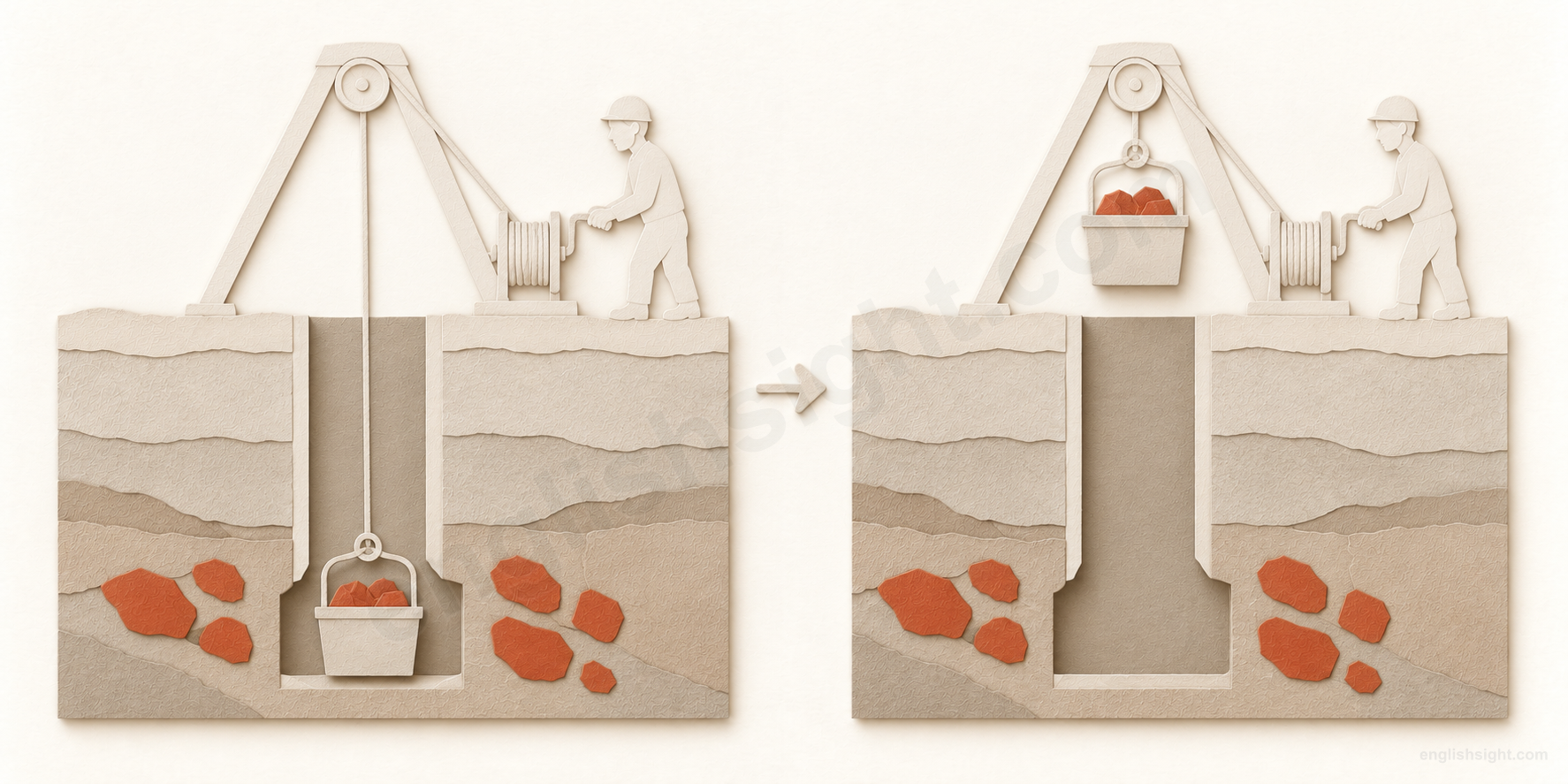
The ore-filled bucket hangs below ground in the mine shaft.
mine
The same load is now above the surface, and the lower shaft is empty.
The helmeted operator uses the hoist to raise the bucket.
A mine gives access to a resource in the ground; mining takes material out.
A mine provides access to material in the ground so that it can be extracted.
The sketch shows one underground mine and a raised load. Other mines are open pits. This model supports the extraction and resource family, not the unrelated possessive pronoun or every conflict expression.
A mine is a place for extracting material from the ground. The verb mine names the work. Information and other useful resources can be described through an extraction comparison.
The same spelling also names an explosive device and forms a possessive pronoun. Keep these families distinct: That is mine does not describe extracting or digging. The visual model is a teaching aid, not a shared mental picture claimed for every speaker.
01
A place and the work of extraction
The countable noun names a site. The verb names extracting material; the object and for identify the material or the ground being worked.
01
a / the + mineral name + mine; work at / in a mine
a coal / copper mine
a site where people obtain minerals from the ground
Situation / source
Copper-bearing rock lies below the surface.
Meaning in context
Workers can reach the rock through an excavation.
Mine names the extraction site, not a lump of mineral.
A mine is a countable place: one mine, several mines. A coal mine produces coal; a copper mine supplies copper-bearing material. Mines can be underground or open pits, so a roofed tunnel is not essential to the meaning.
Use work at a mine for the workplace and work in a mine for being inside it. Mine workers and a mine shaft use the noun before another noun. The sketch selects an underground example to show access and removal.
In a sentence
The old copper mine is now a museum.
Watch the difference A mine is not simply any hole; its mineral-extraction purpose matters.
02
mine + material; material + be mined + (from / in + place)
mine coal / be mined
extract a material from the ground
Situation / source
Coal is part of an underground deposit.
Meaning in context
People remove the coal for use.
The direct object names what is extracted.
In They mine coal, they are the people or company doing the work and coal is the material removed. From can name the source: They mine salt from this deposit. The verb does not mean that they own the material.
The passive puts the material first: Salt is mined here. Is being mined describes work in progress, while was mined refers to past extraction. Forms are mine, mines, mined, mining: drop the final e before -ing.
In a sentence
Salt has been mined here for generations.
Watch the difference Keep the passive auxiliary: Salt is mined here, not Salt mined here when describing the present activity.
03
mine + (in + place) + for + mineral
mine for gold
work to find and obtain a particular mineral
Situation / source
A team starts work in a promising area.
Meaning in context
Gold is the material they are trying to obtain.
For identifies the target of the mining activity.
Mine can be used without a direct object: They mine in the hills. Add for gold to identify the mineral sought. They mine gold instead presents gold directly as the material extracted.
For is a preposition with a noun after it, not a movable particle: mine for it, not mine it for in this meaning. Mining for gold does not by itself tell you how successful the operation is.
In a sentence
The team is mining for gold in the valley.
Watch the difference Mine for gold names a target; it does not guarantee that gold has already been found.
04
mine + area + for + mineral; mine + mineral + from + area
mine an area for minerals
work a place to obtain the material within it
Situation / source
A region contains a mineral deposit.
Meaning in context
An operator extracts material from that region.
The object can name the source area rather than the product.
In mine this area for tin, this area is the place being worked and tin is the target. Compare mine tin from this area: tin becomes the object and from names the source. The prepositions help organize the same extraction relationship.
An area has been mined for tin is a passive description of its history. Without a mineral context, an area has been mined can instead mean explosives were placed there; read the surrounding information.
In a sentence
This hillside was mined for tin long before the road was built.
Watch the difference Do not assume that every passive mined describes mineral extraction; conflict reports may use the explosive sense.
02
Useful sources and extended expressions
Valuable material provides a useful comparison for information and ideas. Some expressions have their own established meaning, including an early warning and computer-based mining.
05
be + a mine of information / data + (about / on + subject)
a mine of information
a person or resource with much useful information
Situation / source
You need to learn about a subject.
Meaning in context
A knowledgeable person or resource provides many details.
Information is compared with a rich supply of material.
Calling someone a mine of information praises how much they can tell you. Books, archives, and websites can also be mines of information. About or on introduces the subject: a mine of information about local plants.
This is an established figurative noun phrase. No digging is required, and the person need not own the information. Information is normally uncountable: a mine of information, not a mine of informations.
In a sentence
Our guide was a mine of information about the island’s plants.
Watch the difference A mine of information describes a rich source; mine alone does not generally mean an expert.
06
mine + source + for + useful material; mine + material + from + source
mine records for details
search a source thoroughly for useful material
Situation / source
An archive contains more records than you need.
Meaning in context
You select details useful for your project.
The source is worked for something valuable to the task.
Mine old records for details treats the records as a resource and the details as the sought material. Mine details from old records changes the object to the result. A writer can similarly mine personal memories for ideas.
This figurative verb is useful in research and writing. Mine data describes extracting useful information or patterns from data; the related term data mining names that activity. It does not mean every use of mine involves computers.
In a sentence
The writer mined old letters for details of village life.
Watch the difference Use the object to distinguish the source from what you take from it.
07
be + a gold mine; a gold mine of + useful things
a gold mine
a very valuable or profitable source
Situation / source
A business has a strong opportunity to earn money.
Meaning in context
The speaker compares its value with a source of gold.
Gold can be literal or part of a figurative evaluation.
A literal gold mine is a place for extracting gold. Calling a busy business a gold mine says it makes, or could make, a great deal of money. Context distinguishes the evaluation from the actual industry.
A gold mine of ideas means a rich source of useful ideas. Gold strengthens the sense of value; it does not say that the ideas contain metal. Unlike possessive mine, this noun can take a and a plural: gold mines.
In a sentence
With so many visitors, the little café became a gold mine for its owner.
Watch the difference A figurative gold mine can concern profit or another valued resource; it need not refer to a mining business.
08
be / act as + a canary in the coal mine
a canary in the coal mine
an early sign that a larger problem may be developing
Situation / source
One small problem appears before others do.
Meaning in context
People treat it as a warning of wider trouble.
The warning meaning belongs to the whole expression.
A canary in the coal mine is something that warns of danger early. The expression recalls birds once used to warn miners about harmful gases; in modern figurative use, it can describe a small but revealing change.
For example, a few early customer complaints might warn of a larger service problem. A canary in a coal mine is also used. Mine alone does not mean warning, and this expression does not promise a precise prediction.
In a sentence
Those first missed deliveries were a canary in the coal mine for the company.
Watch the difference Learn the full expression; its warning meaning cannot be calculated from mine alone.
09
mine + cryptocurrency; mine for + cryptocurrency; a Bitcoin mine
mine Bitcoin
use computer processing to participate in producing cryptocurrency units
Situation / source
A computer performs work required by a cryptocurrency network.
Meaning in context
Successful mining can earn a reward in that currency.
This technical sense names computing work, not physical digging.
Mine Bitcoin uses the currency as the object; mine for cryptocurrency is also found. In this context, computers perform calculations involved in verifying and recording transactions, with the possibility of earning currency rewards.
A Bitcoin mine can name a facility or equipment used for this work. These are computing terms: they do not mean buying Bitcoin or extracting hidden coins from the soil. The ground-extraction picture is only an analogy for obtaining a valuable resource.
In a sentence
The company uses specialized computers to mine Bitcoin.
Watch the difference Mining is not a general synonym for buying, trading, or transferring cryptocurrency.
03
An explosive device and a mined area
In conflict reporting, a mine is a hidden explosive device. The related verb describes placing such devices, not removing minerals.
10
a mine; lay / plant / clear + mines; a mine + go off
a land mine / a sea mine
an explosive device placed in the ground or water
Situation / source
A hidden device creates danger along a route.
Meaning in context
A report describes the device or its removal.
This countable noun names the explosive, not the excavation.
In a report about conflict, a mine can be an explosive device left on land or in water. A land mine is also commonly written landmine. The context of danger separates this noun sense from a coal mine.
Lay or plant mines describes putting them in place; clear mines describes removing the danger. A mine goes off means it explodes. These verb choices belong to the wider sentence, not to the pronoun mine.
In a sentence
Specialists cleared the mines from the road.
Watch the difference A mine detector in a conflict report detects explosive devices, not necessarily mineral deposits.
11
mine + area; area + be mined; a heavily mined area
the road was mined
explosive mines were placed in an area
Situation / source
A road is a possible route.
Meaning in context
Explosive devices have made the route dangerous.
The verb means placing the devices, not digging for a material.
To mine a road, harbour, or area is to place explosive mines there. The area is the object, and the passive is frequent in reporting: The road had been mined. Heavily mined means many such devices were placed there.
Compare The hillside was mined for tin: the mineral and for identify extraction. Oxford also records a vehicle being mined, meaning destroyed with mines; that is another conflict use, not cryptocurrency or ownership.
In a sentence
The road remained closed because the surrounding fields had been mined.
Watch the difference Mined does not mean that mines have been cleared away; context tells you whether it concerns explosives or extraction.
04
Mine: belonging or relating to the speaker
The possessive pronoun is a separate word family. It replaces a phrase such as my bag or my answer and has no extraction meaning.
12
thing + be + mine; my + noun → mine
That is mine.
that belongs or relates to the person speaking
Situation / source
Someone asks whose umbrella it is.
Meaning in context
The speaker identifies it as their umbrella.
Mine supplies my plus the understood thing.
My umbrella includes the noun; mine stands on its own: That umbrella is mine. The owner is the speaker, not automatically the subject of a previous sentence. Mine does not take an apostrophe.
The connection need not be legal ownership. In The mistake was mine, mine means my mistake or my responsibility; in Your answer differs from mine, it means my answer. This pronoun has no meaning connection to mineral extraction.
In a sentence
That blue umbrella is mine.
Watch the difference Use my before a noun and mine without it: my umbrella, not mine umbrella in ordinary modern English.
refer to my thing or things without repeating the noun
Situation / source
Two people compare their packed bags.
Meaning in context
One speaker reports the state of their own bags.
Mine keeps its form; agreement follows what it refers to.
If you mean my bag, say Mine is ready. If you mean my bags, say Mine are ready. The possessive pronoun stays mine in both cases; mines is not its plural.
Mine can also be an object or follow a preposition: You can borrow mine; Put yours beside mine. In a comparison such as Her room is larger than mine, compare her room with my room, not with me as a person.
When choosing a drink, Make mine a tea, please asks for tea as your order. Mine means my drink or my order, and a tea specifies the choice. This applies the make + object + noun pattern; mine is the object, not a word meaning prepare.
In a sentence
Your bags are still open, but mine are ready.
Watch the difference Mines can be a plural noun or a verb form; it is not the plural of possessive mine.
14
a / some + noun + of mine
a friend of mine
a friend connected with the speaker
Situation / source
You introduce someone without naming a unique friend.
Meaning in context
The listener learns that the person is your friend.
Of mine follows a noun phrase instead of preceding it.
A friend of mine is a natural way to say one of my friends. The same pattern works with a colleague of mine or some books of mine. The noun is supplied before of, so mine remains a pronoun.
Compare my friend, which can refer to a friend already relevant to the conversation. Of mine does not imply that people are property. Do not put my after of without its noun: a friend of my is incomplete.
In a sentence
A colleague of mine recommended this course.
Watch the difference Say a friend of mine or one of my friends; avoid a friend of me for this relationship.
15
at mine; to mine; back to mine
at mine / back to mine
at or to the speaker’s home, in informal British English
Situation / source
Friends decide where to meet.
Meaning in context
The speaker offers their home as the place.
Home is understood in this regional informal use.
In informal British English, mine can mean my home: We can eat at mine; Come back to mine. At describes the location and to marks the destination.
My place or my house is clearer across varieties of English. This is an established use of the possessive pronoun, not a reference to an excavation owned by the speaker. A clear home context helps the listener interpret it.
In a sentence
We can have lunch at mine after the walk.
Watch the difference Mark this as informal British usage; do not present at mine as equally usual in every English variety.
16
your guess + be + as good as mine
Your guess is as good as mine.
I do not know any more about it than you do
Situation / source
Someone asks a question you cannot answer confidently.
Meaning in context
You admit that you have no better information.
Mine stands for my guess; the whole reply admits uncertainty.
This informal reply normally means I don’t know either, rather than praising the quality of somebody’s prediction. Mine replaces my guess in the comparison as good as mine.
It can sound friendly or resigned depending on tone. For a practical request needing action, I don’t know, but I’ll check may be a more helpful response. The idiom itself does not promise to investigate.
In a sentence
“When will the lift be fixed?” “Your guess is as good as mine.”
Watch the difference Do not interpret this familiar reply as a claim that both guesses are accurate.
Keep the word families and grammar clear
One spelling, different families
All the main modern uses here are pronounced /maɪn/. The mineral and resource family can share an extraction model. The possessive pronoun is a separate family; do not invent an extraction explanation for mine meaning my thing or my things.
My, mine, and mines
Use my before a noun and mine independently: my keys; These keys are mine. No apostrophe or plural -s is added to possessive mine. Two mines can mean two extraction sites or explosive devices; she mines uses a verb ending.
The sentence supplies the relationship
Mine gold names the material. Mine an area for gold names the source and target. For is a preposition here, not a separable phrasal-verb particle. Passive and progressive forms are ordinary for the action verb; the pronoun has no tense or passive.
Boundaries of this lesson
Archaic mine eyes means my eyes in older writing. Historical siege tunnels, insect tunnels in leaves, and specialized mining techniques are outside the main lesson. Related headwords such as miner, mining, landmine, and minefield have their own uses; this lesson does not claim their full coverage.
Read the context and the construction
Choose the sentence or interpretation that fits the situation.
1. The umbrella belongs to you. Which sentence identifies it naturally?
2. Mine refers to two packed bags. Which verb agrees?
3. You want to name the place as the object and gold as the target. Which pattern fits?
4. A conflict report says that a road has been heavily mined. What does it mean?
5. You answer Your guess is as good as mine. What are you usually admitting?
6. A guide is a mine of information. What does this praise?
Sources and teaching notes
Modern uses and constructions were checked against the publisher pages below. Explanations and examples are original; the extraction sketch is a teaching interpretation.
The picture models extraction; it does not explain the separate possessive word family.